Grain Growth in the Heat-Affected Zone: Effects and Control
When an arc passes over steel, the metal immediately adjacent to the fusion boundary is driven to temperatures approaching 1400°C — well above the threshold at which austenite grains expand rapidly. The resulting coarse-grained microstructure in the heat-affected zone (HAZ) is one of the most consequential outcomes of the welding process: it can slash Charpy toughness by more than half, promote hydrogen-assisted cracking, and create a region of localised hardness that becomes the preferred initiation site for fatigue and stress-corrosion cracks.
For inspection engineers and welding engineers, understanding grain growth in the HAZ is not an academic exercise. It directly governs the choice of heat input limits in a welding procedure specification (WPS), the need for post-weld heat treatment (PWHT), the selection of base metal grade, and the temperature and notch location for impact testing during procedure qualification. This guide covers the metallurgical mechanisms, sub-zone classification, property effects, material-specific behaviour, and — critically — the full toolkit of control measures available at the design, procedure, and post-weld stages.
- Grain growth in the HAZ is irreversible by standard PWHT; only normalising (above Ac3) can refine the grain structure.
- The coarse-grained HAZ (CGHAZ) is the sub-zone most susceptible to hydrogen-assisted cracking and brittle fracture.
- TiN particles in microalloyed steels remain stable to ~1450°C and are the most effective grain-boundary pinning agent during welding.
- Charpy impact tests during PQR must sample the CGHAZ; notch mis-location is a common source of non-conservative results.
- Heat input is the primary field-level control; restricting it to the WPS maximum is the most reliable mitigation.
1. Metallurgical Mechanism of Grain Growth in the HAZ
Steel at room temperature exists as a mixture of ferrite and carbides (or martensite, bainite, etc., depending on prior processing). As the weld arc approaches, the metal immediately adjacent to the fusion boundary heats through the Ac1 and Ac3 temperatures and transforms to austenite. Above Ac3, the steel is entirely austenitic. Austenite grains then grow according to the thermally activated mechanism described by a parabolic growth law:
D² − D⊂0² = K t exp(−Q / RT)
where D is grain diameter at time t, D0 is the initial grain diameter, K is a material constant, Q is the activation energy for grain boundary migration, R is the gas constant, and T is absolute temperature. The exponential temperature dependence means that grain growth accelerates dramatically as peak temperature rises.
The role of grain-boundary pinning precipitates
In plain carbon steels there are few obstacles to grain boundary migration once the steel is fully austenitic. In contrast, aluminium-killed and microalloyed steels contain second-phase particles — aluminium nitride (AlN), niobium carbonitride (NbCN), titanium nitride (TiN), vanadium nitride (VN) — that exert a Zener pinning force on migrating boundaries and dramatically retard grain growth.
The critical concept for welding is the dissolution temperature of each precipitate type. Once the peak weld temperature exceeds this threshold, the particles dissolve into the austenite matrix, the pinning force disappears, and grain growth proceeds unchecked. The following dissolution temperatures are approximate and composition-dependent:
| Precipitate | Approximate dissolution temperature | Grain-pinning effectiveness in HAZ |
|---|---|---|
| AlN | ~1050–1100°C | Limited — dissolves in inner CGHAZ |
| NbCN | ~1150–1250°C | Moderate — restricts outer CGHAZ growth |
| VN / VC | ~900–1050°C | Low — mainly effective below Ac3 |
| TiN | ~1400–1450°C | High — thermally stable across most of HAZ |
TiN is therefore the only precipitate that remains undissolved at the very high peak temperatures experienced in the CGHAZ immediately adjacent to the fusion line. This underpins the widespread use of titanium additions in modern pressure-vessel and structural steels designed for good HAZ toughness.
Weld thermal cycle and cooling rate
Unlike furnace heat treatments, the weld thermal cycle is extremely rapid: typical heating rates in the CGHAZ are 200–1000°C/s. Despite this speed, peak temperatures are high enough and dwell times long enough for substantial grain growth. The t8/5 parameter — time in seconds for the HAZ to cool from 800°C to 500°C — is the standard measure of HAZ thermal severity. Higher heat input produces longer t8/5, coarser microstructures, and reduced hardness and toughness in the CGHAZ for hardenable steels; for lower-strength structural steels the concern shifts to coarser bainite or Widmanstätten ferrite rather than martensite.
2. HAZ Sub-Zone Classification
The HAZ is not a homogeneous region. It spans a temperature gradient from the solidus down to the temperature at which welding has no measurable effect on microstructure. Four principal sub-zones are recognised, each with a distinct microstructure and property profile.
2.1 Coarse-Grained HAZ (CGHAZ)
The CGHAZ occupies the band immediately adjacent to the fusion line, where peak temperatures range from approximately 1100°C to the solidus (~1450–1500°C for most structural steels). In this zone, all grain-boundary pinning precipitates (except TiN in Ti-bearing grades) dissolve, and austenite grain growth is rapid. Prior austenite grain sizes of 100–300 µm are typical in C-Mn steels at moderate heat inputs; at very high heat inputs (submerged arc, electroslag) grains may exceed 500 µm.
Upon cooling, the coarse austenite grains transform to one or more of the following:
- Lath martensite — in higher-carbon or higher-alloy steels with low Ms temperatures; hardest and most brittle transformation product.
- Upper bainite — at intermediate cooling rates; coarse, low-toughness structure with carbides along lath boundaries.
- Widmanstätten ferrite — needle-like ferrite plates growing from prior austenite grain boundaries; associated with significantly reduced ductility and toughness.
- Polygonal ferrite + pearlite — at slow cooling rates in low-carbon steels; microstructure is coarser than base metal but generally not as deleterious as martensite or upper bainite.
The CGHAZ is the primary location for hydrogen-assisted cold cracking (HACC). Its coarse microstructure has a high diffusible hydrogen content tolerance that is lower than the base metal, particularly when martensite or upper bainite is present. Always verify that preheat and interpass temperatures specified in the WPS have been applied before any CGHAZ is subjected to restraint stress.
2.2 Fine-Grained HAZ (FGHAZ)
In the FGHAZ, peak temperatures lie between Ac3 and approximately 1100°C. The steel is fully austenitised but the peak temperature is low enough for grain-boundary pinning precipitates to remain partially or fully intact. The result is a fine, equiaxed austenite grain structure (typically <20 µm) that transforms to a refined final microstructure on cooling. The FGHAZ commonly has mechanical properties equal to or better than the base metal because the fine grain size improves both strength and toughness simultaneously, per the Hall-Petch relationship.
2.3 Intercritical HAZ (ICHAZ)
The ICHAZ experiences peak temperatures between Ac1 and Ac3. Only those regions of the microstructure with compositions favouring austenite transformation actually austenitise; the remainder stays ferritic. On rapid cooling, the austenitised islands can transform to hard martensite-austenite (M-A) constituent, which is associated with reduced toughness — a phenomenon termed intercritical embrittlement. In multi-pass welds, the ICHAZ can also coincide with a previously deposited pass, creating the local brittle zone (LBZ) problem familiar in offshore structural applications.
2.4 Subcritical HAZ (SCHAZ)
The SCHAZ is heated below Ac1. No phase transformation occurs; the only effects are tempering of martensite or bainite (if present from prior processing), dissolution or coarsening of carbides, and over-ageing of precipitates. In normalised or as-rolled steels the SCHAZ may be indistinguishable from the base metal. In quenched-and-tempered (QT) steels, however, the SCHAZ may experience significant softening if the welding thermal cycle exceeds the original tempering temperature.
| Sub-Zone | Peak Temp. | Grain Structure | Primary Concern |
|---|---|---|---|
| CGHAZ | 1100°C → solidus | Very coarse prior austenite grains (>100 µm) | Low toughness, HACC, hardness peaks |
| FGHAZ | Ac3 → ~1100°C | Fine equiaxed austenite (<20 µm) | Generally benign; may over-normalise QT steels |
| ICHAZ | Ac1 → Ac3 | Mixed — partial austenite, M-A islands | Local brittle zones (LBZ) in multi-pass welds |
| SCHAZ | < Ac1 | Tempered / over-aged | Softening in QT steels; negligible in normalised steels |
3. Factors That Promote or Limit HAZ Grain Growth
3.1 Peak temperature
Peak temperature is the dominant variable. At any location in the HAZ, the prior austenite grain size is primarily a function of how close that point gets to the fusion boundary. For inspection engineers, this means the CGHAZ is always present in a fusion weld — it cannot be eliminated, only minimised in width and grain size through process and material selection.
3.2 Time at temperature
For a given peak temperature, grain growth continues as long as the steel remains above the grain-coarsening temperature. Heat input (kJ/mm) determines how rapidly the arc deposits energy and therefore how long the thermal cycle sustains elevated temperatures. The t8/5 parameter captures the combined effect of heat input and thermal diffusion. Each doubling of heat input approximately doubles t8/5, which translates to measurably coarser grain sizes and lower toughness in the CGHAZ.
3.3 Heat input
Heat input is calculated from welding parameters as:
HI (kJ/mm) = (V × I × 60) / (1000 × v)
where V = arc voltage (V), I = welding current (A), and v = travel speed (mm/min). The thermal efficiency factor (k) modifies this for different processes: SMAW k = 0.8, GTAW k = 0.6, SAW k = 1.0 per ISO 3690 / AWS conventions. Welding procedures for toughness-critical applications always specify a maximum heat input limit.
3.4 Plate thickness and joint geometry
Thicker plates act as a more effective heat sink, accelerating cooling and reducing t8/5. A given set of welding parameters therefore produces a coarser CGHAZ in thin plate than in thick plate, all else being equal. T-joints and fillet welds provide more three-dimensional heat flow than butt joints, further increasing the cooling rate.
3.5 Preheat and interpass temperature
Preheat raises the base temperature of the workpiece, slowing the cooling rate and increasing t8/5. Preheat is primarily applied to control hydrogen-assisted cracking risk, not to limit grain growth — in fact, excessive preheat and interpass temperatures can worsen grain coarsening in the CGHAZ by extending the time above the grain-coarsening temperature. Maximum interpass temperature limits in the WPS therefore serve a dual function: preventing HACC on the one hand and controlling CGHAZ grain size and toughness on the other.
3.6 Steel composition and microalloy additions
As discussed in Section 1, Ti, Nb, Al, and V additions all influence the grain-coarsening temperature through precipitate stability. Beyond these elements, carbon content affects transformation kinetics and therefore the nature of the transformation products in the CGHAZ. Low-carbon equivalent (CEIIW) steels are less prone to martensite formation and generally produce tougher CGHAZ microstructures at a given grain size compared with higher-CE grades.
The grain-coarsening temperature (GCT) should not be confused with Ac3. Ac3 is the temperature above which steel is fully austenitic; the GCT is a higher temperature above which grain growth becomes rapid. For plain C-Mn steels, GCT ≈ 1050–1100°C. Grain growth in the FGHAZ (between Ac3 and GCT) is limited, which is why the FGHAZ generally has good properties despite full austenitisation.
4. Effects of Grain Growth on Mechanical Properties
4.1 Impact toughness (Charpy CVN)
Reduced toughness is the most critical consequence of CGHAZ grain coarsening. The mechanisms are interrelated: coarse prior austenite grains produce coarser transformation products (larger martensite packets, wider bainite colonies), which have a larger effective grain size for crack propagation. The ductile-to-brittle transition temperature (DBTT) shifts upward — sometimes by 30–80°C relative to the base metal — placing the weld HAZ at risk of brittle fracture under design operating conditions, particularly in low-temperature service or dynamic loading.
Upper bainite and grain-boundary Widmanstätten ferrite — both associated with slow-to-moderate cooling rates in the CGHAZ — are especially deleterious because carbide films or M-A islands along lath boundaries act as crack initiators. The combination of coarse grain size and upper bainite is the most damaging microstructural combination for HAZ toughness.
4.2 Hardness
CGHAZ hardness depends on the transformation product. Coarse martensite produces the highest hardness (often >350 HV10 in C-Mn steels with CE > 0.43), creating a susceptibility to hydrogen-assisted cracking and stress-corrosion cracking. However, very high heat input can produce a soft CGHAZ if the slow cooling promotes polygonal ferrite and coarse pearlite — this is a particular concern in low-strength structural grades where the coarse soft CGHAZ may control the tensile strength of the weld joint.
4.3 Tensile and yield strength
Coarse grain size reduces yield strength per the Hall-Petch relationship. In C-Mn structural steels at normal heat inputs, this effect is usually modest because the coarse CGHAZ is narrow and the overall joint tensile strength is controlled by weld metal properties. However, in high-strength microalloyed steels where grain refinement and precipitation strengthening contribute substantially to yield strength, CGHAZ grain coarsening and precipitate dissolution can produce a measurable strength undermatching zone — relevant to fracture mechanics assessments under ASME FFS-1 / API 579.
4.4 Fatigue and creep
The CGHAZ is a preferential fatigue crack initiation site, not primarily because of the grain size itself, but because of the associated residual stress concentration at the fusion line and the microstructural discontinuity between the CGHAZ and the weld metal. In high-temperature service (creep range), coarse-grained microstructures in Cr-Mo and Cr-Mo-V steels can be susceptible to creep cavitation along prior austenite grain boundaries — a failure mechanism known as reheat cracking or stress-relief cracking, where PWHT at elevated temperature drives grain boundary decohesion in a sensitised CGHAZ.
| Property | Effect of CGHAZ grain coarsening | Severity |
|---|---|---|
| Charpy CVN toughness | Significant reduction; DBTT rises 30–80°C | High |
| Hardness | Increases with martensite; may decrease with ferrite+pearlite | High (HACC risk) |
| Yield / tensile strength | Slight reduction (Hall-Petch); significant in microalloyed HSSs | Moderate |
| Fatigue resistance | Preferred crack initiation site; reduced fatigue life | Moderate–High |
| Creep / SRC resistance | Grain boundary decohesion risk in Cr-Mo steels | High (elevated temp.) |
| Corrosion resistance | Minimal effect in C-Mn steels; sensitisation in 304SS | Low–Moderate |
5. Grain Growth in Specific Steel Families
5.1 Carbon-manganese structural steels (S275, S355, A36, A572)
Plain C-Mn steels have relatively few grain-boundary pinning precipitates and are most susceptible to grain coarsening. Grain-coarsening temperatures are ~1050–1100°C. At heat inputs above 3 kJ/mm, CGHAZ prior austenite grain sizes of 150–300 µm are common, often producing upper bainite or Widmanstätten ferrite on cooling. Where Charpy toughness requirements apply (e.g., EN 10025 grades with sub-zero impact temperatures), heat input must typically be kept below 3–4 kJ/mm and verified during PQR testing.
5.2 Microalloyed high-strength steels (S420, S460, API X65/X70/X80)
Modern HSLA pipeline and structural steels are produced with Nb-Ti or Nb-Ti-V microalloy combinations. TiN particles raise the effective GCT into the range 1250–1350°C, substantially improving CGHAZ grain size control. However, these steels are also susceptible to HACC due to higher strength levels, demanding careful preheat control. Heat input limits for X70/X80 pipeline welding are typically 2.5–3.5 kJ/mm, balancing CGHAZ toughness requirements against cold cracking risk.
5.3 Quenched and tempered low-alloy steels (A514, S690, P91 Cr-Mo)
QT steels derive much of their strength from a tempered martensite microstructure. In the CGHAZ, retransformation to coarse austenite and cooling to fresh martensite restores hardness but at a coarser grain size, requiring PWHT to temper the HAZ. In the SCHAZ and ICHAZ, the welding thermal cycle can exceed the original tempering temperature, causing over-tempering and softening — the soft zone problem, which can control weld joint performance in tensile loading. P91 and similar Cr-Mo-V steels are particularly vulnerable to CGHAZ reheat cracking and require careful attention to PWHT temperature and hold time per ASME B31.3 and PCC-2 requirements.
5.4 Austenitic stainless steels (304, 316, 347)
Austenitic stainless steels do not undergo a phase transformation on cooling, so there is no grain refinement by transformation. Grain growth in the HAZ is continuous and irreversible. Additionally, in types 304 and 316, sensitisation — chromium carbide precipitation at grain boundaries — can occur in the SCHAZ/ICHAZ temperature range (425–870°C), depleting the adjacent matrix of chromium and creating an intergranular corrosion susceptibility. Stabilised grades (347 with Nb, 321 with Ti) or low-carbon grades (304L, 316L) are used in corrosive service to mitigate sensitisation. Grain growth itself is primarily an aesthetic and toughness concern in austenitic SS rather than a structural integrity issue under most design codes.
6. Control Methods for HAZ Grain Growth
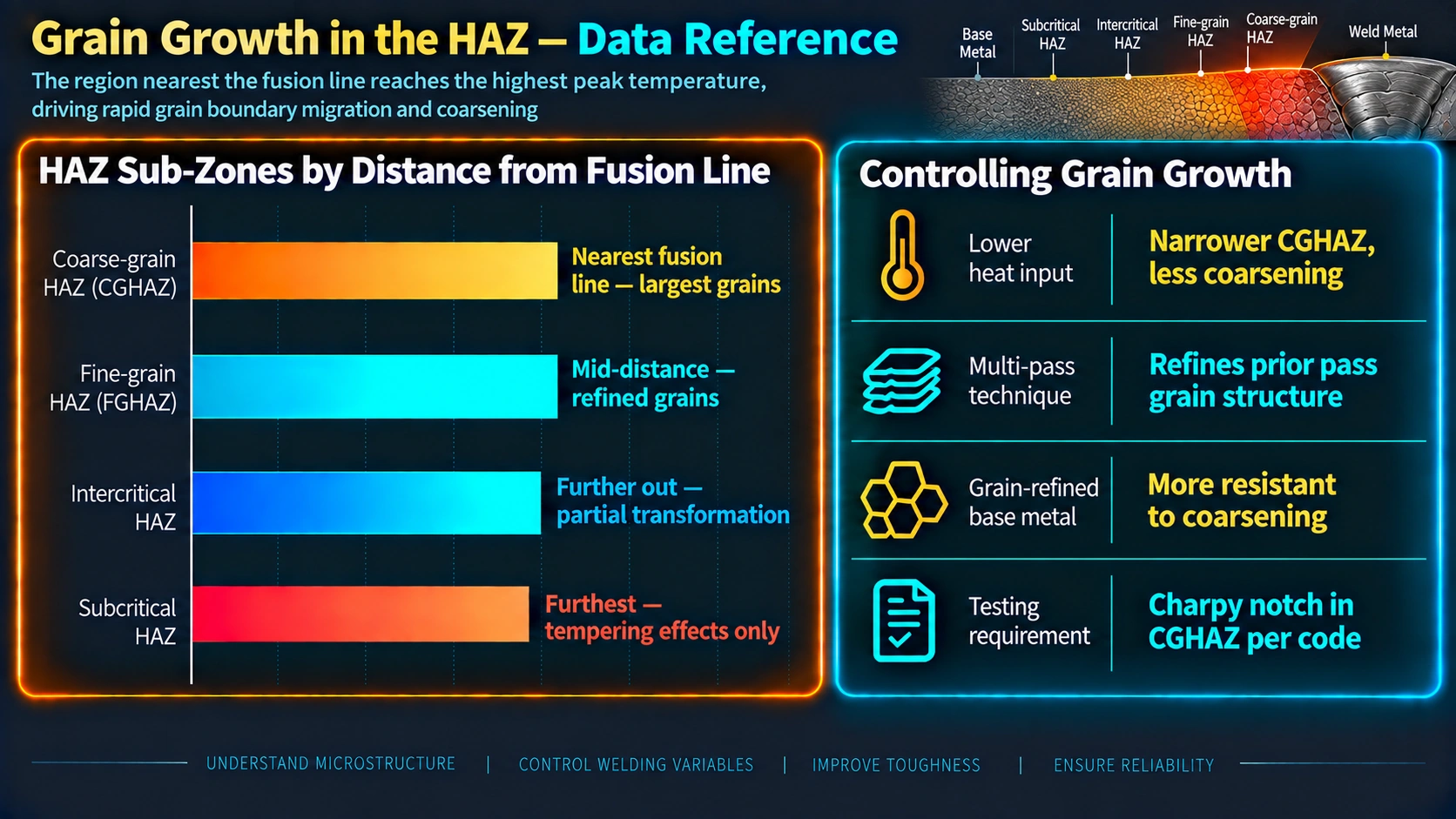
6.1 Heat input control
Limiting heat input is the most direct and effective method available at the point of welding. Every WPS for toughness-critical joints should specify a maximum heat input and this limit must be actively monitored during fabrication. Semi-automatic and mechanised welding processes (GMAW, SAW) with data-logging of voltage, current, and travel speed enable real-time heat input verification. Manual SMAW welding requires electrode diameter and current range controls and periodic travel speed checks.
Typical maximum heat input limits by application:
| Application / Standard | Typical max. heat input | Basis |
|---|---|---|
| Offshore structural welding (DNVGL-OS-C401) | 3.5 kJ/mm (C-Mn steel) | HAZ toughness at −40°C |
| API 1104 pipeline (X65–X80) | 2.5–3.5 kJ/mm | CGHAZ toughness + cold cracking |
| Pressure vessel (ASME Sec. VIII / IX) | Procedure-qualified; typically 2–5 kJ/mm | Impact test qualification |
| General structural (EN ISO 15614-1) | Procedure-qualified; no universal limit | Impact test at specified temp. |
| Cr-Mo pressure piping (ASME B31.3) | Procedure-qualified; SRC risk limits <3 kJ/mm | HACC + SRC risk |
6.2 Interpass temperature control
Controlling the maximum interpass temperature limits the cumulative thermal effect of multiple passes on the CGHAZ. A lower maximum interpass temperature means each subsequent pass is deposited onto cooler metal, reducing the total time the CGHAZ spends above the grain-coarsening temperature. For C-Mn and low-alloy steels in toughness-critical service, maximum interpass temperatures of 200–250°C are common. For Cr-Mo steels requiring PWHT, minimum interpass temperatures of 150–200°C are also specified to prevent HACC.
6.3 Multi-pass welding and thermal refinement
In multi-pass welds, each subsequent pass reheats the CGHAZ of the previous pass. If this reheat reaches temperatures between Ac3 and ~1100°C (the FGHAZ range), it can partially refine the coarse grain structure left by the first pass. Controlled temper-bead or heat-affected zone refinement (HAZR) techniques exploit this mechanism deliberately, using calculated bead placement and size to ensure that the CGHAZ of the first pass is completely covered by the FGHAZ of the second pass. This technique is specified in ASME Code Case 2843 and ASME Section XI, Appendix D for in-service repairs where PWHT is impractical.
6.4 Alloy design — TiN grain pinning
Steel producers control CGHAZ grain growth through composition optimisation. A Ti:N molar ratio of approximately 3.4 (Ti:N ≈ 0.33 by weight, assuming stoichiometric TiN) is targeted to maximise the volume fraction of fine TiN precipitates while avoiding free Ti (which can reduce weld metal toughness by reacting with oxygen). Additional Nb additions raise the GCT in the temperature range 1150–1250°C. The buyer’s specification should include requirements for Ti and N analysis where HAZ toughness is critical, and the mill certificate should be reviewed during material qualification.
6.5 Post-weld heat treatment (PWHT)
Standard PWHT (stress-relief) does not refine grain size. It does, however, temper hard martensitic microstructures and reduce residual stresses, improving toughness indirectly and reducing HACC susceptibility. The benefits for CGHAZ toughness are most pronounced in carbon and low-alloy steels where hard martensite is the transformation product. PWHT parameters (temperature, heating rate, hold time, cooling rate) must be qualified per the applicable code (ASME Section IX, EN ISO 15614-1) and the WPS must reflect the exact PWHT cycle used during PQR.
6.6 Normalising PWHT for grain refinement
Where impact toughness requirements cannot be met by WPS controls and standard PWHT, a full normalising treatment — heating above Ac3 (≈900–950°C for C-Mn steels) followed by air cooling — will refine the grain structure throughout the HAZ and weld metal. Normalising is applied to pressure vessel weld seams and to structural members fabricated from carbon steel where charpy requirements apply at temperatures below −20°C. It is impractical for large fabrications and in-situ repairs.
For most toughness-critical applications, the primary controls are: (1) qualifying the WPS with maximum heat input and interpass temperature limits using PQR impact testing in the CGHAZ; (2) specifying a Ti-treated or Nb-Ti microalloyed base material; and (3) applying PWHT where hardness or cracking risk demands it. Normalising is reserved for cases where HAZ toughness requirements cannot be met by other means.
7. Inspection and Qualification Requirements
7.1 Procedure qualification — PQR testing
Under ASME Section IX, EN ISO 15614-1, and AWS D1.1, weld procedure qualification requires destructive testing of a test coupon welded in accordance with the proposed WPS. For applications requiring notch toughness, Charpy V-notch tests are performed with the notch positioned in the weld metal, the FL (fusion line), FL+2mm, and FL+5mm locations. The FL and FL+2mm positions sample the CGHAZ and FGHAZ respectively. It is essential that the notch location is metallographically verified — a common source of over-optimistic results is a poorly positioned notch that misses the CGHAZ entirely.
7.2 Hardness surveys
Vickers hardness surveys (HV10) across the weld cross-section — weld metal, CGHAZ, FGHAZ, ICHAZ, and base metal — are required by most pressure equipment codes as part of PQR and, in some cases, as a production test. Maximum permitted hardness values are:
- ASME B31.3 / ASME Section VIII Div. 1: 248 HV10 (general); 275 HV10 (some categories with PWHT)
- EN ISO 15614-1 / EN 1011-2: typically 350 HV10 for structural steel without PWHT; 320 HV10 for C-Mn pressure steels
- NORSOK M-601 (offshore): 300 HV10 in sour service
- ISO 15156 / NACE MR0175 (sour service): 250 HV10 maximum for all zones
7.3 Metallographic examination
Metallographic cross-sections from PQR test coupons are examined per ASME Section IX QW-183 / EN ISO 15614-1 Clause 7.4. The examiner should note the width of each HAZ sub-zone, the prior austenite grain size in the CGHAZ (rated per ASTM E112 or ISO 643), the presence of unacceptable microstructural features (coarse upper bainite, Widmanstätten ferrite, M-A constituents), and any evidence of cracking. Documenting the CGHAZ grain size in the PQR provides a reference for future assessments if the WPS is revised.
7.4 Non-destructive testing considerations
Grain coarsening in the CGHAZ affects the propagation and scattering of ultrasonic waves, which is a significant factor in phased array UT (PAUT) and time-of-flight diffraction (TOFD) inspection. Coarser grain structures produce higher acoustic noise (grass) and can mask small defect signals. This is particularly relevant for austenitic welds and dissimilar metal welds where grain sizes may be very large. UT operators must be aware of the HAZ microstructure when setting sensitivity and interpreting indications near the fusion line.
8. Applicable Codes and Standards
| Standard | Relevance to HAZ grain growth |
|---|---|
| ASME Section IX | Weld procedure qualification; defines essential variables including heat input range and PWHT; requires Charpy testing at FL and FL+2mm locations when notch toughness is specified. |
| ASME Section VIII Div. 1 & 2 | Pressure vessel design and fabrication; specifies PWHT requirements, max. hardness limits, and impact test exemption curves based on material thickness and temperature. |
| ASME B31.3 | Process piping; PWHT requirements for Cr-Mo steels; hardness limits for sour service per NACE MR0175. |
| EN ISO 15614-1 | Qualification of welding procedures for steels and nickel alloys; hardness survey requirements; Charpy test locations in HAZ. |
| AWS D1.1 | Structural welding code for steel; prequalified WPS heat input limits; CVN test requirements for fracture-critical members. |
| API 1104 | Pipeline welding; heat input monitoring requirements; nick-break and Charpy testing of HAZ. |
| ISO 15156 / NACE MR0175 | Materials for H2S service; 250 HV10 maximum HAZ hardness to prevent HACC in sour environments. |
| ASTM E112 / ISO 643 | Standard methods for determining and reporting grain size in metals; used during PQR metallographic examination. |
9. Recommended Reading
Disclosure: WeldFabWorld participates in the Amazon Associates programme (StoreID: neha0fe8-21). If you purchase through these links, we may earn a small commission at no extra cost to you. This helps support free technical content on this site.
10. Frequently Asked Questions
What causes grain growth in the HAZ during welding?
Grain growth in the HAZ is driven by the rapid thermal cycle of welding. In the coarse-grained HAZ immediately adjacent to the fusion line, the steel is heated above the grain-coarsening temperature (typically 1100°C for C-Mn steels), dissolving grain-boundary pinning precipitates such as AlN and NbC, allowing austenite grains to grow rapidly. The higher the peak temperature and the longer the time spent above this threshold, the coarser the resultant grain structure.
What are the four sub-zones of the HAZ?
The HAZ is divided into four sub-zones based on peak temperature: (1) Coarse-Grained HAZ (CGHAZ) — peak temperature 1100°C to solidus, where grain coarsening and martensite risk are highest; (2) Fine-Grained HAZ (FGHAZ) — peak temperature Ac3 to ~1100°C, with a refined austenite grain structure; (3) Intercritical HAZ (ICHAZ) — peak temperature Ac1 to Ac3, experiencing partial austenitisation; (4) Subcritical HAZ (SCHAZ) — peak temperature below Ac1, with tempering and over-ageing effects but no phase transformation.
How does grain growth in the HAZ affect toughness?
Coarse austenite grains in the CGHAZ significantly degrade Charpy impact toughness. Larger prior austenite grains produce a coarser final microstructure (larger martensite packets, wider bainite colonies) and raise the ductile-to-brittle transition temperature (DBTT) by 30–80°C relative to the base metal. In severe cases, upper bainite or coarse Widmanstätten ferrite forms, further embrittling the HAZ. Toughness losses of 40–70% relative to base metal are documented in high heat-input welds on C-Mn structural steels.
What is the grain-coarsening temperature and how is it determined?
The grain-coarsening temperature (GCT) is the threshold above which austenite grain growth accelerates markedly, because grain-boundary pinning precipitates dissolve or coarsen sufficiently to lose their pinning effect. For plain C-Mn steels it is approximately 1050–1100°C. For aluminium-killed microalloyed steels, TiN raises the GCT toward 1450°C, while NbC dissolution occurs at ~1150–1200°C. The GCT is determined experimentally by isothermal heat treatments at various temperatures followed by metallographic grain-size measurement.
Does higher heat input always produce more grain growth?
Higher heat input increases both the peak temperature and the time spent above the grain-coarsening temperature at any given point in the HAZ, promoting grain growth. However, the thermal cycle at a specific location also depends on preheat, interpass temperature, joint geometry, and plate thickness. As a general rule, restricting heat input to the maximum in the WPS is the most reliable field-level control for limiting CGHAZ grain size and preserving toughness.
Can post-weld heat treatment (PWHT) reverse HAZ grain growth?
Standard PWHT (stress-relief at 600–700°C for C-Mn and low-alloy steels) does not reverse grain growth or refine the prior austenite grain size. PWHT reduces residual stress and tempers hard microstructures, improving toughness indirectly. To actually refine the grain structure, a full normalising treatment above Ac3 (typically 900–950°C for C-Mn steels) followed by air cooling is required. This is applied to pressure vessel weld seams and structural components where toughness specifications cannot be met by WPS controls alone.
Which alloying elements most effectively control HAZ grain growth?
Titanium (Ti) is the most effective element: TiN particles remain stable up to ~1450°C and pin austenite grain boundaries even at peak temperatures near the fusion line. Niobium (Nb) forms NbC/NbN that dissolve at ~1150–1200°C, limiting grain growth in the outer CGHAZ. Aluminium (Al) forms AlN effective below ~1050°C. Vanadium (V) precipitates are less stable and offer limited pinning during the weld thermal cycle. Modern microalloyed steels use Ti+Nb or Ti+Nb+V combinations to optimise both grain control and precipitation strengthening.
How do inspectors assess HAZ grain growth in a weld?
Inspectors assess HAZ grain growth primarily through destructive testing during weld procedure qualification. Metallographic cross-sections are etched (2–4% nital for carbon steels) and examined under optical microscopy to characterise the grain structure in each HAZ sub-zone. Prior austenite grain size is measured per ASTM E112 or ISO 643. Charpy impact testing at the specified temperature verifies toughness requirements in the CGHAZ and ICHAZ locations. Hardness surveys (Vickers HV10) across the HAZ identify unacceptably hard zones associated with coarse martensitic microstructures. Notch location must be metallographically verified to confirm it samples the CGHAZ correctly.