Residual Stress in Welded Joints — Formation, Distribution and Impact on Fatigue Life
Residual stress is among the most consequential yet least visible consequences of the welding process. Unlike applied loads — which are controlled by design, measured during commissioning, and checked by structural analysis — residual stresses are locked into the welded component during fabrication. They cannot be seen, they are rarely measured in routine production, and in the absence of active management, they are simply assumed to exist at or near the yield strength of the material in the weld and heat-affected zone (HAZ).
For structures loaded in tension or under fatigue cyclic loading, this assumption is not conservative — it is the engineering reality. Tensile residual stresses in the range of 200 to 700 MPa are routinely measured in structural steel welds depending on the material strength, joint geometry, and restraint conditions. These stresses are present from the first day of service and remain unless specific thermal or mechanical treatments are applied to relieve them.
The consequence that receives the most attention in structural engineering is fatigue. Approximately 80% of mechanical failures in engineering structures are fatigue-related, and welded joints are the dominant fatigue initiation sites in virtually every category of welded structure — bridges, offshore platforms, pressure vessels, cranes, rail cars, and ships. Understanding why residual stress degrades fatigue performance, how large the effect is, what controls it, and what can be done about it is therefore one of the most practically important topics in welding engineering and structural integrity assessment.
Why Residual Stress Matters in Welded Fabrication
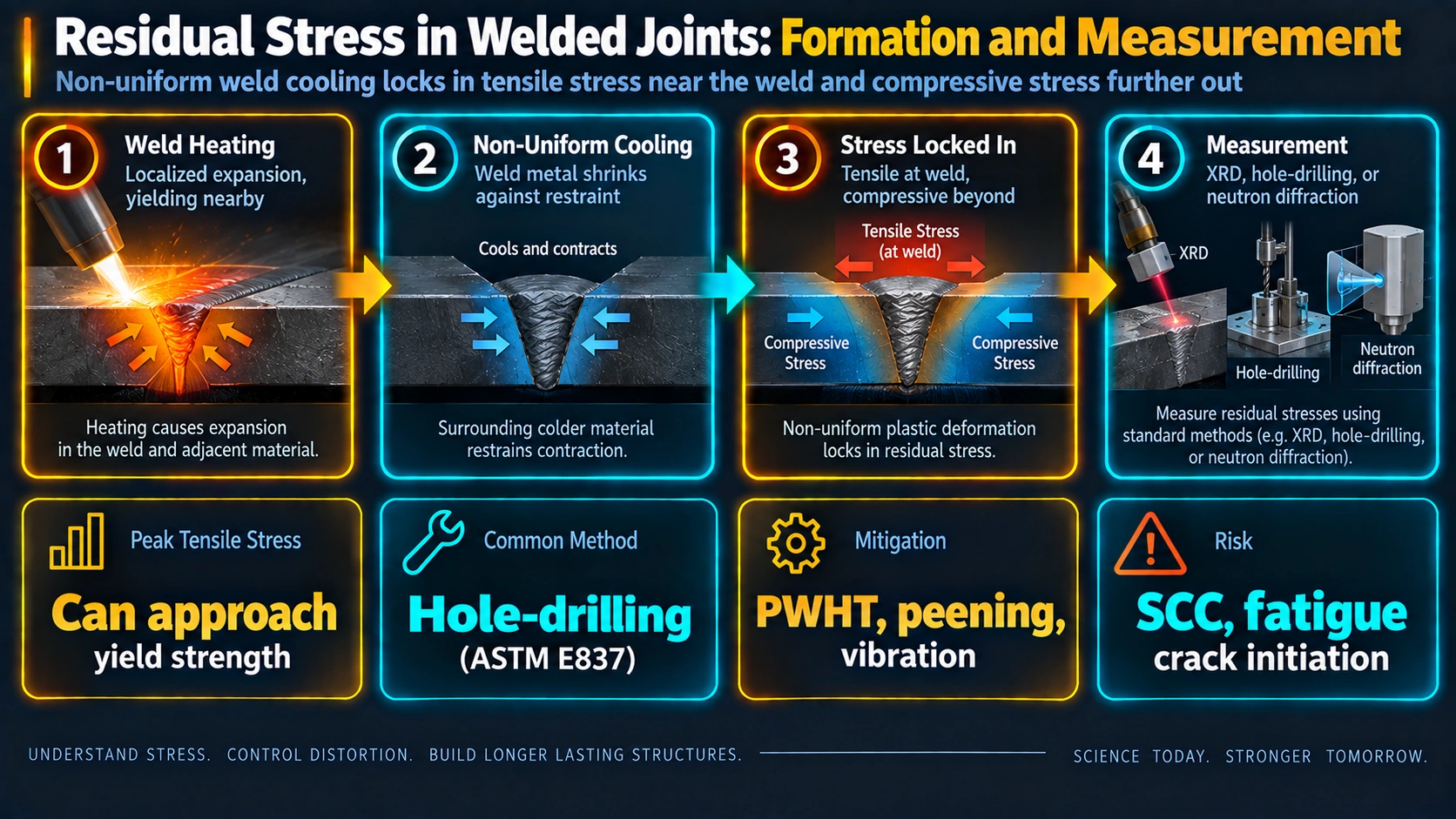
Welding is fundamentally a localised thermal process. The weld heat source — whether an arc, laser, or electron beam — deposits intense energy into a small volume of metal, creating temperatures that range from the base metal melting point at the fusion boundary to several thousand degrees in the arc itself. This localised heating is surrounded by metal at ambient or mildly elevated temperatures, creating a thermal gradient of exceptional severity across a very short distance.
The structural consequence of this thermal process is that the welded component is never in a stress-free state after welding. A complex, three-dimensional field of locked-in stresses — residual stresses — exists throughout the joint from the moment it cools to ambient temperature. These stresses are entirely self-equilibrating (they sum to zero across any cross-section of the component), but their local magnitude and distribution determine whether the welded joint will perform adequately in service or fail prematurely.
Residual stresses in welded joints affect structural performance in three principal ways:
- Fatigue life: Tensile residual stress at weld toes and roots elevates the mean stress at crack initiation sites, accelerating fatigue crack propagation and dramatically reducing the number of cycles to failure.
- Fracture toughness: Tensile residual stress increases the crack driving force in the presence of cracks or crack-like defects, reducing the applied load at which unstable fracture occurs — particularly critical in low-temperature applications where Charpy and CTOD toughness requirements apply.
- Stress corrosion cracking: Tensile residual stress combined with a susceptible material and a corrosive environment creates the conditions for stress corrosion cracking (SCC) and hydrogen-assisted cracking (HAC) in service.
How Residual Stress Forms During Welding
The formation of residual stress during welding follows a thermomechanical sequence that can be divided into three physically distinct phases, each contributing to the final stress state in a different way.
Phase 1 — Heating and Expansion
As the weld heat source approaches and passes a given location in the joint, the local metal temperature rises rapidly. Above approximately 200–300°C in most structural steels, thermal expansion causes the material to attempt to expand volumetrically. The cooler surrounding metal constrains this expansion, placing the hot zone in compression (the hot metal is being squeezed by the surrounding cooler structure). Because the yield strength of steel decreases with increasing temperature, the hot zone yields plastically under relatively low compressive stress — meaning the compressive strains are partly accommodated by plastic deformation rather than purely elastic stress.
Phase 2 — Cooling and Constrained Contraction
After the weld heat source passes, the weld metal and HAZ begin to cool. Thermal contraction now reverses the earlier expansion. The cooling material attempts to contract, but the plastically deformed hot zone now has a different shape than it would have had if allowed to cool freely. This mismatch — between the "natural" contracted state of the cooling weld metal and the shape it is forced to maintain by the surrounding rigid structure — generates tensile stress. As the material cools further and regains its full room-temperature yield strength, the tensile stress continues to build. By the time the component reaches ambient temperature, the weld metal and adjacent HAZ are locked in a state of high tensile residual stress.
Phase 3 — Solid-State Phase Transformations (in Ferritic Steels)
In ferritic and bainitic steels, solid-state phase transformations during cooling from above the austenite transformation temperature (Ac3) create additional volume changes. The austenite-to-martensite or austenite-to-bainite transformation involves a volumetric expansion of approximately 2–4%. This transformation expansion, occurring during cooling, partially counteracts the thermal contraction and can reduce the final magnitude of tensile residual stress compared to materials that do not undergo phase transformation. This effect is the basis for low-transformation-temperature (LTT) weld metals, which are specifically formulated to undergo transformation at lower temperatures — maximising the counteracting expansion effect and generating beneficial compressive residual stresses at the surface.
Longitudinal vs Transverse Components — Distribution and Magnitude
Residual stresses in welded joints are not scalar quantities — they are tensors with components acting in multiple directions simultaneously. For most practical structural engineering purposes, two orthogonal in-plane components are most significant: the longitudinal component (parallel to the weld axis) and the transverse component (perpendicular to the weld axis).
Longitudinal Residual Stress (σL)
The longitudinal residual stress develops as a direct consequence of the longitudinal contraction of the weld bead as it cools from the molten state. Along the weld centreline, this contraction is resisted by the end conditions of the joint — the base metal on either side of the weld prevents the weld from shortening. The resulting longitudinal stress is tensile at and near the weld centreline, with peak values that routinely reach 0.8 to 1.0 times the room-temperature yield strength of the material. Moving away from the weld centreline in the transverse direction, the longitudinal stress transitions from tensile to compressive to maintain force equilibrium across the plate cross-section. The width of the tensile zone is approximately 2 to 3 times the weld bead width for typical single-pass welds and can be significantly wider for multi-pass welds in thick plate.
Transverse Residual Stress (σT)
The transverse residual stress arises from the transverse shrinkage of the weld bead and adjacent HAZ — the weld contracts in the width direction as it cools, pulling the base metal plates toward each other. This transverse contraction is resisted by the plate stiffness perpendicular to the weld. The distribution of transverse residual stress is more complex than the longitudinal component and depends strongly on joint end conditions, restraint geometry, and weld length. Typical peak values are 0.3 to 0.6 times the yield strength — lower than the longitudinal component. However, from a fatigue perspective, the transverse tensile component is frequently the more damaging, as discussed in the next section.
How Residual Stress Reduces Fatigue Life — The Mechanism
The mechanism by which tensile residual stress reduces fatigue life is rooted in the fundamental physics of fatigue crack propagation. Fatigue cracks grow because cyclic stress produces an alternating stress intensity at the crack tip — the crack driving force — that exceeds the material's fatigue crack propagation threshold. The rate of crack growth per cycle is described by the Paris Law:
The most important practical consequence of this analysis is the crack closure effect — or rather, its absence. In specimens with zero or compressive mean stress, fatigue cracks are closed for part of each loading cycle when the applied stress falls below the crack opening stress. The portion of the cycle where the crack is closed does not contribute to crack driving force, effectively reducing the damaging portion of ΔK. When tensile residual stress raises the minimum stress level above the crack opening stress, the crack remains open throughout the entire loading cycle — the crack closure benefit is completely eliminated, and the full applied ΔK acts as the crack driving force on every cycle. This is the primary reason why tensile residual stress is so damaging to fatigue life — it eliminates a natural protective mechanism that would otherwise moderate crack growth.
Weld Toe and Weld Root — Primary Fatigue Crack Initiation Sites
Fatigue cracks in welded joints do not initiate randomly — they begin at specific geometric features where stress concentration combines with tensile residual stress to create the highest local crack driving force. The two dominant initiation sites are the weld toe and the weld root.
Weld Toe Cracking
The weld toe is the junction line between the weld face and the base metal surface — the visible boundary of the weld bead on the joint surface. This location combines three crack-promoting conditions simultaneously:
- Geometric stress concentration: The abrupt change in section geometry at the weld toe produces a stress concentration factor (SCF) that can range from 1.5 to 4.0 depending on the weld toe radius and the weld flank angle. A small toe radius (sharp toe transition) produces the highest SCF. Sharp toes are common in SMAW and FCAW welds and can be significantly improved by grinding, TIG dressing, or HFMI treatment.
- Transverse tensile residual stress: As described above, the transverse component of residual stress acts perpendicular to the weld axis — the same direction as the opening mode of a weld toe crack propagating down into the base metal plate. This is a Mode I configuration: the stress acts normal to the crack plane and directly drives crack opening and growth.
- Weld defects: The weld toe is frequently the location of undercut, sharp slag lines, cold laps, and small lack-of-fusion defects — all of which act as pre-existing notches that require fewer cycles to initiate a fatigue crack than smooth geometries.
Weld Root Cracking
In partial-penetration welds, fillet welds, and joints where the root cannot be inspected or where backing strips are used, the weld root is a competing fatigue initiation site. The root lacks the convex reinforcement geometry of the toe — instead, the crack initiates at the root tip and grows into the weld throat or into the base metal. Root cracking is particularly significant in longitudinally loaded fillet welds (such as web-to-flange welds in beams) where the root is subjected to shear-mode loading, and in transverse butt welds with incomplete root penetration where the root is loaded in tension.
The S-N Curve for Welded Joints and FAT Class
The fatigue performance of a welded joint category is characterised by its S-N (stress range vs cycles to failure) curve, which is specified in terms of a characteristic FAT class value. The FAT class represents the allowable stress range (in MPa) at 2 × 10&sup6; cycles at a survival probability of 97.7% (two standard deviations below the mean). Different joint configurations are assigned to different FAT classes based on their geometry, loading direction, and whether the weld is inspected.
| Joint Configuration | FAT Class (IIW) | Governing Location | Notes |
|---|---|---|---|
| Unwelded plate (base metal) | FAT 160 | Base metal (no weld) | Strength-dependent; reference value for steel |
| Transverse butt weld — flush ground, inspected by RT/UT | FAT 112–125 | Weld toe | Grinding improves toe geometry; NDE confirms no subsurface defects |
| Transverse butt weld — as-welded | FAT 71–90 | Weld toe | Standard structural application; no post-weld improvement |
| Cruciform fillet weld — transverse load | FAT 71 | Weld toe or root | Both locations must be checked; root often governing |
| Longitudinal fillet weld attachment | FAT 50–63 | Weld toe at end of attachment | Severe stress concentration at end of longitudinal attachment |
| Cope holes, cut-outs in members | FAT 50 | Cope hole edge | Ground smooth significantly improves to FAT 71 |
| Welded joint improved by HFMI (high-frequency mechanical impact) | +1 to +2 FAT classes | Weld toe (post-treated) | IIW allows FAT class improvement for verified HFMI treatment |
The key observation from this table is the dramatic reduction from base metal FAT 160 to as-welded FAT 71 for a transverse butt weld — a factor of over two in allowable stress range at 2 × 10&sup6; cycles. This reduction is almost entirely attributable to the combination of weld toe stress concentration and tensile residual stress. Neither the weld filler strength nor the base metal strength appears in the FAT class assignment — confirming that these parameters do not control welded joint fatigue performance.
Factors That Influence Residual Stress Magnitude and Distribution
The magnitude and spatial distribution of residual stress in a welded joint are not fixed material properties — they depend on a complex interaction of processing, geometric, and metallurgical variables. Understanding these factors is essential for controlling residual stress during fabrication design.
| Factor | Effect on Residual Stress | Engineering Control |
|---|---|---|
| Mechanical restraint | Higher restraint (stiffer surrounding structure, more fixturing) significantly increases residual stress magnitude — in extreme cases driving stresses to yield strength throughout the joint | Minimise fixturing restraint where possible; allow free thermal movement during welding; use balanced sequences on symmetric structures |
| Heat input (welding energy) | Higher heat input increases the volume of material affected and can increase residual stress magnitude and spatial extent; very low heat input increases the thermal gradient and can also increase stress concentration in the HAZ | Use controlled, consistent heat input per the WPS; avoid excessive passes or oversized weld deposits |
| Joint geometry and thickness | Thicker sections have more material restraining contraction — residual stresses are typically higher in thick joints; multi-pass welds in thick plate accumulate residual stress through the depth | Optimise joint preparation angle and root gap to minimise weld volume; use narrow-gap welding for very thick sections |
| Material yield strength | Higher yield strength allows higher residual stress magnitude — a 690 MPa steel can sustain up to 690 MPa of residual stress, whereas a 355 MPa steel is limited to 355 MPa; the residual stress as a fraction of yield strength is approximately constant | Cannot control without changing material; highlights why higher-strength steel provides no net fatigue benefit without RS management |
| Weld sequence and pass arrangement | Unbalanced sequences (completing one side of a symmetric joint before starting the other) significantly increase angular distortion and residual stress; backstep welding reduces peak temperatures and stress | Specify balanced, backstep, or skip-weld sequences in the WPS; alternate sides on double-sided welds |
| Preheat and interpass temperature | Elevated preheat reduces the thermal gradient between weld and base metal, reducing differential thermal strain; it also extends the time at temperature, allowing more stress relaxation during welding | Apply preheat per BS EN 1011-2 CEN formula or equivalent; control maximum interpass temperature to avoid over-tempering alloy steel HAZ |
| Solid-state phase transformations | In ferritic steels, the austenite-to-martensite/bainite transformation creates a volumetric expansion that partially offsets thermal contraction — reducing final tensile RS compared to austenitic materials; LTT weld metals exploit this effect deliberately | Consider LTT consumables for fatigue-critical applications; account for transformation plasticity in finite element RS predictions |
Residual Stress Measurement Techniques
Residual stress cannot be inferred from visual inspection or routine mechanical testing — it must be measured by specific techniques. The choice of measurement method depends on the required spatial resolution, the depth below the surface at which information is needed, the material, and the available equipment and budget. Methods are broadly classified as non-destructive, semi-destructive, and fully destructive.
| Method | Principle | Depth Range | Accuracy | Destructive? | Application |
|---|---|---|---|---|---|
| X-Ray Diffraction (XRD) | Measures lattice strain by Bragg diffraction angle shift; stress calculated from Hooke's law using elastic constants | Surface only (<25 μm) | ±30–50 MPa | No | Weld toe surface RS; fatigue research; quality verification of peening |
| Synchrotron X-Ray Diffraction | As XRD but using high-energy synchrotron X-rays; much greater penetration than lab XRD | Up to 25 mm in steel | ±20–40 MPa | No | Research; high-resolution through-thickness profiling |
| Neutron Diffraction | Similar to XRD but using neutrons; high penetration through thick steel | Up to 100 mm in steel | ±20–30 MPa | No | Bulk RS measurement through full joint thickness; requires reactor facility |
| Hole-Drilling (HD) | Small blind hole drilled; strain relief measured by rosette strain gauges; RS computed from ASTM E837 | Up to 0.5 × hole diameter (typically 1–2 mm) | ±50–80 MPa (near yield) | Semi-destructive — small hole left | Field measurement; fabricated components; near-surface RS verification |
| Contour Method | Component cut by wire EDM; surface distortion measured by profilometry; RS back-calculated from elastic FEA | Full cross-section 2D map | ±30–50 MPa | Fully destructive | Research; full cross-section RS mapping; validation of FEA models |
| Barkhausen Noise | Measures magnetic domain wall movements in ferromagnetic materials; correlates with stress state | Surface (<0.5 mm) | Semi-quantitative | No | Rapid screening; PWHT verification; only ferromagnetic materials |
Mitigation Strategies — Overview
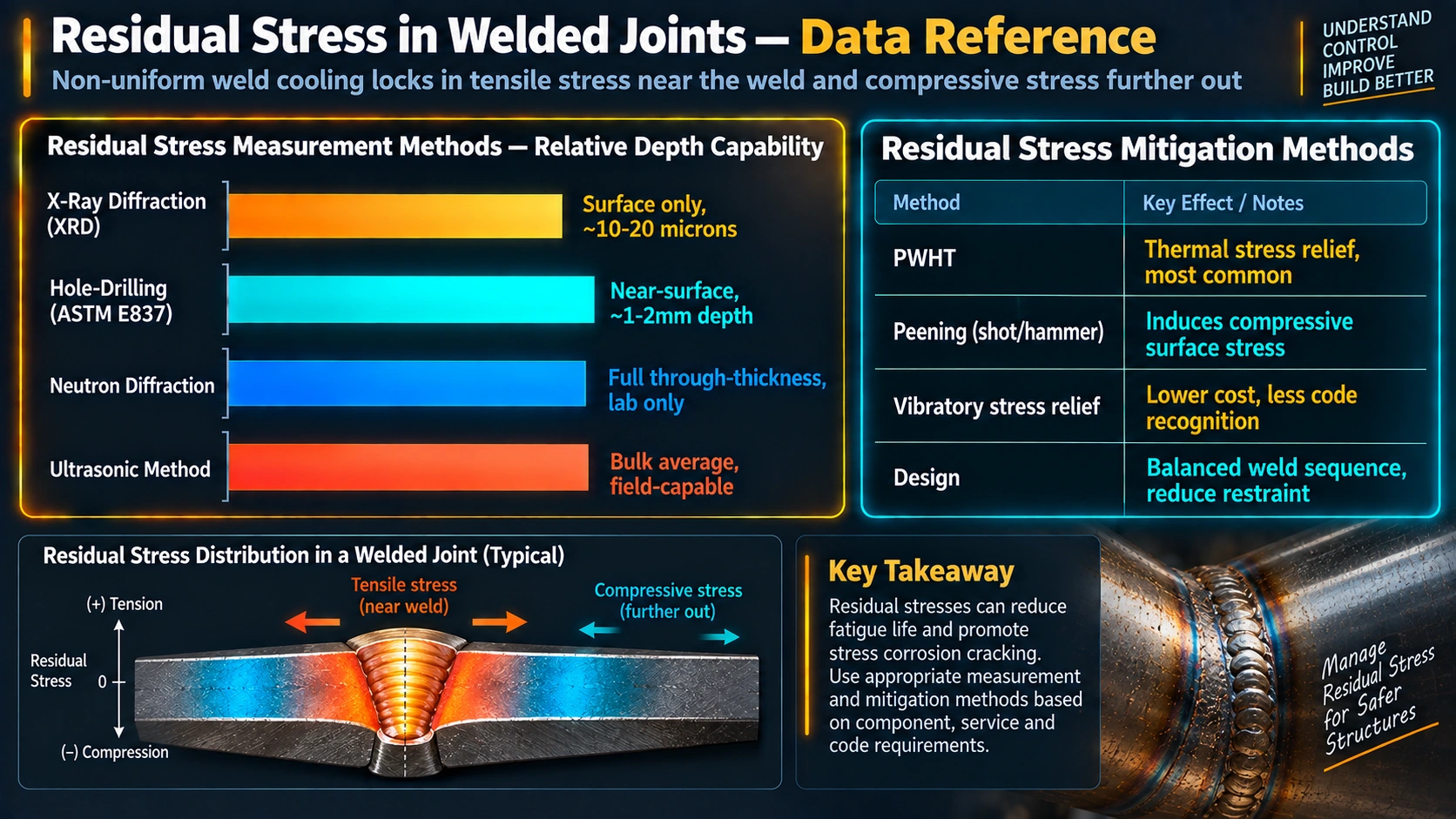
Residual stress management in welded structures encompasses strategies applied at three stages: during design (to minimise restraint and control joint geometry), during fabrication (to reduce RS introduction through weld sequencing and process control), and post-fabrication (to relieve or modify the existing RS field). The following sections cover the most important methods in detail.
Post-Weld Heat Treatment (PWHT) for Stress Relief
Post-weld heat treatment — also called stress relief heat treatment or post-weld stress relief (PWSR) — is the most reliable method for reducing residual stress in welded fabrications and is the only method recognised by ASME Section VIII, EN 13445, and similar pressure equipment codes as providing verified stress relief. The physical mechanism is thermally activated creep: at elevated temperature, the steel's yield strength drops dramatically, allowing the constrained weld metal and HAZ to creep and deform plastically, redistributing the locked-in residual stresses to near zero.
Limitations of PWHT
Despite its effectiveness, PWHT is not universally applicable. Its limitations include:
- Large, assembled structures may be impractical to heat uniformly in a furnace — local PWHT is sometimes permitted by codes but introduces new thermal gradients at the heating zone boundaries
- Some aluminium alloys and cold-worked stainless steels are degraded by the temperatures required for stress relief
- P91 and other precipitation-hardened creep-resistant steels require very precise temperature control — temperatures below the minimum may be ineffective; temperatures above Ac1 can destroy the microstructure
- PWHT adds significant cost, time, and logistical complexity, particularly for field-erected structures and large vessels
- Re-welding after PWHT (repair welding) reintroduces residual stresses at the repair location and typically requires a second PWHT cycle
Mechanical Improvement Methods — Peening and Grinding
Where PWHT is impractical or prohibited, mechanical improvement of the weld toe is the most effective alternative for improving fatigue life in welded structures. Unlike PWHT which reduces the entire residual stress field by thermal relaxation, mechanical methods work by introducing beneficial compressive residual stresses at the specific location — the weld toe — where fatigue cracks initiate. The compressive RS effectively opposes crack opening, raising the crack initiation threshold and reducing crack propagation rate.
High-Frequency Mechanical Impact (HFMI / UIT)
HFMI (also called ultrasonic impact treatment, UIT) uses a pneumatic or electromagnetic tool to deliver rapid high-frequency impacts (90–200 Hz) to the weld toe, using a hardened indenter pin. The impact plastically deforms the toe material, introducing compressive residual stresses of 200 to 600 MPa extending to depths of 0.5 to 2.0 mm, while simultaneously improving the geometric profile of the toe by rounding the sharp transition. IIW document IIW-2151-16 provides verified FAT class improvements of one to two fatigue classes for HFMI-treated joints, depending on the yield strength of the base metal and the quality of the treatment.
Shot Peening
Shot peening propels small spherical steel or ceramic media at the weld toe surface at high velocity. The impact of each shot plastically stretches the surface layer, which is then restrained by the sub-surface material — resulting in a biaxial compressive residual stress at the surface of 200 to 500 MPa to a depth of 0.1 to 0.4 mm. Shot peening is widely used for fatigue improvement in aerospace and automotive components but is less commonly applied to large structural welds because the depth of compressive stress is limited compared to HFMI, and the geometric improvement of the weld toe is less controlled.
Weld Toe Grinding
Grinding the weld toe with a rotary burr or disc removes the sharp geometric notch and embedded surface defects (undercut, sharp slag lines) that act as fatigue crack initiation sites. It does not introduce compressive residual stress but eliminates the geometric stress concentration that amplifies the residual stress effect. The improvement in fatigue class from grinding is typically 0.5 to 1 FAT class — significant, but less than HFMI. For maximum fatigue improvement, TIG toe dressing (re-melting the toe with a TIG arc without filler) both removes the geometric notch and, because TIG re-melts are more controlled than the original weld toe, produces a smoother geometry with lower SCF than mechanical grinding.
Design Guidance for Fatigue-Critical Welded Structures
Effective management of residual stress and its consequences for fatigue life begins at the design stage, long before any welding is performed. The following principles represent the engineering consensus from IIW, BS 7608, DNVGL-RP-C203, and equivalent fatigue design codes for welded structures.
Principle 1 — Reduce Stress Concentration at Weld Toes
Specify full-penetration welds rather than partial-penetration or fillet welds wherever fatigue loading is present — partial-penetration joints have the lowest FAT class because of root initiation risk. Where fillet welds must be used, specify minimum throat dimensions adequate for the applied loading rather than defaulting to minimum code-required weld sizes. Use concave weld profiles for fillet welds rather than convex profiles — a concave profile produces a smoother toe transition and lower SCF.
Principle 2 — Avoid Placing Welds in High-Stress Zones
The single most effective fatigue design strategy is to place weld joints away from regions of peak applied stress. Weld joints on the tensile flange of a plate girder at mid-span are extremely fatigue-critical; identical welds on the neutral axis or in a low-stress region of the web are far less so. Flame-cut or machined openings with smooth radii are strongly preferable to welded attachments in high-stress zones.
Principle 3 — Specify Weld Improvement Where Necessary
For joints where the required applied stress range exceeds the as-welded FAT class capacity, specify post-weld improvement treatment as a fabrication requirement — not as an afterthought. HFMI treatment should be specified with clear quality requirements including verified coverage, overlap between treatment passes, and surface inspection before and after treatment. The improvement factor is only valid when treatment is applied correctly and consistently.
Principle 4 — Account for Residual Stress in Fracture Mechanics Assessments
When performing fitness-for-service (FFS) assessments of cracked welded joints under API 579 Part 9, BS 7910, or FITNET methodology, the residual stress must be included as a primary loading in the stress intensity factor calculation. Codes provide conservative default residual stress profiles (typically yield-strength-level tensile RS through the weld) that should be used in the absence of measured data. Where measured RS data is available from XRD, neutron diffraction, or the contour method, this can be used to reduce the conservatism of the assessment — potentially avoiding unnecessary repair or retirement of the structure.
Frequently Asked Questions — Residual Stress and Fatigue Life
What causes residual stress in welded joints?
Residual stress in welded joints arises from the highly non-uniform thermal cycle imposed by the welding heat source. The weld metal and surrounding HAZ are heated to very high temperatures and expand, but the surrounding cooler base metal constrains this expansion. On cooling, the hot weld metal attempts to contract but is again restrained, generating tensile residual stresses in and near the weld. These are balanced by compressive stresses in the more remote base metal. The tensile residual stress can approach the room-temperature yield strength of the material in high-restraint joint configurations.
Why does residual stress reduce the fatigue life of welded joints?
Tensile residual stress acts as an additional mean stress at potential crack initiation sites such as the weld toe. This elevated mean stress raises the effective stress ratio experienced at the crack tip, increases the crack driving force (stress intensity factor range ΔK), and eliminates the crack closure benefit that normally reduces the damaging portion of each fatigue cycle. As crack growth rate scales with ΔK to the power m (typically 3 for steel), even modest increases in effective ΔK dramatically accelerate crack propagation. This is why welded joints have lower fatigue class (FAT) values than unwelded base metal, regardless of base metal strength.
What is the difference between longitudinal and transverse residual stress in welds?
Longitudinal residual stress acts parallel to the weld axis, peaking at or near the weld centreline at values approaching yield strength, and transitioning to compressive in the remote base metal. Transverse residual stress acts perpendicular to the weld axis, generally with a lower peak magnitude of 0.3 to 0.6 times yield strength. From a fatigue perspective, the transverse component is frequently more significant because it acts in the same direction as the opening mode of weld toe cracks — driving Mode I crack propagation directly into the base metal plate.
How is residual stress measured in welded joints?
Residual stress measurement methods include non-destructive techniques (X-ray diffraction for surface measurement, synchrotron X-ray or neutron diffraction for bulk measurement), semi-destructive techniques (hole-drilling with strain gauges per ASTM E837, which is the most common field method), and fully destructive techniques (contour method for full cross-section mapping). In routine production, RS is not directly measured — the as-welded RS is assumed to equal yield strength for design purposes. Measurement is performed for research, FFS assessments, and verification of stress relief treatments.
What is the most effective way to reduce residual stress in welded joints?
Post-weld heat treatment (PWHT) is the most reliable and widely accepted method. Heating to 550–650°C for ferritic steels and holding for one hour per 25 mm of thickness reduces residual stress by 75–90% through thermally activated creep relaxation. Where PWHT is impractical, high-frequency mechanical impact (HFMI) treatment of the weld toe is the most effective alternative — it introduces beneficial compressive residual stresses at the fatigue-critical toe location and simultaneously improves the toe geometry. IIW allows verified HFMI treatment to increase the FAT class by one to two classes depending on base metal strength.
Why does base metal yield strength not improve the fatigue life of welded joints?
For unwelded steel, fatigue strength scales with tensile strength because failure initiates at microstructural defects whose severity relative to the material's resistance improves with strength. But for welded joints, fatigue is controlled by the weld toe geometry (stress concentration), residual stress (which approaches yield strength magnitude regardless of base metal strength), and weld defects. None of these factors improve with increasing base metal yield strength. Codes such as IIW document 1823-07 assign FAT class values that are independent of base metal strength — a 690 MPa steel weld has the same FAT class as a 355 MPa steel weld in the same joint geometry. Higher-strength steel provides no fatigue benefit without simultaneous improvement of weld geometry, RS management, and defect control.
Key References
- Masubuchi K. Analysis of Welded Structures: Residual Stresses, Distortion, and Their Consequences. Pergamon Press, 1980.
- Fricke W. Effects of residual stresses on the fatigue behaviour of welded steel structures. Mater Sci Eng Technol 2005;36:642–9.
- Withers PJ, Bhadeshia HKDH. Residual stress part 1 – Measurement techniques; part 2 – Nature and origins. Mater Sci Technol 2001;17:355–75.
- IIW Document IIW-2259-15: Recommendations for Fatigue Design of Welded Joints and Components. International Institute of Welding, 2016.
- BS 7608:2014+A1:2015: Code of Practice for Fatigue Design and Assessment of Steel Structures. BSI.
- Leggatt RH. Residual stresses in welded structures. Int J Press Vessel Pip 2008;85:144–51.
- Francis JA, Bhadeshia HKDH, Withers PJ. Welding residual stresses in ferritic power plant steels. Mater Sci Technol 2007;23:1009–20.
- Zerbst U. Application of fracture mechanics to welds with crack origin at the weld toe — a review. Part 2: welding residual stresses. Weld World 2020;64:151–69.
- Coules HE. Contemporary approaches to reducing weld-induced residual stress. Mater Sci Technol 2013;29:4–18.
- DNVGL-RP-C203: Fatigue Design of Offshore Steel Structures. DNV GL, 2019.