Welding Beads — Types, Techniques and When to Use Each
Of all the variables that determine weld quality, torch movement technique — the way you physically manipulate the arc or flame along the joint — is one of the most visible and one of the most misunderstood. Every welder knows that amperage, electrode angle, and travel speed matter. Fewer appreciate that how you oscillate, whip, pause, or rock the torch along the joint is every bit as important as those machine settings, and that the correct technique is different depending on the welding position, joint type, process, and material.
A weld bead is the physical record of your torch movement. Its width, height, ripple pattern, toe fusion, and internal fusion profile all tell a story about how the torch was moved, at what speed, with what arc length, and with what oscillation pattern. Reading a weld bead — being able to look at a finished weld and diagnose from its appearance what went right and wrong — is a foundational inspection skill. Producing a weld bead that is correctly shaped, consistently formed, and fully fused with both base metal faces is the foundational production skill.
This guide covers every significant bead technique used in modern arc welding: stringer beads and all the reasons they are preferred over weaves in many applications; all seven major weave patterns with their specific uses and limitations; the whip motion used for SMAW root passes; the J-weave for hot pass fill work; walking the cup for TIG pipe welding; multi-pass bead sequencing strategy; position-specific bead selection; and the complete list of bead-related weld defects with their causes and corrections.
What Is a Weld Bead?
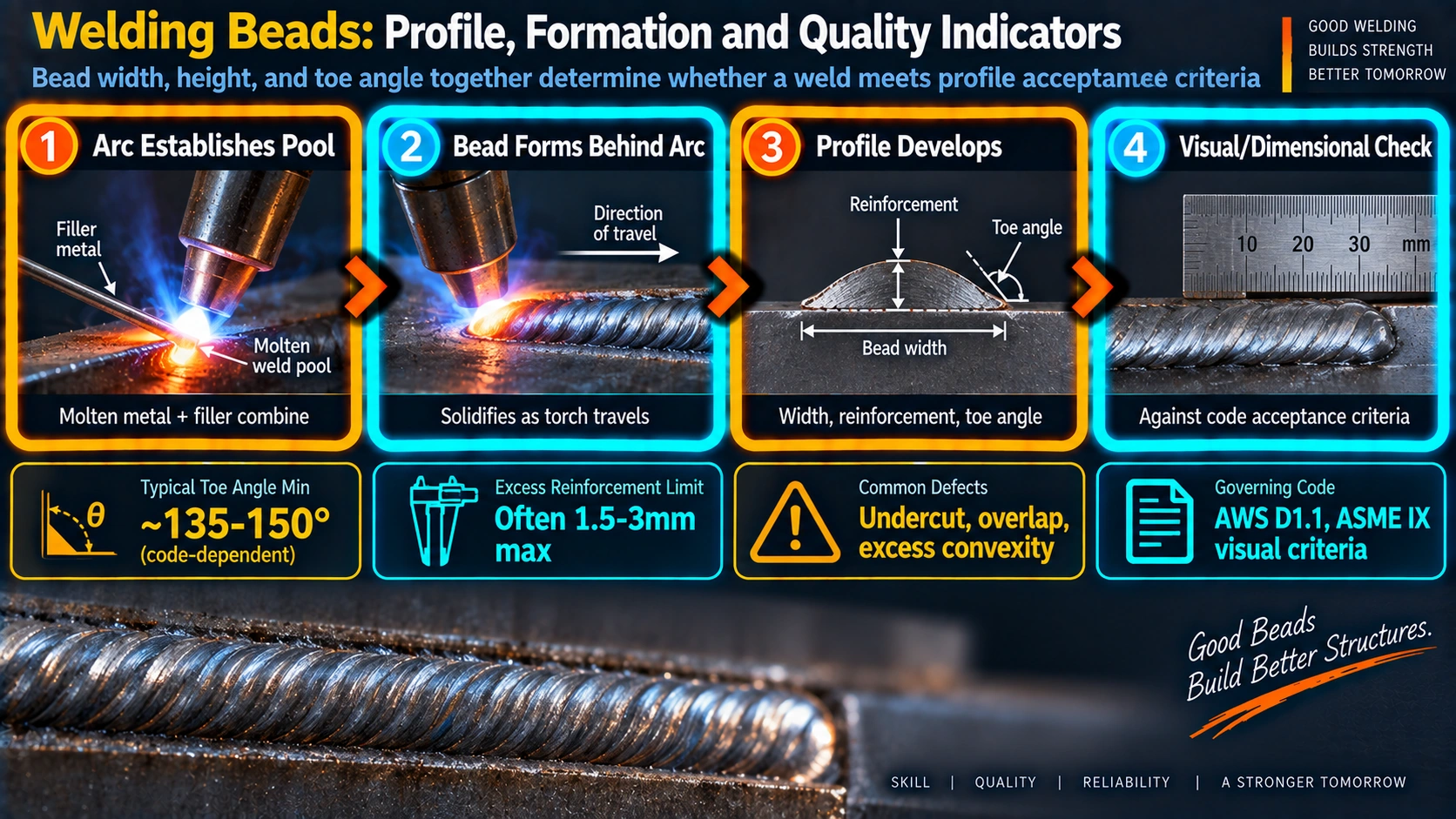
A weld bead is the solidified deposit of filler metal left behind after the heat source — whether an arc, flame, laser, or electron beam — passes along a weld joint. In arc welding processes (SMAW, GMAW, GTAW, FCAW), the bead is formed when the arc melts both the filler material and a controlled amount of the base metal into a molten weld pool that then solidifies as the heat source moves forward.
The characteristics of a weld bead are determined by the interaction of several variables working simultaneously:
- Amperage (heat input): Controls the width and depth of fusion — too low gives cold lap and lack of fusion; too high gives burn-through and wide HAZ.
- Travel speed: Controls the bead length per unit time — faster travel gives narrower, flatter beads with less reinforcement; slower travel gives wider, higher beads with more heat input per unit length.
- Electrode angle (work angle and travel angle): Controls the direction of arc force and therefore where the deepest fusion occurs within the joint cross-section.
- Arc length: Controls arc voltage — longer arc gives higher voltage, wider, flatter bead and more oxidation risk; shorter arc gives concentrated heat, narrower bead, and better control.
- Torch movement pattern: Controls the lateral width of the bead, the distribution of heat across the joint, and the fusion at both toes — the subject of this entire guide.
Anatomy of a Weld Bead
Knowing the names of these features matters practically because welding codes use them in their acceptance criteria. AWS D1.1, ASME Section VIII, and similar codes specify maximum allowed reinforcement height, minimum acceptable fusion at the toes, and maximum permitted undercut depth by reference to these named features. When a welding inspector marks a weld as rejected due to “undercut at the toe,” you need to know precisely where that means.
Why Different Torch Movement Techniques?
The torch movement pattern you choose affects three things that matter to weld quality: how the heat is distributed across the joint width, how the filler metal is deposited into the joint geometry, and how the weld pool behaves under the effects of gravity, surface tension, and arc force.
Consider welding a thick V-groove joint in the flat position: you need to fill a gradually widening gap that at the cap pass may be 16–20 mm wide. Depositing this width with stringer beads would require four or five individual passes. A weave bead can potentially fill the same width in one pass — saving time and reducing the number of interpass cleaning cycles. But in the overhead position, that same weave bead is fighting gravity with every pass of the torch across the joint centre, and the slag pool threatens to fall out of the joint if the technique is wrong.
Gravity is the constant that makes welding position the most significant factor in technique selection. In flat position, the weld pool sits in the joint by gravity and you have maximum time to control it. In overhead position, the pool is held up only by surface tension, arc force, and the speed at which you keep the puddle moving. Position drives technique — always think about position first when selecting your bead approach.
Push vs Pull — Torch Angle Fundamentals
Before discussing specific bead patterns, the fundamental travel angle choice — push or pull — applies to every technique you will use. The travel angle is the tilt of the electrode or torch in the direction of travel, as opposed to the work angle which controls left-right tilt relative to the joint faces.
| Feature | Pull / Drag (Backhand) | Push / Forehand |
|---|---|---|
| Torch angle direction | Tipped 10–15° toward the completed weld (trailing angle) | Tipped 10–15° toward the unwelded joint (leading angle) |
| Arc force direction | Into the pool — digs deeper, creates narrower pool | Ahead of the pool — displaces base metal, wider, shallower pool |
| Penetration | Deeper | Shallower |
| Bead width | Narrower | Wider, flatter |
| Visibility | Less — torch body blocks view of upcoming joint | Better — can see ahead of the weld |
| Spatter (MIG) | More | Less |
| Best for | Thick carbon steel, root passes, maximum penetration | Thin material, stainless steel, aluminium, out-of-position welds |
| FCAW (flux-cored) | Pull always — slag protection requires trailing angle | Not recommended — slag unprotected ahead of pool |
Stringer Beads — Straight-Line Technique
A stringer bead is deposited by moving the electrode or torch in a straight line along the joint axis with no deliberate side-to-side oscillation. The torch maintains the correct work angle and travel angle while progressing at a consistent travel speed. Any minor side-to-side movement is incidental and limited — if the lateral movement becomes intentional and significant, the technique becomes a weave bead.
The puddle in a stringer bead is narrower than a weave bead, typically 1.5 to 2 times the electrode diameter in width. Because the heat is concentrated in a narrower zone, the depth of fusion at the joint root is generally better than a weave at the same amperage. The HAZ is also narrower, making stringer beads the preferred technique for heat-sensitive materials including stainless steel (where wide HAZ zones increase sensitisation risk), low-alloy steels requiring controlled heat input, and thin-section work where distortion must be minimised.
- Lower heat input per unit length — less distortion
- Narrower HAZ — better for sensitisation-critical stainless
- Better root penetration in narrow grooves
- Usable in all positions including overhead
- Easier to control than weave in difficult positions
- Preferred for root and hot passes in pipe welding
- Better tie-in at weld toes on narrow joints
- Multiple passes required to fill wide grooves — slower overall
- More interpass cleaning cycles on multi-pass joints
- Weld toe undercut possible if travel speed varies on thicker material
- Requires consistent travel speed — more demanding on long joints
Weave Beads — Side-to-Side Technique
A weave bead is deposited by deliberately oscillating the electrode or torch from side to side across the joint as it progresses along the joint axis. The lateral width of the oscillation — the weave amplitude — controls how wide the bead is. The speed of oscillation relative to travel speed controls the bead height profile: faster lateral movement and slower travel speed produces a flatter bead; slower lateral movement with quicker travel tends to leave a high crown.
The most important timing control in weave bead technique is the pause at each toe. As the torch reaches the far side of each weave pass, a momentary pause (fraction of a second) allows the pool to flow into and fuse with the base metal at the weld toe. Without this pause, the torch spends insufficient time at each edge, leaving cold lap or undercut at the toes and a hump of excess metal in the centre. Moving quickly across the centre of the weave and pausing at each side is the universal rule for weave bead technique.
- Fills wide grooves in fewer passes — faster for thick plate caps
- Achieves flat cap bead profile across wide joints
- Better tie-in at toes when correctly timed
- Reduces number of interpass cleaning cycles on fill passes
- Effective for overhead flat single-pass fillets
- Higher heat input than stringer — more distortion
- Wider HAZ — not suitable for sensitisation-critical materials
- Risk of high crown if centre travel is too slow
- Risk of undercut or cold lap if toe pause is omitted
- Challenging overhead — gravity fights the wide puddle
- May be prohibited by WPS on heat-sensitive base metals
The Seven Weave Patterns Explained
The weave bead family contains several distinct oscillation patterns, each with a specific geometry that produces different bead shapes and is suited to different joint configurations and positions. Every welder develops preferences, but understanding why each pattern exists helps you choose the most effective one for the situation rather than defaulting to a single pattern for everything.
| Pattern | Shape | Best Position | Best Process | Primary Benefit |
|---|---|---|---|---|
| Zigzag | Sharp V-shape oscillation | Flat, horizontal | SMAW, GMAW | Simple, consistent general-purpose fill |
| Crescent (C-Weave) | Smooth C or moon arc | Flat, horizontal, vertical | All processes | Smooth flat cap bead; excellent toe tie-in |
| Triangular | Sharp upward triangles | Vertical-up | SMAW, FCAW | Builds a shelf behind the pool to prevent slag run-down in PF position |
| Figure-8 | Overlapping loops | Flat, wide groove | SMAW, GMAW | Extra-wide bead coverage; complex gap filling |
| Box / Square | Right-angle corners | Flat, horizontal | GMAW (MIG) | Excellent toe fusion on corner and T-joints in flat position |
| Parabola | U-arch movement | Overhead, flat | SMAW, GMAW | Helps control a wide pool against gravity in overhead position |
| C-Weave / Semicircle | Half-circle forward arcs | All positions | All processes | Heat control; good for managing pool size and controlling crown height |
Whip Motion — SMAW Root Pass Technique
The whip motion is one of the most technically demanding torch manipulation techniques in all of arc welding. It is used almost exclusively in SMAW for the root pass on open-groove butt joints — the type of joint where two pieces of plate or pipe are prepared with bevels and a root face, fitted up with a defined root gap, and welded from one side to achieve full penetration through to the back face without a backing strip.
The Keyhole
When welding an open root pass with sufficient penetration, the arc burns through the root gap and creates an opening at the leading edge of the weld pool called a keyhole. The keyhole appears as an elongated oval or tear-drop shaped hole at the front of the molten pool. Seeing a keyhole is confirmation that full penetration is being achieved — the arc has melted through both root faces and the pool is bridging the gap. The welder must maintain the keyhole at a consistent size — typically not wider than 1.5 to 2 times the electrode diameter. If the keyhole grows too large, the bridge collapses and a hole forms in the root bead.
The Whip Cycle
The whip motion consists of a repeating cycle:
- With the arc established at the back of the pool, briefly advance the electrode tip forward and upward ahead of the pool — the “whip” forward — typically 5–10 mm beyond the front edge of the keyhole. This removes heat from the pool edge and allows the pool to begin solidifying at the back.
- Almost immediately, return the electrode to the pool — the “return” — making contact with the leading edge of the solidified bead just behind the keyhole. A drop of fresh weld metal is deposited, and the arc energy re-establishes the pool and maintains the keyhole.
- The cycle repeats. Each whip-and-return cycle deposits one ripple — one “dime” — of the bead. The frequency of the cycle is not fixed; it is adjusted continuously based on the visible size of the keyhole and the heat state of the joint.
As the joint warms up — which happens progressively from the start toward the end of a long root pass — the whip frequency increases. Early in a cold joint, the welder may barely need to whip at all. By the end, the wrist may be working steadily at 1–2 cycles per second to prevent the keyhole from growing. This continuous real-time adjustment is what makes the whip motion technique a skill that takes months to develop and years to master.
- Achieves full penetration root bead without backing bar
- Consistent dime pattern confirms controlled deposition
- Keyhole provides real-time visual feedback on penetration
- Adaptable — frequency adjusts continuously with heat state
- Industry standard for E6010/E6011 pipe root passes
- Requires significant practice — most difficult SMAW technique
- Only practical with fast-freeze electrodes (E6010, E6011)
- Position-sensitive — hardest in overhead (5G bottom)
- Demands very precise amperage — too low or too high and keyhole becomes unmanageable
The J-Weave — Hot Pass and Fill Variation
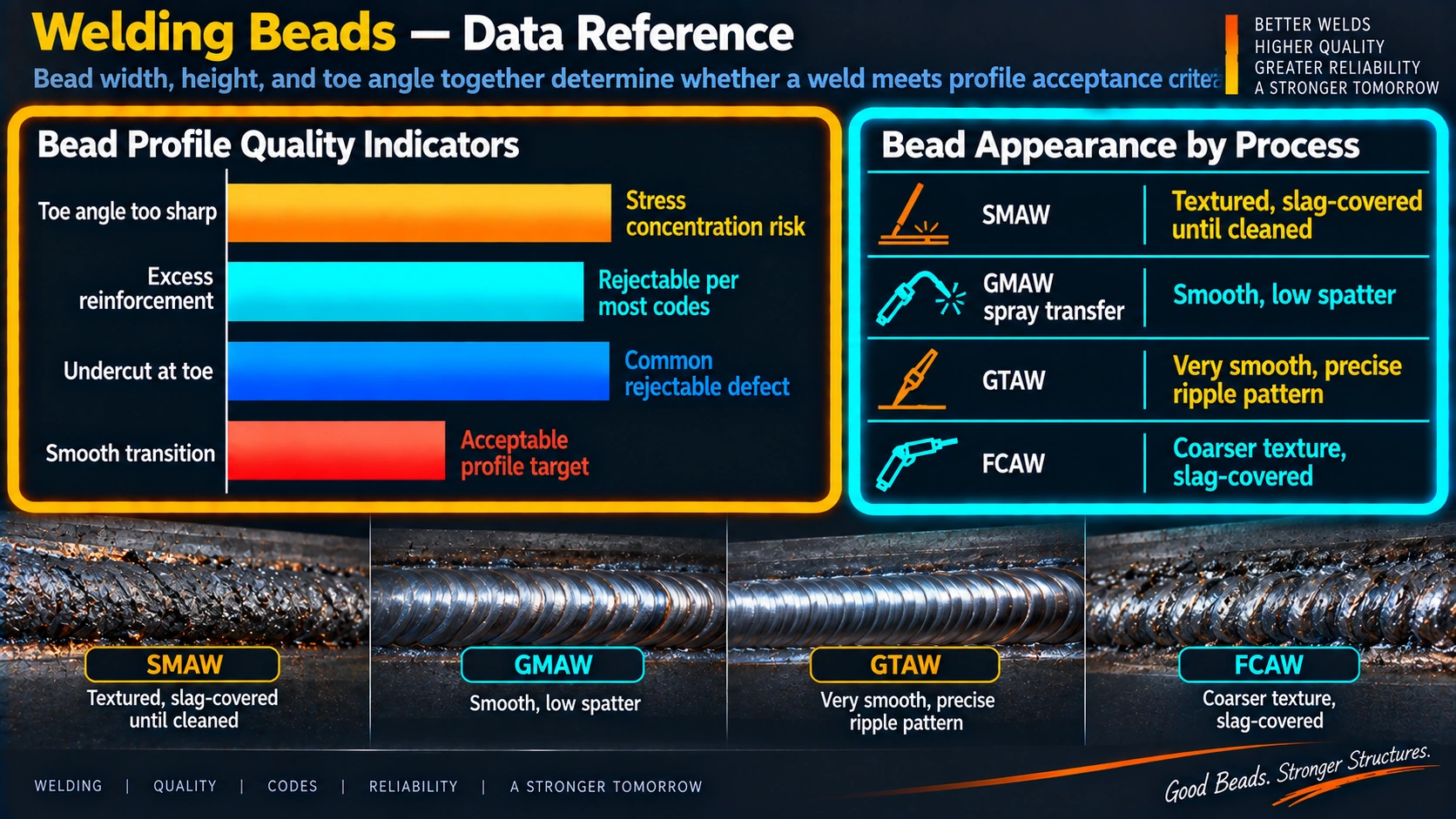
The J-weave is a hybrid technique that combines elements of the crescent weave and the whip motion. It is named for the J-shaped path the electrode traces as the welder sweeps from one toe of the weld to the other, pauses briefly, and then whips the electrode forward and upward along one side of the groove before returning to resume the sweep at the opposite toe.
The J-weave is used primarily for the hot pass (second pass after the root pass) and fill passes on V-groove joints, particularly in pipe welding. After the root pass is complete, the groove walls are wider and the available space allows a wider bead technique. The J-weave allows the welder to cover both walls of the groove in a single pass motion while still using the forward whip to control heat and prevent the bead from becoming too fluid or crowning excessively.
J-Weave Execution
- Starting at the left toe, sweep the electrode across to the right toe, pausing briefly at each side to ensure fusion.
- At the right toe, instead of sweeping straight back, whip the electrode forward and upward along the right sidewall of the groove for 8–12 mm.
- Bring the electrode back down to the front of the pool and resume the sweep across to the left toe.
- At the left toe, mirror the same upward whip along the left sidewall.
- Continue alternating, building the bead progressively along the joint.
Walking the Cup — TIG Pipe Welding Technique
Walking the cup is a TIG (GTAW) technique unique to pipe and certain structural welding situations where the torch’s ceramic gas cup can physically contact and roll along the groove faces of the weld joint. Instead of holding the torch entirely freehand — as most TIG welding is done — the welder uses the cup as a rolling pivot, rocking it back and forth from one groove wall to the other in a steady, rhythmic motion.
How It Works
The welder places the rim of the ceramic gas cup on the groove face of the pipe (or structural member) and tilts it so the tungsten electrode extends down into the groove at the correct arc length. By rocking the cup from wall to wall — rolling it on its rim — the tungsten follows a consistent arc path across the joint. The filler rod is fed into the leading edge of the pool with the other hand. The cup’s contact with the groove wall provides a mechanically defined arc length (determined by the cup diameter and the groove geometry) and a mechanically controlled weave width (determined by how far the cup rocks).
| Cup Walking Variable | Effect | Typical Range |
|---|---|---|
| Cup diameter | Larger diameter = wider arc to groove wall distance = different arc length geometry | 5/8 in (most common), 3/4 in, 1 in for wide groove |
| Rock angle | How far the cup tilts to each side — controls weave width | 15–30° each side from vertical |
| Rock frequency | Speed of the side-to-side rocking — controls bead ripple spacing | Typically 1–2 rocks per second |
| Travel advance per rock | How far forward the torch advances per complete rock cycle | 3–8 mm per cycle depending on groove width and fill requirement |
Why Welders Use It
The primary benefit of walking the cup is consistency and reproducibility. Because the cup is physically guided by the groove face, the arc length and weave width are mechanically stabilised — the welder does not have to maintain these by hand-eye coordination alone. The resulting weld beads tend to be more consistent in width and ripple spacing than freehand TIG, particularly for welders who are less experienced or who are welding in difficult positions like 5G (horizontal fixed pipe, welding uphill).
- Mechanically guided arc length — more consistent than freehand
- Consistent weave width and ripple pattern
- Reduces fatigue on long pipe welds
- Produces the classic TIG pipe “stack of dimes” appearance
- Preferred by many code-qualified pipe welders for certification tests
- Only possible where cup can contact a groove surface
- Not applicable on flat plate, outside corner joints, or thin material
- Cup grinding or chipping can disrupt the rolling contact
- Tungsten contamination from dipping disrupts the rhythm
- Requires practice to coordinate filler rod feeding with cup rocking rhythm
Multi-Pass Bead Sequences and Layering
Most structural and pressure-containing welds require multiple passes to fill the joint from root to cap. How those passes are sequenced — the order and geometry of individual beads — affects the final weld quality, the distortion of the assembled structure, and the mechanical properties of the completed joint.
Pass Sequence Terminology
| Pass Name | Position in Joint | Primary Purpose | Typical Technique |
|---|---|---|---|
| Root Pass | First pass — at the joint root, between the root faces | Achieve full penetration and seal the root gap; foundation for all subsequent passes | Whip motion (SMAW), walking the cup (TIG), short-circuit MIG (GMAW) |
| Hot Pass | Second pass — immediately over the root pass | Refine root bead, remove slag inclusions and porosity from root, establish fusion on groove walls above root | J-weave or stringer (SMAW); stringer or weave (GMAW) |
| Fill Pass(es) | Intermediate passes building the groove to near-cap level | Fill the groove volume progressively; each pass must fuse to sidewalls and previous pass | Stringer (preferred for quality) or weave (faster for thick plate) |
| Cap Pass | Final pass(es) at the weld face | Achieve specified profile, width, and reinforcement; visual acceptance criteria apply | Weave (for flat profile across wide joint) or stringer sequence (for controlled appearance) |
Bead Selection by Welding Position
Select a welding position to see the recommended bead technique, notes on gravity effects, and which patterns work best.
Bead Defects and How to Fix Them
Frequently Asked Questions — Welding Beads
What is a weld bead?
A weld bead is the solidified deposit of filler metal left behind after the arc passes along a joint. It is formed when filler material is melted into the joint and solidifies as the heat source moves forward. The shape, width, height, ripple pattern, and fusion profile of the weld bead are directly controlled by torch movement technique, travel speed, amperage, and electrode angle. A correctly formed weld bead fuses fully with both base metal faces, has a flat or slightly convex profile, consistent width, and smoothly blended toes with no undercut.
What is the difference between a stringer bead and a weave bead?
A stringer bead is deposited with straight travel along the joint and minimal side-to-side movement. It produces a narrow bead with lower heat input — preferred for root passes, stainless steel, thin material, and any application where heat input must be controlled. A weave bead uses deliberate side-to-side oscillation to produce a wider bead that fills grooves faster. Weave beads are used for fill and cap passes on thick structural joints but increase heat input per unit length, so they are restricted or prohibited on sensitisation-critical materials like stainless and on high-strength or alloy steels where maximum HAZ hardness is specified.
What is the whip motion in stick welding?
The whip motion is used in SMAW for root pass welding on open-groove joints. The welder briefly advances the electrode tip forward and upward ahead of the pool — the whip — then immediately returns to the molten pool at the keyhole. This controlled cycle allows the pool edge to cool, maintains a consistent keyhole size, and deposits each ripple of the root bead one at a time. The frequency of whipping is adjusted continuously based on heat build-up in the joint — more frequent as the joint warms, less frequent at the cold start. It is most commonly used with fast-freeze electrodes E6010 and E6011.
What is walking the cup in TIG welding?
Walking the cup is a TIG pipe welding technique where the ceramic gas cup of the torch is used as a physical pivot, rocked back and forth along the weld groove. Rather than holding the torch freehand, the welder rolls the cup rim on the groove face — the tungsten follows a consistent arc across the joint as the cup rocks. This stabilises arc length mechanically and produces a consistent ripple pattern. It is used on pipe root and fill passes in the 5G and 6G positions where the cup can contact the groove surface. The technique is not applicable on flat plate or joints where the cup cannot contact a groove face.
Should I push or pull the torch when MIG welding?
In MIG welding, pushing (torch angled toward the unwelded joint, 10–15 degrees forward lean) produces a wider, flatter, shallower bead with less spatter — better for thin material and stainless steel. Pulling (torch angled toward the completed weld, 10–15 degrees trailing) produces a narrower, deeper bead — better for thick carbon steel needing maximum penetration. In flux-cored arc welding (FCAW), pulling is always preferred to allow the slag to protect the weld pool. In SMAW (stick), dragging (pulling) is standard for most electrodes. The correct choice depends on the material, thickness, and process — when in doubt for MIG on steel, push for thin, pull for thick.
What causes a high crown (convex) weld bead?
A high crown bead is caused by insufficient heat input for the travel speed — the weld metal piles up because the base metal is not hot enough to allow the pool to flow flat. Primary causes are: travel speed too fast, amperage too low, arc too long, or in weave welding, moving too slowly across the centre of the weave. The fix is to increase amperage, reduce arc length, or slow travel speed. For weave beads specifically, moving quickly through the weave centre and pausing at the toes produces a flatter profile. Excessively convex beads also trap slag at the toes, making interpass cleaning difficult and risking slag inclusions in subsequent passes.