Microbiologically Influenced Corrosion (MIC) in Welded Structures
Microbiologically influenced corrosion (MIC) is corrosion that bacteria and other microorganisms cause indirectly, by forming biofilms that quietly rewrite the local chemistry at the metal surface — consuming oxygen, generating acids, or producing hydrogen sulfide — until conventional pitting or crevice attack initiates far faster and in far milder bulk conditions than the same material would otherwise experience. Welded structures are disproportionately affected because welds routinely provide exactly the surface roughness, crevice geometry, and (for new construction) stagnant water exposure that MIC-associated bacteria need to establish themselves.
This guide covers the MIC mechanism, the main microorganism groups involved, why welded joints are particularly susceptible, the well-documented hydrotest water risk specific to new fabrication, and the detection and prevention strategies used to manage it. For the underlying oxygen-depletion mechanism MIC frequently exploits, see the crevice corrosion guide.
How MIC Actually Works
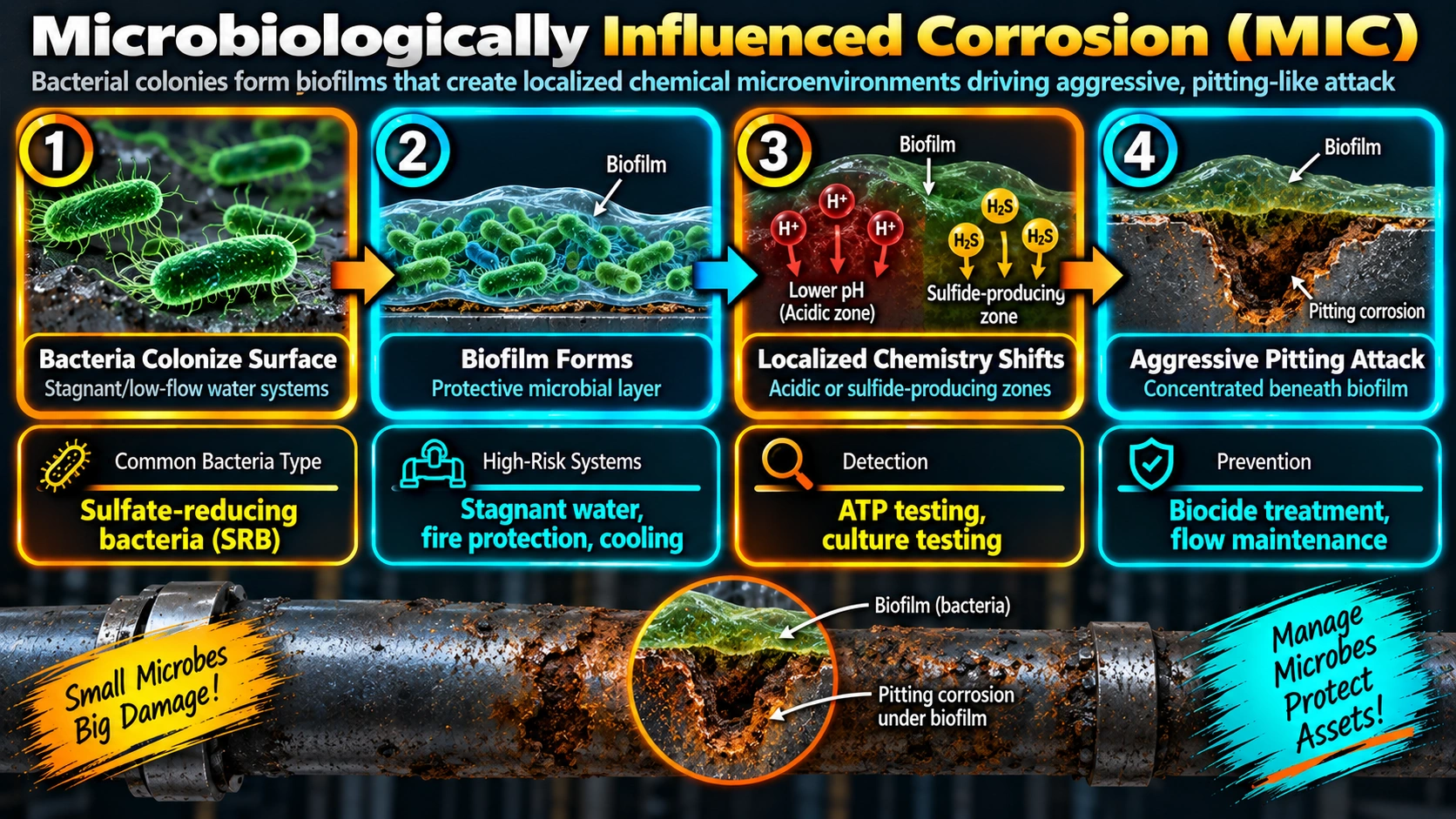
Microorganisms do not consume metal directly. Instead, bacteria and other microbes attach to a wetted metal surface and form a biofilm — a structured community embedded in a self-produced protective matrix — and the metabolic activity of that biofilm changes the local chemical and electrochemical environment immediately beneath it. Depending on which organisms dominate the biofilm, this can mean localized oxygen depletion, acid production, hydrogen sulfide generation, or a shift in the local electrochemical potential, any of which can trigger or dramatically accelerate a conventional corrosion mechanism — pitting, crevice corrosion, or hydrogen-related damage — at that specific spot, even while the surrounding, biofilm-free surface remains largely unaffected.
Key Microorganism Groups and Their Mechanisms
Sulfate-Reducing Bacteria (SRB)
SRB are anaerobic organisms that reduce sulfate to hydrogen sulfide as part of their energy metabolism, thriving in the oxygen-depleted conditions found beneath biofilms, tubercles, and deposits. Their activity produces a locally sulfidic, hydrogen-generating environment that drives direct corrosion and, in susceptible high-strength materials, can contribute to hydrogen-related cracking — overlapping with the mechanisms covered in the hydrogen cracking guide and the sour service guide.
Acid-Producing Bacteria (APB)
APB metabolize available nutrients into organic acids, locally lowering pH at the metal surface and accelerating straightforward acid-driven dissolution rather than the sulfide-based mechanism associated with SRB. APB and SRB frequently coexist within the same biofilm community, acting together to accelerate damage beyond what either group alone would produce.
Iron-Related Bacteria (IRB)
IRB oxidize iron and can promote the formation of the characteristic tubercles associated with MIC, contributing to the oxygen concentration cell that develops beneath the deposit.
Manganese-Oxidizing Bacteria
Certain manganese-oxidizing bacteria raise the local open-circuit potential of stainless steel through a process called ennoblement, pushing the local electrochemical potential into a range where pitting or crevice corrosion becomes more likely at a lower chloride concentration or lower temperature than would otherwise be expected on that alloy.
Tubercle Formation: The Classic MIC Signature
Why Welded Joints Are Particularly Susceptible
Weld metal and the HAZ often present rougher surface finish, heat tint discoloration, and localized microstructural variation compared to the smoother, more uniform surrounding base metal — all factors that can promote bacterial attachment and biofilm formation more readily. Weld-related crevices compound this: incomplete penetration, retained backing rings, and root undercut all create the stagnant, oxygen-depleted micro-environment that sulfate-reducing bacteria and similar organisms need to become established. See the crevice corrosion guide for the specific weld geometries involved. In austenitic stainless steel, sensitized HAZ regions can add localized susceptibility to intergranular attack that MIC-associated bacteria can exploit alongside the chromium depletion mechanism itself — see the sensitization guide for that underlying mechanism.
Hydrotest Water: A Well-Documented MIC Trigger in New Construction
Standard mitigation practice includes limiting hydrotest water dwell time, using treated or biocide-dosed test water where practical, prompt and complete draining and drying immediately after the test rather than leaving water standing “temporarily,” and inspecting for early tubercle formation on any system where extended dwell time could not be avoided.
Detection and Monitoring
| Method | What It Measures | Notes |
|---|---|---|
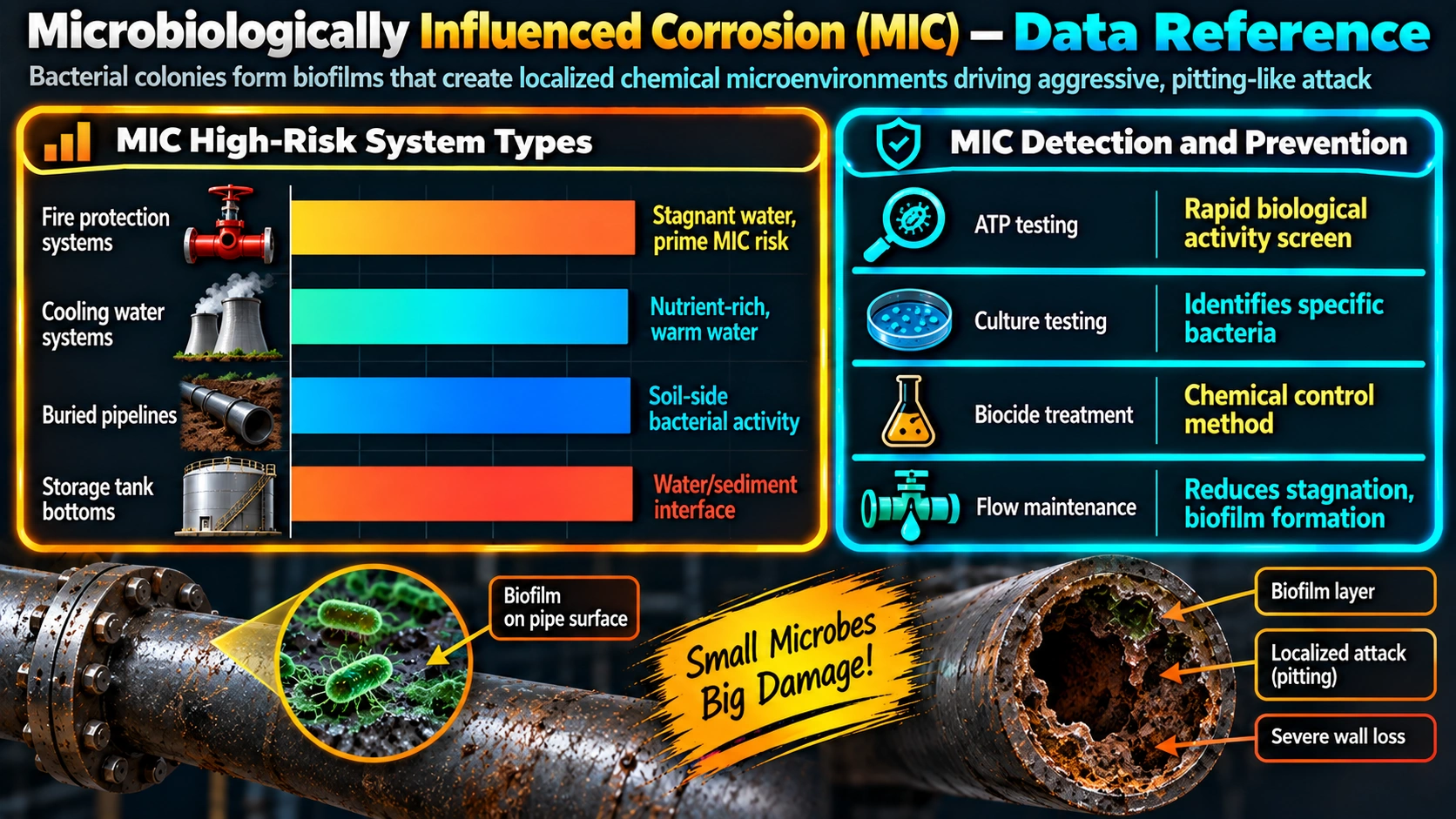
| ATP bioluminescence testing | Total microbial activity (rapid, on-site) | Fast screening, does not identify specific organism types |
| Culture-based MPN testing | Presence and estimated population of specific bacteria groups (e.g. SRB) | Traditional method; can under-report viable-but-non-culturable organisms |
| Molecular methods (qPCR) | Specific, sensitive identification of target organism DNA | More sensitive and specific than culture methods; higher cost |
| Corrosion coupons | Direct weight-loss and pitting evidence in the actual system water | Ground-truth confirmation alongside biological testing |
| Physical/visual inspection | Tubercle presence, biofilm, characteristic pit morphology | Requires access; often the first indicator found during a shutdown |
Prevention and Control Strategies
- Limit stagnant water dwell time, especially hydrotest water — drain and dry promptly rather than leaving water standing.
- Biocide treatment — oxidizing (chlorine, bromine) or non-oxidizing biocides reduce planktonic bacteria, though established biofilms resist penetration and require combined treatment.
- Mechanical cleaning / pigging — physically disrupts and removes biofilm and tubercles that biocide alone cannot fully eliminate.
- Flow velocity management — reduces stagnant zones and dead legs where biofilms preferentially establish.
- Weld quality control — minimizing crevices (backing rings, incomplete penetration) and controlling surface finish and heat tint removal at welds reduces bacterial attachment sites.
- Material and coating selection — while no common structural alloy is fully immune, coatings and higher-alloy materials can reduce (not eliminate) susceptibility in known high-risk services.
Frequently Asked Questions
Do microorganisms actually eat the metal in MIC, or is something else happening?
Microorganisms do not consume the metal directly. Instead, they form biofilms on the metal surface and their metabolic activity changes the local chemical and electrochemical environment beneath the biofilm — consuming oxygen, producing acids or hydrogen sulfide, or shifting the local electrochemical potential — in ways that create or accelerate conventional corrosion mechanisms such as pitting, crevice corrosion, or hydrogen-related damage at that specific location. MIC is best understood as microorganisms creating the conditions for corrosion, not as biological metal consumption.
Why are welded joints often the starting point for MIC attack?
Weld HAZs and weld metal often have rougher surface finish, heat tint, and microstructural variation compared to the surrounding base metal, all of which can promote bacterial attachment and biofilm formation more readily than a smooth, uniform surface. Weld-related crevices — incomplete penetration, retained backing rings, weld root undercut — also provide the stagnant, oxygen-depleted micro-environment that many MIC-associated bacteria, particularly sulfate-reducing bacteria, require to become established and active.
What is a tubercle and why does it matter in MIC?
A tubercle is a mound-like deposit, often composed of layered iron oxide/hydroxide corrosion products, biofilm, and mineral deposits, that forms over an active corrosion site. Tubercles are significant in MIC because they create an oxygen concentration cell — oxygen-depleted, anaerobic conditions develop underneath the tubercle even in an otherwise aerated bulk environment — providing exactly the anaerobic micro-environment that sulfate-reducing bacteria need, while the tubercle itself conceals the active pit beneath it from casual visual inspection.
Why is hydrotest water considered a major MIC risk for new welded piping and vessels?
Hydrotest water is often untreated water left standing inside a newly fabricated pipeline or vessel for the duration of the pressure test and sometimes considerably longer afterward if draining is delayed. That stagnant water, combined with nutrients already present in it or introduced from the water source, can allow bacteria — particularly sulfate-reducing bacteria — to establish an active population during the dwell period, and if the system is not promptly drained, dried, or dosed with biocide, MIC pitting can initiate before the equipment ever enters normal service.
Is stainless steel immune to microbiologically influenced corrosion?
No. While stainless steel resists many forms of general corrosion, certain bacteria (particularly manganese-oxidizing species) can raise the local open-circuit potential of stainless steel through a process called ennoblement, pushing the local potential into a range where pitting or crevice corrosion becomes more likely at a lower chloride level or lower temperature than would otherwise be expected. Austenitic stainless steel weldments in stagnant natural water service have documented MIC-related pitting failures despite the material’s normally good general corrosion resistance.
How is MIC detected before it causes a failure?
Common detection methods include ATP (adenosine triphosphate) bioluminescence testing for rapid on-site estimation of total microbial activity, culture-based most probable number (MPN) testing for specific bacteria groups such as sulfate-reducing bacteria, molecular methods such as qPCR for more specific and sensitive organism identification, and physical inspection for characteristic tubercles, pitting morphology, and biofilm presence combined with corrosion coupon monitoring in the actual system water. No single method is fully conclusive on its own, so MIC monitoring programs typically combine several of these techniques.
What is the difference between sulfate-reducing bacteria and acid-producing bacteria in MIC?
Sulfate-reducing bacteria (SRB) are anaerobic organisms that reduce sulfate to hydrogen sulfide as part of their metabolism, producing a locally sulfidic, hydrogen-generating environment beneath biofilms and tubercles that drives both direct corrosion and, in susceptible materials, hydrogen-related damage. Acid-producing bacteria (APB) instead metabolize available nutrients into organic acids, locally lowering pH at the metal surface and accelerating dissolution through straightforward acid attack rather than the sulfide and hydrogen-driven mechanisms associated with SRB. The two groups often coexist within the same biofilm community and can act together to accelerate damage beyond what either would cause alone.
Can biocide treatment alone control MIC in a piping system?
Biocide treatment reduces planktonic (free-floating) bacteria populations effectively but often struggles to fully penetrate and eliminate bacteria protected within an established biofilm or beneath a tubercle, since the biofilm matrix itself provides some physical and chemical protection against biocide penetration. Effective MIC control therefore typically combines biocide dosing with mechanical cleaning or pigging to physically disrupt and remove biofilm and tubercles, flow velocity management to reduce stagnant zones, and monitoring to confirm treatment effectiveness rather than relying on biocide alone.
Recommended Reading
Microbiologically Influenced Corrosion Handbook (Borenstein)
Foundational reference covering MIC mechanisms, detection, monitoring, and the welding and metallurgical factors involved.
View on AmazonMicrobiologically Influenced Corrosion (Little & Lee)
Multi-disciplinary reference on MIC diagnosis, biofilm formation, and control strategies across industries.
View on AmazonMicrobiologically Influenced Corrosion: An Engineering Insight (Javaherdashti)
Practical engineering-focused treatment of MIC recognition, mechanisms, and mitigation.
View on AmazonCorrosion Engineering (Fontana)
Classic corrosion textbook providing the electrochemical fundamentals underlying MIC-driven attack.
View on AmazonDisclosure: WeldFabWorld participates in the Amazon Associates programme (StoreID: neha0fe8-21). If you purchase through these links, we may earn a small commission at no extra cost to you. This helps support free technical content on this site.