Welding Cast Steel vs Cast Iron: Key Differences
Welding cast steel vs cast iron is a comparison that trips up a lot of welders and engineers who assume “cast” means one material behaves like the other. It does not. Cast steel is, metallurgically, just steel that happens to be shaped by casting instead of rolling or forging – it welds like ordinary carbon or low-alloy steel. Cast iron is an entirely different animal: a high-carbon material containing free graphite that makes it brittle, prone to cracking, and chemically hostile to a normal steel weld pool.
This guide lays out exactly where these two materials diverge – carbon content and microstructure, preheat needs, filler metal selection, and cracking behaviour – so you can walk onto a job, correctly identify what you are actually looking at, and choose a procedure that will not fail. We also cover the different types of cast iron (gray, ductile, malleable, white) since they do not all weld the same way either.
If you regularly work with high-hardenability wrought alloy steels, you will find much of the cast steel guidance below familiar. Cast iron, on the other hand, calls for an entirely different mindset and consumable selection.
Scope note: This guide covers arc welding (SMAW/GMAW/GTAW) repair and fabrication of cast steel and the common cast iron types – gray, ductile (nodular), malleable, and white iron. Braze welding and cold-metal-stitching repair methods for cast iron are mentioned but not covered in depth.
The Core Difference: Carbon Content and Microstructure
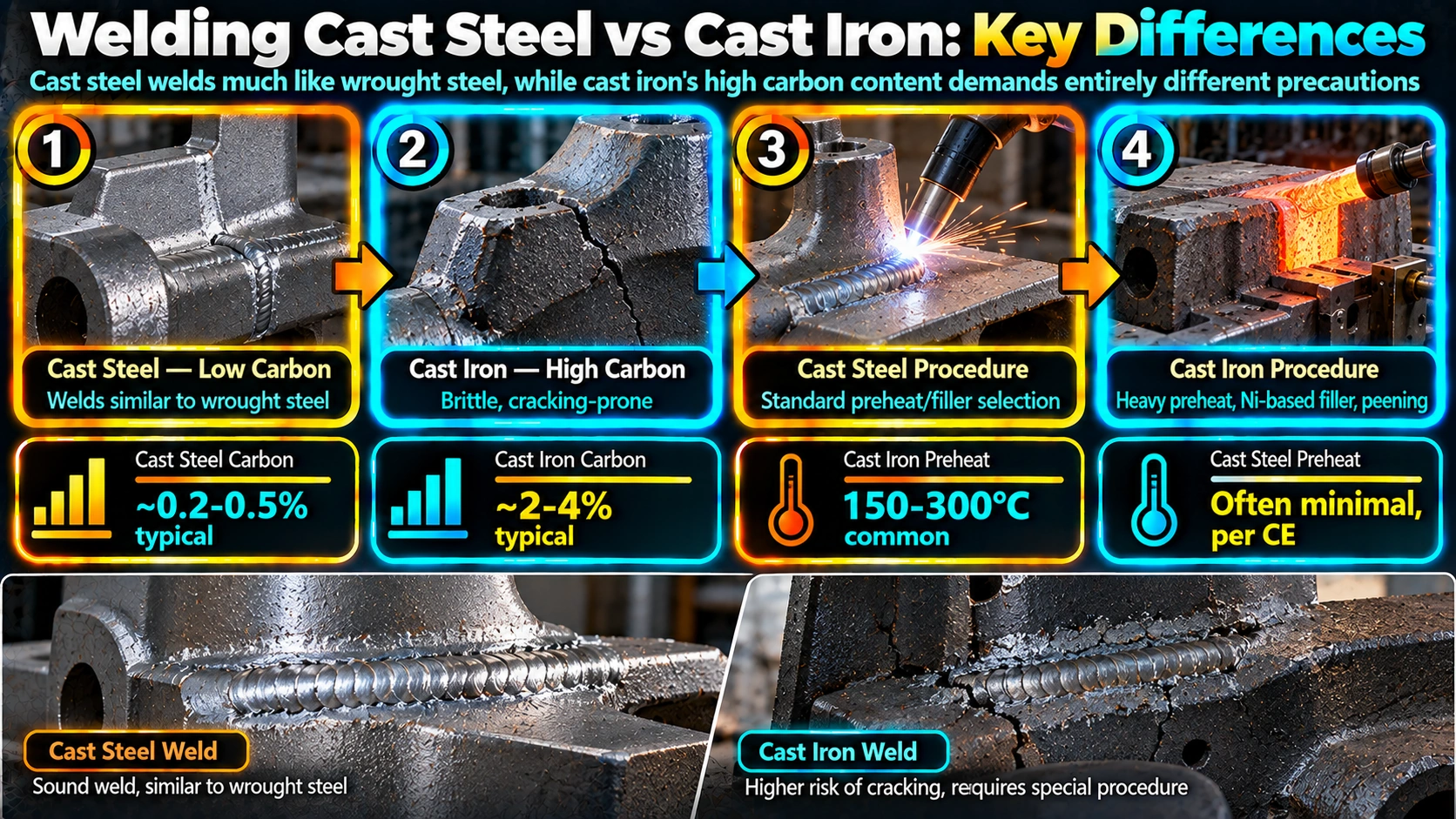
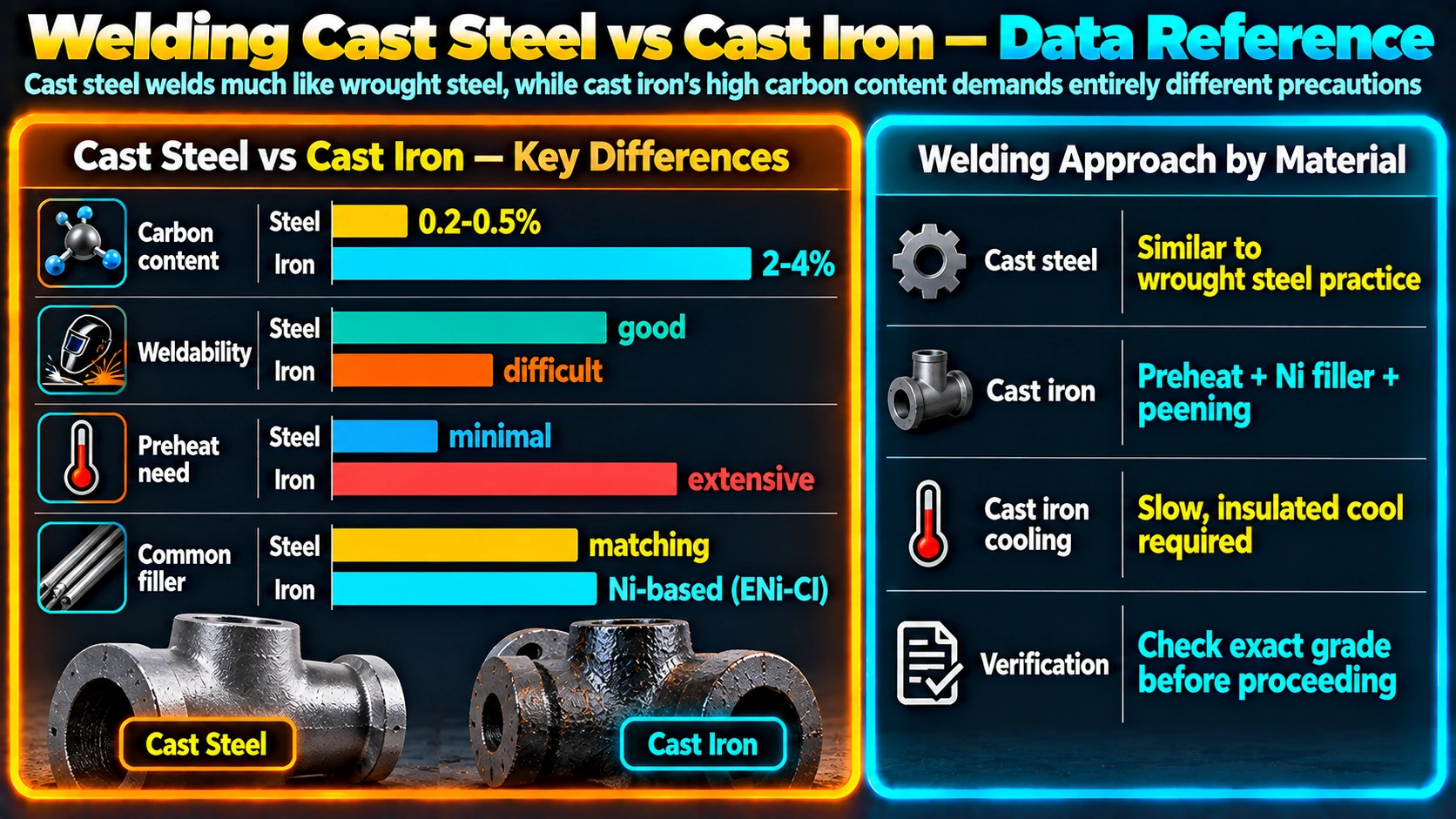
Cast steel typically contains 0.1 to 0.5 percent carbon, similar to the wrought steel grades most welders are trained on, and its carbon exists in solid solution or as fine carbide – not as free graphite. Cast iron, by contrast, contains 2.1 to 4 percent carbon, most of which precipitates out as graphite during slow cooling in the mold. That graphite is the single biggest reason cast iron behaves so differently under a welding arc.
Why graphite causes problems
Because gray cast iron contains graphite in flake form, carbon is readily introduced into the weld pool during a weld repair. This carbon pickup can transform an otherwise ductile weld deposit into a hard, brittle one, and it is also a major source of porosity if the graphite is not accounted for in electrode selection and technique.
Ductility – or the lack of it
Grey cast iron has relatively low ductility; if loaded beyond its yield point, it breaks rather than deforming to any significant extent. Cast steel, sharing the ductile behaviour of wrought steel, can absorb welding-induced residual stress through plastic deformation. Cast iron generally cannot – which is why cracking, not distortion, is the dominant failure mode in cast iron repair welding.
Preheat Requirements
| Material | Typical Preheat | Basis |
|---|---|---|
| Cast steel (low carbon) | Often none to minimal | Follows standard carbon equivalent tables, same as wrought steel |
| Cast steel (alloyed/higher carbon) | Per CE-based preheat tables | Same hydrogen cracking logic as equivalent wrought grade |
| Gray cast iron | 260-650 degC (500-1200 degF), or minimal with nickel electrodes | Reduces thermal gradient and residual stress across a low-ductility casting |
| Ductile (nodular) iron | Recommended, moderate range | Less brittle than gray iron but still crack-sensitive |
| White cast iron | Not practically weldable | Extremely hard, brittle cementite structure resists sound repair |
A critical temperature in most cast iron is around 1450 degrees F (about 790 degrees C); when the casting is held at this temperature for extended periods, conditions that lead to cracking can occur, so the goal is to control heat input and cooling rate rather than simply reach a preheat number. Preheat is about managing the whole thermal gradient across the casting, not just satisfying a single target temperature.
Filler Metal Selection
| Material | Typical Filler | Notes |
|---|---|---|
| Cast steel to cast steel | E7018 / ER70S-2, or alloy-matched consumable | Standard steel practice |
| Cast steel to wrought steel | Matched to the wrought grade per AWS consumable classification | Standard steel practice |
| Gray cast iron, machinable repair | ENi-CI (approx. 85-99% nickel) | Best machinability |
| Gray/ductile iron, higher strength | ENiFe-CI (nickel-iron, approx. 50-55% Ni) | Higher strength, more dilution-tolerant |
| Cast iron to steel | ENiFe-CI | Verify dilution and preheat on iron side |
| White cast iron | None reliable | Generally not weldable |
Why nickel electrodes work on cast iron: Nickel and nickel-iron weld deposits are extremely ductile and resist the brittleness that would otherwise result from carbon pickup out of the cast iron base metal, and minimizing penetration into the casting further reduces hardness in the heat-affected zone. A mild steel electrode, by contrast, picks up enough carbon from the base metal to become hard and crack-prone.
ENi-CI versus ENiFe-CI
ENi-CI is a nearly pure nickel electrode designed for gray cast iron repairs where a soft, very machinable deposit and low cracking risk are the priority – ideal for cold repairs, short beads, and buttering. ENiFe-CI, with roughly 45 percent iron, produces a stronger, harder weld with better tolerance for dilution and is preferred for higher-strength joints, multi-pass work, or joining cast iron to steel.
Cracking Behaviour Compared
Cast steel cracking follows the same rules as wrought steel: hydrogen-assisted cold cracking in a hardened HAZ, driven by carbon equivalent, hydrogen level, and cooling rate. Standard low-hydrogen practice and carbon-equivalent-based preheat selection (see the Carbon Equivalent calculator) apply directly.
Cast iron cracking is driven by a different mechanism entirely – low base metal ductility combined with an inherently uneven thermal gradient during welding. Even a metallurgically sound weld can crack the surrounding casting if the heat input and cooling rate create enough differential stress across the part. This is why technique (small beads, peening between passes, minimizing arc time, directing the arc into the weld pool rather than the base metal) matters as much as electrode selection for cast iron.
Phosphorus sensitivity: Phosphorus has low solubility in nickel, so welding cast irons that are high in phosphorus with nickel-base electrodes can itself lead to cracking. Where the phosphorus content of a specific casting is unknown or suspected to be high, ENiFe-CI generally tolerates it better than high-nickel ENi-CI.
Cast Iron Types and Their Weldability
| Type | Graphite Form | Weldability |
|---|---|---|
| Gray cast iron | Flake graphite | Weldable with care – most common but crack-sensitive |
| Ductile (nodular) iron | Spheroidal (nodular) graphite | More forgiving – better ductility than gray iron |
| Malleable iron | Temper carbon (irregular nodules) | Weldable – long heating cycles can degrade properties |
| White cast iron | Carbon as cementite (no graphite) | Not practically weldable |
Process Selection
| Process | Cast Steel | Cast Iron |
|---|---|---|
| SMAW (Stick) | Standard | Most common – nickel electrodes dominate |
| GMAW (MIG) | Standard | Nickel flux-cored wire, small diameter, low current |
| GTAW (TIG) | Good for precision work | Usable but less common than stick |
| Oxy-acetylene / braze welding | Rarely used | Alternative – lower peak temperature reduces cracking risk |
Post-Weld Practice
Cast steel components generally follow the same PWHT logic as wrought steel of equivalent composition – stress relief where required by code or service condition. Cast iron repairs are typically slow-cooled rather than heat treated: wrapping the casting in insulating blankets or returning it to a furnace for controlled cooling reduces the residual stress that would otherwise crack the casting hours after the arc is extinguished.
Amazon Recommended References
Welding Metallurgy
Sindo Kou’s reference on solidification, cracking mechanisms and dissimilar/cast metal weldability.
View on AmazonCast Iron Technology
Reference covering gray, ductile, malleable and white cast iron metallurgy and repair welding.
View on AmazonASM Handbook: Welding, Brazing and Soldering
Covers cast iron and cast steel repair welding processes and consumable selection.
View on AmazonSteel Castings Handbook
Reference data on cast steel grades, mechanical properties and weld repair practice.
View on AmazonDisclosure: WeldFabWorld participates in the Amazon Associates programme (StoreID: neha0fe8-21). If you purchase through these links, we may earn a small commission at no extra cost to you. This helps support free technical content on this site.
Frequently Asked Questions
Is cast steel easier to weld than cast iron?
Yes, considerably. Cast steel has low carbon content and no free graphite, so it welds much like wrought carbon or low-alloy steel using ordinary low-hydrogen electrodes and standard preheat practice. Cast iron contains 2 to 4 percent carbon as free graphite, which causes brittleness, carbon pickup into the weld pool, and a strong tendency toward cracking unless special nickel-based fillers and preheat are used.
Why does cast iron crack more easily than cast steel when welded?
Cast iron has almost no ductility – it fractures rather than deforming under stress, so any residual stress from an uneven weld thermal cycle is likely to crack it rather than simply distort it. Cast steel, being a low-carbon alloy with a ductile microstructure, can accommodate the same thermal stresses through plastic deformation instead of cracking.
What filler metal is used for welding cast iron?
Nickel-based electrodes are the standard choice: ENi-CI (about 85-99 percent nickel) for machinable, single-pass repairs, and ENiFe-CI (nickel-iron, roughly 50-55 percent nickel) for higher-strength, multi-pass repairs or joining cast iron to steel. Both tolerate the carbon pickup from the base metal far better than a mild steel electrode would.
Do you need to preheat cast steel before welding?
Preheat requirements for cast steel are determined the same way as for wrought steel – by its carbon equivalent, thickness and hydrogen control needs. Low-carbon cast steel grades often need little or no preheat, while higher-carbon or alloyed cast steel grades follow the same preheat tables used for equivalent wrought compositions.
What preheat temperature is needed for welding cast iron?
Gray cast iron is commonly preheated to 260-650 degrees C (500-1200 degrees F) depending on section size and complexity, though nickel electrodes can sometimes be used with little or no preheat on smaller repairs. The casting should also be cooled slowly and evenly after welding, since uneven cooling is as likely to cause cracking as the welding heat itself.
Can white cast iron be welded?
Practically, no. White cast iron is extremely hard and brittle because its carbon exists as cementite rather than graphite, and even with very high preheat and nickel electrodes, success rates are low. Repairs to white iron components are generally better handled by mechanical means or replacement rather than welding.
Can cast iron be welded to cast steel or wrought steel?
Yes, using a nickel-iron electrode such as ENiFe-CI, which tolerates dilution from the steel side without becoming brittle. Preheat is still governed by the cast iron side of the joint, and the weld should be made with minimal penetration into the iron to limit carbon pickup and the resulting HAZ hardness. This is conceptually similar to the buffer-layer logic used in dissimilar metal welding more broadly.