Inconel Welding Guide: Challenges and Best Practices
Inconel welding is one of the most metallurgically demanding jobs an engineer or welder will ever plan a procedure for. These nickel-chromium superalloys are chosen precisely because they hold their strength and corrosion resistance where carbon and stainless steels give up – in flue gas scrubbers, aerospace exhaust systems, subsea piping, and high-temperature reactor internals. That same chemistry, however, makes Inconel far less forgiving in the weld pool than the structural steels most welders cut their teeth on.
This guide walks through the real reasons Inconel welds crack, why delta ferrite thinking from stainless steel welding does not transfer directly to nickel alloys, how to select the right filler metal for similar and dissimilar joints, and what a sound welding procedure specification actually needs to control. Whether you are qualifying a WPS for Inconel 625 overlay, joining Inconel 718 turbine hardware, or transitioning a carbon steel line into a nickel alloy pressure vessel, the principles below will keep your welds out of the rejection pile.
We will also cover heat input and interpass temperature control, PWHT decisions, shielding gas practice, and inspection expectations, so that by the end you have a complete mental model – not just a list of filler metal part numbers – for planning Inconel welding work with confidence.
Scope note: “Inconel” is a trademarked family of nickel-chromium alloys (Special Metals Corporation) that commonly includes Alloy 600, 601, 625, 690 and 718. This guide focuses on the three grades encountered most often in fabrication and repair work – 600, 625 and 718 – since their welding behaviour differs enough to matter in procedure planning.
Why Inconel Welds Differently to Steel
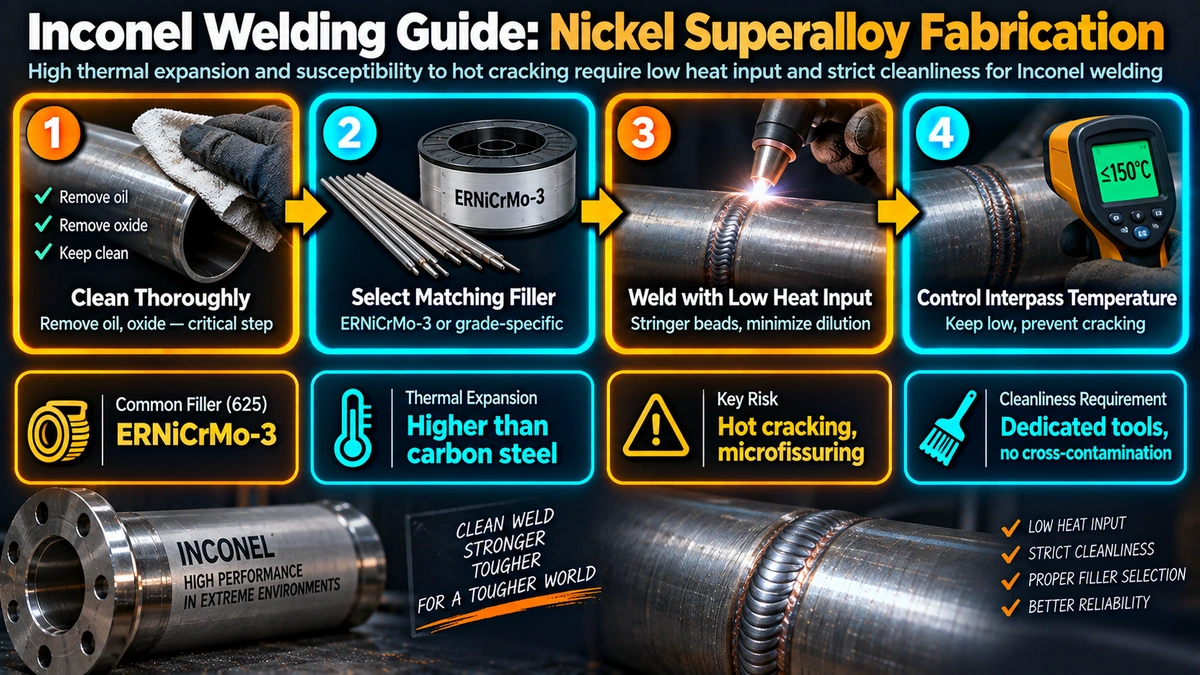
Three physical properties drive almost every welding problem you will encounter with Inconel, and none of them are things a carbon steel welder is trained to watch for.
Low thermal conductivity, high thermal expansion
Inconel conducts heat away from the arc far more slowly than carbon or stainless steel, so heat concentrates locally instead of spreading through the part. Combined with a thermal expansion coefficient roughly 30-40 percent higher than ferritic steel, this produces more distortion, more residual stress, and a wider, hotter heat-affected zone (HAZ) for a given heat input than you would expect from steel experience alone.
Solidification segregation and Laves phase
Nickel alloys strengthened with niobium and titanium (notably Inconel 718) reject these elements into the last liquid to solidify at the weld centerline and dendrite boundaries. This produces a brittle, low-melting-point intermetallic called Laves phase. Laves phase is the single biggest cause of solidification (hot) cracking and HAZ microfissuring in nickel superalloy welds, and it is a direct function of how much heat you put into the joint.
Sensitivity to surface contamination
Sulfur, lead, phosphorus and other low-melting elements picked up from grease, marking crayons, or carbon-steel-contaminated grinding wheels will migrate into the grain boundaries of a nickel alloy weld and cause severe liquation cracking. Inconel is far less tolerant of this contamination than stainless steel is.
Filler Metal Selection
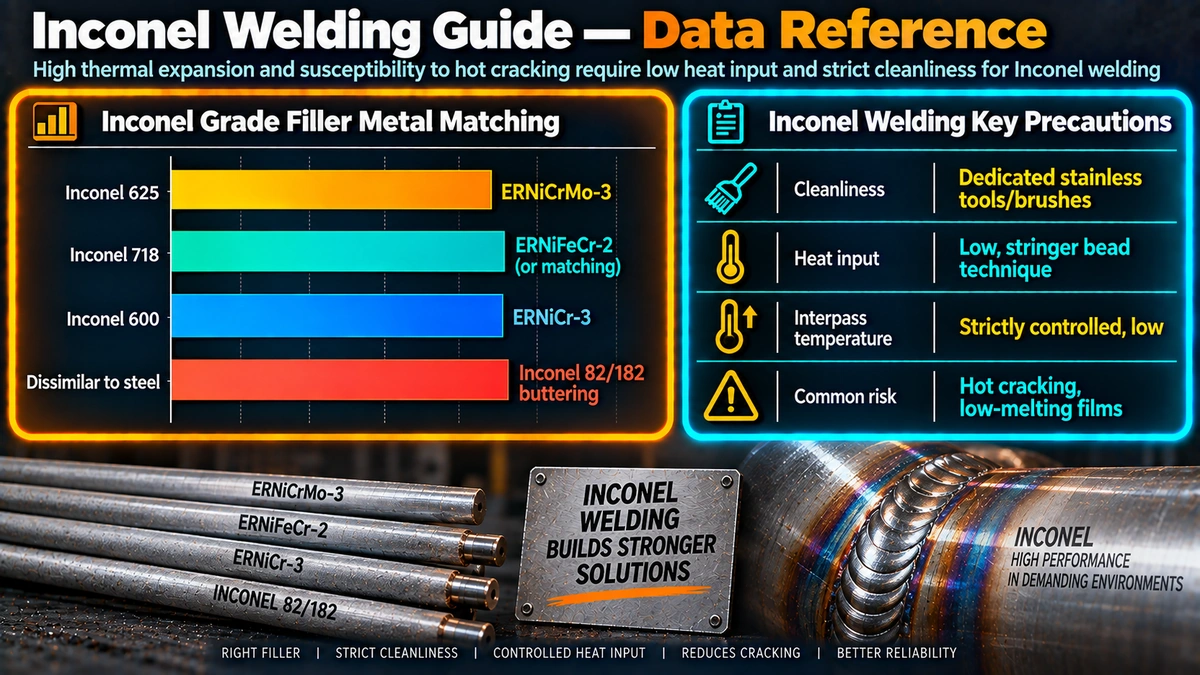
Filler selection is the single most consequential decision in any Inconel WPS. The table below covers the fillers you will use for the overwhelming majority of fabrication and repair scenarios.
| AWS Classification | Common Name | Typical Use | Cracking Resistance |
|---|---|---|---|
| ERNiCr-3 | Inconel 82 / Filler Metal 82 | Welding Alloy 600/601/800 to itself; dissimilar joints to steel; nuclear-grade dissimilar welds | Very good |
| ERNiCrMo-3 | Inconel 625 filler | Welding Alloy 625/601/690 and Incoloy 800/825; the default buffer for nickel-to-steel dissimilar joints; corrosion overlay | Excellent |
| ERNiCrMo-4 | Hastelloy C-276 filler | Alloy C-276 and severe chloride/sour service where pitting resistance is paramount | Very good |
| ERNiFeCr-2 | Inconel 718 filler | Matching filler for Alloy 718 where full aged strength is required in the weld metal | Fair – crack sensitive |
Why ERNiCrMo-3 dominates dissimilar joints: Its niobium and molybdenum content stabilizes the weld pool against solidification cracking while its high nickel content absorbs the mismatch in thermal expansion between carbon steel and stainless steel. This is why it is frequently reached for even when neither base metal is nickel alloy – for example in P91 to carbon steel transition joints where a nickel buffer avoids martensite formation at the fusion line.
Matching filler is not always the right filler
For Inconel 718, matching filler (ERNiFeCr-2) is only used when the weld metal itself must reach the aged strength of the base metal – typically after a full solution anneal and age cycle. For lower-criticality repairs, many fabricators deliberately substitute Inconel 625 filler for 718 base metal because 625 tolerates as-welded conditions without post-weld aging and is dramatically more resistant to microfissuring, accepting a lower weld metal strength in exchange for reliability.
Heat Input and Interpass Temperature Control
Because Laves phase formation and grain growth are both time-and-temperature dependent, heat input is the primary lever a welding engineer has over crack susceptibility. Unlike carbon steel, where heat input calculations mainly manage HAZ hardness, on Inconel they manage segregation directly.
Interpass temperature: Most Inconel procedures cap interpass temperature between 100 degC and 150 degC (212-300 degF). Going higher does not help fusion – it slows cooling rate, coarsens the grain structure, and gives Laves phase more time to segregate. Monitor with contact pyrometers or temperature-indicating crayons rated for nickel alloys, and let each pass cool back down before starting the next rather than “chasing” a hot joint to save time.
Practical tip: Unlike carbon steel or even many stainless grades, Inconel generally needs no preheat at all. Applying preheat “for safety” out of steel habit typically works against you here by extending the time the weld pool and HAZ spend at temperatures where Laves phase forms.
Dissimilar Metal Joints: Steel to Inconel
Transition joints between carbon or low-alloy steel and Inconel are common in refinery, power, and offshore work, and they fail for a predictable set of reasons: dilution pulling too much iron into the weld pool, thermal expansion mismatch cycling the joint under service, and carbon migration embrittling the fusion line during high-temperature service or PWHT.
Dilution control
Every pass that touches the steel side of the joint picks up iron into the weld pool. If dilution runs too high, the resulting deposit no longer has the corrosion resistance or ductility of the intended nickel filler. The standard countermeasure is to build the first layer or two with lower current and a stringer technique specifically to minimize base metal melt-through, then increase deposition rate on filling passes once the dilution-sensitive root is established.
The buttering technique
For thick-wall, high-temperature transitions (for example a P22 or P91 header nozzle transitioning to an Inconel-clad vessel), fabricators often “butter” the steel face with nickel filler and stress-relieve the buttered component alone before final assembly. This lets the steel side receive its full PWHT and P-Number-driven heat treatment without exposing the completed dissimilar joint to a second thermal cycle it does not need.
Process Selection and Typical Parameters
| Process | Typical Use on Inconel | Shielding Gas | Notes |
|---|---|---|---|
| GTAW (TIG) | Root passes, thin sheet, precision repair | Pure argon, or Ar-He blend for heavier sections | Preferred for control and cleanliness |
| GMAW (MIG) | Fill and cap on medium-thick sections, overlay production | Ar + 5% He, pulsed spray transfer | Good – pulsed mode limits heat input |
| SMAW (Stick) | Field repair, positional welding, tie-ins | Flux-shielded (Ni-base electrode) | Use with care – higher spatter, slag control needed |
| SAW | High-deposition overlay cladding on flat plate | Agglomerated/fused flux | Higher heat input – monitor dilution closely |
Post-Weld Heat Treatment Decisions
PWHT for Inconel is not primarily about stress relief the way it is for carbon steel – it is metallurgical. Alloy 625 welds are largely used as-welded because they are solid-solution strengthened and do not depend on aging for corrosion performance. Alloy 718, by contrast, is precipitation hardened, and the as-deposited weld metal will not match the strength of aged base metal until it goes through a qualified solution anneal and age cycle.
Engineering note: Never assume PWHT requirements transfer between Inconel grades. Confirm against the applicable code (ASME Section IX for procedure qualification, plus the governing construction code such as ASME Section VIII) and the specific material specification sheet, since PWHT windows for 718 are narrow and getting them wrong can either fail to develop strength or trigger strain-age cracking.
Comparison of Common Inconel Grades
| Grade | Strengthening Mechanism | Weldability | Typical Service |
|---|---|---|---|
| Alloy 600 | Solid solution | Good | High-temperature, caustic and chloride resistance |
| Alloy 625 | Solid solution (Nb, Mo) | Excellent | Chemical processing, marine, dissimilar buffer layers |
| Alloy 718 | Precipitation hardened (Nb, Al, Ti) | Crack sensitive | Aerospace, high-strength/high-temperature rotating parts |
| Alloy 825 | Solid solution, Cu addition | Good | Sulfuric/phosphoric acid service, sour environments |
Inspection and Quality Control
Because Inconel defects are often subsurface microfissures rather than large obvious voids, inspection needs to be more rigorous than the equivalent carbon steel joint.
- Surface examination: Liquid penetrant testing on every pass surface, not just the cap, is standard practice on critical Inconel work – microfissures found at the root are far cheaper to grind out than after the joint is filled.
- Volumetric examination: Radiography or mechanical testing requirements should follow the governing code, but be aware that fine Laves-phase-related microfissuring can be difficult to resolve on radiographs and may need supplemental UT or metallographic sectioning on procedure qualification coupons.
- Hardness and dilution checks: On dissimilar joints, hardness traverses across the fusion boundary confirm dilution stayed within acceptable limits and that no untempered martensite formed on the steel side.
- Cleanliness verification: Confirm dedicated, contamination-free grinding and brushing tools were used – a documented control point in the WPS, not just a verbal instruction.
Amazon Recommended References
Welding Metallurgy
Sindo Kou’s core reference on solidification behaviour, hot cracking, and Laves phase formation in nickel alloys.
View on AmazonSuperalloys: Fundamentals and Applications
Covers the physical metallurgy behind Inconel, Hastelloy and Incoloy strengthening mechanisms in depth.
View on AmazonASME Section IX Handbook
Procedure and performance qualification requirements referenced throughout Inconel WPS development.
View on AmazonNickel and Its Alloys Handbook
Reference data on nickel alloy grades, corrosion behaviour, and fabrication practice.
View on AmazonDisclosure: WeldFabWorld participates in the Amazon Associates programme (StoreID: neha0fe8-21). If you purchase through these links, we may earn a small commission at no extra cost to you. This helps support free technical content on this site.
Frequently Asked Questions
What is the best filler metal for welding Inconel 625?
ERNiCrMo-3 (Inconel 625 filler wire) is the standard choice for welding Inconel 625 to itself and is also the most common buffer layer for dissimilar joints between nickel alloys and steels. Its niobium and molybdenum content stabilizes the weld pool against solidification cracking while preserving corrosion resistance. See the PREN calculator for how alloying elements translate into pitting resistance.
Does Inconel need preheating before welding?
No. Most Inconel grades do not require preheat, and applying high preheat can actually increase the risk of hot cracking and distortion because nickel alloys have low thermal conductivity and hold heat in the joint area longer than carbon steel. Interpass temperature control matters far more than preheat for these alloys.
Why does Inconel 718 crack more than Inconel 625 during welding?
Inconel 718 is precipitation hardened with niobium and titanium/aluminum, which segregate into a brittle, low-melting Laves phase at the solidification front. This makes it susceptible to weld metal microfissuring and HAZ liquation cracking. Inconel 625 is solid solution strengthened, so it does not experience the same age hardening reaction and tolerates welding heat much more forgivingly.
What is the maximum interpass temperature for welding Inconel?
Most welding procedures for Inconel hold interpass temperature between 100 and 150 degrees C (212-300 degrees F), with some specifications capping Inconel 718 near this range specifically to limit HAZ over-aging and microfissuring. The exact limit must be set and verified through procedure qualification, since it varies by alloy, thickness and code.
Can Inconel be welded to carbon steel directly?
Yes, but not with a filler that matches either base metal alone. A nickel-based buffer filler such as ERNiCrMo-3 or ERNiCr-3 is used because it tolerates the dilution from carbon steel without forming brittle martensite, and it accommodates the mismatch in thermal expansion between the two materials, which is one of the leading causes of dissimilar joint failure. This is closely related to the buffer logic used in duplex stainless steel dissimilar joints.
Is post-weld heat treatment always required for Inconel welds?
It depends on the alloy and the service requirement. Inconel 625 welds generally do not require PWHT for corrosion service. Inconel 718 welds destined for high-strength or high-temperature service typically need a solution anneal followed by an aging treatment to restore full mechanical properties, since the as-welded structure does not match the strength of the wrought, aged base metal.
What shielding gas should be used for GTAW welding of Inconel?
Pure argon is the default shielding and backing gas for GTAW on Inconel. Argon-helium blends (typically 75/25 or 80/20) increase heat input efficiency and travel speed on thicker sections, and trailing or backing gas coverage is essential because nickel alloys oxidize readily and any residual oxide film left on a root pass will show up as inclusions in the next layer.
How should Inconel weldments be cleaned before and between passes?
Surfaces must be free of oil, grease, paint, marking crayon and grinding dust from carbon steel tools, since sulfur, lead and other low-melting elements from these contaminants cause severe liquation cracking in nickel alloys. Use dedicated stainless-wire brushes reserved only for nickel alloy work, degrease with acetone or a similar solvent, and grind out inclusions between passes rather than welding over them.