Electron Beam Welding (EBW) — Process and Applications
Electron beam welding is a fusion welding process that uses a tightly focused stream of high-velocity electrons, generated and accelerated inside a vacuum, to melt and join metal with a depth-to-width ratio that no arc process can match. When the beam strikes the workpiece, kinetic energy converts almost instantly into heat, driving a narrow vapor-filled keyhole deep into the joint while the surrounding material stays comparatively cool. That combination of deep penetration and low total heat input is why EBW has become the process of choice for aerospace shafts, gear clusters, medical implants, and sealed electronic housings where distortion and heat-affected zone size are unforgiving constraints.
This guide walks through how the electron gun and vacuum system actually produce a weld, the parameters an engineer must set and control, the three recognized vacuum classes of EBW equipment, common defects such as spiking and root porosity, and how EBW stacks up against laser beam welding and conventional arc processes such as GTAW. Worked examples and comparison tables are included so the numbers are grounded in real production practice rather than generic theory.
Whether you are qualifying a welding procedure under ASME Section IX, specifying a joint for a titanium airframe bracket, or simply trying to understand why EBW costs more per hour than TIG but still wins the job, this article gives you the working knowledge to make that call with confidence.
How Electron Beam Welding Works
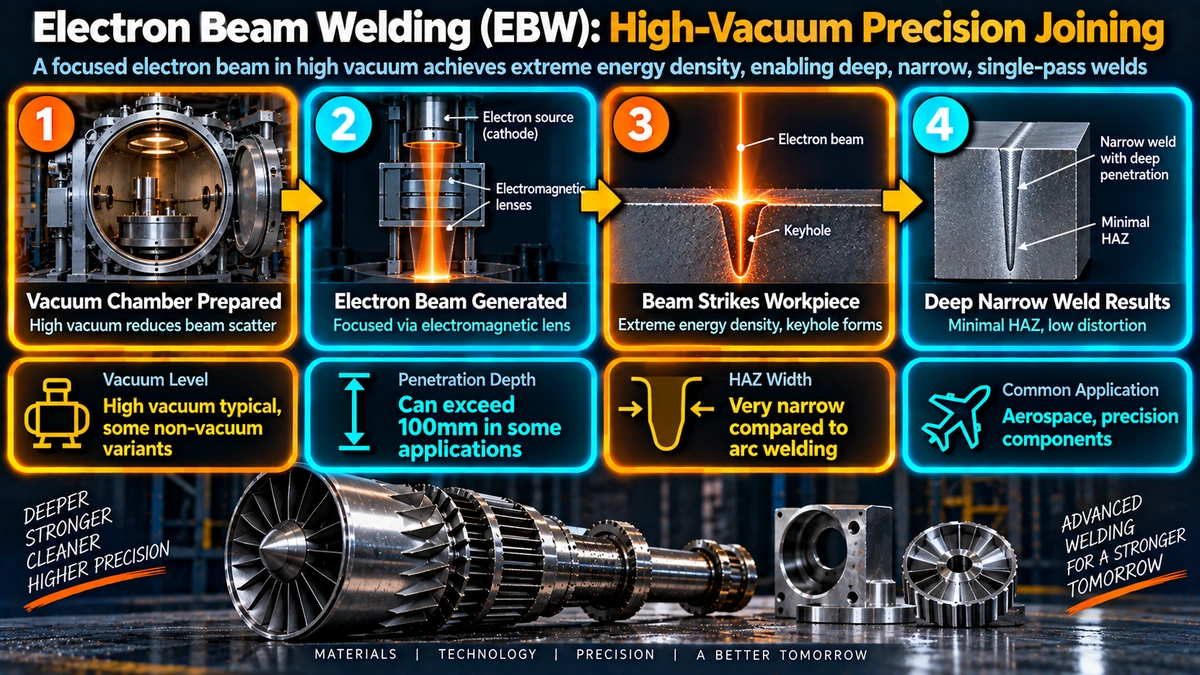
An electron gun assembly generates free electrons from a heated tungsten or lanthanum hexaboride cathode filament. A high-voltage field, typically between 60 kV and 150 kV, accelerates these electrons toward the anode, where they pass through a hole and continue as a beam traveling at a substantial fraction of the speed of light. Electromagnetic focus coils then converge the beam to a spot diameter that can be smaller than half a millimeter, and deflection coils steer the beam precisely across the joint line.
When the beam strikes the workpiece, the electrons decelerate almost instantly, and their kinetic energy converts to heat at the point of impact. Power densities in the beam spot can exceed 107 W/cm2, which is high enough to vaporize metal locally and create a narrow vapor cavity, commonly called a keyhole, that the beam travels through as it moves along the joint. Molten metal flows around and behind the keyhole and resolidifies to form the weld, giving the characteristic deep, parallel-sided, narrow fusion zone that distinguishes EBW and laser welding from arc processes.
Why the vacuum matters
Air molecules scatter free electrons through collisions, which spreads the beam and drains its energy before it reaches the workpiece. Operating inside a vacuum chamber, typically pumped down to 10-4 to 10-6 torr for high vacuum EBW, keeps the mean free path of the electrons long enough that the beam arrives at the work surface still tightly focused. Vacuum also protects the molten weld pool from atmospheric oxidation and nitrogen pickup, which is one reason EBW welds in reactive metals such as titanium and zirconium routinely pass radiographic inspection without any separate shielding gas.
Vacuum Classes of EBW Equipment
Not every EBW installation runs at the same vacuum level, and the choice has a direct effect on weld quality, cycle time, and equipment cost. Three classes are recognized in industrial practice.
High vacuum EBW (HV-EBW)
The entire welding chamber is pumped down to 10-4 torr or better before welding begins. This gives the best beam focus, the deepest penetration-to-width ratio, and the cleanest weld metal, but pump-down time can add several minutes to each cycle, which matters for high-volume production.
Medium vacuum EBW (MV-EBW)
The chamber is only partially evacuated, typically to 10-1 to 10-3 torr, which shortens pump-down time at some cost to beam focus quality and maximum achievable penetration.
Non-vacuum EBW (NV-EBW)
The electron gun column itself is still held under high vacuum, but the beam exits through a series of pressure-differential apertures and travels through a short column of helium or open air to reach the workpiece, which sits at or near atmospheric pressure. This eliminates chamber pump-down entirely, which is why NV-EBW is used for high-volume automotive gear and transmission welding, at the cost of somewhat reduced penetration depth and a larger focused spot size compared with HV-EBW.
| Class | Typical Pressure | Penetration | Cycle Time | Typical Use |
|---|---|---|---|---|
| High vacuum (HV-EBW) | 10-4 to 10-6 torr | Highest | Longer (pump-down) | Aerospace, medical, nuclear |
| Medium vacuum (MV-EBW) | 10-1 to 10-3 torr | Moderate | Reduced | General fabrication, larger chambers |
| Non-vacuum (NV-EBW) | Near atmospheric at workpiece | Lower | Shortest | Automotive gears, high-volume production |
Key EBW Process Parameters
An EBW welding schedule is defined by a small set of interacting parameters, and small changes in any one of them shift both penetration depth and weld profile.
Accelerating voltage
Sets the velocity, and therefore the energy, of the electrons. Industrial machines typically run 60 kV to 150 kV, with specialized high-energy systems reaching up to 200 kV for very thick sections.
Beam current
Controls the number of electrons striking the workpiece per unit time and, together with voltage, sets total beam power. Beam current is usually the primary variable adjusted to control penetration depth for a fixed voltage and travel speed.
Focus current
Determines where along the beam path the spot diameter is smallest. Focusing above the surface (over-focus) or below it (under-focus) is a deliberate technique used to control the depth of maximum energy density and to suppress spiking.
Travel speed
The rate at which the beam or workpiece moves along the joint. Faster travel speed reduces heat input and penetration for a given power level; slower travel speed increases both.
Beam oscillation
Superimposing a small circular, linear, or figure-eight oscillation pattern on the beam path widens the fusion zone slightly and is one of the most effective tools for reducing porosity and spiking in deep welds.
Common EBW Defects and How They Are Controlled
Spiking (root porosity)
Spiking is an intermittent collapse and reopening of the keyhole cavity, which traps gas or leaves narrow voids along the root of the weld. It is the single most process-specific defect in EBW and is controlled through beam oscillation, correct focus position relative to the joint surface, and stable, ripple-free beam current rather than through post-weld repair.
Underfill and root sag
On thicker sections welded near the top of the machine’s power range, gravity can pull the molten column down before it solidifies, leaving a sunken root bead. Slightly defocusing the beam or reducing power while increasing travel speed usually resolves this without sacrificing full penetration.
Cold shuts and lack of fusion at the joint edges
Poor joint fit-up is far less forgiving in EBW than in arc welding because the beam spot is so small; a gap of even a few tenths of a millimeter can leave the beam missing part of the joint face entirely. Square-groove butt joints for EBW are typically specified with a maximum gap of 0.1 mm to 0.15 mm.
EBW Compared with Laser Beam Welding and Arc Processes
Electron beam welding and laser beam welding are often discussed together because both produce a deep, narrow, keyhole-mode weld with low overall heat input, but the two processes differ in some important practical respects.
| Characteristic | EBW | Laser Beam Welding | GTAW (TIG) |
|---|---|---|---|
| Environment | Vacuum (or near-vacuum for NV-EBW) | Open air, with or without shielding gas | Open air with shielding gas |
| Depth-to-width ratio | Very high | High | Low |
| Typical heat input | Lowest | Low | Moderate to high |
| Reflective metals (Cu, Al) | Handles well | Can be challenging | Handles well |
| Cycle time overhead | Pump-down time (HV/MV) | Minimal | Minimal |
| Capital equipment cost | High | High | Low |
| Filler metal typical use | Usually autogenous | Often autogenous | Common |
Applications of Electron Beam Welding
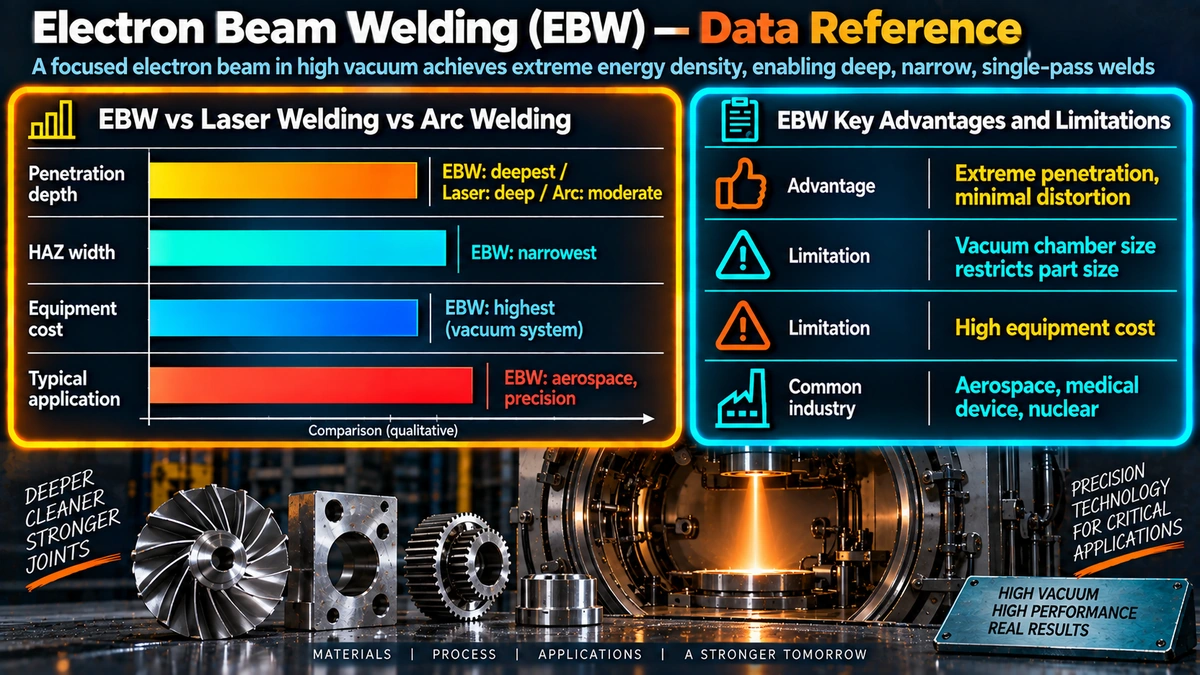
EBW earns its equipment cost premium in applications where weld quality, distortion control, or metallurgical precision outweigh cycle time.
Aerospace
Turbine disks, shafts, and rotating assemblies are welded by EBW because the narrow HAZ preserves the mechanical properties of surrounding forged material, and the low distortion means finish machining tolerances can be held without extensive post-weld straightening.
Automotive
Transmission gear clusters and differential assemblies are high-volume EBW applications, typically run on non-vacuum or medium vacuum equipment to keep cycle times compatible with production line takt times.
Medical devices
Implantable devices and surgical instruments made from titanium and cobalt-chrome alloys use EBW for its clean, oxide-free welds and minimal thermal distortion of precision-machined components.
Nuclear and electronics
Fuel rod end caps and hermetically sealed electronic or sensor housings rely on EBW’s ability to produce a fully fused, leak-tight joint without introducing filler metal or shielding gas residue into a sealed enclosure.
Joint Design and Fit-Up for EBW
Because the beam spot is so small, EBW joints are almost always square-groove butt joints machined to a tight, self-supporting fit rather than the beveled grooves used in SMAW or GMAW. Root gaps beyond roughly 0.15 mm risk the beam passing through the gap without fully fusing both joint faces. Fixturing must hold this tolerance through the full length of the weld, and beam-to-joint tracking systems, using either mechanical seam followers or electron beam seam probing, are standard on production EBW machines welding long or curved joints.
Frequently Asked Questions
What is Electron Beam Welding used for?
Why does EBW need a vacuum?
What is the difference between EBW and laser beam welding?
Does Electron Beam Welding need filler metal?
What is beam spiking in electron beam welding?
What accelerating voltage is typical for EBW?
Can Electron Beam Welding join dissimilar metals?
What is non-vacuum electron beam welding?
Recommended Reading
Electron Beam Welding Handbook
Reference text covering EBW equipment, process physics, and production practice for engineers specifying or qualifying the process.
View on AmazonWelding Metallurgy (Kou)
Covers the metallurgical fundamentals behind fusion zone formation, heat input, and dissimilar metal welding relevant to EBW.
View on AmazonLaser and Electron Beam Welding Processes
Side-by-side treatment of high-energy density beam welding processes, useful for process selection decisions.
View on AmazonASM Handbook: Welding, Brazing, and Soldering
Reference volume with a dedicated section on electron beam welding equipment, parameters, and defects.
View on AmazonDisclosure: WeldFabWorld participates in the Amazon Associates programme (StoreID: neha0fe8-21). If you purchase through these links, we may earn a small commission at no extra cost to you. This helps support free technical content on this site.