Welding Engineer vs QA/QC Engineer vs Welding Inspector: Roles Explained
If you have spent any time around a fabrication shop, an EPC project office, or a job board, you have almost certainly seen these three titles used loosely, sometimes even interchangeably, in the same job posting. A Welding Engineer, a QA/QC Engineer, and a Welding Inspector are three distinct roles with different qualifications, different day-to-day responsibilities, and different points of authority within a project’s quality system, yet the overlap between them is real enough that confusion is common even among experienced hiring managers.
This matters more than it might first appear. Getting the role definitions wrong leads to mis-written job descriptions, unclear reporting lines on site, and — in the worst cases — quality failures because nobody was actually accountable for a specific decision, whether that is qualifying a WPS, approving an ITP, or physically walking down a joint before it gets covered with insulation. Understanding where each role starts and stops is essential whether you are a student mapping out a career path, a hiring manager writing a job spec, or a working professional trying to figure out which certification path to pursue next.
In this guide we break down the Welding Engineer, QA/QC Engineer, and Welding Inspector roles individually, then compare them side by side across qualifications, deliverables, and authority, before looking at where the overlaps genuinely occur and how the three roles work together on a real project.
Why These Three Roles Get Confused
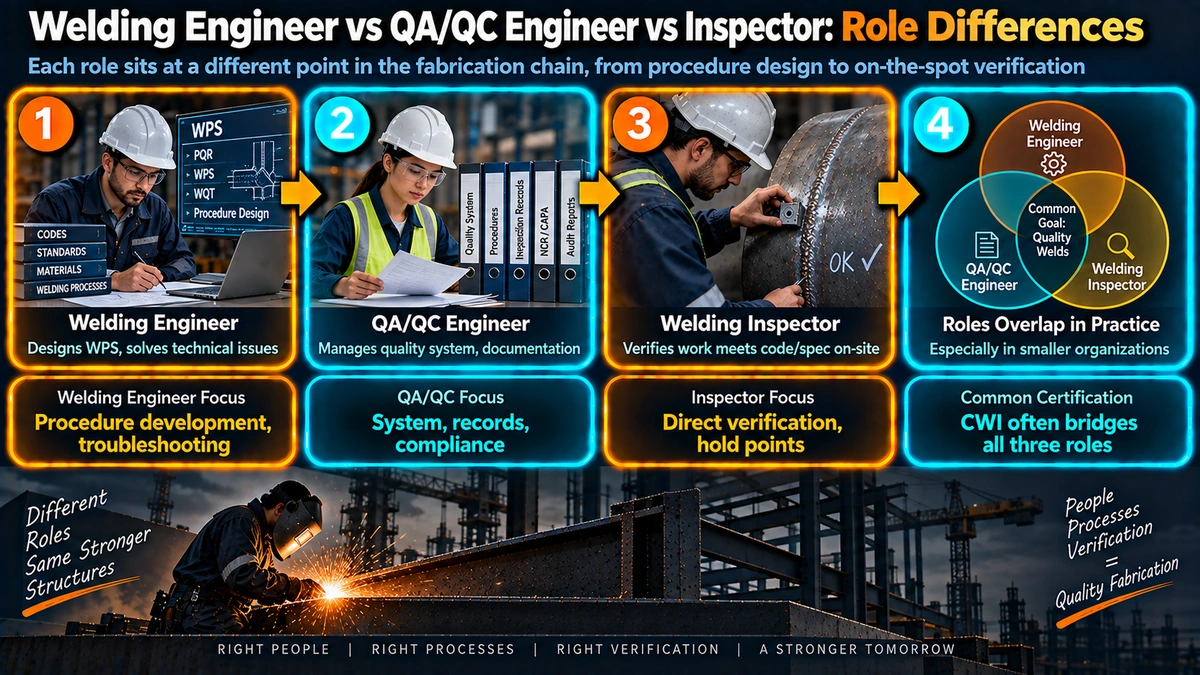
The confusion is not accidental. In smaller fabrication shops, one person frequently wears all three hats: writing the welding consumable specifications, approving the quality documentation, and physically inspecting the joints. On large EPC and offshore projects, however, these functions split into separate, often unionised or contractually distinct, positions with their own reporting lines to the client and third-party inspection agencies.
Job postings compound the problem. It is common to see a listing titled “QA/QC Engineer” that actually describes inspector-level duties, or a “Welding Inspector” posting that expects WPS development work that properly belongs to a Welding Engineer. Understanding the underlying responsibilities — not just the title — is the only reliable way to evaluate a role correctly.
The Welding Engineer Role
The Welding Engineer is the technical authority behind how a weld is designed, qualified, and controlled. This role sits closest to the design and metallurgy side of fabrication and typically reports into engineering rather than the quality department.
Core Responsibilities
A Welding Engineer develops and qualifies Welding Procedure Specifications (WPS) supported by Procedure Qualification Records (PQR), selects filler metals and joint designs appropriate to the base material and service condition, and resolves metallurgical issues such as delta ferrite control in stainless steels or preheat and interpass temperature requirements for hardenable alloys. When a defect is found that goes beyond a simple repair, it is usually the Welding Engineer who provides the engineering disposition — deciding whether to repair, accept as-is with justification, or reject the component entirely.
Qualifications and Career Path
Most Welding Engineers hold a formal degree in mechanical, metallurgical, or welding engineering, often supplemented by an International Welding Engineer (IWE) diploma or equivalent. Deep familiarity with P-Number, F-Number, and A-Number classification systems under ASME Section IX, along with practical exposure to codes like ASME B31.3 and AWS D1.1, is standard.
Typical Deliverables
Expect a Welding Engineer’s output to include WPS/PQR packages, welding engineering specifications for a project, technical justifications submitted to third-party inspection agencies, and root cause investigations for weld failures involving mechanisms such as stainless steel weld decay or reheat cracking.
The QA/QC Engineer Role
The QA/QC Engineer role blends two functions that are conceptually different but commonly combined in practice: Quality Assurance, which is about the systems and processes that prevent defects, and Quality Control, which is about the checks and tests that catch defects. On a fabrication project, this person owns the project’s quality management system as it applies to welding and fabrication activities.
Core Responsibilities
A QA/QC Engineer prepares and maintains Inspection and Test Plans (ITPs), manages document control for WPS/PQR packages and welder qualification records, conducts internal and vendor audits, raises and tracks Non-Conformance Reports (NCRs), and coordinates third-party inspection agency involvement at hold and witness points. This role interfaces heavily with procurement and vendor quality as well as with site inspection teams.
Qualifications
QA/QC Engineers typically come from an engineering or technical background with training in quality management systems (ISO 9001 auditing is common), and many hold or work toward CSWIP or AWS CWI certification even though inspection is not their primary daily task, because it strengthens their credibility when reviewing inspection records and disputing NCR classifications.
Typical Deliverables
Expect ITPs mapped against project specifications, audit reports and corrective action trackers, NCR logs, and consolidated quality dossiers submitted at project handover, often referencing mechanical testing results and material certificates.
The Welding Inspector Role
The Welding Inspector is the hands-on, code-referencing eyes and hands on the shop floor or site. This role executes the checks defined in the ITP that the QA/QC Engineer built, working against acceptance criteria established through the WPS the Welding Engineer qualified.
Core Responsibilities
A Welding Inspector performs visual inspection before, during, and after welding, verifies welder qualification and WPS compliance at the point of production, checks joint fit-up and dimensional tolerances, coordinates and reviews NDT results such as PREN-relevant corrosion-resistant alloy welds or radiographic film review, and makes the immediate accept or reject call against the applicable code, typically ASME Section IX, AWS D1.1, or a client specification.
Certification
The two dominant global certifications are CSWIP (Certification Scheme for Welding and Inspection Personnel), administered by TWI in the UK and widely used across Europe, the Middle East, and offshore projects, and AWS CWI (Certified Welding Inspector), the standard in North America and on ASME/AWS-code projects. Both require a combination of experience, an eye examination, and a written and practical examination.
Typical Deliverables
Expect daily inspection reports, weld traceability logs mapped to welding symbols and joint drawings, punch lists, and sign-off records for hold points witnessed by the client or third-party inspection agency.
Side-by-Side Comparison
| Aspect | Welding Engineer | QA/QC Engineer | Welding Inspector |
|---|---|---|---|
| Primary focus | Weld design & metallurgy | Quality system & documentation | Hands-on inspection |
| Typical reporting line | Engineering department | Quality department | QA/QC or third-party agency |
| Core deliverable | WPS / PQR package | ITP, NCR, audit reports | Inspection reports, sign-offs |
| Typical qualification | Engineering degree | QMS / ISO 9001 training | CSWIP / AWS CWI |
| Accept/reject authority | Engineering disposition | Quality system decisions | Direct field accept/reject |
| Involvement stage | Design & procedure qualification | Planning & documentation lifecycle | Production & execution |
| Common overlap role | Metallurgist | Document controller | NDT technician |
How the Three Roles Interact on a Project
On a well-run fabrication or construction project, these roles form a sequence rather than a hierarchy: engineering authority flows from the Welding Engineer, system control flows from the QA/QC Engineer, and field verification flows from the Welding Inspector.
Where the Overlaps Genuinely Occur
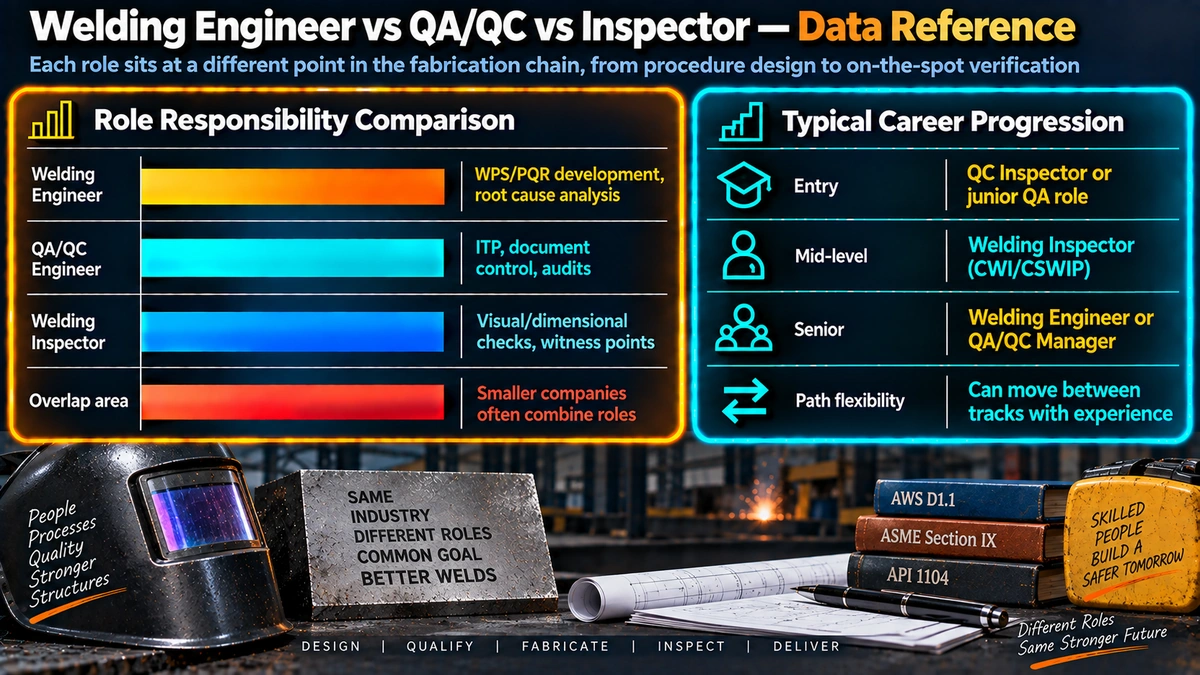
Despite the clean sequence above, real overlap exists. Many Welding Engineers pursue CSWIP or AWS CWI certification to strengthen their standing with client inspection teams. Many QA/QC Engineers, especially in smaller organisations, personally perform inspector-level duties when a dedicated inspector is not on the payroll. And experienced Welding Inspectors, after years in the field, frequently move into QA/QC or even welding engineering roles once they accumulate enough code and metallurgy depth, sometimes supported by further study into topics like duplex stainless steel behaviour or sour service requirements.
Career Path: Which Role Should You Pursue
If you enjoy metallurgy, code interpretation, and solving why a weld failed, the Welding Engineer path offers the deepest technical ceiling but requires a formal engineering education. If you are drawn to systems, documentation, audits, and coordinating across vendors and third parties, QA/QC Engineering offers strong career stability and a natural bridge into project management. If you want to start hands-on and build credibility through certification and field time, the Welding Inspector path via CSWIP or AWS CWI offers the fastest entry point, with a realistic progression into QA/QC or engineering roles later.
Common Mistakes in Job Descriptions
Hiring managers frequently list “welding engineer” experience requirements against what is functionally an inspector role, discouraging qualified inspector candidates who lack an engineering degree from applying to a job they could actually perform well. Equally common is listing CSWIP or CWI certification as mandatory for a QA/QC Engineer role that is genuinely document- and audit-focused, when ISO 9001 auditor training would be far more relevant. Getting these distinctions right in a job posting improves both the quality and the speed of hiring.
Recommended Reference Books
ASME Section IX Handbook
A practical reference for welding procedure and welder qualification under ASME Section IX, useful for both Welding Engineers and Inspectors.
View on AmazonCSWIP 3.1 Exam Preparation Guide
Structured preparation material covering visual inspection, code interpretation, and practical exam technique for aspiring Welding Inspectors.
View on AmazonQuality Management Systems for Fabrication
A grounding in ISO 9001-based quality systems, audit techniques, and documentation control relevant to QA/QC Engineers in fabrication industries.
View on AmazonWelding Metallurgy Reference
Covers the metallurgical fundamentals behind procedure qualification and defect analysis, essential reading for Welding Engineers.
View on AmazonDisclosure: WeldFabWorld participates in the Amazon Associates programme (StoreID: neha0fe8-21). If you purchase through these links, we may earn a small commission at no extra cost to you. This helps support free technical content on this site.
Frequently Asked Questions
Can one person be both a Welding Engineer and a Welding Inspector?
Yes. Many professionals hold both a welding engineering background and a CSWIP or AWS CWI inspector certification, especially in mid-sized fabrication shops where roles combine. However, on large EPC projects the roles are usually split for independence of inspection and to avoid conflict of interest between the person who designs the weld procedure and the person who accepts or rejects the weld.
Which role pays more: Welding Engineer, QA/QC Engineer, or Welding Inspector?
Compensation varies heavily by industry, region, and certification level. In general, Welding Engineers with strong metallurgy and code knowledge command the highest salaries because the role sits closest to design authority. Senior QA/QC Engineers with multi-code auditing experience and CSWIP 3.1 or higher Inspectors on offshore or nuclear projects can match or exceed typical welding engineer pay due to demand and travel premiums.
Do I need a degree to become a Welding Inspector?
Not necessarily. Most welding inspector certifications such as AWS CWI and CSWIP 3.1 accept candidates based on a combination of education and verified welding-related work experience, so a diploma or trade certificate plus several years in fabrication or NDT can qualify you. A Welding Engineer role, by contrast, typically requires a formal engineering degree in metallurgy, mechanical, or welding engineering.
What is the main difference between QA and QC in a welding shop?
QA (Quality Assurance) is process-focused: it covers the systems, procedures, and audits that prevent defects before they happen, such as approving WPS documents and maintaining ITPs. QC (Quality Control) is product-focused: it covers the actual inspection and testing activities that catch defects after welding, such as visual inspection, dimensional checks, and coordinating NDT. In practice most fabrication shops merge these into a single QA/QC Engineer role.
Who has the authority to reject a weld: the Inspector or the QA/QC Engineer?
In most quality systems the Welding Inspector performs the hands-on accept or reject call against the applicable acceptance criteria, referencing codes such as ASME Section IX or AWS D1.1. The QA/QC Engineer holds broader authority over the quality system itself, including raising a nonconformance report and deciding whether repair, rework, or engineering disposition is required, often in consultation with the Welding Engineer.
Does a Welding Engineer need CSWIP or CWI certification?
It is not mandatory, since the welding engineer role is defined by code and metallurgical knowledge rather than inspection certification. That said, many welding engineers pursue CSWIP or AWS CWI credentials to strengthen their credibility with clients and third-party inspection agencies, and it often improves job mobility between engineering and inspection functions.
Which certification is better for a welding inspection career: CSWIP or AWS CWI?
Neither is universally better; the right choice depends on your target market. CSWIP, administered by TWI in the UK, is widely recognised across Europe, the Middle East, and offshore oil and gas projects. AWS CWI is the standard reference in North America and on projects following ASME and AWS codes. Many senior inspectors eventually hold both to work across regions.
How do these three roles interact on a typical fabrication project?
The Welding Engineer develops and qualifies the WPS and PQR package based on code and design requirements. The QA/QC Engineer builds the inspection and test plan around those procedures and manages documentation, audits, and nonconformance handling. The Welding Inspector then executes the hands-on visual and dimensional checks during production, verifying that welders and procedures are followed and coordinating any NDT called for in the plan.