Monel Welding Procedure and Precautions
A sound Monel welding procedure comes down to controlling two things most welders never think about on carbon steel: crater solidification cracking and moisture-driven porosity. Monel 400 – the nickel-copper alloy prized for its resistance to seawater, hydrofluoric acid, and reducing acids – welds without the hardenability problems of a low-alloy steel, but it is far less forgiving of contamination and sloppy technique than most engineers expect walking in.
This guide covers the complete Monel welding procedure: filler metal selection for similar and dissimilar joints, why arc pit cracking happens and how to prevent it, interpass and cleaning practice, and the process parameters that keep a Monel weld sound and corrosion-resistant. We will also cover the special case of welding Monel to carbon steel and stainless steel, which is common in marine and offshore fabrication.
If you have worked with Inconel welding procedures before, some of this will feel familiar – both are nickel-based alloys demanding careful cleanliness and heat input control – but Monel’s cracking mechanism and filler logic are distinctly its own.
Scope note: This guide focuses on Monel 400 (UNS N04400), the most widely fabricated grade, welded by GTAW, GMAW and SMAW. Monel K-500, an age-hardenable variant, follows different post-weld heat treatment logic and is only referenced briefly for contrast.
Why Monel Welds Differently
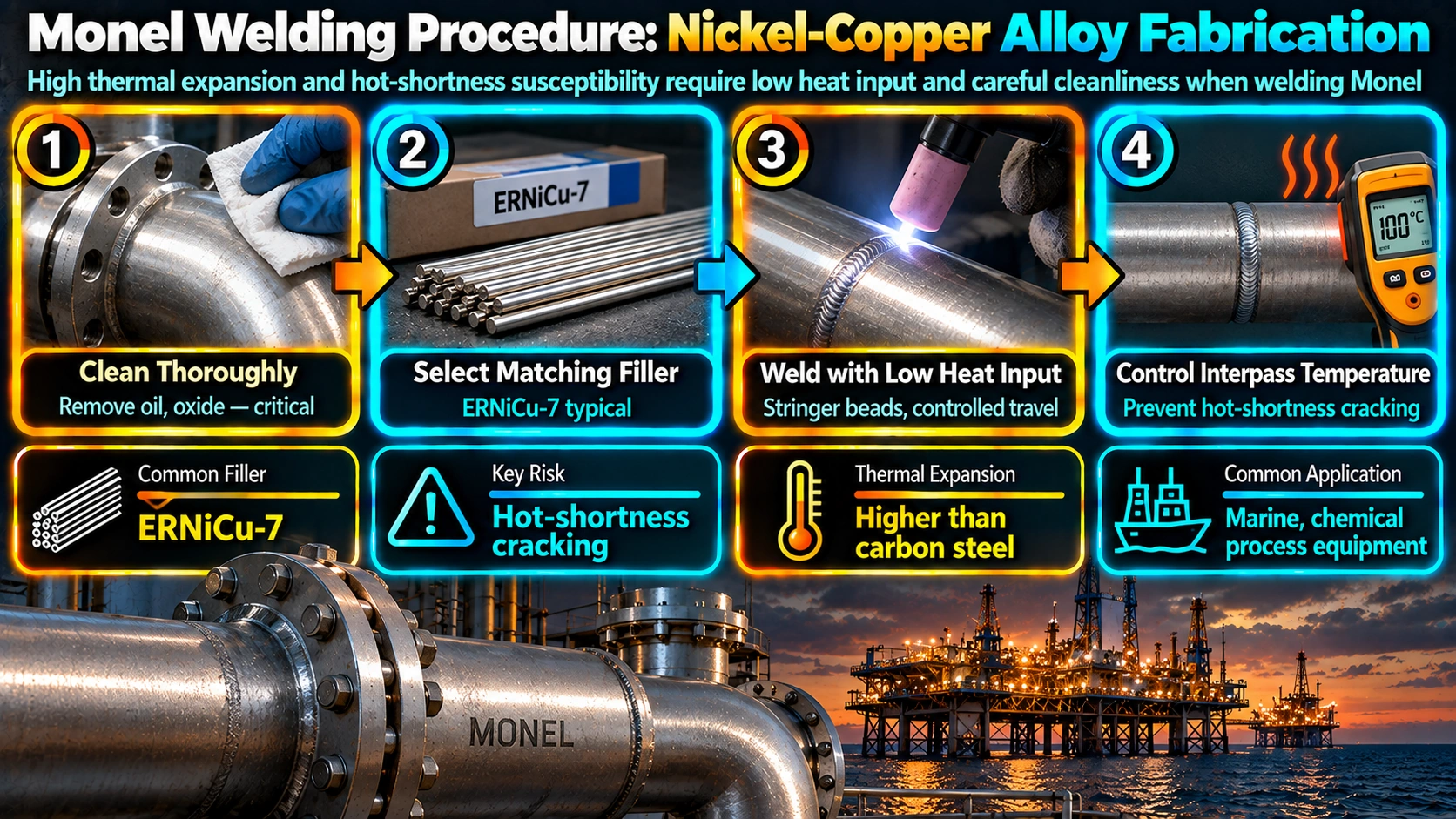
Monel 400 is roughly 63-70 percent nickel and 28-34 percent copper, a single-phase, face-centered-cubic (austenitic) solid solution. Unlike carbon or low-alloy steel, it has no phase transformation to control during cooling, which is exactly why it needs no preheat and no post-weld heat treatment for hardness control. Its problems come from a different direction entirely.
Arc pit (crater) cracking
Monel is easy to produce thermal cracks in, especially crater cracks, mainly because sulfur and phosphorus segregate to the arc pit, where they form low-melting-point co-crystals with nickel; as the weld pool finishes solidifying under tensile stress, cracking occurs along these segregated grain boundaries. This is the single most common defect reported in Monel welding, and it is almost entirely a technique issue rather than a filler chemistry problem.
Low fluidity and fusion control
Monel weld pools are noticeably more sluggish than steel, and the alloy’s low fluidity means poor fit-up or excessive travel speed readily produces lack of fusion rather than a clean, wetted-in bead. Narrow weave or stringer technique, with only slight oscillation, is standard practice to keep the pool moving without losing fusion control.
Porosity from moisture and contamination
Monel weld pools absorb hydrogen and nitrogen readily from atmospheric moisture, oils, and residual cleaning solvents, producing porosity that both weakens the joint and can compromise corrosion resistance at exposed pores. Rod baking, thorough degreasing, and continuous shielding gas coverage are non-negotiable rather than optional good practice.
Filler Metal Selection
| Joint | Filler/Electrode | Process | Notes |
|---|---|---|---|
| Monel 400 to Monel 400 | ERNiCu-7 (Monel 60) / ENiCu-7 (Monel 190) | GTAW/GMAW/SAW / SMAW | Matching filler |
| Monel 400 to carbon steel | ERNiCu-7 or ERNiCr-3 (Inconel 82) | GTAW/GMAW/SMAW | Standard buffer |
| Monel 400 to stainless steel | ERNiCr-3 (Inconel 82) or ERNiCrMo-3 (Inconel 625) | GTAW/GMAW | Preferred for dilution tolerance |
| Monel 400 to Hastelloy C-22/C-276 | ENi-1/ERNi-1 | GTAW/SMAW | Verify with PQR |
ENiCu-7, sold under the name Monel welding electrode 190, has a composition of roughly 66 percent nickel, 30 percent copper, 3 percent manganese and 1 percent iron – close enough to Monel 400 to give a weld deposit of similar metallurgy without difficulty. This is why matching filler is the default choice whenever both sides of the joint are Monel 400.
Why nickel-chromium fillers appear in dissimilar joints
When welding Monel to carbon steel or stainless steel, ERNiCr-3 (Inconel 82) or ERNiCrMo-3 (Inconel 625) are frequently substituted for ERNiCu-7 because they tolerate dilution from the second base metal without forming brittle phases, following the same buffer-layer logic covered in our dissimilar metal welding guide. Either approach can work; the choice usually comes down to what has already been PQR-qualified for the specific combination in your shop.
Preheat and Interpass Temperature
Practical tip: Keep the fusion ratio (dilution) below about 50 percent on the first pass of any Monel weld, and use low current with a short arc length. This limits how much base metal chemistry variation gets mixed into the weld pool and helps avoid both cracking and loss of corrosion resistance.
Cleaning and Joint Preparation
- Degrease thoroughly: Remove all oil, grease and marking crayon with acetone or an equivalent solvent before fit-up – sulfur and phosphorus from contamination feed directly into the arc pit cracking mechanism described above.
- Dedicated tools: Use stainless-wire brushes reserved only for nickel alloy work; carbon steel contamination from shared grinding or brushing tools introduces the same low-melting-element risk.
- Bake covered electrodes: SMAW electrodes should be baked per the manufacturer’s data sheet and kept in a holding oven to control moisture pickup.
- Clean between passes: Remove slag completely between SMAW passes; trapped slag reduces corrosion resistance at the joint even when it does not cause an immediate mechanical defect.
Process Parameters and Technique
| Process | Polarity/Setup | Notes |
|---|---|---|
| GTAW (TIG) | DCEN, pure argon 99.99%+, minimal or no filler oscillation | Preferred for root passes and thin sections |
| GMAW (MIG) | Argon shielding, spray transfer on thicker sections | Good for production fill passes |
| SMAW (Stick) | DCEP, baked ENiCu-7 electrodes | Common for field repair – slag control matters |
Fill the crater: Never break the arc abruptly at the end of a pass or a stop-start point. Back-step or use a crater-fill technique so the last liquid to solidify is not left as an unsupported pocket of segregated, low-melting material – this single habit prevents the majority of reported Monel cracking.
Post-Weld Practice
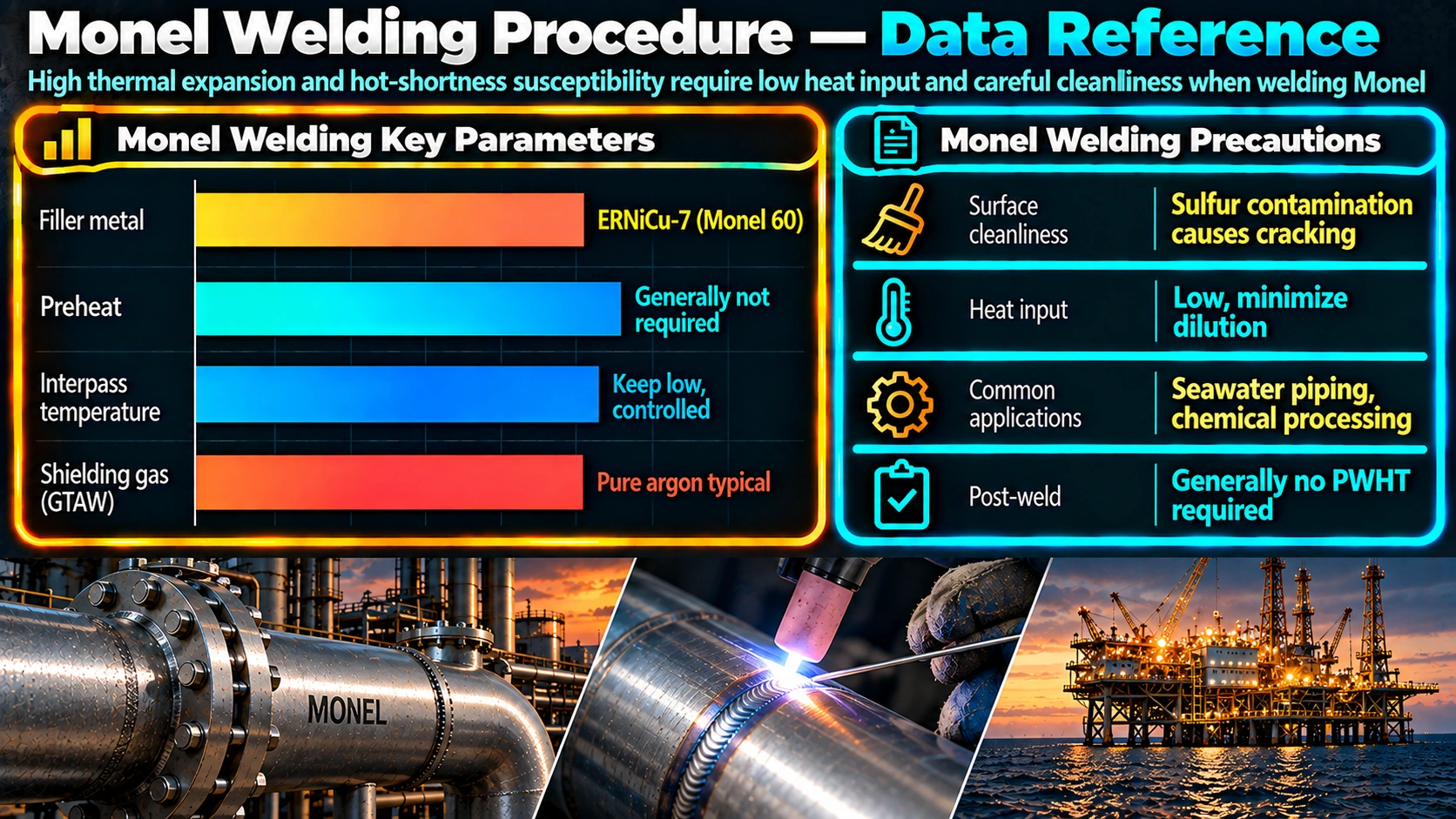
Post-weld heat treatment is not required for Monel 400 welds, since the alloy gains its strength from solid solution and cold work rather than a precipitation or tempering reaction. A stress-relief cycle can still be specified by the governing code or client specification for particular services, but it is not the metallurgical necessity it is on age-hardenable nickel alloys such as Inconel 718 or Monel K-500.
Engineering note: Monel’s P-Number under ASME Section IX is P-42, distinct from both the carbon steel and stainless steel P-Number groups, so procedure and performance qualification must be tracked separately even where a shop already has extensive nickel alloy WPS coverage from Inconel or Hastelloy work.
Inspection Considerations
- Liquid penetrant testing: Given the arc-pit cracking mechanism, PT on every pass surface – not just the cap – catches crater cracks before they are buried under subsequent passes.
- Radiography: Confirms freedom from the porosity that moisture and contamination readily produce in nickel-copper weld metal.
- Dilution verification on dissimilar joints: Where a buffer filler is used against carbon or stainless steel, confirm dilution stayed within the range validated by the PQR.
Amazon Recommended References
Welding Metallurgy
Sindo Kou’s reference covering solidification cracking mechanisms relevant to nickel-copper alloys.
View on AmazonNickel and Its Alloys Handbook
Reference data on Monel, Inconel and Hastelloy grades, corrosion behaviour and fabrication practice.
View on AmazonASME Section IX Handbook
Procedure and performance qualification requirements for P-42 nickel-copper alloy welding.
View on AmazonCorrosion Engineering Handbook
Corrosion resistance data relevant to Monel service in seawater and acidic environments.
View on AmazonDisclosure: WeldFabWorld participates in the Amazon Associates programme (StoreID: neha0fe8-21). If you purchase through these links, we may earn a small commission at no extra cost to you. This helps support free technical content on this site.
Frequently Asked Questions
What filler metal is used to weld Monel 400?
ERNiCu-7 (also sold as Monel filler metal 60) is the standard filler wire for GTAW, GMAW and SAW, and ENiCu-7 (Monel 190) is the equivalent covered electrode for SMAW. Both match Monel 400’s nickel-copper chemistry closely enough to reproduce its strength and corrosion resistance in the weld deposit.
Does Monel 400 need preheating before welding?
No, Monel 400 does not require preheat under normal conditions because it is a single-phase, austenitic (face-centered cubic) alloy with no hardening transformation to control. Some procedures apply mild preheat around 65-150 degrees C purely to dry the joint area and remove moisture, and preheat may be added on the carbon steel side of a dissimilar joint.
Why does Monel weld metal crack in the arc crater?
Sulfur and phosphorus segregate to the last liquid to solidify, typically the arc crater, where they form low-melting-point eutectics with nickel. Under the tensile stress that develops as the weld pool finishes solidifying, these low-melting films at grain boundaries tear apart, producing crater cracks. Filling the crater properly at the end of each weld pass, rather than breaking the arc abruptly, is the primary defence against this.
What filler should be used to weld Monel 400 to carbon steel?
ENiCu-7/ERNiCu-7 can be used directly for many carbon steel to Monel joints, though ERNiCr-3 (Inconel 82) or ERNiCrMo-3 (Inconel 625) is often preferred as a buffer filler because it tolerates dilution from the steel side without forming brittle phases, and it better bridges the difference in thermal expansion between the two base metals. See our dissimilar metal welding guide for the underlying selection logic.
What shielding gas is used for GTAW welding of Monel?
High-purity argon (99.99 percent or better) is standard for both shielding and backing gas. Monel is highly sensitive to porosity from moisture and atmospheric contamination, so continuous, well-purged argon coverage on both sides of the joint is essential, particularly on root passes.
Is post-weld heat treatment required for Monel welds?
No, PWHT is not required for Monel 400 because the alloy is not hardened by heat treatment and gains its mechanical properties from solid solution strengthening and cold work rather than a controlled aging or tempering reaction. A stress relief cycle can still be applied where the design or code specifically calls for it, but it is not a metallurgical necessity the way it is for precipitation-hardened alloys like Inconel 718.
Why is cleanliness so critical when welding Monel?
Any oil, grease, paint, or sulfur-bearing marking material on the joint surface introduces exactly the low-melting contaminants that cause arc crater and HAZ cracking in nickel-copper alloys. Surfaces should be degreased with acetone and cleaned with dedicated stainless-wire brushes reserved only for nickel alloy work, since cross-contamination from carbon steel tools carries the same risk.