4140 / 4340 Alloy Steel Welding Guide
Welding 4140 and 4340 steel successfully comes down to one central problem: both are medium-carbon, chromium-molybdenum-nickel alloys with high hardenability, which means the heat-affected zone will transform into hard, crack-sensitive martensite unless the thermal cycle is deliberately controlled. Get the preheat, filler selection, or interpass temperature wrong on either grade and you are gambling with delayed hydrogen cracking – a failure mode that can show up hours or days after the weld looks perfectly sound.
This guide covers the practical differences between 4140 and 4340, how to select preheat and interpass temperatures using carbon equivalent, which filler metals match strength versus ductility, and when post-weld heat treatment is mandatory rather than optional. We will also cover the special case of welding these alloys to mild steel, and how the pre-weld condition of the material (annealed, normalized, or quenched and tempered) changes your entire approach.
If you already work with creep-strength enhanced ferritic steels like P91, much of the preheat and interpass logic here will feel familiar – 4140 and 4340 sit in a similar hardenability bracket, just without the elevated-temperature creep service that drives P91 requirements.
Scope note: AISI 4140 (chromium-molybdenum) and 4340 (chromium-nickel-molybdenum) are both quenched-and-tempered, medium-carbon low-alloy steels used for shafts, gears, tooling, fasteners and structural components requiring high strength. Their welding behaviour is close enough that this guide treats them together, calling out differences where they matter.
Why These Alloys Are Different From Mild Steel
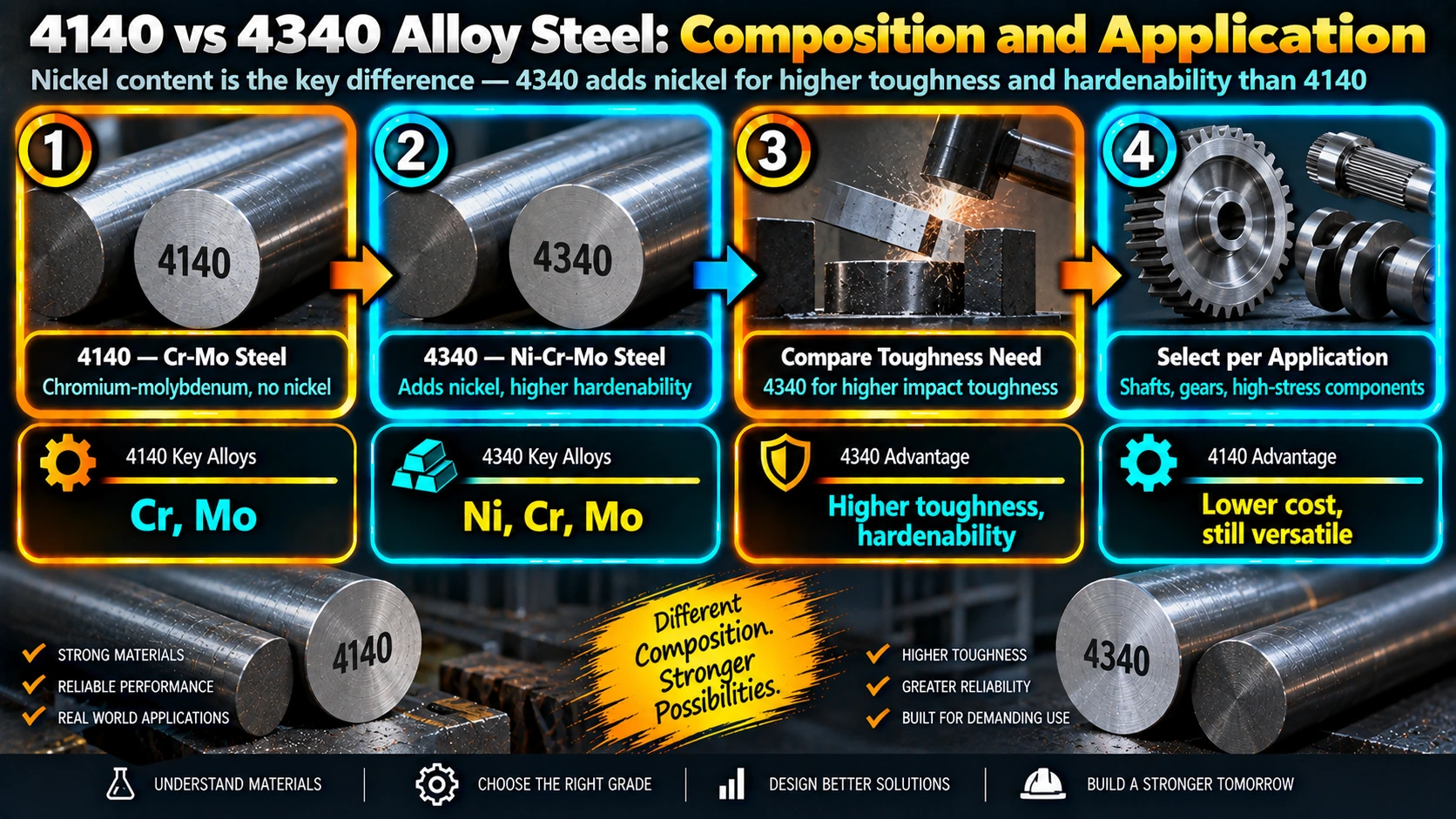
Mild steel (A36, 1018) has low hardenability – it simply does not form much martensite even when cooled quickly, so preheat is rarely a serious concern. 4140 and 4340 are the opposite: their carbon content combined with chromium, molybdenum, and (in the case of 4340) nickel gives them deep hardenability, meaning even moderate cooling rates from a weld arc can produce a hard, brittle HAZ.
Carbon equivalent tells the story
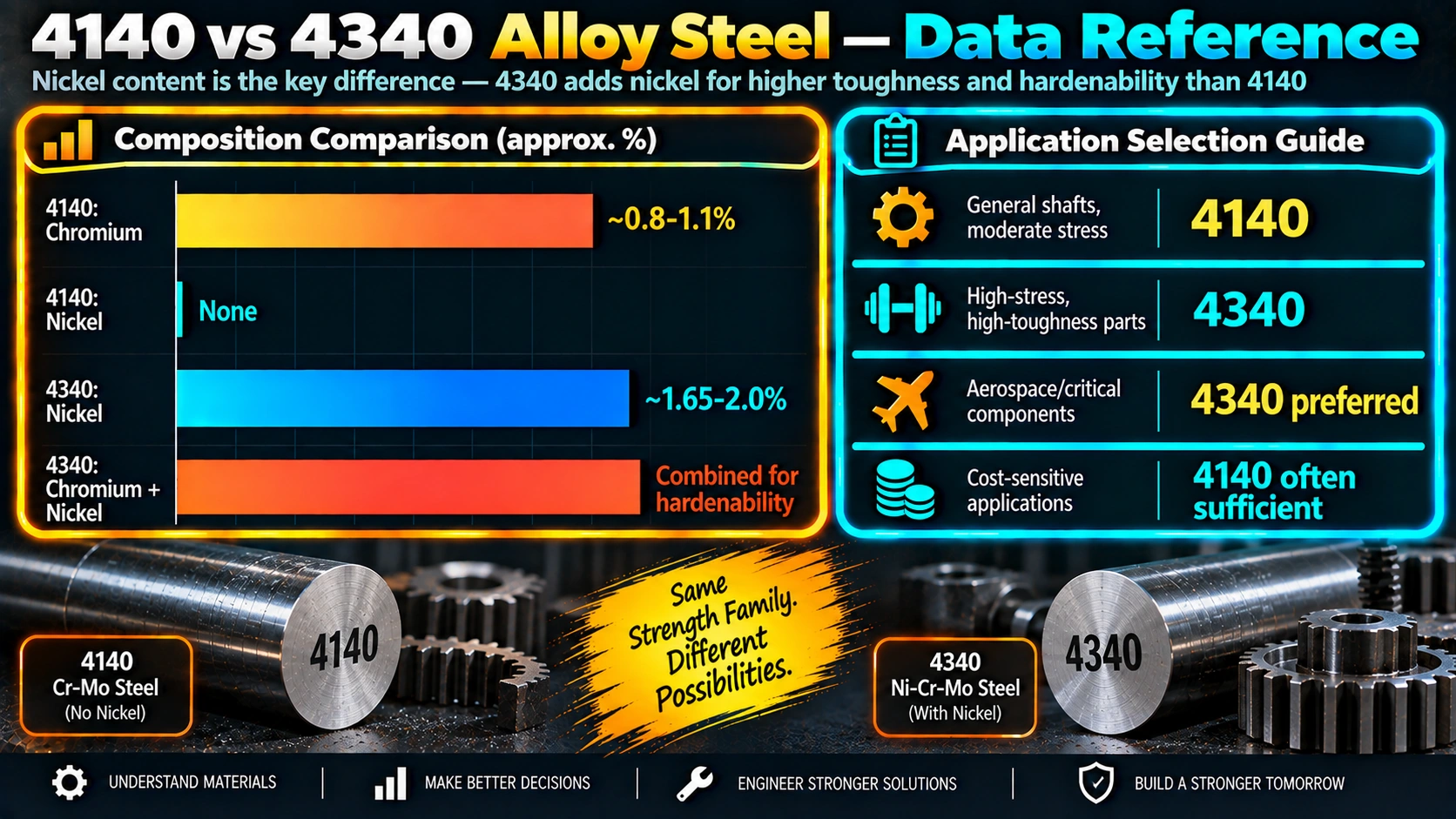
Carbon equivalent (CE) is the standard way to quantify how much preheat and hydrogen control a steel needs. Both 4140 and 4340 sit well above the 0.45 threshold most codes use to flag steels as requiring mandatory preheat and low-hydrogen practice.
You can cross-check this against the Carbon Equivalent calculator for any actual mill certificate composition rather than relying on nominal values, since real heats vary within the specification band.
Preheat and Interpass Temperature
| Parameter | 4140 | 4340 | Notes |
|---|---|---|---|
| Minimum preheat | 150-200 degC (300-400 degF) | 150-230 degC (300-450 degF) | Increase for thicker sections or higher measured CE |
| Interpass temperature | up to ~260-315 degC (500-600 degF) | up to ~260-315 degC (500-600 degF) | Never exceed the original tempering temperature of Q&T material |
| Cooling after welding | slow cool, avoid rapid air cooling | slow cool, avoid rapid air cooling | Insulating blankets are common practice |
| PWHT temper range | 590-675 degC (1100-1250 degF) | 590-675 degC (1100-1250 degF) | Hold time and exact target set by required final hardness/strength |
Do not exceed original tempering temperature: If the component was supplied in the quenched and tempered condition, interpass temperature must stay below the temperature the part was originally tempered at. Going above it will over-temper the base metal locally, softening it below the specified mechanical properties even though the weld itself may look fine.
Base metal condition matters as much as chemistry
Welding is far more predictable when 4140 or 4340 is in the annealed or normalized condition rather than fully quenched and tempered. In the Q&T condition, the base metal already carries a specific hardness and strength from heat treatment, and any welding heat input reopens the risk of locally re-hardening or over-tempering that structure. Where possible, weld before final heat treatment, or plan a full post-weld re-temper cycle when welding on finished Q&T components.
Filler Metal Selection
| AWS Classification | Process | Use Case | Priority |
|---|---|---|---|
| ER80S-D2 / E8018-B2 | GTAW/GMAW / SMAW | Matching strength on 4140 similar joints | Strength match |
| E10018-D2 / ER100S-D2 | SMAW / GTAW/GMAW | Higher-strength 4340 similar joints | Strength match |
| ER70S-2 / E7018 | GTAW/GMAW / SMAW | Dissimilar joints to mild steel; ductility priority | Ductility priority |
| ER80S-B2 / E8018-B2 | GTAW/GMAW / SMAW | General-purpose low-alloy match, moderate strength | Balanced |
Strength match versus ductility priority: Matching filler (ER80S-D2, E10018-D2) reproduces the base metal’s strength in the weld, which is appropriate for highly loaded similar joints. When welding to mild steel, or on non-critical repairs, deliberately choosing an under-matched, more ductile filler such as ER70S-2 or E7018 gives a weld that can absorb strain rather than crack, at the cost of lower joint strength – a trade worth making unless the design specifically requires matching strength.
Practical tip: All low-hydrogen electrodes must be baked and stored in a rod oven per the manufacturer’s data sheet. On a CE this high, moisture pickup in a stick electrode is one of the most common root causes of unexplained hydrogen cracking traced back weeks after the job is finished.
Process Selection
| Process | Typical Role | Notes |
|---|---|---|
| GTAW (TIG) | Root passes, precision repair, thin sections | Preferred for heat input control and cleanliness |
| GMAW (MIG) | Fill passes on production work | Good with spray or pulsed transfer to limit heat input |
| SMAW (Stick) | Field repair, positional welding | Requires baked low-hydrogen electrodes |
Regardless of process, use stringer beads rather than wide weaving. A narrower bead reduces total heat input per pass and gives more control over the resulting HAZ width and cooling rate, both of which directly affect the risk of martensite formation described above.
Welding 4140 or 4340 to Mild Steel
Dissimilar joints between 4140/4340 and mild steel (A36, 1018, 1045) are common in shaft and fabrication repair work. The general rule mirrors the logic used across dissimilar metal welding: pick the filler that gives the joint the best chance of surviving the strain mismatch, not necessarily the filler that matches either base metal exactly.
- Filler choice: Use a lower-strength, higher-ductility filler such as ER70S-2 or E7018 rather than one matched to the 4140/4340 side. The ductile weld metal absorbs strain concentration at the joint rather than cracking.
- Preheat: Preheat is driven by the higher-hardenability side of the joint – apply it to the 4140/4340 member even if the mild steel side alone would not need it.
- Hydrogen control: Low-hydrogen practice still applies to the whole joint, since diffusible hydrogen migrates freely between the two base metals during cooling.
Post-Weld Heat Treatment
PWHT on 4140 and 4340 is functionally a temper: heating the completed weldment to 590-675 degC (1100-1250 degF) and holding long enough to relieve residual stress and temper any untempered martensite that formed in the HAZ despite preheat and interpass control. This is not optional for critical, high-strength, or fatigue-loaded components.
Engineering note: The exact PWHT temperature and hold time should target the same tempering curve used for the original heat treatment of the base metal, so the HAZ ends up with mechanical properties consistent with the rest of the part. Confirm requirements against the governing code and the material’s heat treatment specification sheet – ASME Section IX qualification testing is the way to validate the combination of preheat, interpass, filler and PWHT actually delivers the required properties.
4140 vs 4340 at a Glance
| Property | 4140 | 4340 |
|---|---|---|
| Key alloying elements | Chromium, molybdenum | Chromium, molybdenum, nickel |
| Hardenability | High | Very high (deepest hardening of the two) |
| Typical carbon equivalent | ~0.70-0.80 | ~0.80-0.90 |
| Typical service | Shafts, gears, tooling, fasteners | Aircraft landing gear, high-strength structural components, heavy-duty shafts |
| Weldability | Requires control | Requires tighter control |
Amazon Recommended References
Welding Metallurgy
Sindo Kou’s reference covering hardenability, HAZ transformation and hydrogen cracking mechanisms in low-alloy steels.
View on AmazonASM Handbook: Welding, Brazing and Soldering
Covers preheat, interpass and PWHT practice across low-alloy and tool steel grades.
View on AmazonASME Section IX Handbook
Procedure and performance qualification requirements for WPS/PQR development on alloy steels.
View on AmazonSteel Metallurgy for the Non-Metallurgist
Accessible reference on hardenability, CCT diagrams and heat treatment fundamentals for engineers.
View on AmazonDisclosure: WeldFabWorld participates in the Amazon Associates programme (StoreID: neha0fe8-21). If you purchase through these links, we may earn a small commission at no extra cost to you. This helps support free technical content on this site.
Frequently Asked Questions
What is the minimum preheat temperature for welding 4140 steel?
A minimum preheat of 150-200 degrees C (300-400 degrees F) is typically applied to 4140 steel, and the exact value should be confirmed against the carbon equivalent, section thickness and diffusible hydrogen level of the chosen consumable per the qualified WPS. Thicker sections and higher-hardenability heats need the upper end of this range.
What filler metal should I use to weld 4140 to itself?
ER80S-D2 (GTAW/GMAW) or E8018-B2/E10018-D2 (SMAW) are the standard choices when matching the strength of 4140 base metal. ER70S-2 can be substituted when ductility matters more than strength matching, such as in dissimilar joints to mild steel.
Why is 4140 steel prone to hydrogen cracking during welding?
4140 has a relatively high carbon content combined with chromium and molybdenum, giving it high hardenability. A fast-cooling weld thermal cycle transforms the heat-affected zone into hard, brittle martensite, and any diffusible hydrogen trapped in that martensite is enough to initiate delayed cracking, sometimes hours after welding is complete.
Do I need to weld 4140 in the annealed condition, or can it be welded quenched and tempered?
Welding in the annealed or normalized condition is strongly preferred because the base metal hardness is lower and more predictable going into the weld. Welding a fully quenched and tempered part risks softening the HAZ below the original tempering temperature and can leave a hardness gradient that behaves unpredictably in service.
What interpass temperature should be maintained when welding 4340 steel?
Interpass temperature is typically held between the minimum preheat value and about 260-315 degrees C (500-600 degrees F), and should never be allowed to exceed the original tempering temperature of the supplied material, since doing so will over-temper the base metal and reduce its mechanical properties.
Is post-weld heat treatment always required after welding 4140 or 4340?
For any critical, high-strength, or fatigue-loaded component, yes. A post-weld temper in the 590-675 degree C (1100-1250 degree F) range relieves residual stress, softens untempered martensite in the HAZ, and restores toughness. Non-critical, low-stress fabrications may sometimes skip PWHT if the WPS and engineering review support it.
Can 4140 steel be welded to mild steel or A36 plate?
Yes. The joint is normally made with a lower-strength, more ductile filler such as ER70S-2 or an E7018 electrode rather than a filler matched to the 4140 side, because the ductile filler better absorbs the stress mismatch between the two materials. Preheat is still applied, focused on the 4140 side of the joint.
How does carbon equivalent relate to preheat requirements for 4140 and 4340?
Carbon equivalent (CE) combines carbon, manganese, chromium, molybdenum, nickel and other elements into a single number that predicts hardenability and cracking risk. Both 4140 and 4340 have CE values well above 0.45, placing them firmly in the range where preheat, low-hydrogen practice and controlled cooling are considered mandatory rather than optional.