Strain Hardening and Its Effect on Weld Properties
Strain hardening and its effect on weld properties goes well beyond the familiar statement that cold work increases strength. Quantified through the strain hardening exponent, strain hardening behavior actually governs where plastic strain concentrates across a welded joint under load, why tensile test specimens sometimes neck and fail in the HAZ rather than the weld metal, and why a cold-formed pressure vessel head can lose notch toughness near a weld even when the weld itself was executed perfectly. These are distinct, practical consequences that go beyond the general “cold work raises strength, lowers ductility” summary covered elsewhere on this site.
This guide covers three specific mechanisms: the strain hardening exponent (n-value) and how it governs strain distribution across weld metal, HAZ, and base metal; strain-age embrittlement in cold-formed components that are subsequently welded; and the ASME Section VIII UCS-79 forming strain calculation that determines when cold-formed pressure parts require mandatory heat treatment.
The Strain Hardening Exponent (n-value)
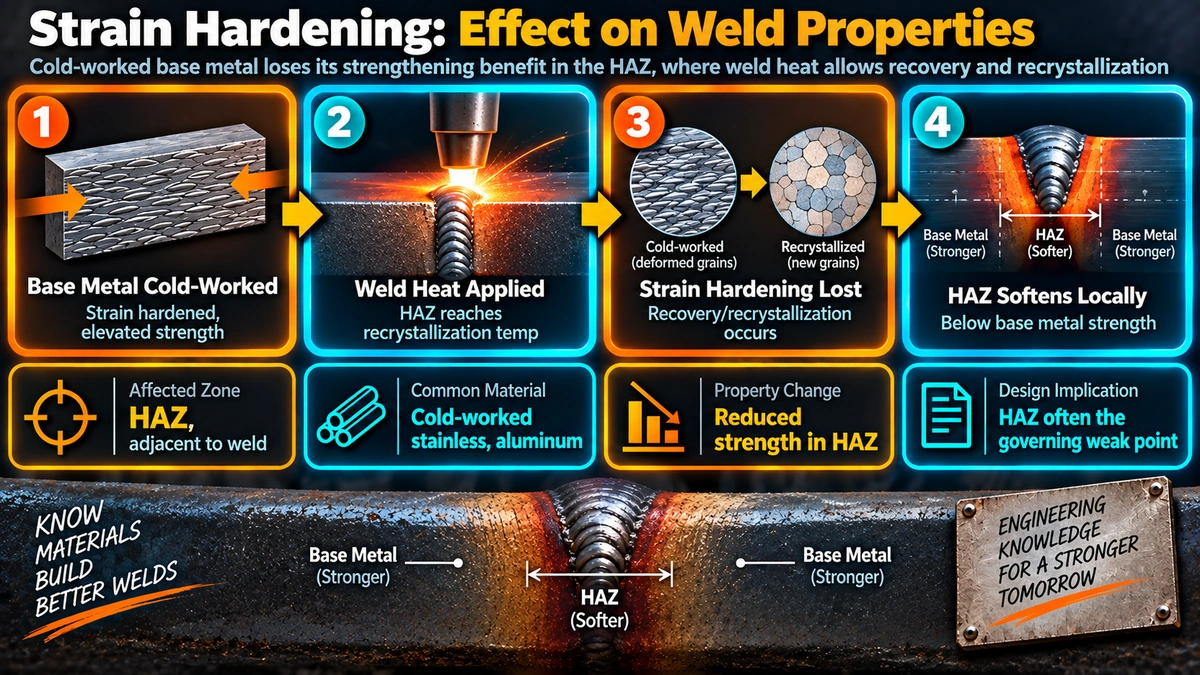
Strain hardening behavior during plastic deformation is commonly described by the Hollomon relationship, which relates true stress to true strain through a power law. The exponent n in this relationship, called the strain hardening exponent, quantifies how strongly a material continues to gain strength as plastic deformation proceeds — a higher n means the material keeps hardening significantly as it strains further, while a lower n means it reaches something closer to a constant flow stress relatively quickly.
σ = K · εn
σ = true stress, ε = true plastic strain, K = strength coefficient, n = strain hardening exponent
Considere criterion (onset of necking)
Necking begins when true strain ε = n
A material with n = 0.20 can sustain roughly 20% uniform true strain before localized necking begins; one with n = 0.10 begins necking at roughly half that strain
| Material | Typical n-value | Relative Strain-Distribution Behaviour |
|---|---|---|
| Austenitic stainless steel (e.g., 304/316) | 0.30-0.50 | High capacity to redistribute strain before necking |
| Mild / low-carbon steel | 0.15-0.25 | Moderate strain redistribution capacity |
| HSLA / microalloyed steel | 0.08-0.15 | Lower capacity — necking initiates earlier |
| Cold-worked / strain-hardened steel | 0.02-0.10 | Little remaining hardening capacity — necks early |
| Aluminum alloys (varies by temper) | 0.05-0.20 | Wide range; heavily temper-dependent |
Why n-value Matters Specifically at a Weld Joint
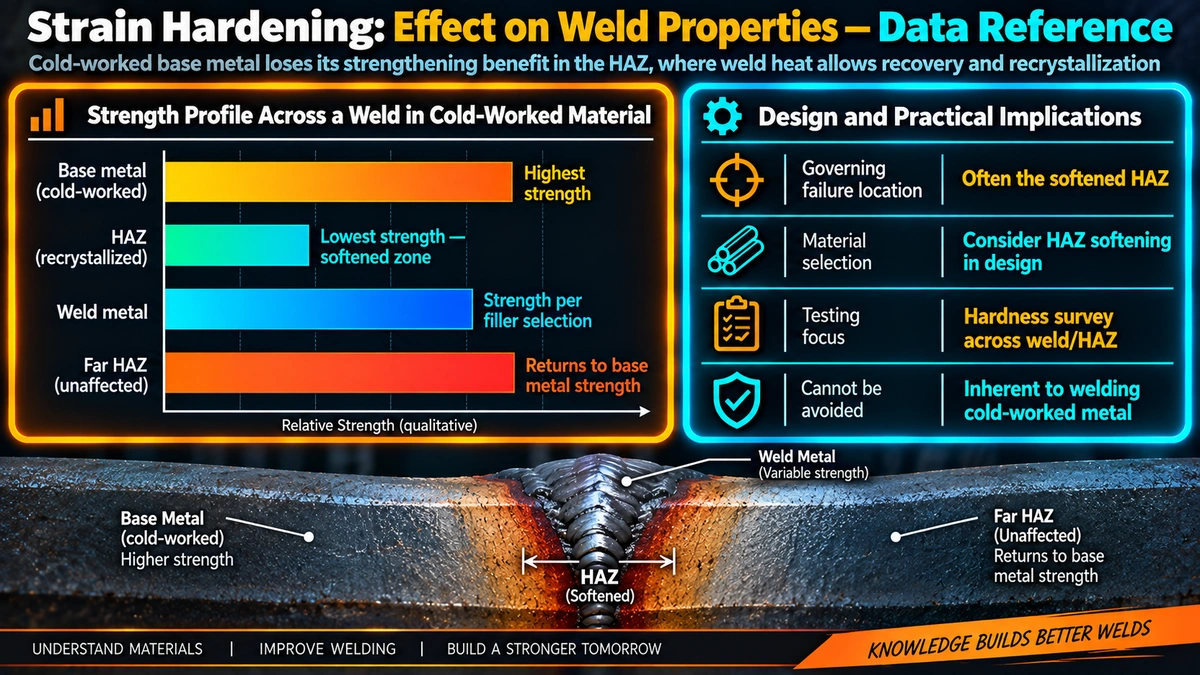
A welded joint is not mechanically homogeneous: the weld metal, the HAZ, and the unaffected base metal each have their own yield strength and their own n-value, shaped by composition, thermal history, and prior cold work. Under tensile loading, plastic strain does not distribute evenly across these three zones — it concentrates first wherever local flow stress is lowest, and how far that concentration goes before the material starts to redistribute strain into adjacent, stronger zones depends directly on the n-value of the zone carrying the strain.
Undermatched vs. Overmatched Weld Metal
This is the practical basis for weld metal matching strategy. Overmatched weld metal (deposited weld metal yield strength above the base metal) keeps subsequent plastic strain concentrated in the base metal or HAZ rather than in the weld deposit, which is generally the preferred outcome — the joint’s ductility reserve is exercised in the parent material, and the weld itself is protected from carrying the bulk of any plastic overload. Undermatched weld metal reverses this, and while sometimes chosen deliberately for specific applications (for example, to intentionally sacrifice the weld metal in preference to the base metal in certain corrosion or cracking-resistant designs), it needs to be a justified decision rather than an accidental consequence of consumable selection.
Strain-Age Embrittlement in Cold-Formed, Welded Components
Strain aging is a distinct phenomenon from ordinary strain hardening, though it starts from the same source. When a susceptible steel is cold strained and then held at a moderately elevated temperature — whether from an intentional aging treatment, ambient exposure over an extended period, or simply proximity to a weld thermal cycle — interstitial carbon and nitrogen atoms in the lattice diffuse to and pin the dislocations introduced by the cold strain. The result is a further increase in yield strength and hardness, but this time accompanied by a sharp reduction in notch toughness and a marked upward shift in the ductile-to-brittle transition temperature.
Rimmed and semi-killed carbon steels, which retain higher levels of free nitrogen in solution, are considerably more susceptible to strain-age embrittlement than aluminum-killed, fine-grain steels, where the nitrogen is largely tied up as stable aluminum nitride precipitates rather than left free to migrate to dislocations. This is one of the practical reasons killed, fine-grain steel is frequently specified for pressure parts that are known to require significant cold forming before welding, and why some codes and specifications require simulated strain-aging notch toughness testing (deliberately straining a specimen, then aging it at an elevated temperature before impact testing) for components in this category.
ASME Section VIII UCS-79: Forming Strain and Mandatory Heat Treatment
Cold forming a plate into a cylindrical shell course or a dished head introduces exactly the kind of strain hardening discussed above, and ASME Section VIII Division 1 addresses this directly through UCS-79, which requires the fabricator to calculate the extreme fiber elongation (EFE) resulting from cold forming and compare it against defined thresholds.
Single curvature (cylindrical shell course): EFE% = (50t / Rf) × (1 − Rf/Ro)
Double curvature (dished heads): EFE% = (75t / Rf) × (1 − Rf/Ro)
t = plate thickness, Rf = final centerline radius after forming, Ro = original centerline radius (infinite for flat plate)
Worked example — shell course
t = 20 mm, Rf = 800 mm, Ro = infinity (starting from flat plate)
EFE% = (50 × 20 / 800) × (1 − 0) = 1.25%
Result: below the 5% threshold — no mandatory heat treatment triggered on this basis alone
| Condition | UCS-79 Outcome (verify against current Code edition) |
|---|---|
| EFE ≤ 5% | No PWHT required on cold-forming grounds |
| EFE > 5%, general materials | Heat treatment per UCS-56 generally required |
| P-No. 1, Group 1/2 material | Exemptions available up to certain thickness/EFE combinations; heat treatment required above 40% EFE, or above 5% with specific aggravating conditions (lethal service, impact-test requirement, thickness, forming temperature, reduction percentage) |
| P-No. 15E material | Distinct exemption provisions — confirm against current Code text |
Bringing the Three Mechanisms Together
| Mechanism | What It Governs | Practical Tool |
|---|---|---|
| Strain hardening exponent (n) | Where plastic strain localizes across the joint under load | Tensile test / stress-strain curve comparison across zones |
| Strain-age embrittlement | Toughness loss in previously cold-formed zones near welds | Simulated strain-aging notch toughness testing |
| UCS-79 forming strain | Whether cold-formed pressure parts require mandatory PWHT | Extreme fiber elongation calculation per Code |
Recommended Reference Books
Mechanical Metallurgy — George Dieter
Standard reference for strain hardening theory, the Hollomon relationship, and necking behavior in engineering materials.
View on AmazonWelding Metallurgy (2nd Ed.) — Sindo Kou
Covers HAZ mechanical property variation and how it affects strain distribution across welded joints.
View on AmazonASME Boiler and Pressure Vessel Code, Section VIII, Division 1
The primary Code reference for UCS-79 forming strain calculations and mandatory heat treatment provisions.
View on AmazonMaterials Science and Engineering — William Callister
Foundational treatment of strain hardening, strain aging, and dislocation-solute interaction mechanisms.
View on AmazonDisclosure: WeldFabWorld participates in the Amazon Associates programme (StoreID: neha0fe8-21). If you purchase through these links, we may earn a small commission at no extra cost to you. This helps support free technical content on this site.
Frequently Asked Questions
What is the strain hardening exponent and why does it matter for welding?
The strain hardening exponent (n-value) quantifies how strongly a metal continues to strengthen as it is plastically deformed, following the Hollomon relationship true stress = K times true strain to the power n. It matters at a weld joint because weld metal, HAZ, and base metal each have their own n-value and yield strength, and under load, plastic strain concentrates preferentially in whichever zone has the lowest combination of yield strength and remaining hardening capacity, rather than distributing evenly across the joint.
Why does a tensile test specimen sometimes neck and fail in the HAZ rather than the weld metal?
When the HAZ is softer than both the weld metal and the unaffected base metal, plastic strain concentrates there first once the local flow stress is exceeded, and if that zone’s remaining strain-hardening capacity is also limited, necking initiates and propagates to failure in the HAZ rather than in the weld metal. This is a normal and often acceptable outcome in procedure qualification testing under codes such as ASME Section IX, provided the specimen still meets the specified minimum tensile strength regardless of where the fracture occurs.
What is strain-age embrittlement and which steels are most susceptible?
Strain-age embrittlement occurs when a metal that has been cold strained is subsequently held at a moderately elevated temperature, allowing interstitial carbon and nitrogen atoms to diffuse to and pin dislocations introduced by the strain, which raises yield strength and hardness while sharply reducing notch toughness and raising the ductile-to-brittle transition temperature. Rimmed and semi-killed carbon steels with higher free nitrogen content are considerably more susceptible than aluminum-killed, fine-grain steels, which is one of the practical reasons killed steel is often specified for pressure parts that will be cold formed and later welded.
What extreme fiber elongation triggers mandatory heat treatment under ASME Section VIII UCS-79?
Under UCS-79, cold-formed shell sections, heads, and other pressure parts generally require post-forming heat treatment when the calculated extreme fiber elongation exceeds 5% from the as-supplied condition, with specific exemptions available for P-No. 1 Group 1 and 2 materials and P-No. 15E materials under defined thickness, service, and forming-temperature conditions. Always verify the exact exemption criteria and heat treatment requirements against the current edition of the Code, since specific thickness and condition thresholds are revised between editions.
How is extreme fiber elongation calculated for a cold-formed shell or head?
UCS-79 provides separate formulas for single curvature (cylindrical shell courses) and double curvature (dished heads): single curvature elongation equals 50 times thickness divided by final radius, multiplied by one minus final radius over original radius, expressed as a percentage; double curvature elongation uses the same form with a factor of 75 instead of 50. The original radius is taken as infinite for flat plate before forming, and for ellipsoidal heads the calculation is typically performed separately for the knuckle and spherical regions since they have different final radii.
Does overmatching weld metal strength help avoid strain concentration problems?
Yes, in general. Overmatched weld metal (yield strength higher than the base metal) keeps subsequent plastic strain concentrated in the base metal or HAZ rather than in the weld itself, which is often the preferred outcome since it allows the joint’s overall ductility reserve to be exercised in the parent material rather than in the weld deposit. Undermatched weld metal reverses this, concentrating strain in the weld metal or HAZ first, which is sometimes a deliberate design choice for specific applications but needs to be justified against the expected service loading.
Can strain aging occur without any welding, purely from cold forming?
Yes. Strain aging can proceed slowly at room temperature over weeks to months in susceptible steels, or considerably faster at moderately elevated temperature. Welding accelerates the effect specifically in regions adjacent to the weld that were previously cold formed but did not get hot enough to recrystallize, since the weld thermal cycle acts as an accelerated aging treatment on that already strained material, which is why strain-aged toughness loss is frequently discovered near welds on cold-formed components even though the weld itself is not the direct cause of the strain.