Grain Refinement Techniques in Welding
Grain refinement techniques in welding give the welding engineer a rare combination: a way to increase both strength and toughness at the same time, rather than trading one for the other. Where most strengthening methods sacrifice ductility or notch toughness, refining grain size through the Hall-Petch relationship improves both simultaneously, which is exactly why it is one of the most heavily used levers in modern high-toughness welding consumable design and welding procedure development.
This guide covers the practical techniques used to achieve grain refinement in weld metal and the HAZ — heat input and interpass temperature control, weld metal inoculation, pulsed and oscillated arc processes, multi-pass refinement, post-weld normalizing, and mechanical/vibration-assisted methods. It assumes familiarity with the underlying grain boundary pinning and recrystallization mechanisms, which are covered in depth in WeldFabWorld’s alloying elements and recrystallization guides; this article focuses on what to actually do in the welding procedure to achieve a refined grain structure.
Why Grain Refinement Is a Rare Win-Win in Weld Metallurgy
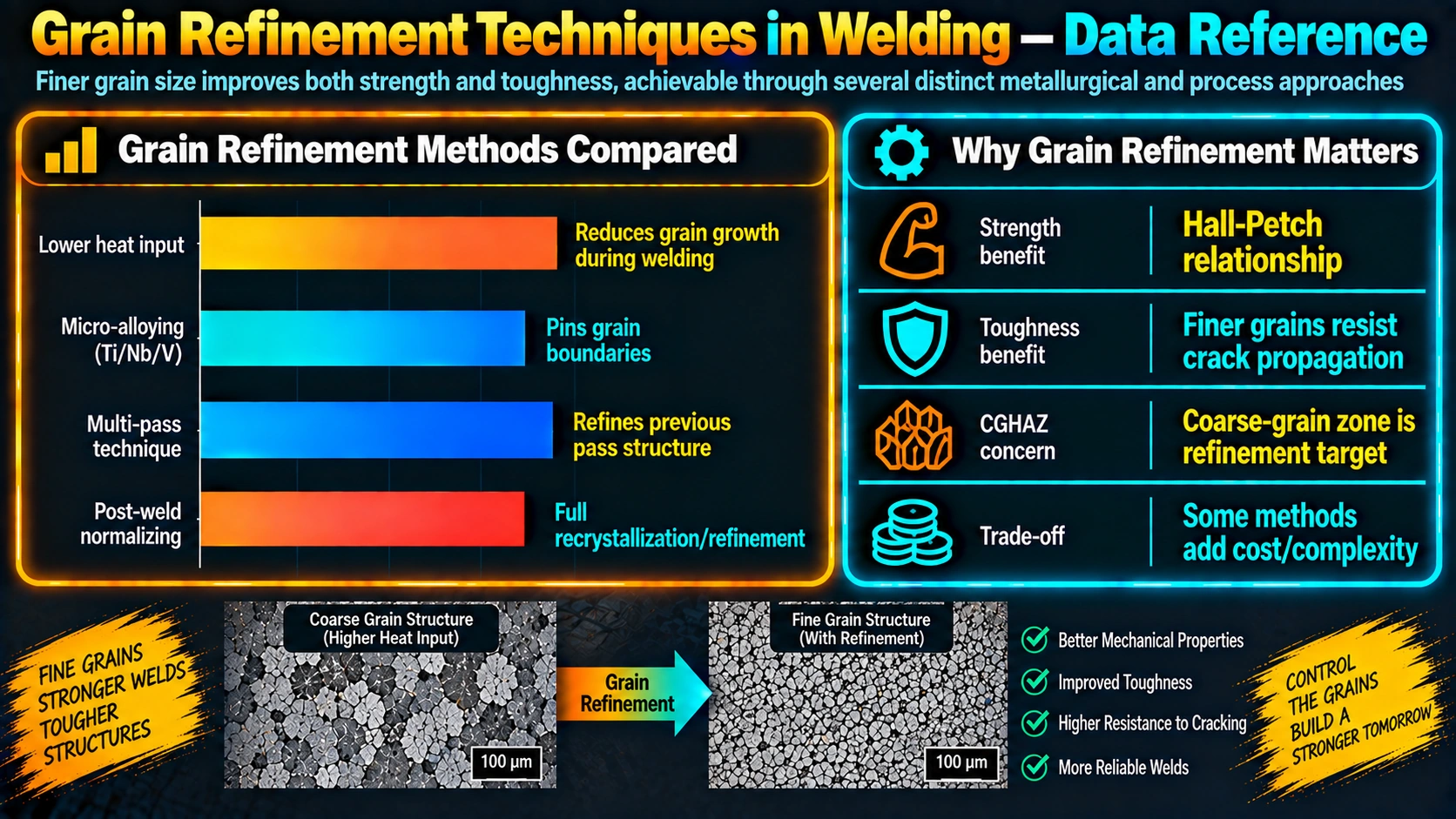
The Hall-Petch relationship describes how yield strength increases as grain size decreases, because grain boundaries impede dislocation motion and a finer grain structure means more boundary area per unit volume. Unusually, a finer grain size also improves toughness, since grain boundaries deflect and blunt propagating cracks and a fine grain structure distributes plastic deformation more evenly ahead of a crack tip. Most other strengthening mechanisms — solid solution strengthening, precipitation hardening, strain hardening — improve strength at some cost to toughness or ductility, which is what makes grain refinement a particularly valuable tool wherever both properties are governing requirements, such as structural steel, pipeline, and offshore fabrication.
Technique 1: Heat Input and Interpass Temperature Control
Lower heat input reduces both the peak temperature and the time spent at elevated temperature in the HAZ, which directly limits grain growth near the fusion line, and it simultaneously increases the weld metal cooling rate, promoting a finer as-solidified grain structure. This is why toughness-critical welding procedures specify a maximum heat input and a maximum interpass temperature rather than leaving them open, and why smaller, more numerous weld passes are frequently preferred over fewer large passes when HAZ grain size is a governing acceptance criterion.
- Lower amperage/voltage combinations at a given travel speed reduce heat input directly
- Faster travel speed reduces heat input per unit length of weld
- Stringer bead technique (minimal weave) generally delivers lower heat input than a wide weave pass of the same amperage
- Strict interpass temperature limits prevent cumulative grain coarsening across a multi-pass weld
Technique 2: Weld Metal Inoculation (Acicular Ferrite Promotion)
Modern high-toughness welding consumables are engineered to refine weld metal grain structure through controlled inoculation, most commonly using titanium and boron additions. Fine titanium oxide and titanium nitride particles form in the weld pool and act as heterogeneous nucleation sites, so the weld metal solidifies as a dense population of fine, randomly oriented acicular ferrite plates rather than growing as coarse columnar grains from the fusion boundary inward. This mechanism is the basis for most modern offshore, pipeline, and structural steel consumables where weld metal Charpy toughness is a specified acceptance criterion.
| Inoculant / Additive | Effect on Weld Metal Structure |
|---|---|
| Titanium (as oxide/nitride) | Primary acicular ferrite nucleation sites |
| Boron (trace) | Suppresses grain boundary ferrite formation, favouring intragranular acicular ferrite nucleation |
| Oxygen (controlled level) | Forms the oxide inclusions that serve as nucleation sites — too much degrades toughness |
| Rare earth additions (in some specialty consumables) | Additional inclusion modification for nucleation and inclusion shape control |
Technique 3: Pulsed and Oscillated Arc Processes
Pulsed current welding cycles between a high peak current and a lower background current, repeatedly disrupting the solidifying weld pool and interrupting continuous columnar grain growth, which promotes a finer, more equiaxed grain structure compared to a constant-current weld of similar overall heat input. Arc oscillation or weaving produces a related effect by redistributing heat across the weld pool and altering the local solidification direction, further disrupting the continuity of columnar grains as they attempt to grow toward the pool centreline.
Technique 4: Multi-Pass Grain Refinement
In a multi-pass weld, each subsequent pass reheats a portion of the underlying weld metal and HAZ from the previous pass into a grain-refining temperature range without remelting it, effectively normalizing and refining what would otherwise remain a coarse as-deposited or as-welded structure. This self-refining effect is one reason multi-pass welds, when interpass temperature is well controlled, often show measurably better toughness in the reheated regions of earlier passes than an equivalent single-pass weld of comparable total thickness.
Technique 5: Post-Weld Normalizing
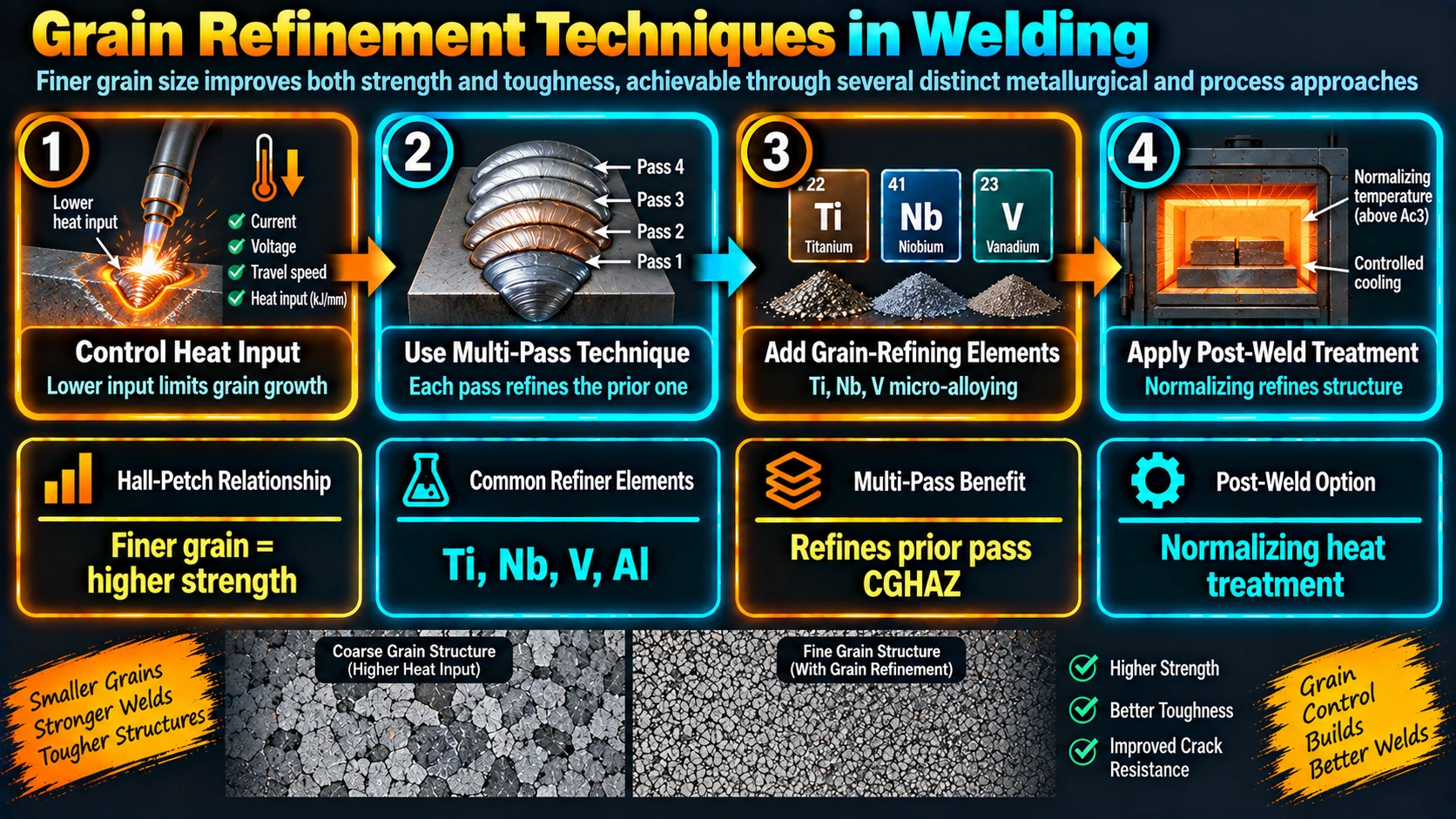
Where the entire fabricated component can be uniformly reheated, post-weld normalizing — heating into the austenitizing range followed by air cooling — allows a fresh cycle of austenite grain nucleation that is independent of the as-welded thermal history, refining both weld metal and HAZ grain size back toward that of the base metal. This differs fundamentally from stress-relief PWHT, which is typically performed below the transformation range specifically to relieve residual stress without altering grain size, and normalizing is generally only practical for components small enough, or important enough, to justify a full furnace cycle rather than a localized treatment.
Technique 6: Mechanical and Vibration-Assisted Grain Refinement
Applying mechanical vibration, ultrasonic energy, or hammering to the weld pool or the still-hot weld metal during or immediately after welding introduces additional plastic deformation that can promote dynamic recrystallization and physically disrupt the dendritic solidification structure, producing a finer resulting grain size than an equivalent weld made without mechanical assistance. This class of thermomechanical welding technique is an active area of process development, particularly aimed at compensating HAZ softening in high-strength low-alloy steels, where conventional grain refinement alone cannot fully restore properties lost to the weld thermal cycle. Related, fully solid-state approaches such as friction stir welding achieve grain refinement through dynamic recrystallization by design rather than as a secondary effect.
Technique Comparison
| Technique | Primarily Refines | Typical Application |
|---|---|---|
| Heat input / interpass control | HAZ grain growth + weld metal cooling rate | All fusion welding processes, toughness-critical procedures |
| Weld metal inoculation (Ti-B) | Weld metal (acicular ferrite) | High-toughness structural, pipeline, offshore consumables |
| Pulsed / oscillated arc | Weld metal solidification structure | GTAW, GMAW, thin-section and positional welding |
| Multi-pass self-refinement | Weld metal (underlying passes) | Any multi-pass fusion weld with controlled interpass temp |
| Post-weld normalizing | Weld metal + HAZ (whole component) | Smaller fabrications, components tolerant of full heat treatment |
| Mechanical/vibration-assisted | Weld metal + adjacent HAZ | Research/specialty processes, HSLA HAZ property recovery |
Recommended Reference Books
Welding Metallurgy (2nd Ed.) — Sindo Kou
Covers weld metal solidification, inoculation, and grain refinement mechanisms across major alloy systems.
View on AmazonWelding Metallurgy: Principles — John Lippold
Detailed treatment of acicular ferrite formation, HAZ grain growth control, and toughness optimization.
View on AmazonMetallurgy of Welding — J.F. Lancaster
Classic reference on weld pool solidification, inclusion nucleation, and process-driven grain structure control.
View on AmazonASM Handbook: Welding, Brazing, and Soldering
Comprehensive industry reference covering process-specific grain refinement techniques across welding methods.
View on AmazonDisclosure: WeldFabWorld participates in the Amazon Associates programme (StoreID: neha0fe8-21). If you purchase through these links, we may earn a small commission at no extra cost to you. This helps support free technical content on this site.
Frequently Asked Questions
Why is a fine grain structure generally preferred in weld metal and the HAZ?
A finer grain size increases both yield strength and toughness simultaneously through the Hall-Petch relationship, which is unusual since most strengthening methods trade toughness for strength. In weld metal, fine acicular ferrite is specifically preferred over coarse columnar grain structures because it deflects and blunts crack propagation, while in the HAZ, controlling grain growth close to the fusion line directly limits the toughness loss associated with the coarse grain HAZ.
How does heat input control refine grain size in welding?
Lower heat input reduces both peak temperature and time at temperature in the HAZ, which directly limits the extent of grain growth near the fusion line, and it also increases the weld cooling rate, which produces a finer as-solidified weld metal grain structure. This is why heat input limits are specified in welding procedures for toughness-critical applications, and why multi-pass welding with smaller weld beads is often preferred over fewer, larger passes when HAZ grain size is a governing concern.
What is weld metal inoculation and how does it refine grain structure?
Weld metal inoculation introduces controlled additions, most commonly titanium and boron, that form fine titanium oxide and titanium nitride particles which act as heterogeneous nucleation sites within the weld pool during solidification. Rather than growing as coarse columnar grains from the fusion boundary inward, the weld metal nucleates a much finer, randomly oriented acicular ferrite structure throughout the pool, which is the basis for most modern high-toughness welding consumables used in offshore, pipeline, and structural steel applications.
Does pulsed welding current refine weld metal grain size?
Yes. Pulsed current welding processes cycle between a high peak current and a lower background current, which repeatedly disrupts the solidifying weld pool and interrupts continuous columnar grain growth, promoting a finer, more equiaxed grain structure compared to a constant-current weld of similar heat input. Arc oscillation or weaving has a related effect, redistributing heat across the weld pool and altering the local solidification direction in a way that can further disrupt columnar grain continuity.
Can multi-pass welding refine the grain structure of previous passes?
Yes. In multi-pass welding, each subsequent weld pass reheats a portion of the underlying weld metal and HAZ into the grain-refining temperature range without remelting it, effectively normalizing and refining the coarse as-deposited or as-welded grain structure left by the previous pass. This is one reason multi-pass welds with well-controlled interpass temperature often show better toughness in the reheated regions of earlier passes than a single-pass weld of comparable total thickness would show throughout.
Is post-weld normalizing an effective way to refine grain size after welding?
Post-weld normalizing, where the entire welded component is reheated into the austenitizing range and air cooled, can refine a coarse-grained weld metal and HAZ back toward the grain size of the base metal, since it allows a fresh cycle of austenite grain nucleation independent of the as-welded thermal history. This is different from stress-relief PWHT, which is typically performed below the transformation range and does not refine grain size, and normalizing is generally only practical where the whole component, not just the weld zone, can be uniformly heat treated.
How does mechanical vibration or hammering during welding contribute to grain refinement?
Applying mechanical vibration, ultrasonic energy, or hammering to the weld pool or the still-hot weld metal during or immediately after welding introduces additional plastic deformation that can promote dynamic recrystallization and disrupt dendritic solidification structure, producing a finer resulting grain size than an equivalent weld made without mechanical assistance. This thermomechanical welding approach is an active area of process development, particularly for compensating HAZ softening in high-strength low-alloy steels where conventional grain refinement alone cannot fully restore lost properties.