Lifting rigging safety in a fabrication yard means planning every lift, choosing rated gear and keeping people out of the load path, because plates, pipe spools and vessels are heavy, awkward and often fitted with welded lifting points.
Safe lifting and rigging in a fabrication yard rests on five controls: know the load weight and centre of gravity, use rated and inspected slings and hardware, keep sling angles at 45 degrees or more, plan the lift with a trained operator, rigger and signaller, and keep everyone clear of the load. Check gear before every lift and never exceed the working load limit.
This guide covers the equipment, calculations and procedures that matter most to fabricators: sling types, sling-angle effects, lift plans, inspection and the special risks of welding near lifted loads. For heavy fabrication examples, see our guides on welding for wind turbine tower fabrication and pipeline welding for cross-country transmission lines, where pipe and shell handling is a daily task.
It is a general guide, not a lift plan. Local law, client rules, the crane manufacturer’s manual and the lift plan always take priority.

- Know the load weight and centre of gravity before rigging; an unknown weight means the lift does not proceed.
- Sling tension rises as the sling angle falls: at 30 degrees each leg of a two-leg sling carries as much as the whole load.
- Only rated, marked and inspected slings, shackles and hooks may be used, within their working load limit for the actual hitch.
- A written lift plan, a test lift and one appointed signaller turn a risky lift into a controlled one.
- Welding current and spatter can damage rigging, so land and support the load before welding, and never weld lifting lugs without design and inspection.
- Legal duties and inspection intervals depend on the jurisdiction, client and contract applicable to your project.
What Does Lifting and Rigging Safety Cover in a Fabrication Yard?
Lifting and rigging safety is a set of controls that plans, equips and supervises load handling so loads move without injuring people or damaging equipment.
In a fabrication yard it covers the crane or hoist, the slings and hardware that connect the load to it, the people who plan and direct the lift, and the area around the load. It also covers the weld attachments, such as lifting lugs and trunnions, that fabricators build into their own products.
This guide covers overhead cranes, mobile cranes and common rigging in fabrication yards. It does not replace crane manuals, local regulations or a project lift plan. Related topics are collected in the Safety & Compliance section of this site.
What Makes Lifting in Fabrication Yards Different?
Fabrication yards combine heavy, awkward, changing loads with hot work, mixed crews and tight spaces. A load that weighed 2 tonnes in the morning can weigh more after nozzles, internals or cladding are added.
| Hazard | Why it occurs in fabrication | Typical controls |
|---|---|---|
| Overloaded gear | Loads change as welding, cladding and attachments are added | Re-check weight at each stage, mark WLL, never exceed rated capacity |
| Unbalanced load | Offset centre of gravity on nozzled vessels, skids and spools | Locate centre of gravity, adjust sling lengths, use a spreader or test lift |
| Low sling angle | Short slings on wide plates and frames | Longer slings, spreader beam, check angle factor |
| Damaged slings | Sharp plate edges, weld spatter, heat, abrasion | Edge protection, pre-use inspection, tag out defective gear |
| People in the load path | Fitters, welders and inspectors working close to lifts | Barriers, exclusion zone, signaller, no work under loads |
| Welding near gear | Hot work on or near lifted loads and rigging | Land the load first, protect gear, control the earth return |
Because many people work around the same load, lifting hazards overlap with hot work and permit systems. The hot work permit system explains how permits control fire risk, and a lift near hot work needs both systems to agree.
What Lifting Equipment and Slings Are Used?
Fabrication yards use overhead cranes, mobile cranes, gantries and hoists as the lifting machine, and slings, shackles, hooks, beams and clamps as the rigging between the machine and the load. Each item has its own rating, marking and inspection rules.
What are the main lifting machines?
- Overhead (EOT) cranes: fixed to the building, ideal for shop bays and repetitive lifts.
- Mobile and crawler cranes: used for yard work, loading and large erection lifts, with load charts that depend on radius and configuration.
- Gantry cranes and hoists: common for lighter loads and workstations.
What sling types are used, and when?
Sling choice depends on the load, the edges, the temperature and the finish of the item. Table 2 summarises the main types.
| Sling type | Strengths | Limits | Typical use |
|---|---|---|---|
| Wire rope sling | Strong, abrasion resistant, tolerates some heat | Kinks and bird-caging damage it, can mark finished surfaces | General steel lifting, heavy plates and sections |
| Alloy chain sling (Grade 80 or 100) | Very durable, tolerates heat and rough use | Heavy, link damage is easy to miss, no shock loading | Heavy fabrications, hot or abrasive environments |
| Synthetic web or round sling | Light, flexible, protects finished surfaces | Cut by sharp edges, damaged by heat, spatter and some chemicals | Machined parts, painted or finished items |
| Metal mesh sling | Handles hot, dirty conditions, wide bearing surface | Heavier, less common, needs inspection of the mesh | Hot parts, sharp-edged loads |
What other rigging hardware is used?
Shackles, hooks with safety latches, eyebolts, spreader beams, lifting beams, plate clamps and magnets complete the system. Each must be rated, marked and compatible with the sling and the lifting point. Standards include ASME B30.9 (slings), ASME B30.26 (rigging hardware) and ASME B30.20 with ASME BTH-1 (below-the-hook lifting devices), and in Europe EN 13414 for steel wire rope slings, EN 818 for chain and EN 1492 for textile slings.
How Do You Find the Load Weight and Centre of Gravity?
Find the load weight from the drawing, a calculation or a weighing, add the weight of the rigging, and locate the centre of gravity before choosing any lifting gear. Never estimate by eye for a lift that matters.
For steel plate, weight equals volume multiplied by density, with carbon steel density taken as about 7,850 kg/m3 (0.284 lb/in3). Weight tools on this site help with common shapes: use the steel plate weight calculator, the pipe weight calculator, the elbow weight calculator and the dish end weight calculator.
How do you locate the centre of gravity?
The centre of gravity is the point where the load balances. For symmetrical items it lies on the centreline, for complex fabrications it should come from the design model, and where it is uncertain a test lift will reveal it. The hook must sit directly above the centre of gravity to keep the load level.
How Does Sling Angle Affect the Load on a Sling?
Sling angle, measured from the horizontal, controls how much force each sling leg carries: the lower the angle, the higher the tension. Tension in each leg equals the load divided by the number of legs and by the sine of the angle.
| Angle from horizontal | Factor 1 / sin θ | Comment |
|---|---|---|
| 90 deg (vertical) | 1.000 | No angle effect |
| 75 deg | 1.035 | Small effect |
| 60 deg | 1.155 | Common good practice |
| 45 deg | 1.414 | Typical minimum in many procedures |
| 30 deg | 2.000 | Lowest angle that should ever be used |
The sling’s rated capacity must be checked at the actual angle, not the vertical rating. With four-leg slings on rigid loads, many procedures assume that only two legs carry the load because of uneven leg stretch, unless the lift plan shows otherwise. Choker and basket hitches also change capacity, so use the rating for the hitch from the sling tag or manufacturer’s chart.
If the sling angle falls below the planned minimum, use longer slings or a spreader beam. Do not accept a low angle because the slings are already on site.
What Should a Lift Plan Include?
A lift plan is a written description of how a lift will be done safely: the load, the equipment, the people, the area and the method. It can be a one-page form for routine lifts and a full engineered document for critical lifts.
- Load description, weight, dimensions, centre of gravity and lifting points.
- Crane and rigging selection, with load chart check at the working radius and sling angle check.
- Lift route, set-down position and supports, plus ground or floor bearing checks.
- Personnel: operator, rigger, signaller, lift supervisor, and their competence.
- Exclusion zone, barriers, traffic and interface with other work, including hot work.
- Weather limits, communication and emergency arrangements.
Many sites classify a lift as critical when it uses a high share of the crane’s capacity, involves two cranes, is near live equipment or involves personnel. Criteria vary, so use the definition in your company or client procedure. The crane check is simple but essential, for example an illustrative 8.0 t net capacity at the working radius gives 3.12 / 8.0 = 39% utilisation for the plate lift above; always read the real load chart.
How Do You Carry Out a Lift Step by Step?
Carry out a lift by confirming the plan, inspecting the gear, securing the area, rigging the load, making a test lift, travelling under signaller control, landing the load safely and releasing the rigging. The numbered steps below follow common industry practice.
- Confirm the load weight, centre of gravity and lift plan. Check the weight on the drawing or calculation, locate the centre of gravity, and confirm that a lift plan exists for the lift. If the weight is unknown, stop and find it before rigging.
- Inspect the crane and the rigging. Check the crane’s pre-use inspection, load chart and limit devices. Inspect every sling, shackle and hook, and reject anything damaged, unmarked or out of date for examination.
- Set up the area and check the ground. Barrier the lift zone, keep people clear of the load path, and confirm that the floor or ground can carry the crane and the load. Position outriggers on firm, level, supported ground.
- Attach the rigging to the designated lifting points. Use rated lifting lugs or pad eyes, fit shackle pins properly, protect slings from sharp edges and keep the sling angle at the planned value or higher. Position the hook over the centre of gravity.
- Take up the slack and make a test lift. Raise the load slowly just clear of the supports, usually a few hundred millimetres, and hold it. Check balance, sling tension, hook position and the crane brake before going further.
- Lift and travel under signaller control. Lift only as high as needed, keep the load low and travel along the planned route. One signaller directs the crane, and a tag line controls rotation where needed.
- Land and support the load. Lower onto dunnage or stands that suit the load, keep the sling legs from being trapped, and confirm the load is stable before slackening the rigging.
- Release, inspect and return the gear. Remove the rigging only when the load is stable, check it for damage and store it correctly. Report any damage and tag defective gear out of service.
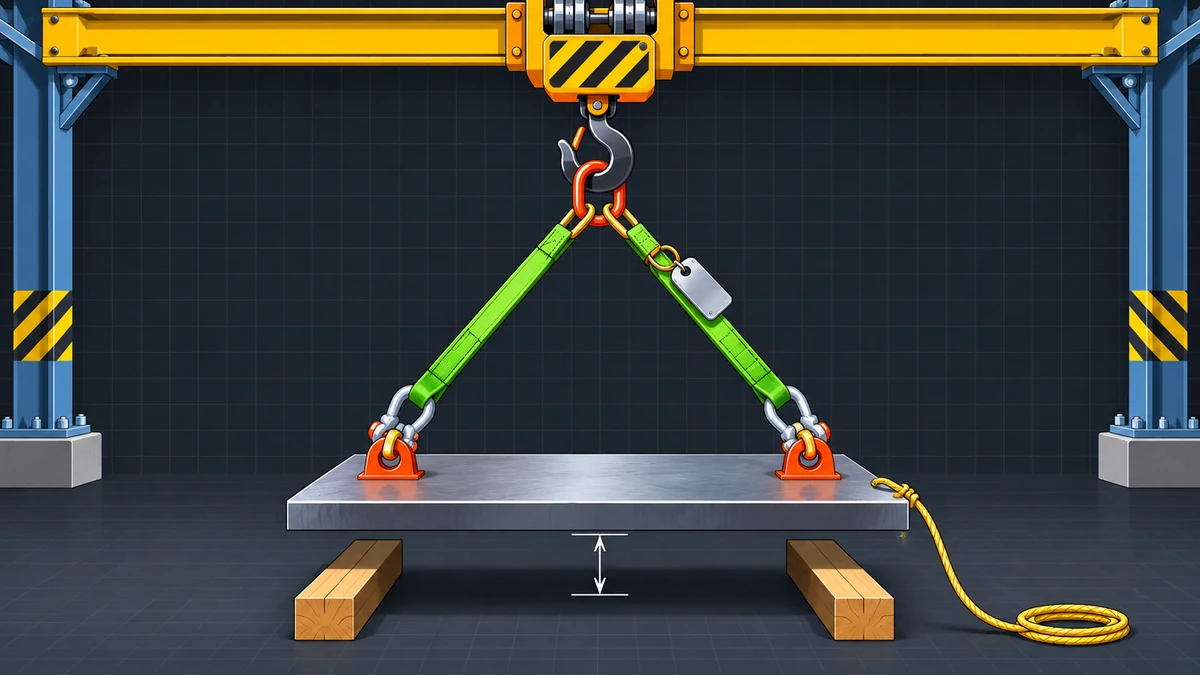
The test lift is the best chance to catch a wrong centre of gravity or a damaged sling while the load is still low. If the load tilts, set it down and correct the rigging instead of trying to fix it in the air.
How Do You Inspect Slings and Rigging Hardware?
Inspect slings and hardware visually before every use, and have a competent person carry out documented periodic examinations at the interval required by the rules and the severity of service. Damaged or unmarked gear is removed from service, not repaired informally.
| Item | Remove from service if you find |
|---|---|
| Wire rope sling | Kinks, bird-caging, crushed sections, broken wires beyond the limit, heat damage, severe corrosion, damaged end fittings |
| Chain sling | Stretched or distorted links, nicks and gouges, wear, bent or opened hooks, weld spatter, missing tag |
| Synthetic sling | Cuts, abrasion, melting or charring, chemical damage, broken stitching, exposed core, missing tag |
| Shackle, hook, eyebolt | Bent or distorted body, worn pin or threads, cracks, missing markings, increased hook throat opening, missing latch |
| Any item | No legible rating or identification, or past its examination date |
Periodic examination intervals depend on the rule. OSHA requires slings to be inspected at least every 12 months in general industry, and the UK Lifting Operations and Lifting Equipment Regulations (LOLER) require lifting accessories to be thoroughly examined at least every 6 months. Keep the certificates and inspection records with the lifting register as part of your quality system; the welding documentation and record-keeping guide explains how quality and safety records are controlled.
How Do Welding and Hot Work Affect Lifting Gear and Loads?
Welding can damage lifting gear in two ways: welding current can arc through hooks, shackles, chains or wire ropes, and spatter or heat can burn synthetic slings and nick metal ones. Best practice is to land and support the load before welding.
- Keep the welding earth return on the workpiece, so the current does not flow through the crane, hook or rigging. See the welding cables, connectors and earthing guide.
- Protect slings from spatter with covers or move them away, and inspect them afterwards.
- Do not weld on a suspended load unless a written procedure allows it and addresses current path, support and gear condition.
- Check the hot work permit for lifting activity in the same area; simultaneous lifting and hot work in the same area must be coordinated by the permit issuer.
How Should Lifting Lugs Be Designed, Welded and Inspected?
A lifting lug is a designed component, so its size, plate, hole, weld and inspection should come from an engineer’s calculation and the applicable standard, not from shop judgement. A poor lug weld is a hidden failure that shows up only under load.
- Design: allow for the lift weight, sling angle, load direction and the dynamic allowance set by the design standard or project specification.
- Hole and pin: match the shackle pin so the load bears correctly without excessive clearance.
- Weld: follow the design weld joint, which may be full penetration or fillet; review options in our guide to welding joint types.
- Inspection: examine the finished weld, usually with magnetic particle or penetrant testing, as discussed in the NDT method selection guide.
- Marking: mark the lug or the equipment with its rated load and keep the lift record with the quality file.
Tack welds, bent rebar and unrated eyes must never be used for lifting. If the design does not show lifting points, stop and ask the engineer.
Who Does What on a Lift?
A lift needs clearly assigned roles: a competent crane operator, a rigger who slings the load, a signaller who directs the operator, and a lift supervisor who owns the plan. Exact titles vary, but each role must be named before the lift starts.
- Crane operator: operates the crane within its load chart, follows the signaller and stops on any stop signal.
- Rigger (slinger): selects and attaches the rigging, checks angles and hitches, and confirms the load is secure.
- Signaller: the only person who directs the crane operator, using agreed signals or radio.
- Lift supervisor or appointed person: prepares or approves the lift plan, checks conditions and can stop the lift.
After a near miss or incident, a structured investigation helps; see root cause analysis for weld failures for an approach that also applies to lifting events.
What Practical Notes Apply in India and the Gulf?
Heat, wind, ground conditions and client examination rules shape lifting in India and the Gulf. These notes are general practice; local law and client requirements govern.
- Indian law: Section 29 of the Factories Act, 1948 covers lifting machines, chains, ropes and lifting tackle, with examination and testing duties set by the Act and state rules. Confirm which rules apply to your site.
- Client rules: oil and gas, power and EPC clients often require third-party examination of cranes and lifting gear, and certified operators and riggers.
- Wind: open and coastal yards can have strong, gusty winds. Stop lifts when wind exceeds the crane manufacturer’s limit.
- Ground: monsoon rain can soften yard ground in India, and loose sand can reduce bearing in desert yards. Check outrigger support and use mats.
What Are the Most Common Lifting and Rigging Mistakes?
The most common lifting mistakes are lifting an unknown weight, using low sling angles, using damaged or unrated gear, and letting people stand in the load path. Most of these can be removed by a short pre-lift check.
- Guessing the weight. Weight and centre of gravity must be known, not estimated by eye.
- Low sling angles. Short slings can double the force in each leg.
- Improvised lifting points. Tack-welded eyes and unrated brackets are common causes of dropped loads.
- Working under suspended loads. No task is worth standing in the drop zone.
Requirements depend on the code edition, regulation and contract specification applicable to your project.
Quick Reference: Lifting Rigging Safety Cheat Sheet
Use the flowchart below as a final check before every lift. It summarises common practice and does not replace the lift plan or crane manual.
Frequently Asked Questions
What is the difference between WLL and SWL on lifting gear?
Working load limit (WLL) is the current term for the maximum load a piece of lifting gear may carry in the configuration marked on it. Safe working load (SWL) is the older term, still seen on legacy equipment. Never exceed the marked value, and remember that the rating depends on the hitch and angle, so a sling’s capacity changes when it is used in a choker or at a low angle.
How often must slings and rigging hardware be inspected?
Users should inspect gear visually before each use or at the start of each shift. A competent person must also carry out a documented periodic examination, commonly at least every 12 months, and more often in severe service. Some rules, such as the UK LOLER regulations, require lifting accessories to be thoroughly examined every 6 months, so follow the rule that applies to your site.
Can you weld on a load while it hangs from a crane?
The safest practice is to land the load on stands or blocking before welding. Welding current can arc through hooks, shackles, chains and wire ropes and damage them, and spatter can burn synthetic slings. If a procedure allows welding on a suspended load, it must cover the welding current path, the earth connection and the condition of the rigging afterwards.
What is the minimum safe sling angle?
Many lifting procedures set a minimum of 45 degrees from the horizontal, and treat 30 degrees as the lowest angle that should ever be used. At 30 degrees each leg carries twice the share of the load that it would at 90 degrees. Use longer slings or a spreader beam to keep the angle high.
What is a critical lift?
A critical lift is a lift with higher risk than routine lifting, so it needs a detailed written plan and extra approval. Typical triggers set by site procedures include a load near the crane’s rated capacity, a tandem lift with two cranes, a lift near live equipment, a lift of personnel, or a load that is expensive or hard to replace. The exact criteria come from your company or client procedure.
Who is allowed to give signals to a crane operator?
Only a trained and appointed signaller should give signals, and there should be one signaller for each lift. The operator should follow signals from that person only, except that anyone must be obeyed when the signal is stop. Agree hand signals or radio protocol before the lift and make sure the signaller can see the load and the operator.
Can lifting lugs be welded to any plate?
No. A lifting lug is a designed component, so its plate, size, hole, weld and inspection should come from an engineer’s design and the applicable standard. The weld usually needs inspection by magnetic particle or penetrant testing after welding, and the lug should be marked with its rated load. Tack welds or improvised eyes must never be used as lifting points.
Key Terms
- Working load limit (WLL)
- The maximum load that lifting gear may carry in the configuration marked on it.
- Centre of gravity
- The point at which a load balances, which should lie directly below the hook during a lift.
- Sling angle
- The angle between a sling leg and the horizontal, which controls the tension in the leg.
- Rigger
- The person who selects and attaches slings and hardware to a load.
- Signaller
- The one person who directs the crane operator during a lift.
- Test lift
- A short lift just clear of the supports to check balance, rigging and brakes.
Conclusion
Lifting rigging safety in a fabrication yard depends on knowing the weight, using rated and inspected gear, keeping sling angles high, planning the lift, and keeping people clear of the load. Add a test lift, one signaller and a clear stop-work rule, and most lifting incidents become preventable. Treat welded lifting points and hot work near rigging as special risks.
Welded lifting points and hot work near rigging deserve special care, because their failures are hidden until the load is in the air. For a structured way to rank lifting risks across your yard, read the FMEA practical guide as a next step. Review your lift plans and gear records regularly so that the controls stay effective.
Standards and References
- ASME B30.9 – Slings (ASME)
- ASME B30.26 – Rigging Hardware (ASME)
- ASME B30.20 – Below-the-Hook Lifting Devices (ASME)
- ASME BTH-1 – Design of Below-the-Hook Lifting Devices (ASME)
- ASME B30.2 – Overhead and Gantry Cranes (ASME)
- ASME B30.5 – Mobile and Locomotive Cranes (ASME)
- 29 CFR 1910.184 – Slings (OSHA)
- 29 CFR 1910.179 – Overhead and Gantry Cranes (OSHA)
- EN 13414-1 – Steel wire rope slings – Safety – Part 1: Slings for general lifting service (CEN)
- EN 818 series – Short link chain for lifting purposes – Safety (CEN)
- EN 1492 series – Textile slings – Safety (CEN)
- ISO 4309 – Cranes – Wire ropes – Care and maintenance, inspection and discard (ISO)
- LOLER 1998 – The Lifting Operations and Lifting Equipment Regulations 1998 (UK Government and HSE)
Primary sources: ASME, Occupational Safety and Health Administration (OSHA), UK Health and Safety Executive (HSE) and International Organization for Standardization (ISO).
This guide was prepared by the WeldFabWorld technical team from the standards listed above. Verify all requirements against the regulations, crane manual, client rules and lift plan applicable to your project.