Failure Mode and Effects Analysis (FMEA) — Complete Guide with RPN Calculation and Welding Examples
Failure Mode and Effects Analysis (FMEA) is a structured, proactive risk-assessment methodology used to identify potential failures in products, processes, or systems before they reach the customer or cause a safety incident. Originally developed by the US military in the late 1940s and formalized by NASA during the Apollo programme, FMEA has evolved into a cornerstone quality tool across manufacturing, welding fabrication, pressure equipment, aerospace, automotive, oil and gas, and healthcare. If you are a welding engineer, quality inspector, or fabrication manager, understanding FMEA is no longer optional — it is a fundamental competency required by ISO 9001, IATF 16949, and most Tier-1 customer quality plans.
At its core, FMEA asks three deceptively simple questions: How can this product or process fail? What happens when it fails? How likely is the failure to be detected before it causes harm? The answers are quantified using a Risk Priority Number (RPN) — the product of Severity, Occurrence, and Detection ratings — which drives corrective action priorities. The modern AIAG-VDA FMEA Handbook (2019) supplements RPN with an Action Priority (AP) system that ensures catastrophic-consequence failures are never buried by favourable occurrence or detection scores.
This guide covers the complete FMEA process from scope definition to closure, explains both Design FMEA (DFMEA) and Process FMEA (PFMEA), walks through RPN and AP calculations with a real welding example, and provides the rating tables, worked example, and best-practice checklist you need to implement FMEA in your fabrication shop or quality system.
What is Failure Mode and Effects Analysis?
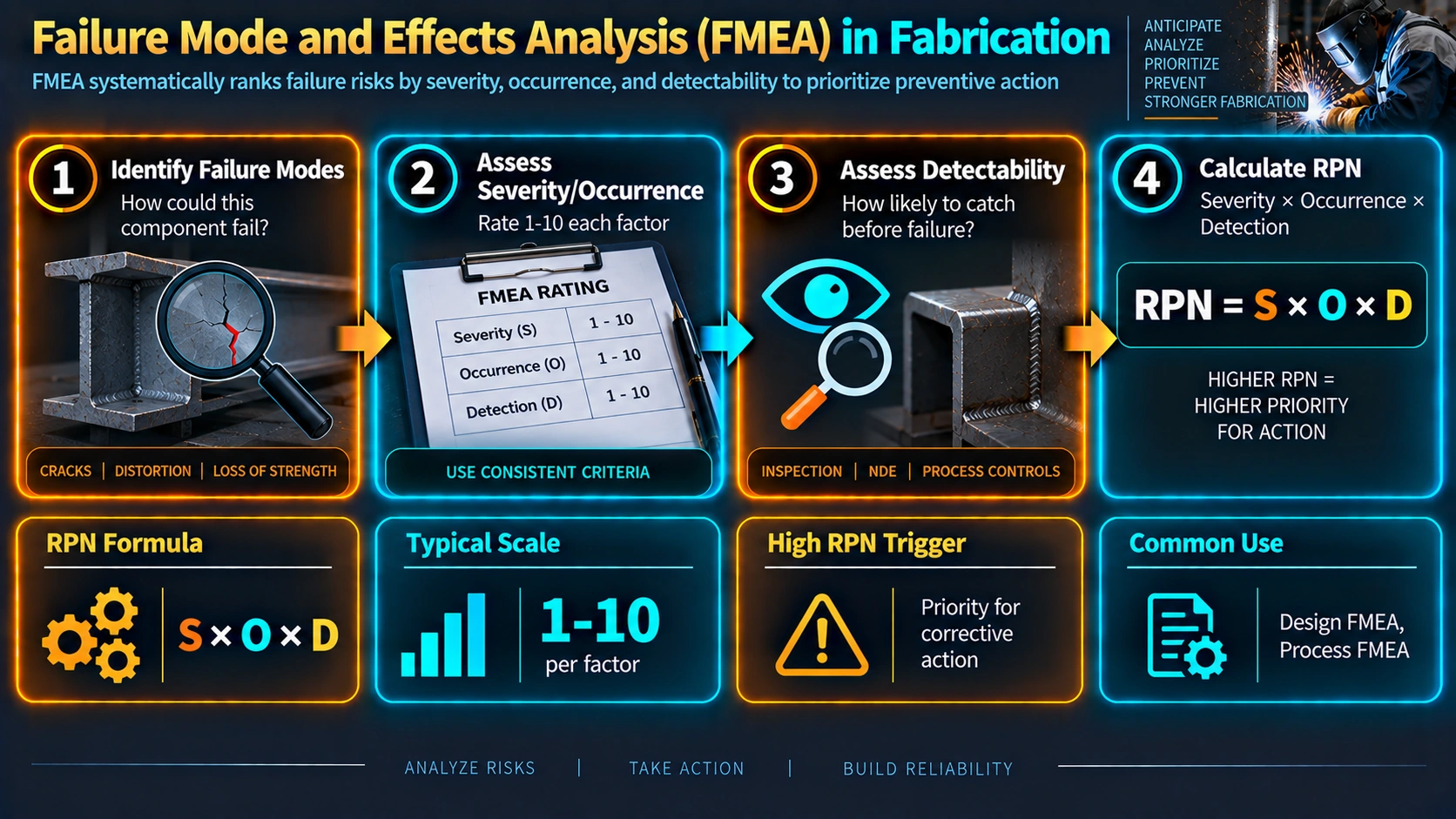
FMEA is a systematic, inductive (forward-logic) analysis that examines individual components or process steps, identifies the ways each can fail (failure modes), assesses the consequences of those failures on the system or customer (effects), and establishes controls to prevent or detect the failures. It is a living document — started during concept or planning and updated throughout the product or process lifecycle.
Three fundamental concepts underpin every FMEA:
- Failure Mode: The specific manner in which a component, joint, or process step ceases to perform its intended function. Example: a butt weld exhibits lack-of-fusion at the root.
- Effect: The consequence of the failure mode at the next higher level and ultimately at the customer or end-user. Example: lack-of-fusion reduces load-carrying capacity and may cause brittle fracture under pressure cycling.
- Cause: The mechanism or root cause that produces the failure mode. Example: inadequate arc energy (low heat input), incorrect joint fit-up, or improper electrode manipulation.
By mapping this cause-mode-effect chain for every function in a product or process, the FMEA team builds a risk register that can be ranked, prioritised, and acted upon before production begins — not after field failures, non-conformances, or customer complaints force reactive repairs.
Types of FMEA
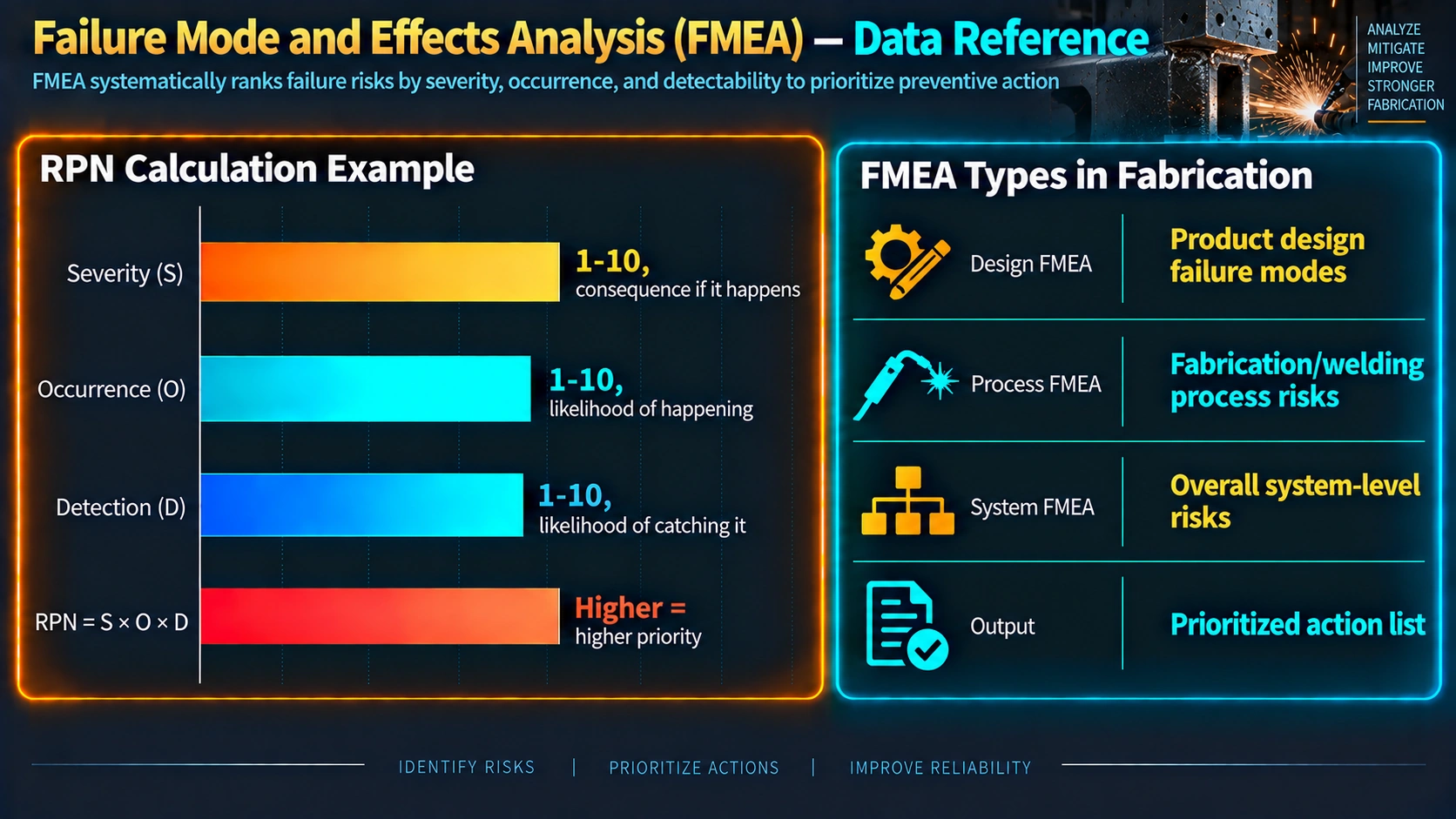
Several FMEA variants exist, each suited to a different stage of product or process development. The two most widely used are DFMEA and PFMEA, but engineers working in complex systems or service environments will encounter others.
Design FMEA (DFMEA)
DFMEA analyses the risk arising from product design decisions — material selection, geometry, tolerances, load cases, and interface specifications. It is performed by design engineers before drawings are released and aims to identify design-induced failure modes that cannot be fully controlled by manufacturing. In welding applications, DFMEA would evaluate the choice of weld joint type, the selection of base and filler metal grades, the positioning of welds relative to stress concentrations, and the accessibility of joints for required NDE.
Process FMEA (PFMEA)
PFMEA analyses potential failures in the manufacturing or fabrication process — machine capability, operator skills, tooling variation, material handling, and environmental conditions. It is owned by process and manufacturing engineers and is typically prepared before WPS qualification or production trials. In welding fabrication, PFMEA covers preheat application, inter-pass temperature control, fit-up and gap tolerances, welder qualification scope, consumable storage and drying, and calibration of welding equipment.
System FMEA (SFMEA)
SFMEA operates at the top system level, analysing interactions between sub-systems and their interfaces. It is used in complex installations such as offshore topside modules, power plant piping systems, or pressure vessel trains where sub-system interface failures (e.g., thermal differential expansion between dissimilar metal welds) are a primary concern.
Functional FMEA (FFMEA)
FFMEA analyses non-hardware systems — services, inspection routines, software logic, or quality procedures — in terms of their functional failure modes. An example is applying FMEA to a radiographic interpretation procedure to identify scenarios where rejectable defects could be missed.
| Type | Primary Focus | Typical Owner | Timing | Welding Application Example |
|---|---|---|---|---|
| DFMEA | Design decisions | Design / R&D Engineer | Before drawing release | Weld joint geometry, filler metal grade selection |
| PFMEA | Manufacturing process | Process / Manufacturing Engineer | Before WPS qualification | Preheat control, fit-up tolerance, consumable handling |
| SFMEA | System interfaces | Systems Engineer | Concept phase | Dissimilar metal interface, expansion loop behaviour |
| FFMEA | Functional / service failures | Quality / Reliability Engineer | Process design | NDE interpretation procedure failure modes |
Risk Priority Number (RPN) — Calculation and Rating Scales
The Risk Priority Number is the primary quantitative output of a traditional FMEA. It is calculated by multiplying three independent ratings, each scored on a 1–10 scale:
RPN = S × O × D
Where:
S = Severity (1 = negligible effect → 10 = catastrophic / safety / regulatory)
O = Occurrence (1 = extremely unlikely → 10 = almost certain)
D = Detection (1 = almost certain to detect → 10 = no detection possible)
Maximum possible RPN: 10 × 10 × 10 = 1000
Minimum possible RPN: 1 × 1 × 1 = 1
Severity (S) Rating Scale
| Rating | Effect | Criteria | Category |
|---|---|---|---|
| 10 | Hazardous — no warning | Failure affects safe operation; non-compliance with a government regulation without warning | Critical |
| 9 | Hazardous — with warning | Failure affects safe operation; non-compliance with a government regulation with warning | Critical |
| 8 | Very High | Product / process inoperable; 100% of product may be scrapped | Major |
| 7 | High | Product operable but at significantly reduced level; customer dissatisfied | Major |
| 6 | Moderate | Product operable, some comfort / convenience item inoperable; customer experiences discomfort | Moderate |
| 5 | Low | Product operable; minor performance reduction noticed by most customers | Minor |
| 4 | Very Low | Minor defect noticed by average customer | Minor |
| 3 | Minor | Defect noticed by discriminating customers only | Low |
| 2 | Very Minor | Defect noticeable only by very discriminating customers | Low |
| 1 | None | No discernible effect | Negligible |
Occurrence (O) Rating Scale
| Rating | Likelihood | Approximate Failure Rate | Category |
|---|---|---|---|
| 10 | Almost Certain | > 1 in 2 | Very High |
| 9 | Very High | 1 in 3 | Very High |
| 8 | High | 1 in 8 | High |
| 7 | Moderately High | 1 in 20 | High |
| 6 | Moderate | 1 in 80 | Moderate |
| 5 | Low-Moderate | 1 in 400 | Moderate |
| 4 | Low | 1 in 2,000 | Low |
| 3 | Very Low | 1 in 15,000 | Low |
| 2 | Remote | 1 in 150,000 | Very Low |
| 1 | Almost Impossible | < 1 in 1,500,000 | Negligible |
Detection (D) Rating Scale
| Rating | Detection Likelihood | Description | Category |
|---|---|---|---|
| 10 | Absolutely Uncertain | No known control available to detect the failure | No Control |
| 9 | Very Remote | Very remote chance control will detect failure | Poor |
| 8 | Remote | Remote chance control will detect failure | Poor |
| 7 | Very Low | Very low chance control will detect failure | Weak |
| 6 | Low | Low chance of detection | Moderate |
| 5 | Moderate | Moderate chance of detection | Moderate |
| 4 | Moderately High | Moderately high chance of detection | Good |
| 3 | High | High chance control will detect failure | Good |
| 2 | Very High | Very high chance control will detect failure | Strong |
| 1 | Almost Certain | Current controls almost certain to detect failure | Excellent |
Action Priority (AP) — The AIAG-VDA Approach
The AIAG-VDA FMEA Handbook (2019) introduced Action Priority (AP) as a structured supplement to RPN that addresses the severity-weighting problem. AP classifies each failure mode as High (H), Medium (M), or Low (L) priority based on a lookup table that combines all three ratings, but gives disproportionately greater weight to severity.
The key rules for AP assignment are:
- Any failure mode with S = 9 or 10 receives at minimum AP = Medium, regardless of O and D scores.
- Any failure mode with S = 9 or 10 and O ≥ 4 or D ≥ 4 receives AP = High.
- Low-severity failures (S = 1–3) with low occurrence are likely AP = Low and may be accepted with documentation.
Worked Example — PFMEA for a Pressure Piping Butt Weld
The following worked example applies PFMEA to a single-V butt weld in P-No. 1 carbon steel piping (ASME B31.3 service, design pressure 150 bar). The process is SMAW using E7018 electrodes. Three representative failure modes are analysed.
— Failure Mode 1 —
Failure Mode: Lack of root fusion (incomplete fusion at root bevel)
Effect: Reduced weld cross-section; potential brittle fracture under pressure cycling
Cause: Incorrect arc length; excessive travel speed; contaminated bevel surface
Current Controls: WPS specifies arc energy range; 100% RT per ASME B31.3 Normal Fluid
S = 9 (pressure boundary integrity compromised; safety hazard with warning)
O = 4 (occasional — 1 in 2,000 welds based on shop NCR history)
D = 2 (very high detection — 100% RT detects lack of fusion reliably)
RPN = 9 × 4 × 2 = 72 | AP = Medium (S=9, O=4, D=2)
— Failure Mode 2 —
Failure Mode: Hydrogen-induced cracking (HIC) — delayed cracking after completion
Effect: Through-wall cracking; catastrophic failure under pressure
Cause: Insufficient preheat; wet or undried E7018 electrodes; high restraint joint
Current Controls: WPS preheat 100°C; electrode oven 120°C hold; pre-job inspection
S = 10 (catastrophic failure without prior warning possible)
O = 2 (remote — proper controls make HIC rare in P-No. 1 steels)
D = 5 (moderate — PWHT + MT/PT post-weld; delayed HIC may form after NDE)
RPN = 10 × 2 × 5 = 100 | AP = High (S=10, D=5 ≥ 4)
— Failure Mode 3 —
Failure Mode: Surface undercut exceeding ASME B31.3 acceptance criteria (>0.8mm)
Effect: Stress concentration at weld toe; reduced fatigue life
Cause: Excessive current; incorrect electrode angle; welder technique
Current Controls: VT per WPS after each layer; AWS D1.1 Table 6.1 acceptance criteria
S = 6 (reduced structural performance; not immediate safety hazard)
O = 5 (low-moderate — occasional occurrence in fillet and cap passes)
D = 2 (very high detection — VT detects undercut easily)
RPN = 6 × 5 × 2 = 60 | AP = Low
Action Priority Summary:
HIC (FM2): AP = High → Corrective action REQUIRED: add post-weld delay MT/PT at 24h
Lack of Fusion (FM1): AP = Medium → Review and tighten welder qualification scope for root passes
Undercut (FM3): AP = Low → Accept with documented monitoring; address in welder training
This worked example demonstrates a critical insight: Failure Mode 2 (HIC) has a lower RPN (100) than would intuitively seem most dangerous, yet its AP is High because S = 10 and D = 5. Without AP methodology, a team relying only on RPN might focus more effort on undercut than on hydrogen cracking — an inversion of real priorities that the AP system corrects.
Step-by-Step FMEA Process
The AIAG-VDA Handbook structures the FMEA process into seven steps. Each step builds on the output of the previous one.
- Planning and Preparation: Define the analysis boundary (system, sub-system, or process step), assemble the cross-functional team (CFT), set the FMEA scope document, and agree on a timeline. In welding fabrication, this means selecting the weld joint or welding process to be analysed and naming the team: welding engineer, QC inspector, production supervisor, NDE technician, and materials engineer.
- Structure Analysis: Build a block diagram or process flow map showing every element and its relationship to adjacent elements. For a PFMEA, this is the process flow diagram (PFD) from the control plan. For a DFMEA, it is the product structure tree or assembly BOM. This step ensures that interface failures — failures at the boundary between two elements — are not missed.
- Function Analysis: Assign a function and performance requirement to each element. Functions are written in verb-noun format (“Transfer load across joint at ≥70% of parent metal strength”). This step is the foundation: a failure mode can only be correctly identified when you know precisely what the item is supposed to do.
- Failure Analysis: For each function, identify every possible failure mode (how the function fails), the effect of that failure on the next higher level and on the customer, and the root cause(s) of the failure mode. This is the most time-intensive and important step. Use historical NCR data, field failure reports, and engineering knowledge. Ishikawa (fishbone) diagrams and fault tree analysis can support this step for complex failure modes.
- Risk Analysis: Assign Severity, Occurrence, and Detection ratings using the agreed rating scales. Calculate RPN and determine Action Priority (AP). Review all items with S ≥ 9 regardless of RPN. Identify current prevention controls (that reduce occurrence) and current detection controls (that catch failures before they reach the customer).
- Optimisation: For all AP = High items, assign specific corrective actions to named responsible persons with target completion dates. Actions should target: (a) reducing Severity through design change, (b) reducing Occurrence through process controls or error-proofing (poka-yoke), or (c) improving Detection through additional NDE, in-process inspection, or automated sensing. Revise ratings after actions are implemented and verified.
- Results Documentation: Record all actions taken, the revised S/O/D ratings and RPN/AP after actions, and the verification evidence. Sign-off the FMEA document and integrate it into the control plan and quality management system. Update the FMEA whenever a design change, NCR, field failure, or process change occurs.
FMEA in Welding and Fabrication — Key Applications
FMEA is particularly valuable in welding and fabrication because the welding process is highly sensitive to parameter variation, operator skill, and material condition. Minor deviations — inadequate preheat, damp electrodes, incorrect inter-pass temperature, or joint misalignment — can produce weld defects that are invisible to visual inspection yet catastrophic under service loading.
FMEA on Welding Procedure Specifications (WPS)
Applying PFMEA to a WPS qualified under ASME Section IX is a powerful way to identify which essential variables carry the greatest consequence if they drift outside the qualified range. Preheat temperature, heat input, PWHT parameters, and filler metal moisture content are typical high-severity causes in any WPS PFMEA. The analysis also clarifies which parameters are adequately controlled by current in-process inspection and which require enhanced monitoring.
FMEA for P91 and Creep-Strength-Enhanced Alloys
Materials such as P91 (Grade 91 Cr-Mo-V steel) present unique FMEA challenges. The Ni+Mn restriction in P91 filler metals (to preserve creep strength), the narrow PWHT temperature window (730–760°C), and the risk of Type IV cracking in the heat-affected zone each represent failure modes with Severity = 9 or 10 in a power plant pressure part application. FMEA drives the decision to monitor PWHT continuously (reducing D from 6 to 2) rather than relying on periodic spot checks.
FMEA for Duplex and Austenitic Stainless Steels
For duplex stainless steels and austenitic grades susceptible to sensitization (weld decay), PFMEA helps quantify the risk of inter-pass temperature exceedance, excessive heat input, and inadequate shielding gas coverage. The consequence — precipitation of chromium carbides or sigma phase — is assessed as S = 8 to 10 depending on the corrosion or embrittlement service environment, and corrective actions are directed at real-time inter-pass temperature measurement and shielding gas flow monitoring.
FMEA and Non-Destructive Examination
FMEA output directly influences the NDE programme. Detection ratings for each failure mode are evaluated based on the NDE method specified. For example:
- Surface-breaking cracks detected by MT or PT — D = 2 to 3 (high detection probability)
- Internal volumetric defects detected by 100% RT — D = 2 to 4 depending on defect type
- Planar defects (lack of fusion, cracks) detected by TOFD + PA-UT — D = 2 to 3
- Delayed hydrogen cracking, potential to occur after NDE completion — D = 5 to 7
Understanding these Detection ratings directs the quality team to add post-weld delay NDE for hydrogen-sensitive materials rather than inspecting immediately after cool-down — a decision that reduces the D score and thus both the RPN and the AP.
DFMEA vs PFMEA — Side-by-Side Comparison
| Parameter | DFMEA | PFMEA |
|---|---|---|
| Primary Question | “How can the design fail to perform its function?” | “How can the process produce a non-conforming product?” |
| Scope | Product geometry, material, tolerances, interfaces | Process steps, parameters, equipment, environment, operators |
| Team Owner | Design / R&D Engineer | Manufacturing / Process Engineer |
| Triggered By | New design, design change, new application of existing design | New process, process change, NDE/NCR finding, new material |
| Input Documents | Product drawings, design specs, DVP&R | Process flow diagram, control plan, WPS, inspection plan |
| Output | Design change requests, updated DVP&R, revised tolerances | Control plan updates, WPS revisions, poka-yoke devices, updated inspection criteria |
| Welding Example | Weld joint geometry causing stress concentration at weld toe | Insufficient preheat causing hydrogen cracking in root pass |
| ASME Section IX Link | Base metal selection, P-Number and groove geometry | Essential variables — preheat, PWHT, heat input, filler metal |
FMEA Best Practices and Common Pitfalls
Best Practices
- Start early: A design change during concept review costs a fraction of the same change after tooling or WPS qualification is complete. FMEA leverage is highest before commitments are made.
- Use real data: Base Occurrence ratings on actual shop NCR history, field failure rates, and process capability data — not engineering intuition alone. Inflated or deflated ratings defeat the purpose of FMEA.
- Keep Severity consistent: Severity ratings must reflect the effect on the end customer or system, not on the immediate next operation. A failure mode that can cause catastrophic pressure loss must carry S = 10 even if it would be caught internally by RT before shipping.
- Update after events: Every NCR, customer complaint, field failure, or process change is a trigger to review and update the FMEA. A static FMEA quickly becomes irrelevant.
- Integrate with CAPA: FMEA action items should be tracked in the CAPA system with responsible persons, due dates, and verification evidence. Close the loop by revising S/O/D ratings after corrective actions are verified effective.
- Use a cross-functional team: A single engineer completing FMEA alone misses interface failures and cross-discipline causes. The CFT should include at minimum design, process, quality, and production representation.
Common Pitfalls to Avoid
- Treating FMEA as a one-time exercise: FMEA is a living document, not a project deliverable that goes into a drawer after sign-off.
- Inflating Detection ratings: Rating Detection = 1 (almost certain to detect) for all items because “we do 100% inspection” invalidates the analysis. Consider the probability that the inspection method actually catches the specific failure mode reliably.
- Ignoring high-Severity, low-RPN items: As demonstrated in the worked example, S = 10 failures with low O and D can produce deceptively low RPNs. Always review all S ≥ 9 items separately from the RPN ranking.
- Not closing corrective actions: FMEA generates recommendations, not guarantees. An FMEA with 20 open AP = High actions and no closure is worse than no FMEA — it creates false assurance and regulatory liability.
- Doing FMEA alone without team input: The value of FMEA comes from the collective expertise of the cross-functional team. Solo FMEA misses the interface failures and operator-knowledge failure modes that only emerge in group discussion.
FMEA and Related Quality Tools
FMEA works most effectively when integrated with complementary quality and reliability analysis tools:
- Fault Tree Analysis (FTA): Where FMEA is inductive (bottom-up), FTA is deductive (top-down). FMEA basic failure mode records provide the basic events for fault tree construction. Used together on high-consequence systems, they provide the most complete risk picture.
- Control Plan: The FMEA drives the control plan — a document that specifies the product and process characteristics to be monitored, the measurement methods, the sample frequency, and the reaction plan when out-of-control conditions occur. FMEA and control plan are linked documents that must be updated together.
- CAPA (Corrective and Preventive Action): FMEA AP = High actions become CAPA items. The CAPA process tracks action completion, verifies effectiveness, and feeds revised ratings back into the FMEA.
- HAZOP (Hazard and Operability Study): HAZOP is a complementary technique used in process plant design and operation, examining deviations from design intent using guide words (more, less, no, reverse, other than). FMEA and HAZOP often run in parallel on process plant projects.
- Six Sigma / DMAIC: FMEA is a core tool in the Analyse and Improve phases of DMAIC. It provides the risk-ranked list of failure modes that the improvement team addresses with designed experiments and process capability studies.
Recommended Books on FMEA and Quality Engineering
Disclosure: WeldFabWorld participates in the Amazon Associates programme (StoreID: neha0fe8-21). If you purchase through these links, we may earn a small commission at no extra cost to you. This helps support free technical content on this site.
Frequently Asked Questions — FMEA
What is the difference between DFMEA and PFMEA?
DFMEA (Design FMEA) analyses potential failures arising from product design decisions — material selection, tolerances, geometry, and interface specifications — and is performed by design engineers before drawings are released. PFMEA (Process FMEA) analyses potential failures in manufacturing or fabrication processes — machine settings, operator errors, tooling variations, and handling — and is owned by process/manufacturing engineers.
In welding fabrication, DFMEA would cover weld joint design and filler metal selection, while PFMEA covers the WPS essential variables, preheat application, and inter-pass temperature control. Both are required for a complete quality risk picture.
How is the Risk Priority Number (RPN) calculated?
RPN = Severity (S) × Occurrence (O) × Detection (D), where each rating is scored 1–10. Severity rates how serious the failure effect is; Occurrence rates how likely the failure cause is to occur; Detection rates how likely current controls are to catch the failure before it reaches the customer.
A higher RPN indicates higher risk, with a maximum of 1,000. However, RPN alone is insufficient — the AIAG-VDA FMEA Handbook recommends supplementing RPN with Action Priority (AP) to ensure high-severity failures receive appropriate attention regardless of their RPN value.
What is Action Priority (AP) and why is it preferred over RPN alone?
Action Priority (AP) is a risk classification introduced in the AIAG-VDA FMEA Handbook (2019) that categorises each failure mode as High (H), Medium (M), or Low (L) based on a structured combination of S, O, and D that gives greater weight to Severity than RPN does.
The key advantage is that any failure mode with S = 9 or 10 automatically receives at least AP = Medium, regardless of how low the Occurrence or Detection ratings are. This prevents catastrophic-consequence failure modes from being buried by a low overall RPN. Most modern automotive and aerospace quality programmes mandate AP alongside or instead of RPN.
When should FMEA be conducted in a welding fabrication project?
FMEA should begin as early as the design concept stage. For a welding fabrication project, DFMEA is initiated during joint design and WPS development, while PFMEA begins during production planning and before WPS qualification trials.
FMEA is also triggered when a new welding process is introduced, a material or consumable changes, a weld joint geometry is modified, or a non-conformance or field failure occurs. It is a living document — not a one-time exercise — and must be reviewed and updated throughout the product lifecycle.
What Severity rating applies to weld defects affecting pressure boundary integrity?
Weld defects affecting pressure boundary integrity — cracks, lack of fusion, or unacceptable porosity in ASME Section VIII or B31.3 pressure-containing welds — should receive Severity = 9 or 10. S = 10 applies when failure could cause injury or non-compliance without warning; S = 9 applies when a warning precedes the event.
Under AIAG-VDA AP methodology, S = 9 or 10 triggers at minimum AP = Medium regardless of O and D scores. These items must be addressed through design controls or mandatory NDE, not managed solely by relying on inspection to catch defects.
How does FMEA relate to FTA and CAPA?
FMEA is inductive (bottom-up): it starts with individual failure modes and traces upward to system effects. Fault Tree Analysis (FTA) is deductive (top-down): it starts from an undesired event and works backward to root causes. The two complement each other — FMEA basic failure mode records can serve as FTA basic events for complex systems.
CAPA (Corrective and Preventive Action) is the action management process that consumes FMEA outputs. High-priority RPN or AP items drive corrective actions, whose effectiveness is verified and fed back into FMEA updates. In ISO 9001 and IATF 16949 quality systems, FMEA, FTA, and CAPA form an integrated closed-loop risk management cycle.
What is the minimum team composition for a valid FMEA?
A valid FMEA requires a cross-functional team (CFT) with representation from design/engineering, manufacturing/process, and quality assurance at minimum. In welding fabrication, the CFT typically includes the welding engineer, QC inspector, production supervisor, NDE technician, and materials or metallurgy engineer.
FMEA performed by a single person is considered invalid because it misses cross-disciplinary failure modes and interface failures. The AIAG-VDA handbook recommends a dedicated facilitator to manage sessions, with core members who have direct knowledge of the product or process and the customer’s requirements.
Can FMEA be applied to WPS qualification under ASME Section IX?
Yes. Process FMEA is directly applicable to WPS qualification under ASME Section IX. Each essential variable — base metal P-Number, filler metal F-Number, preheat, PWHT parameters, position, and heat input range — represents a potential failure mode if it deviates from the qualified range.
FMEA on a WPS identifies which essential variables carry the highest consequence if exceeded — for example, insufficient preheat on P91 steel leading to hydrogen cracking (S = 10) — and which current controls adequately detect or prevent deviation. The results drive decisions about continuous versus periodic monitoring of specific variables during production welding.