A job safety analysis (JSA) for welding is the written review that turns a welding task into a list of steps, hazards and controls before anyone strikes an arc, and good JSA welding practice is what stops routine hot work becoming a fire, fume or electrical incident.
In JSA welding work, you break the task into steps, identify the hazards at each step, rate the risk, and assign controls before work starts. Cover fire, fume, arc radiation, electric shock, burns and falls, apply the hierarchy of controls, re-rate the residual risk, and have every crew member read and sign the JSA.
This guide shows how to write a welding JSA step by step, how to score risk, and what a completed example looks like. The JSA is normally a prerequisite for the hot work permit system, and the finished form becomes a safety record, as covered in our welding documentation and record-keeping guide.
That earlier guide explains where the JSA sits among weld maps, travellers and data books. This article goes deeper on the analysis itself: how to find the hazards, rate them and choose controls that work on a real job.
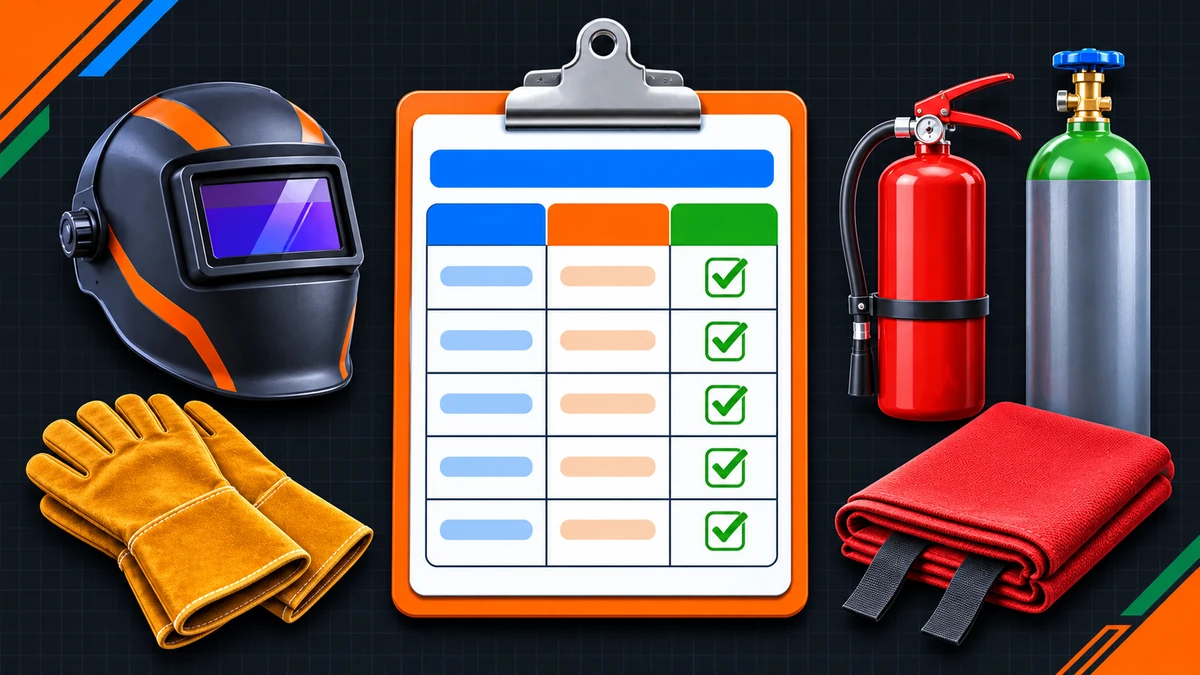
- A JSA breaks one welding task into steps, then lists the hazards, risk rating and controls for each step.
- A JSA identifies the hazards and controls; a hot work permit authorises the work at a specific place and time.
- Core welding hazards are fire, fume, arc radiation, electric shock, burns, falls, noise, gas cylinders and confined spaces.
- Controls must follow the hierarchy: eliminate, substitute, engineer, administer, then use PPE.
- The JSA must be written with the crew, briefed before work, signed, and revised whenever conditions change.
- Legal status and required format depend on the jurisdiction, client and company procedure applicable to your project.
What Is a JSA for Welding Jobs?
A job safety analysis is a documented method that breaks a task into steps, identifies hazards at each step and assigns controls before work begins.
For welding, the JSA names the process, the location and the crew, then walks through each step from setting up equipment to clean-up. It is also called a job hazard analysis (JHA), task risk assessment (TRA) or safe work method statement (SWMS). OSHA describes job hazard analysis as a technique that focuses on job tasks to find hazards before they occur.
This guide covers task-level JSA for welding, cutting and grinding in shops and the field. Individual hazards such as arc radiation or ventilation each have their own guides in the Safety & Compliance section of this site.
How is a JSA different from a hot work permit, risk assessment and method statement?
The four documents answer different questions, and welding jobs on controlled sites usually need more than one. The table compares typical use; names and requirements vary by company.
| Document | Main question it answers | Scope | Typical validity |
|---|---|---|---|
| JSA / JHA | What can go wrong in each step, and how is it controlled? | One defined task | While task and conditions stay the same |
| Hot work permit | Is it safe to do hot work here, now? | One place, one time window | Time-limited, often one shift |
| Risk assessment | What are the significant risks of this activity, area or process? | Activity, area or process | Reviewed on a cycle or after change |
| Method statement | In what sequence and by what method will the work be done? | Whole job or work package | For the job duration |
Failure mode and effects analysis (FMEA) is a related but different technique. It ranks failure modes of a product or process, while a JSA ranks the hazards to people during a task.
When Do You Need a JSA for a Welding Job?
You need a JSA before any welding task that is new, non-routine, high-risk or done in a controlled area, and whenever site rules or the contract require one. Many companies require it for all hot work outside a designated welding bay.
- Hot work in an operating plant, near flammable materials or in a permit-controlled area.
- Welding in confined spaces such as tanks, vessels, pits and trenches.
- Elevated work, including pipe racks, scaffolds, tank roofs and towers.
- Welding on stainless steel, galvanised steel or coated surfaces that produce hazardous fume.
- Field welding at a new location, with a new crew or after a change in method.
- Any repeat task where conditions have changed, or after an incident or near miss.
The legal basis of a JSA depends on the country, state and contract. Where local law, client rules and company procedure differ, follow the strictest requirement.
What Hazards Should a Welding JSA Cover?
A welding JSA should cover fire, fume, arc radiation, electric shock, burns, cylinders, noise, falls, manual handling and heat stress, plus any hazard created by the location. The list below is a prompt, not a substitute for looking at the actual job.
| Hazard | Typical cause | Typical controls |
|---|---|---|
| Fire and explosion | Spatter, sparks, hot slag, fuel gas, flammable vapour | Hot work permit, clear or cover combustibles, fire watch, extinguisher, gas testing where needed |
| Welding fume and gases | Consumables, coatings, stainless and galvanised steel, shielding gas | Local exhaust ventilation, general ventilation, correct position, respiratory protection per assessment |
| Arc radiation | Ultraviolet and infrared from the arc | Correct helmet filter, welding screens, covered skin, warning to nearby workers |
| Electric shock | Damaged cables, wet conditions, poor earthing, live parts | Cable inspection, dry insulating conditions, proper earth return, lockout tagout (LOTO) of machinery |
| Burns and spatter | Hot metal, slag, preheated parts, torch flames | FR clothing, gloves, face shield, cooling time, warning signs on hot parts |
| Compressed gas cylinders | Falls, leaks, flashback, damaged valves | Secure upright, valve caps, flashback arrestors, separate oxygen from fuel gas |
| Noise and grinding injuries | Grinders, chipping, air arc gouging | Guards, discs checked, face shield, hearing protection |
| Falls and dropped objects | Work at height, unprotected edges | Safe access, edge protection, harness tied off, tool lanyards, exclusion zone below |
| Manual handling and crush | Heavy plates, pipes, positioners, lifts | Mechanical lifting, rigging plan, positioner isolation, clear communication |
| Heat stress | Hot weather, heavy PPE, confined spaces | Shade, water, rest breaks, scheduling cooler hours, buddy checks |
Fume deserves special attention. The International Agency for Research on Cancer (IARC) classifies welding fumes as carcinogenic to humans, and the UK Health and Safety Executive (HSE) has stated that all welding fume, including from mild steel, can cause lung cancer. See our guide to welding ventilation requirements indoors and outdoors for control options.
Radiation and electrical hazards are the other two that routinely appear on incident reports. Filter selection and eye protection are covered in the guide to welding arc flash and eye injury prevention, and cable condition and earth return are covered in the welding cables, connectors and earthing guide.
What Is the Hierarchy of Controls for Welding Hazards?
The hierarchy of controls ranks hazard controls from most to least effective: elimination, substitution, engineering controls, administrative controls and personal protective equipment. A JSA should work from the top down and rely on PPE only for the risk that remains.
Elimination removes the hazard, for example by prefabricating a spool in the shop rather than welding it at height. Substitution replaces it with a lower-risk option, such as a process or consumable that generates less fume. Engineering controls isolate people from the hazard, administrative controls change how people work, and PPE protects the individual.
A JSA that lists only PPE for every hazard is a warning sign. It usually means the analysis stopped at the last line of defence.
How Do You Write a JSA for a Welding Job?
Write a welding JSA by defining the task, walking the site with the crew, listing the job steps, finding and rating hazards, applying controls, re-rating the risk and briefing everyone who signs. The numbered procedure below follows common industry practice.
- Define the task and scope. Write down exactly what work will be done, where, with which process, equipment and crew. A JSA covers one defined task, not a whole project.
- Assemble the crew and walk the site. Involve the welders and fitters doing the work, plus the supervisor and area authority where needed. Inspect the work area for combustibles, access, overhead work and nearby activities. A pre-weld checklist such as the pre-weld and post-weld inspection checklist helps cover equipment and joint readiness.
- Break the task into sequential steps. List the job steps in the order they will happen, from mobilisation to clean-up. Keep each step small enough that its hazards are easy to see.
- Identify the hazards at each step. For each step, ask what can hurt someone: fire, fume, radiation, shock, burns, falls, lifting, noise and confined space. Check the process, material, consumable safety data sheet and site conditions.
- Rate the risk. Score each hazard by likelihood and consequence using the project risk matrix. Record the initial risk before any new controls.
- Apply the hierarchy of controls. Choose controls in priority order: eliminate, substitute, engineering controls, administrative controls, then personal protective equipment. Name who is responsible for each control.
- Re-rate the residual risk and approve. Score the risk again with the controls in place. Anything still high needs further controls or higher-level approval before work starts.
- Brief the crew, sign and review. Brief everyone on the JSA, collect signatures, and make stop-work authority clear. Revise the JSA if the task, crew, location or conditions change.
Keep the language plain and specific. A control such as “be careful with sparks” does not help anyone; “fire blanket over the grating below and a fire watch with a 9 kg dry powder extinguisher” does.
How Do You Rate Risk in a Welding JSA?
Rate risk as likelihood multiplied by consequence, usually on a 5 x 5 matrix, and score each hazard twice: once before new controls and once after. The matrix below is illustrative; use the one in your company or project procedure.
Consequence stays high for hazards like fire and falls because the worst credible outcome does not change. Good controls reduce the likelihood, which is why the residual score moves down the matrix rather than across it.
Risk management principles are described in ISO 31000, and occupational health and safety management in ISO 45001 (both issued by ISO). Matrix definitions and acceptance criteria belong to your employer and project.
Worked Example: JSA for Field Pipe Welding at Height
This worked example shows an extract of a JSA for welding a 6 in. carbon steel pipe spool on an elevated pipe rack, using the matrix above. All inputs are illustrative; a real JSA must reflect the actual site, process and procedure.
| Hazard | Initial L x C | Controls | Residual L x C |
|---|---|---|---|
| Electric shock from damaged cable or wet ground | 2 x 5 = 10 High | Inspect cables and connectors, residual-current protection on supply, dry footing, earth clamp on the workpiece | 1 x 5 = 5 Medium |
| Fire from spatter reaching combustibles below | 3 x 5 = 15 High | Hot work permit, fire blankets, 11 m (35 ft) area cleared or protected, fire watch with extinguisher for at least 30 minutes after work | 1 x 5 = 5 Medium |
| Fume in a partly enclosed pipe rack | 4 x 3 = 12 High | Portable fume extractor at the arc, welder positioned out of the plume, respiratory protection if the assessment requires it | 2 x 3 = 6 Medium |
| Arc radiation to welder and bystanders | 4 x 2 = 8 Medium | Correct helmet filter, welding screens, covered skin, bystanders warned | 2 x 2 = 4 Low |
| Fall from 4 m working height | 3 x 5 = 15 High | Scaffold or work platform with edge protection, harness tied off, tool lanyards, exclusion zone below | 1 x 5 = 5 Medium |
| Hot metal burns and grinding injury | 4 x 2 = 8 Medium | FR clothing, gloves, face shield, guard on grinder, cooling time before handling | 2 x 2 = 4 Low |
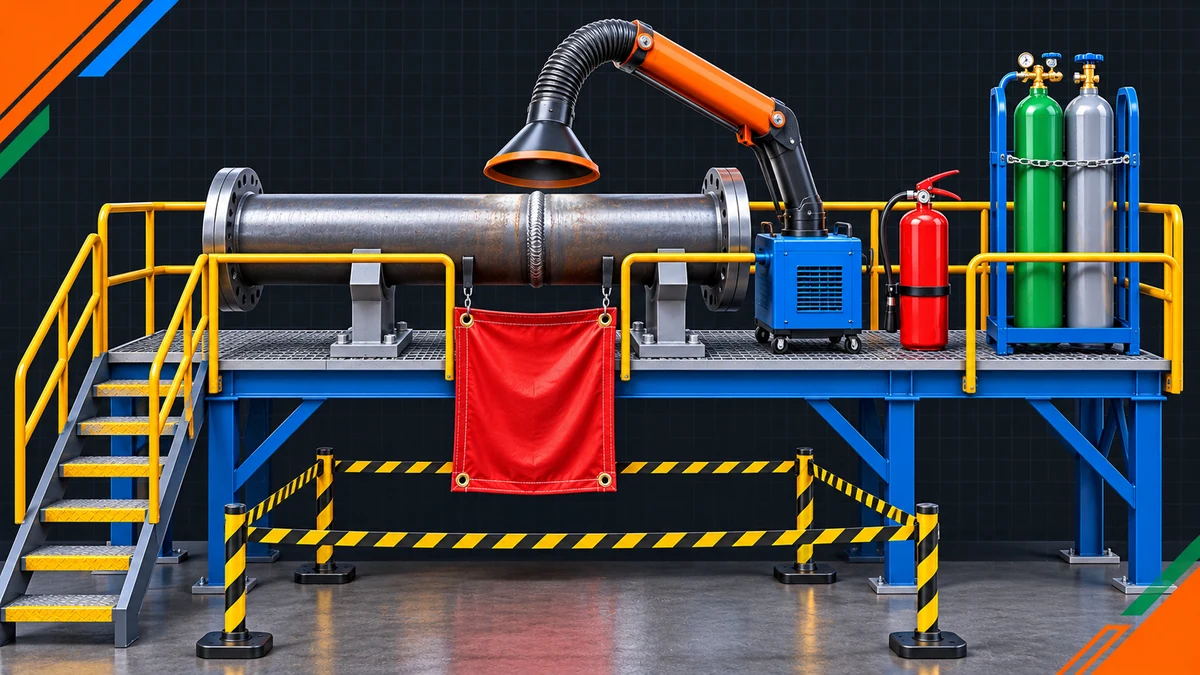
After controls, no hazard remains in the High band, and every residual score is Medium or Low. Several Medium scores sit on severe consequences (fire, fall, shock), so the controls must be verified in the field, not just written on the form. If a control cannot be put in place, the job stops until the JSA is revised.
How Does a Welding JSA Change by Work Environment?
The dominant hazards change with the environment, so a JSA copied from a shop job rarely fits a plant, tank or platform. Use the table below to decide where to focus the analysis.
| Environment | Dominant hazards | Additional JSA focus |
|---|---|---|
| Fabrication shop | Fume, noise, manual handling, crush | Fume extraction, lifting plans, positioner isolation |
| Operating plant (field) | Fire, explosion, simultaneous operations | Hot work permit, gas testing, isolation, area authority sign-off |
| Confined space | Oxygen deficiency, fume build-up, restricted escape | Entry permit, ventilation, gas monitoring, standby person, rescue plan |
| Offshore or marine | Fire, dropped objects, weather, limited escape | Permit to work interface, emergency response, weather limits |
| Work at height | Falls, dropped objects, spatter below | Platform design, harness anchors, exclusion zones, fire blankets |
In confined spaces, shielding gases such as argon and carbon dioxide can displace oxygen, and fume can accumulate quickly. See the confined space welding safety guide for entry controls. For platforms and ships, the permit interface and emergency response dominate, as discussed in welding in offshore oil and gas platforms.
Who Is Responsible for the JSA on a Welding Job?
Responsibility is shared: the supervisor owns preparation, the crew contributes and follows it, and the safety function and area authority review and approve it where site rules require. Exact titles vary by employer and contract.
- Welders and fitters: help identify hazards, follow the controls and stop work if conditions change.
- Welding supervisor or foreman: prepares the JSA, briefs the crew and checks controls in the field.
- Welding coordinator: aligns the JSA with the welding procedure and quality plan; see welding coordinator roles and responsibilities per ISO 14731.
- HSE officer: reviews the JSA against site rules and legal requirements.
- Area authority or permit issuer: confirms site conditions and issues the hot work permit.
How Do You Brief, Review and Close Out a JSA?
Brief the JSA verbally before work starts, have each person confirm understanding by signing, and review it whenever the task, crew, location or conditions change. The brief is where most of the safety value is created.
- Hold the brief at the work location, not in the office, and walk the hazards on site.
- Confirm that every person has stop-work authority and knows the emergency arrangements.
- Check the controls physically before the arc is struck: blankets, extraction, extinguisher, barriers.
- Revise the JSA when something changes, and re-brief the crew on the revision.
- After the job, record lessons learned and file the JSA with the permit and other safety records.
What Practical Notes Apply in India and the Gulf?
Heat, site permit systems and client rules shape the JSA in India and the Gulf. These notes are general practice; local law and client requirements govern.
- Heat stress: high ambient temperature plus PPE makes heat illness a real hazard. Include water, shade, rest breaks and cooler working hours in the controls.
- Summer work restrictions: several Gulf countries enforce midday outdoor work restrictions in summer. Confirm the current rule for your location before planning shifts.
- Client permit systems: plants and EPC projects commonly use their own JSA and permit-to-work formats. Use the client format where one is specified.
- Legal framework in India: requirements sit in laws such as the Factories Act, 1948 and state rules, plus client site rules. Check which apply to your site.
What Are the Most Common JSA Mistakes in Welding?
The most common JSA mistakes are copying an old form without a site walk, writing vague controls, relying on PPE alone, and not revising the JSA when conditions change. Each one makes the document look complete while leaving the real hazards unmanaged.
- Generic copy-paste JSAs. A template is a starting point; it must be checked against the actual job.
- Written by one person at a desk. The crew sees hazards the office misses.
- Vague controls. “Take care” is not a control. Name the measure and who is responsible.
- PPE as the only control. Check whether elimination, substitution or engineering controls were considered first.
- Ignoring neighbouring work. Simultaneous operations, overhead work and flammable sources nearby change the risk.
- Signing without a brief. Signatures should follow a real briefing, not replace it.
- Not revising after change. A new location, crew or weather condition needs a revised JSA.
Requirements depend on the code, regulation and contract specification applicable to your project, and on your employer’s procedure.
Quick Reference: JSA Welding Checklist
Use this checklist to test a welding JSA before work starts. Each item should be answerable with a clear yes from the form and the work area.
- Is the task defined, with process, location, equipment and crew named?
- Were the crew involved and the site walked?
- Does each job step list its hazards, including fire, fume, radiation, shock, burns and falls?
- Are risks rated before and after controls using the project matrix?
- Do controls follow the hierarchy, with PPE as the last item?
- Is a hot work permit, confined space permit or isolation in place where required?
- Are the fire watch, extinguisher, fire blankets and gas monitoring ready?
- Is the emergency plan known, including the nearest first aid and alarm point?
- Has everyone been briefed and signed, with stop-work authority confirmed?
| Process or task | Dominant hazards to check in the JSA |
|---|---|
| SMAW (stick) | Spatter, fume from rods and flux, slag burns, arc radiation, shock from damaged holders |
| GTAW (TIG) | Intense UV, ozone, tungsten grinding dust, shielding gas displacing oxygen in confined spaces |
| GMAW and FCAW | Higher fume output, spatter, ozone, cylinders and gas lines |
| SAW | Hot slag and flux handling, moving machinery, pinch points |
| Gas cutting and preheat | Fuel gas leaks, flashback, oxygen enrichment, flame burns |
| Air arc gouging | Molten metal spray, noise, heavy fume |
| Grinding and chipping | Disc failure, flying particles, noise, vibration |
Frequently Asked Questions
Is a JSA mandatory for welding work?
The name and legal status of the document depend on the country, the employer and the contract. Many jurisdictions require a documented risk assessment for hazardous tasks, and most plants, EPC contractors and oil and gas sites require a JSA or equivalent before hot work. OSHA describes job hazard analysis as a recommended technique, while site rules often make it mandatory. Always follow the strictest of the law, the client rules and your company procedure.
What is the difference between a JSA and a hot work permit?
A JSA identifies the hazards of a task and the controls needed. A hot work permit authorises the work at a specific place and time after someone has checked that the controls are in place. The JSA is usually valid while the task and conditions stay the same, while the permit is time-limited, often one shift. Both are normally required for welding in a live plant.
Are JSA, JHA, TRA and SWMS the same thing?
They are closely related names for task-level hazard analysis. JSA and JHA are common in North America and the Gulf, task risk assessment (TRA) is common in oil and gas, and safe work method statement (SWMS) is used in Australia. Formats and required content differ, so use the form your site or employer specifies.
Who should sign a welding JSA?
Everyone who will do the work should read and sign it, together with the supervisor who prepared it. Many sites also require sign-off from the area authority or HSE representative, and from the permit issuer when a hot work permit is involved. The signatures show that the crew understood the hazards and controls, not just that the form exists.
Do you need a new JSA for every welding job?
You need a JSA for each distinct task, but you can reuse a reviewed template for repeat work in the same conditions. Check the template against the actual location, crew, equipment, materials and weather before each use. Write a new or revised JSA whenever the task, location, process, materials or site conditions change.
What PPE should a welding JSA list?
PPE depends on the process and the risks, but a typical list includes a welding helmet with the correct filter, flame-resistant clothing, leather gloves, safety boots, safety glasses under the helmet, and hearing protection when grinding. Respiratory protection is added when fume assessment or the safety data sheet requires it. PPE is the last line of defence, so the JSA should list higher-level controls first.
How often should a welding JSA be reviewed?
Review it before each use, whenever conditions change, and after any incident or near miss. Many companies also review standing JSA templates on a fixed cycle, such as annually, as part of their safety management system. Reviews should check that controls still work in practice, not only that the paperwork is current.
Key Terms
- Job safety analysis (JSA)
- A written breakdown of a task into steps, hazards and controls prepared before the work starts.
- Hierarchy of controls
- A ranking of control measures from elimination down to personal protective equipment.
- Residual risk
- The risk that remains after controls have been applied.
- Hot work permit
- A time-limited authorisation to carry out welding or other hot work at a specific place.
- Fire watch
- A trained person who watches for sparks and fire during hot work and for a set period afterwards.
- Local exhaust ventilation (LEV)
- An extraction system that captures welding fume at or near the arc before it reaches the breathing zone.
- Stop-work authority
- The right and duty of any worker to halt a job when conditions are unsafe.
- Task risk assessment (TRA)
- A task-level hazard and risk review, often used as another name for a JSA.
Conclusion
A JSA for welding works when it is written with the crew, specific to the task, and checked in the field. Break the job into steps, find the hazards at each step, rate the risk, and apply controls from elimination down to PPE. Re-rate the residual risk, brief everyone, and revise the document whenever conditions change. Keep the signed JSA with the permit and other safety records for the job.
Good JSA welding practice also links to the permit system and to basic fire readiness. As a next step, review our fire extinguisher types guide to confirm that the extinguisher named in your JSA suits the fire risks at the work position.
Standards and References
- ANSI/ASSP Z49.1 – Safety in Welding, Cutting, and Allied Processes (American Welding Society (AWS) and ASSP)
- NFPA 51B – Standard for Fire Prevention During Welding, Cutting, and Other Hot Work (NFPA)
- 29 CFR 1910.252 – Welding, Cutting, and Brazing – General Requirements (OSHA)
- 29 CFR 1910.146 – Permit-Required Confined Spaces (OSHA)
- 29 CFR 1910.147 – The Control of Hazardous Energy (Lockout/Tagout) (OSHA)
- OSHA 3071 – Job Hazard Analysis (OSHA)
- ISO 45001 – Occupational health and safety management systems – Requirements with guidance for use (ISO)
- ISO 31000 – Risk management – Guidelines (ISO)
- IEC 60974-1 – Arc welding equipment – Part 1: Welding power sources (IEC)
Primary sources: Occupational Safety and Health Administration (OSHA), UK Health and Safety Executive (HSE), American Welding Society (AWS) and National Fire Protection Association (NFPA).
This guide was prepared by the WeldFabWorld technical team from the standards listed above. Verify all requirements against the regulations, client rules and company procedures applicable to your project.