The polyurethane vs epoxy topcoat decision controls how a coated steel structure looks and performs after its first years in service, because the topcoat is the only layer that faces sunlight, rain, chemicals and abrasion directly.
In a polyurethane vs epoxy topcoat decision, polyurethane is the standard choice for outdoor steel, because aliphatic polyurethane resists ultraviolet (UV) light and keeps its gloss and colour. Epoxy gives tougher chemical and abrasion resistance but chalks and fades in sunlight, so it suits indoor, immersion and chemical-exposed surfaces. Most durable systems put an epoxy coat under a polyurethane finish.
This guide compares the two finish coats on chemistry, UV behaviour, chemical resistance, application and cost, then shows how to combine them. It covers topcoats only. For the layer underneath, see our epoxy primer vs zinc-rich primer selection guide.
Wrong topcoat chemistry is one of the most preventable causes of early coating breakdown. Chalking, colour change and gloss loss are well-documented failure modes in the guide to coating defects, causes and challenges, and most of them trace back to a topcoat that did not match the exposure.
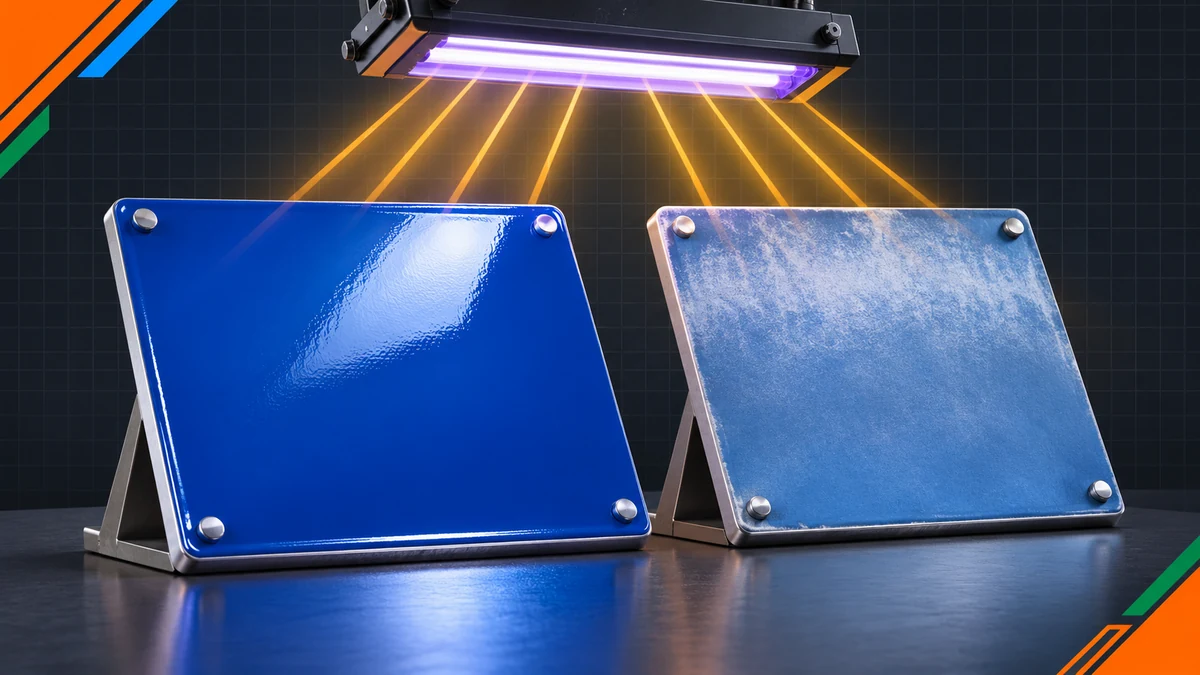
- Aliphatic polyurethane is UV stable, so it keeps gloss and colour on exterior steel; epoxy topcoats chalk and fade in sunlight.
- Epoxy generally resists chemicals, solvents and abrasion better, and it is the usual choice for tank linings, immersion and indoor service.
- The best-performing systems combine both: epoxy for barrier build, polyurethane as the UV-stable finish.
- Polyurethane must be applied within the epoxy overcoat window, and it is more sensitive to moisture during application.
- Isocyanate hardeners in polyurethane are respiratory sensitisers, so spray application needs proper respiratory protection and control.
- Requirements depend on the project specification and the coating manufacturer’s data sheet, not on rules of thumb alone.
What Is a Topcoat and Why Does the Choice Matter?
A topcoat is the final paint layer that protects a coating system from weather, chemicals and wear while providing colour and gloss.
In a typical industrial system on steel, the primer provides adhesion and, with zinc, galvanic protection. The intermediate coat builds film thickness as a barrier. The topcoat, usually 50 to 80 µm dry film thickness (DFT), takes the exposure. It is also the layer owners see, which is why colour and gloss retention matter for facilities, tank farms and bridges.
This article compares epoxy and polyurethane finish coats on carbon and low-alloy structural steel. It does not cover primers, powder coatings, or specialist high-temperature and fire-protection coatings. All coating systems sit in the Painting & Coatings section of this site.
Where does the topcoat sit in the coating system?
The topcoat sits last, over the primer and any intermediate coat. Its job differs from the layers below, so a topcoat that is perfect for chemical resistance can still be wrong for sunlight. Three questions drive the choice:
- Will the surface see sunlight, and does appearance matter?
- Will it be immersed, splashed or washed with chemicals?
- What durability range does the ISO 12944 specification require?
How Do Epoxy and Polyurethane Topcoats Differ in Chemistry?
Epoxy topcoats cure when an epoxy resin reacts with an amine-based hardener, forming a dense, aromatic network with excellent adhesion and chemical resistance. Polyurethane topcoats cure when a polyol reacts with an isocyanate hardener. Aliphatic grades have no aromatic rings in the backbone, which is why they resist UV.
What is an epoxy topcoat made of?
Epoxy topcoats are two-component (2K) products. The base contains epoxy resin, usually bisphenol-based, plus pigments and extenders. The hardener is an amine, amidoamine or polyamide, and the two react chemically after mixing.
The cured film is hard, tightly cross-linked and strongly adherent to blast-cleaned steel and to other epoxy coats. The same aromatic structure that gives epoxy its toughness is also what absorbs UV light, which leads to the outdoor weakness covered below.
What is a polyurethane topcoat made of?
Polyurethane (PU) topcoats are also 2K. The base is a polyol, commonly an acrylic or polyester polyol, with pigment. The hardener is a polyisocyanate. For exterior work the hardener is aliphatic, typically based on hexamethylene diisocyanate (HDI).
The cured film is flexible, glossy and UV stable, and it holds colour well. It is thinner than a typical epoxy build coat and depends on the coats beneath it for the corrosion barrier.
What is the difference between aliphatic and aromatic polyurethane?
Aliphatic polyurethane uses isocyanates without aromatic rings, so it resists UV and keeps its appearance outdoors. Aromatic polyurethane uses aromatic isocyanates, costs less, and yellows and chalks in sunlight. Only aliphatic grades belong in an exterior finish coat.
Why Does an Epoxy Topcoat Chalk and Fade Outdoors?
An epoxy topcoat chalks outdoors because UV light degrades its aromatic binder at the surface, leaving loose pigment as a powder and dulling gloss and colour. The process starts within the first months of exposure, and its speed depends on climate, colour and product.
Chalking is a surface effect. Photo-oxidation breaks polymer chains in the outer film, the binder erodes, and pigment particles are freed. Gloss drops, dark colours look washed out, and light colours often yellow. The film also loses thickness slowly as the chalk washes away.
Chalking is rated with a tape or rub method. ISO 4628-6 assesses the degree of chalking by tape on a 0 to 5 scale, and ASTM D4214 gives test methods for evaluating chalking on exterior paint films. Gloss is measured with ASTM D523. Laboratory UV exposure uses ASTM G154 (fluorescent UV), ASTM G155 (xenon arc) or the ISO 16474 series.
Chalk is a weak boundary layer. Wash and scrub it off, or abrade the surface, before applying any new coat, otherwise adhesion will fail in the chalk layer. Our coating breakdown and failure analysis case studies include a tank exterior where an approved substitution of an epoxy finish for a polyurethane finish led to early chalking.
Chalking does not mean the steel is unprotected. While enough film remains, the barrier still works. The cost is cosmetic and maintenance related: faded colour coding, dull appearance and an earlier repaint cycle.
Polyurethane vs Epoxy Topcoat: How Do They Compare Side by Side?
Epoxy leads on chemical resistance, hardness and film build, while polyurethane leads on UV stability, gloss retention and flexibility. The table below compares typical behaviour of standard industrial products; individual products vary, so use the data sheet for design values.
| Property | Epoxy topcoat | Aliphatic polyurethane topcoat |
|---|---|---|
| UV resistance | Poor Chalks and fades | Excellent Stable outdoors |
| Gloss and colour retention | Low Yellowing common | High Holds appearance |
| Chemical and solvent resistance | Strong Broad resistance | Moderate Good for mild chemicals |
| Abrasion and hardness | Strong Hard film | Good Tough and flexible |
| Flexibility | Moderate More brittle | Good Tolerates movement |
| Typical DFT per coat | 75 to 150 µm (high-build more) | 50 to 80 µm |
| Continuous immersion | Yes With lining-grade product | No Not for standard grades |
| Moisture sensitivity when applying | Low to moderate; amine blush in cool, humid air | High; moisture causes bubbles and gloss loss |
| Overcoat sensitivity | Strict maximum overcoat interval | Recoatable; abrade weathered film first |
| Main health hazard | Amine skin sensitisation | Isocyanate respiratory sensitisation |
| Relative cost per litre | Lower | Higher |
| Typical role | Primer, build coat, interior or immersion topcoat | Exterior finish coat over epoxy |
When Should You Specify an Epoxy Topcoat and When Polyurethane?
Specify polyurethane where sunlight or appearance matters, and specify epoxy where chemical exposure, immersion or abrasion dominates and sunlight does not. When both apply, use an epoxy build coat with a polyurethane finish.
When is an epoxy topcoat the right choice?
- Indoor equipment, plant rooms and structures with no direct sunlight.
- Tank and vessel interiors, bunds and secondary containment, where a lining-grade epoxy is the standard. See our tank lining coatings selection and application guide.
- Chemical splash zones, process areas and floors with heavy abrasion.
- Underside, hidden or internal surfaces where chalking and colour change do not matter.
When is a polyurethane topcoat the right choice?
- Exterior structural steel, pipe racks, storage tank exteriors and bridges.
- Offshore and marine atmospheric zones, usually over zinc primer and epoxy build coat. See the marine and offshore coating systems guide.
- Colour-coded piping, safety markings and branded equipment where colour must last.
- Maintenance repaints where a UV-stable finish is added over sound epoxy.
How does ISO 12944 corrosivity category affect topcoat choice?
ISO 12944 classifies atmospheric environments into corrosivity categories from C1 (very low) to C5 (very high), with CX added in the 2018 edition, and sets four durability ranges: low, medium, high and very high. The category and durability range set the system build, but UV exposure decides the finish chemistry independently of category. Offshore projects often add NORSOK M-501 requirements on top.
| Exposure condition | Typical topcoat | Reason |
|---|---|---|
| Indoor, dry, C1 to C2 | Epoxy | No UV; economical, tough |
| Outdoor, C3 to C5 | Aliphatic polyurethane | UV stability, colour retention |
| Offshore, marine atmospheric | Polyurethane (or fluoropolymer, polysiloxane) | UV plus salt; long durability range |
| Tank interior, immersion | Lining-grade epoxy | Chemical resistance, low permeability |
| Chemical splash area | Epoxy or novolac epoxy | Resistance to solvents and acids |
Corrosivity categories and system durability come from the ISO 12944 series (issued by ISO). Requirements depend on the code edition and contract specification applicable to your project.
How Are Epoxy and Polyurethane Used Together in One System?
Epoxy and polyurethane are used together because each does a job the other does poorly: epoxy builds the barrier and polyurethane protects the epoxy from UV and keeps the finish. Replacing the polyurethane with another epoxy coat keeps the barrier but loses the UV protection.
A typical durable system on blast-cleaned steel is a zinc-rich primer, an epoxy intermediate coat and a polyurethane topcoat. In lower corrosivity categories the zinc primer is often replaced by an epoxy primer, giving a two-coat epoxy and polyurethane system.
Zinc silicate primers need extra care. A porous inorganic zinc film can release air under a full-build topcoat and cause bubbles and pinholes, so a mist coat or tie coat is often used. The inorganic zinc silicate coatings guide explains the sequencing in detail.
What is the overcoat window and why does it matter?
The overcoat window is the time range during which a coating can be recoated without special preparation. Epoxy has a minimum interval, so it is dry enough to take the next coat, and a maximum interval, after which it cures too hard for good chemical bonding. Polyurethane applied beyond the maximum interval may show poor intercoat adhesion unless the surface is abraded as the data sheet directs.
How Do You Apply a Polyurethane Topcoat Over Epoxy?
Apply a polyurethane topcoat over epoxy by confirming the overcoat window, preparing the surface, checking the weather, mixing correctly, and then spraying and inspecting the film. The steps below follow common industry practice; the data sheet and project specification always take priority.
- Confirm the epoxy is within its overcoat window. Check the epoxy data sheet for minimum and maximum overcoat intervals at the actual temperature. Confirm the epoxy is touch-dry and cured enough to accept the topcoat.
- Clean and prepare the epoxy surface. Remove dust, oil, grease and soluble salts. Wash off any amine blush with clean water and let the surface dry. Lightly abrade if the overcoat window has been exceeded.
- Check the environmental limits. Measure air temperature, steel temperature and relative humidity. The steel must be at least 3 degrees C above the dew point, and the readings must sit inside the data sheet limits. See the guides on coating application weather restrictions and dew point and humidity calculation for painting.
- Mix the two components correctly. Mix base and hardener in the stated ratio, allow the induction time if required, and note the pot life. Never add moisture-containing thinner to a polyurethane.
- Stripe coat edges, welds and fasteners. Brush a stripe coat on edges, weld caps, bolts and corners before the full coat, so these thin-film areas reach the specified thickness.
- Spray the full coat and check wet film thickness. Apply the topcoat in even, overlapping passes. Check wet film thickness with a comb gauge during application to predict the final dry film thickness. Equipment choice is covered in the airless spray vs conventional spray painting guide.
- Cure and measure dry film thickness. Allow the coating to cure for the time on the data sheet, then measure dry film thickness and compare it with the specified minimum and maximum.
- Inspect the finished topcoat. Inspect for runs, sags, dry spray, pinholes and colour match. Carry out adhesion and holiday tests only where the specification requires them. Test methods are summarised in coating and painting tests and pinhole detector testing for coatings.
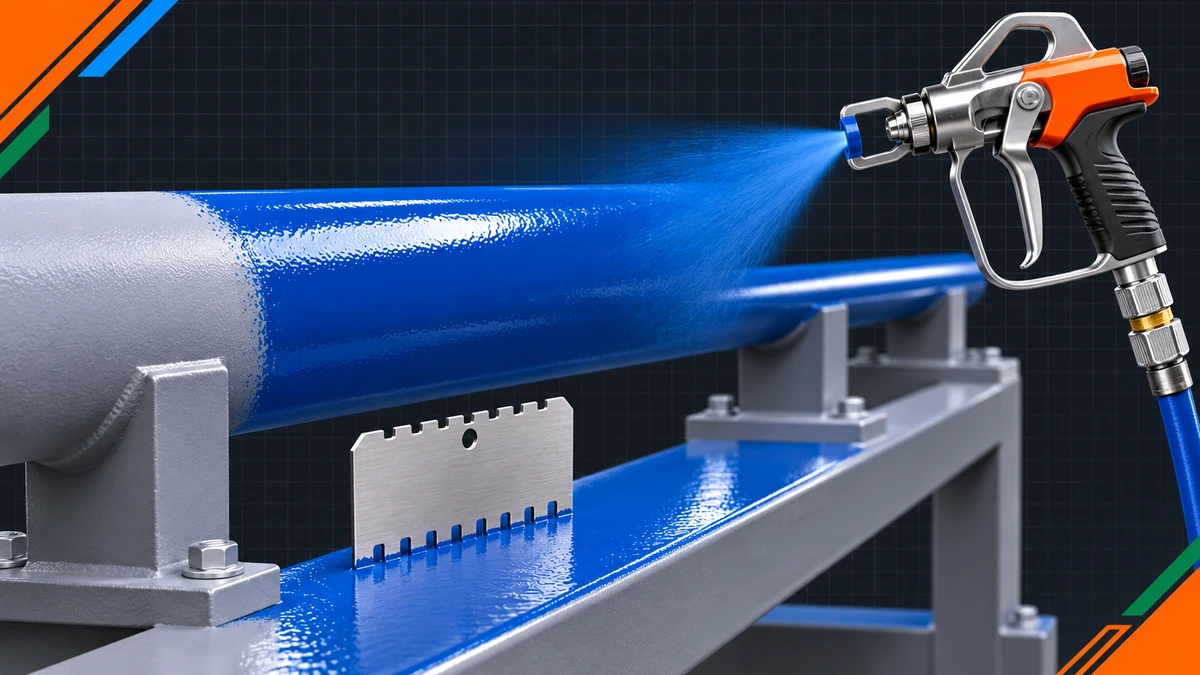
Adhesion of a polyurethane topcoat to epoxy is commonly verified by pull-off testing to ISO 4624 or ASTM D4541, where the specification calls for it. Typical acceptance values are set by the project specification and product data sheet, not by the test standard itself.
How Much Topcoat Do You Need? Worked Coverage Example
Topcoat quantity depends on volume solids, target dry film thickness and application losses. The theoretical coverage in square metres per litre equals 10 multiplied by volume solids percent, divided by DFT in micrometres.
The polyurethane needs slightly less paint here because its specified DFT is lower, even though its volume solids are lower too. Real products differ, so use the data sheet values. Measurement of the finished film follows the guidance in the dry film thickness (DFT) testing guide, and rough blasted steel is addressed by ISO 19840 (ISO).
What Are the Health and Safety Differences?
The main hazard of polyurethane is isocyanate, a respiratory sensitiser, while the main hazard of epoxy is amine hardener, a skin and eye sensitiser. Both products also contain flammable solvents, so ventilation and ignition control apply to each.
- Polyurethane: isocyanate vapour and spray mist can cause occupational asthma. Spray application normally calls for air-fed respiratory protection, controlled work areas and health surveillance as required by local rules.
- Epoxy: amine hardeners can cause skin burns and dermatitis. Use gloves, eye protection and good housekeeping, and avoid skin contact with mixed material.
- Confined spaces: tank interiors need forced ventilation and gas monitoring for both systems.
Control measures must follow the product safety data sheet, local regulation and your employer’s risk assessment. Guidance on isocyanates is available from the UK Health and Safety Executive.
What Practical Notes Apply in India and the Gulf?
High UV, high humidity and hot steel surfaces affect topcoat choice and application in India and the Gulf. These notes are general practice; project specifications and local clients’ requirements govern.
- UV exposure: intense sunlight makes unprotected epoxy topcoats chalk quickly, so a UV-stable finish is advisable on visible exterior steel.
- Monsoon and coastal humidity (India): high humidity and condensation make moisture control critical for polyurethane. Measure dew point and steel temperature, and stop work when conditions fall outside limits.
- Hot surfaces (Gulf): steel in direct sun can run far hotter than the air. Check the maximum application temperature on the data sheet, because heat shortens pot life and can cause dry spray or solvent boiling.
- Coastal and offshore sites: these are frequently in the highest corrosivity categories, which favours a full zinc, epoxy and polyurethane system.
What Are the Most Common Topcoat Mistakes?
The most common topcoat mistakes are choosing on cost alone, ignoring UV exposure, missing the overcoat window, and applying polyurethane in damp conditions. Each one is avoidable with a documented check before painting.
- Substituting epoxy for polyurethane because it is in stock. The product may be fine for corrosion and fail visually within a year or two outdoors.
- Using aromatic polyurethane outdoors. It is cheaper but yellows and chalks like epoxy.
- Missing the overcoat window. Over-cured epoxy gives weak intercoat adhesion. Abrade as the data sheet directs.
- Leaving amine blush on epoxy. The greasy film forms in cool, humid conditions and must be washed off before recoating.
- Applying polyurethane in damp air or on a damp surface. Isocyanate reacts with water, which causes bubbles, pinholes and loss of gloss.
- Skipping stripe coats. Edges and welds lose film thickness by surface tension and fail first. Our surface preparation standards guide covers the preparation that supports these details.
- Overlooking limits of the product. Standard organic topcoats are not high-temperature or immersion coatings unless the data sheet says so.
All requirements depend on the code edition and contract specification applicable to your project, and on the manufacturer’s data sheet.
Quick Reference: Topcoat Selection Cheat Sheet
Use the flowchart and table below as a first screen when choosing between an epoxy topcoat and a polyurethane topcoat. They summarise common practice and do not replace the project specification.
| If the surface is… | Then specify… |
|---|---|
| Outdoors, visible, appearance matters | Aliphatic polyurethane over epoxy system |
| Outdoors, hidden or underside | Epoxy may be acceptable; confirm with specification |
| Indoors, no sunlight | Epoxy topcoat |
| Immersed or in chemical service | Lining-grade epoxy or novolac epoxy |
| Offshore, splash or highest corrosivity | Full zinc, epoxy and polyurethane system, or duplex system |
| Needs UV stability with extra durability | Consider polysiloxane or fluoropolymer finish |
Frequently Asked Questions
Can you apply polyurethane over epoxy?
Yes. Applying a polyurethane topcoat over a cured epoxy primer or intermediate coat is the standard practice for outdoor steel. The polyurethane must go on within the epoxy overcoat window stated on the data sheet, because fully cured epoxy has a hard, low-energy surface. If the window is exceeded, lightly abrade the epoxy to a uniform scuffed finish, remove all dust, and follow the manufacturer’s instructions for recoating.
Can an epoxy topcoat be used outdoors?
An epoxy topcoat can protect steel outdoors, but it chalks, fades and loses gloss under sunlight. The corrosion barrier remains while the film is intact, so the damage is mainly cosmetic at first. Epoxy is acceptable on unseen surfaces or where appearance does not matter, but most exterior specifications require a UV-stable polyurethane or similar finish coat on visible steel.
Why does epoxy paint chalk and yellow in sunlight?
Most epoxy resins contain aromatic rings that absorb ultraviolet light. Absorbed UV breaks bonds at the film surface, and the degraded binder releases pigment as a loose powder, which is chalking. Aromatic structures also oxidise to coloured by-products, which explains the yellowing seen on light colours.
Is polyurethane topcoat more expensive than epoxy?
Per litre, aliphatic polyurethane topcoats usually cost more than standard epoxy topcoats. The comparison should use total life-cycle cost, however. A polyurethane finish that keeps its appearance for the design life can avoid an early recoat, and access, blasting and downtime during recoating often cost more than the paint itself.
Can polyurethane be applied directly to bare steel?
Polyurethane topcoats are not formulated to be the only coat on blast-cleaned steel. They depend on a primer for adhesion and corrosion protection, and usually on an intermediate coat for barrier thickness. Direct-to-metal polyurethane products exist for light-duty service, but they are a different product class and should follow the data sheet and project specification.
Which has better chemical resistance, epoxy or polyurethane?
Epoxy generally resists a wider range of chemicals, solvents and fuels than polyurethane, which is why epoxy is common in tank linings and chemical splash zones. Polyurethane gives good resistance to weathering, mild chemicals and cleaning agents. Always check the manufacturer’s chemical resistance chart for the exact chemical, concentration and temperature.
What is the difference between aliphatic and aromatic polyurethane?
Aliphatic polyurethane uses an isocyanate hardener without aromatic rings, so it resists UV, holds gloss and keeps its colour outdoors. Aromatic polyurethane is cheaper but yellows and chalks in sunlight, so it suits indoor or primer-type use rather than an exterior finish coat.
Key Terms
- Aliphatic isocyanate
- A polyurethane hardener without aromatic rings that gives the cured film UV stability.
- Amine blush
- A greasy surface film that forms on curing epoxy in cool, humid conditions and must be removed before recoating.
- Chalking
- Powdery residue on a coating surface caused by binder breakdown and pigment release under UV light.
- Dry film thickness (DFT)
- The thickness of a coating after it has fully cured, measured from the substrate.
- Overcoat window
- The time range during which a coating can be recoated without special surface preparation.
- Polyol
- The resin component of a polyurethane that reacts with an isocyanate hardener to form the film.
- Pot life
- The time after mixing a two-component coating during which it can still be applied properly.
- Volume solids
- The percentage of a wet coating by volume that remains as dry film after solvent evaporates.
Conclusion
The polyurethane vs epoxy topcoat choice comes down to exposure. Use aliphatic polyurethane where sunlight, colour and gloss matter, and use epoxy where chemicals, immersion or abrasion dominate and there is no UV. For durable outdoor systems, combine them: an epoxy build coat for barrier protection under a polyurethane finish for UV stability. A short pre-paint checklist covering UV exposure, chemical exposure, overcoat window and film thickness prevents most topcoat failures in service.
Check the overcoat window, control moisture when applying polyurethane, and verify the specified film thickness. For the next step, review the anti-corrosive coating selection guide by environment to match a full system to your corrosivity category.
Standards and References
- ISO 12944 series – Paints and varnishes – Corrosion protection of steel structures by protective paint systems (ISO)
- ISO 8501-1 – Preparation of steel substrates before application of paints and related products – Visual assessment of surface cleanliness – Part 1 (ISO)
- ISO 8503 series – Preparation of steel substrates before application of paints and related products – Surface roughness characteristics of blast-cleaned steel substrates (ISO)
- ISO 2808 – Paints and varnishes – Determination of film thickness (ISO)
- ISO 19840 – Paints and varnishes – Corrosion protection of steel structures by protective paint systems – Measurement of, and acceptance criteria for, the thickness of dry films on rough surfaces (ISO)
- ISO 4628-6 – Paints and varnishes – Evaluation of degradation of coatings – Assessment of degree of chalking by tape method (ISO)
- ISO 4624 – Paints and varnishes – Pull-off test for adhesion (ISO)
- ISO 16474 series – Paints and varnishes – Methods of exposure to laboratory light sources (ISO)
- ASTM D4214 – Standard Test Methods for Evaluating the Degree of Chalking of Exterior Paint Films (ASTM International)
- ASTM D523 – Standard Test Method for Specular Gloss (ASTM International)
- ASTM D4541 – Standard Test Method for Pull-Off Strength of Coatings Using Portable Adhesion Testers (ASTM International)
- ASTM G154 – Standard Practice for Operating Fluorescent Ultraviolet (UV) Lamp Apparatus for Exposure of Nonmetallic Materials (ASTM International)
- ASTM G155 – Standard Practice for Operating Xenon Arc Light Apparatus for Exposure of Materials (ASTM International)
- NORSOK M-501 – Surface preparation and protective coating (Standards Norway)
Primary sources: International Organization for Standardization, ASTM International and Association for Materials Protection and Performance (AMPP).
This guide was prepared by the WeldFabWorld technical team from the standards listed above. Verify all requirements against the code edition, product data sheet and specification applicable to your project.