Airless Spray vs Conventional Spray Painting Guide
Choosing between airless spray and conventional (air) spray painting shapes almost everything downstream in a coating application job, from production rate and finish quality to material consumption and the technique an applicator needs to master. Airless spray dominates large-scale industrial and structural steel coating work because of its speed and penetration, while conventional spray, particularly its HVLP variant, remains the standard choice wherever fine finish quality and precise control matter more than raw coverage speed.
This guide explains how each atomization method actually works, compares transfer efficiency and finish quality, walks through airless spray tip selection, covers correct spray technique and common defects, and highlights the serious injection injury risk unique to airless equipment that every applicator must understand before picking up a gun.
This article covers airless and conventional air-atomized spray application of liquid coatings on steel structures. It does not cover electrostatic liquid spray or powder coating application, which are covered separately in our powder coating process guide.
How Each Method Atomizes Paint
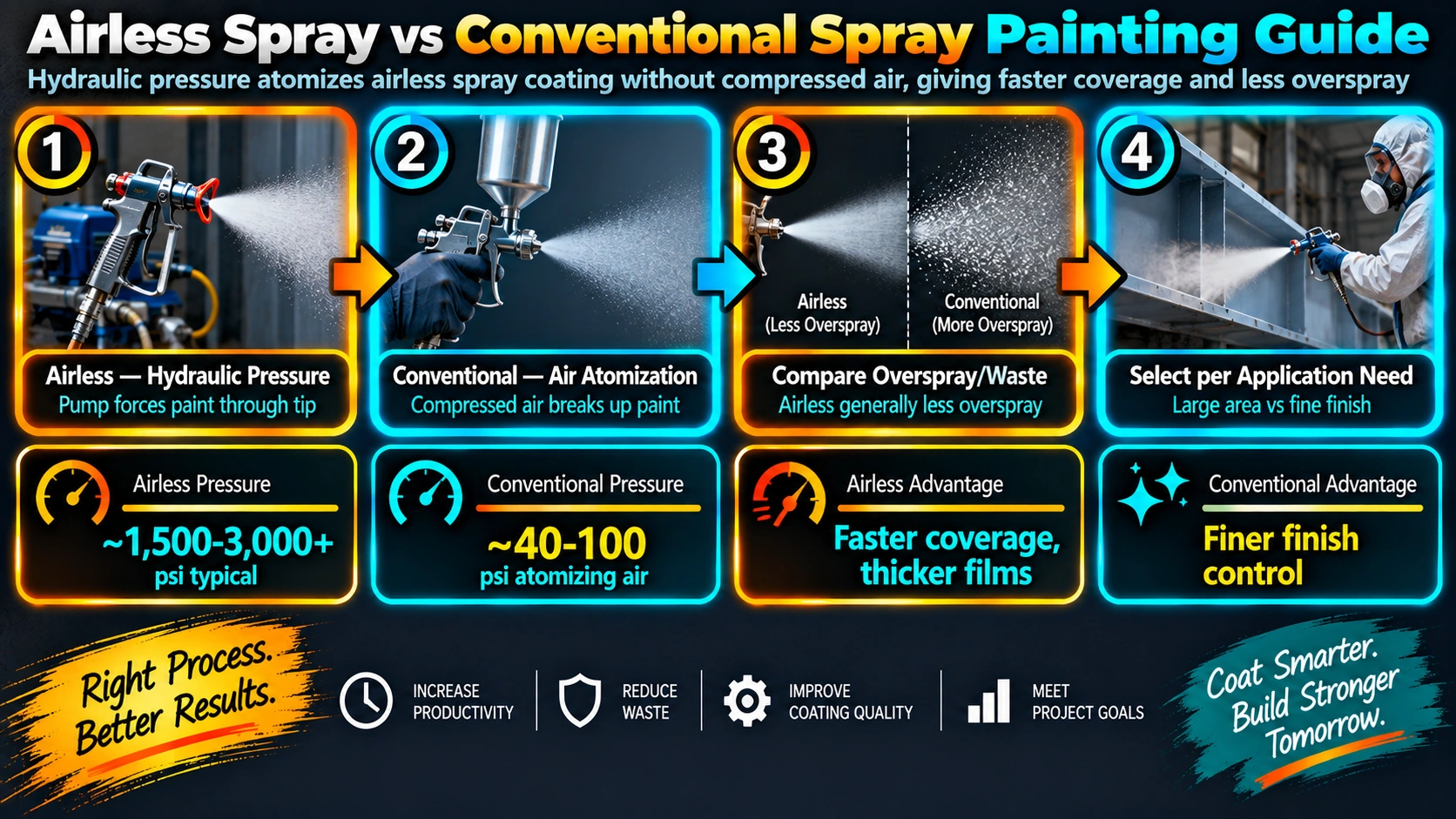
Airless Spray
Airless spray uses a hydraulic pump to pressurize the coating material, typically to 1500 to 3000+ psi depending on the material and equipment, and forces it through a small, precisely shaped tip orifice. The sudden pressure drop as fluid exits the tip causes it to atomize into fine droplets purely through hydraulic shear, with no compressed air involved in the atomization process itself, though air is still used elsewhere in the shop for tools and blasting.
Conventional (Air) Spray
Conventional spray guns mix compressed air with the coating fluid stream, either inside the gun (internal mix) or just outside the nozzle (external mix), breaking the fluid into a fine mist through air shear rather than hydraulic pressure. This generally produces a finer, more controllable atomization pattern than airless spray, at the cost of higher overspray volume and typically slower coverage rate on large areas.
Comparison Summary
| Property | Airless Spray | Conventional Spray |
|---|---|---|
| Atomization method | Hydraulic pressure through tip orifice | Compressed air mixed with fluid stream |
| Typical pressure | 1500-3000+ psi | Air pressure typically 30-70 psi (HVLP lower) |
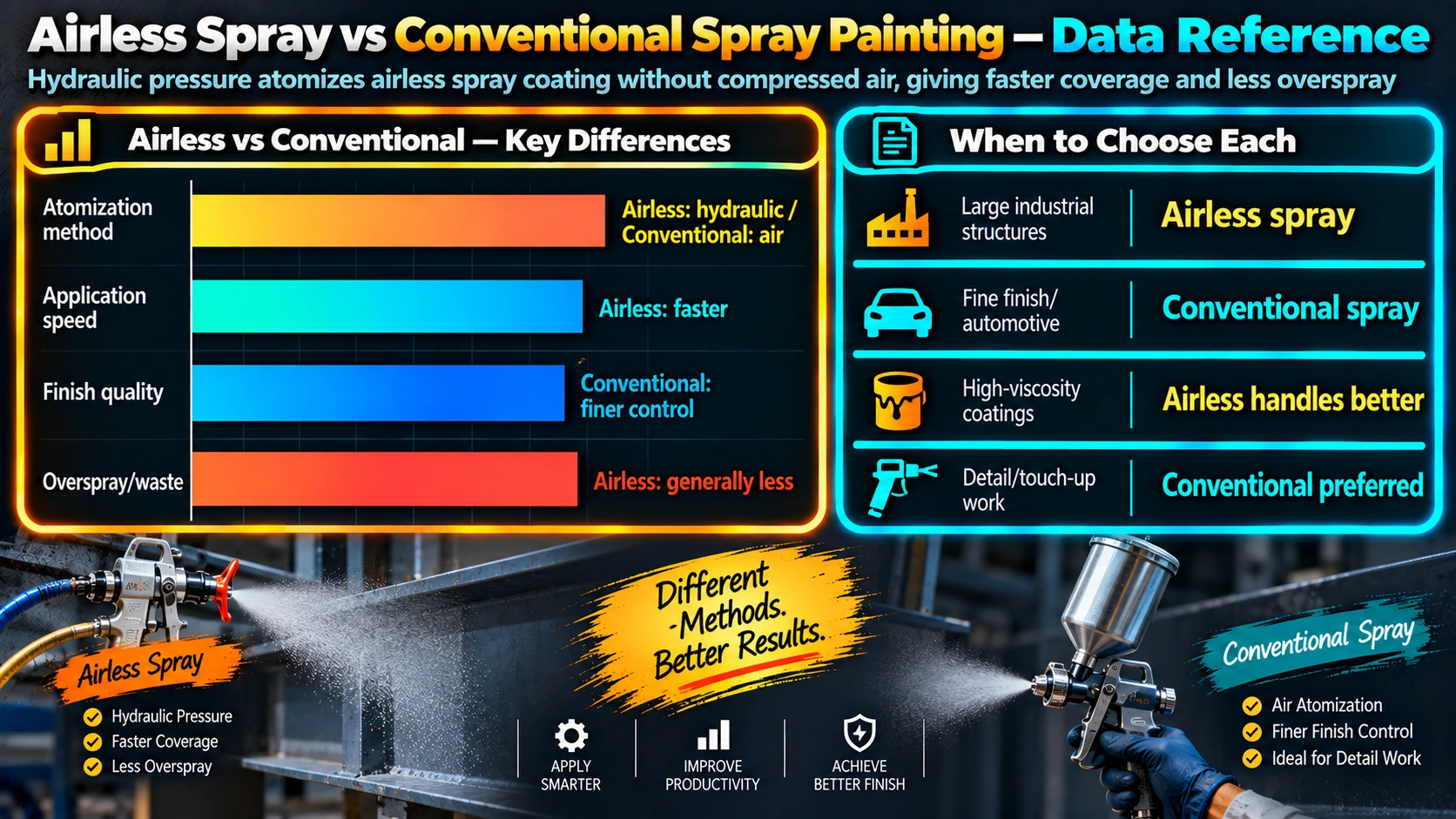
| Transfer efficiency | Moderate-good, less fine overspray than standard conventional | Lower for standard; HVLP specifically designed for high efficiency |
| Production rate | Fast, ideal for large surfaces | Slower, better suited to smaller/detailed work |
| Finish quality/control | Good for industrial finish, less fine control | Finer atomization, better for decorative/precision finish |
| Penetration into recesses/profile | Better, forces material into rough surface profile | Can struggle on very rough or complex surfaces |
| Typical use | Structural steel, tanks, pipelines, large industrial coatings | Automotive refinish, furniture, decorative and small parts |
Airless Spray Tip Selection
Airless spray tips are labeled with a number combining fan width and orifice size, and selecting the correct tip for the coating being applied is essential for both finish quality and efficient material use.
Coating manufacturers publish recommended tip size ranges specific to their product’s viscosity, and using a tip outside that range can produce poor atomization, excessive overspray, or an uneven film build regardless of correct pump pressure setting.
Correct Spray Technique
| Technique Element | Guidance |
|---|---|
| Gun distance from surface | Typically 10-14 inches (25-35cm) for airless; adjust per tip fan width |
| Gun angle | Keep perpendicular to surface; avoid arcing the stroke |
| Overlap | 50% overlap between passes for uniform film build |
| Trigger technique | Trigger at the start of each pass, release at the end, not mid-stroke |
| Stroke speed | Consistent speed matched to pump output for even wet film thickness |
Use a wet film comb periodically during application to confirm technique and pressure settings are producing the target film build, rather than relying on visual judgment alone, since WFT checks catch a drifting technique before it affects a large area.
Common Spray Defects
| Defect | Common Cause |
|---|---|
| Tails/fingers (ragged fan edges) | Worn tip, insufficient pressure for viscosity, debris in tip |
| Spitting/sputtering | Air in the fluid line, low material level, clogged filter |
| Orange peel texture | Incorrect tip size, gun too far from surface, incompatible thinning |
| Sagging/running | Excessive film build in one pass, gun held too close or too slow |
| Dry spray/overspray buildup | Gun too far from surface, excessive pressure, fast-drying conditions |
Airless Spray Safety: Injection Injury Risk
The high hydraulic pressure used in airless spray can force paint or solvent through skin on contact, even through light clothing, causing a skin injection injury that looks minor externally but can cause severe internal tissue damage requiring emergency surgical treatment. Any suspected injection injury must be treated as a medical emergency immediately, regardless of how small the entry wound appears, and the operator should never point the gun at any part of the body, always engage the trigger safety lock when not spraying, and follow the manufacturer’s depressurization procedure before performing any maintenance or tip changes.
Conventional spray, using lower air pressure for atomization, does not carry the same injection injury risk, though standard PPE, respiratory protection appropriate to the coating’s solvent content, and adequate ventilation remain essential for both spray methods.
HVLP: The High-Efficiency Conventional Variant
HVLP (High Volume Low Pressure) spray guns use a high volume of air at relatively low pressure, typically under 10 psi at the air cap, specifically engineered to maximize transfer efficiency and reduce overspray compared to standard conventional spray. HVLP is the standard choice in automotive refinishing and furniture finishing where material cost, finish quality, and reduced VOC release into the shop environment are priorities, though its lower output volume makes it less practical than airless spray for coating large structural steel surfaces.
For large structural steel, tank exteriors, and pipeline coating covered throughout this category, airless spray is generally the standard production method due to its speed and ability to build film thickness efficiently, while conventional and HVLP spray remain the better choice for smaller fabricated parts, touch-up work, and any application where finish appearance is the primary driver.
Both airless and conventional spray equipment require thorough flushing and cleaning at the end of each shift and between incompatible coating types, since dried material inside fluid passages, tips, or hoses causes clogging, pattern defects, and can compromise coating batch integrity on the next job if cross-contamination occurs.
Recommended Reference Material
Airless Paint Sprayer (Industrial Grade)
High-pressure airless spray unit suited to structural steel and large-surface coating application.
View on AmazonAirless Spray Tip Assortment Kit
Assorted airless spray tip set covering common fan width and orifice size combinations.
View on AmazonHVLP Conventional Spray Gun
High-efficiency HVLP spray gun for fine finish and detail coating application work.
View on AmazonSpray Applicator Safety and PPE Kit
Respiratory protection, gloves, and safety gear appropriate for spray coating application.
View on AmazonDisclosure: WeldFabWorld participates in the Amazon Associates programme (StoreID: neha0fe8-21). If you purchase through these links, we may earn a small commission at no extra cost to you. This helps support free technical content on this site.
Frequently Asked Questions
What is the main difference between airless spray and conventional spray painting?
Airless spray atomizes paint purely through hydraulic pressure, forcing fluid through a small precision-shaped tip orifice at high pressure (often 1500-3000+ psi) with no compressed air involved in atomization, while conventional (air) spray uses compressed air mixed with the paint stream inside or just outside the gun to atomize the fluid into a fine mist. Airless generally gives faster coverage and better penetration into recesses, while conventional spray typically gives a finer, more controllable finish suited to detailed or decorative work.
Which method has higher transfer efficiency, airless or conventional spray?
Airless spray generally has higher transfer efficiency than standard conventional air spray because it produces less fine overspray mist, though both methods are typically less efficient than HVLP (High Volume Low Pressure) conventional spray, which is specifically designed to maximize the percentage of sprayed material that actually lands on the part rather than becoming overspray.
How is airless spray tip size selected?
Airless spray tips are selected based on two numbers: the fan width (the first one or two digits, indicating spray pattern width at a given distance) and the orifice size (the last two digits, indicating fluid flow rate and droplet size in thousandths of an inch), with larger orifice sizes suited to higher viscosity coatings like heavy-build epoxies and smaller orifices suited to thinner, faster-drying coatings. The correct tip size depends on the specific coating’s viscosity and the manufacturer’s recommended tip range on its data sheet.
Why is airless spray considered more dangerous than conventional spray?
Airless spray operates at very high hydraulic pressure, and contact with the spray stream at close range can cause a skin injection injury, forcing paint or solvent under the skin even through light clothing, which is a serious medical emergency requiring immediate treatment regardless of how minor the entry wound appears. Conventional spray, using lower air pressure for atomization, does not carry this same injection injury risk, making trigger safety lock use and never pointing an airless gun at any body part critical safety practices.
What is HVLP spray and how does it differ from standard conventional spray?
HVLP (High Volume Low Pressure) spray is a conventional air spray variant that uses a high volume of air at relatively low pressure to atomize and carry coating material, specifically engineered to increase transfer efficiency and reduce overspray compared to standard high-pressure conventional spray. HVLP is widely used for automotive refinishing, furniture, and other applications where finish quality and reduced material waste are priorities, though it typically has a lower production rate than airless spray on large surfaces.
What causes spray tails or fingers in an airless spray pattern?
Spray tails, also called fingers or fish-tailing, appear as ragged, uneven edges on the spray fan pattern rather than a clean, uniform oval, and are typically caused by a worn or damaged spray tip, insufficient fluid pressure for the material viscosity, or coating material that is too thick or contains debris partially blocking the tip. Replacing a worn tip, adjusting pressure, and straining the coating material before use are the standard corrective actions.