Passive Fireproofing Coatings for Structural Steel
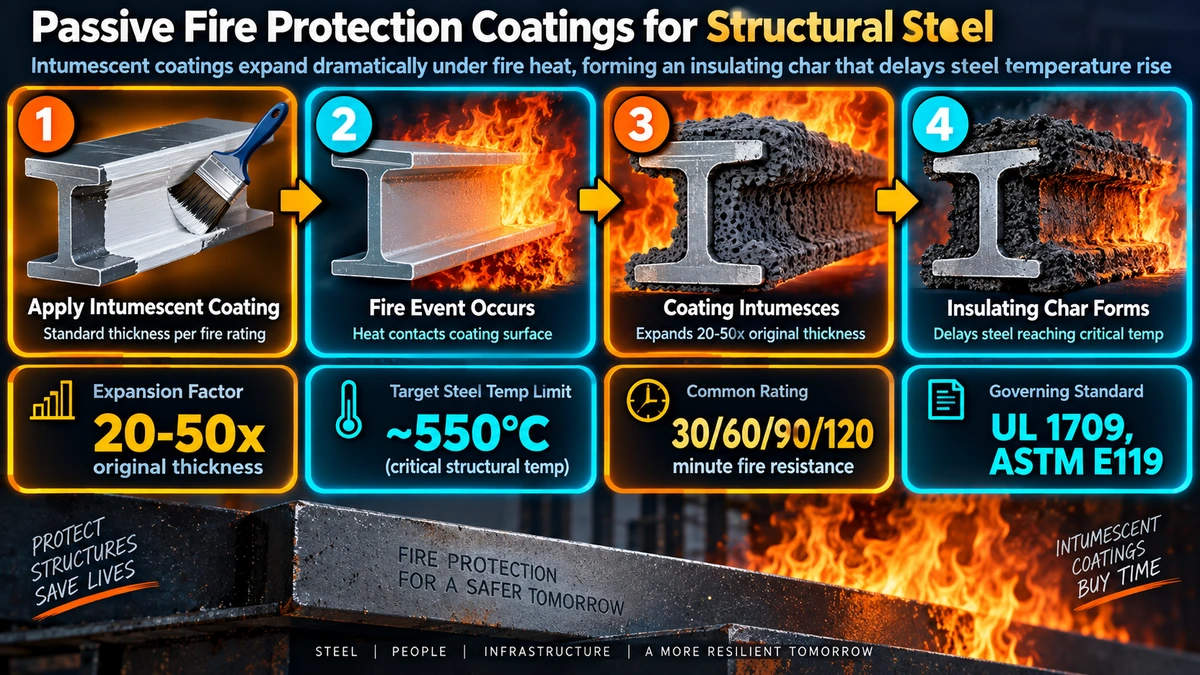
Passive fireproofing coatings for structural steel exist because steel loses strength fast in a fire. Unprotected structural steel can reach temperatures around 550-600 degC in a matter of minutes under real fire conditions, and at that temperature a typical structural steel section has already lost a large share of its design strength, putting the whole frame at risk of collapse long before the fire itself would otherwise burn out. Passive fireproofing buys time, insulating the steel so it takes substantially longer to reach that critical temperature, giving occupants time to evacuate and firefighters time to respond.
This guide covers the two dominant passive fireproofing coating families, intumescent coatings and cementitious spray-applied fire resistive materials (SFRM), the section factor (Hp/A) concept that governs how thick a coating needs to be for a given member and fire rating, the standards used to certify these systems, and the quality control checks used to verify installed thickness. You will also find a free section factor calculator to help frame the coating thickness discussion for a specific structural member.
Whether you are a coating inspector verifying DFT on a steel frame, a QA/QC engineer reviewing a fireproofing specification, or a structural or fire engineer trying to understand why two members with the same fire rating requirement carry very different coating thicknesses, this guide gives you the underlying logic.
Section Factor (Hp/A) Calculator
Why Passive Fireproofing Is Needed
Structural steel has excellent strength at ambient temperature but loses that strength rapidly as it heats. As a rough guide widely used in fire engineering, structural steel retains only about half of its ambient-temperature yield strength once it reaches roughly 550-600 degC, and continues to weaken sharply beyond that. In a real building or process fire, unprotected steel can reach this critical temperature range within a relatively short time, well before a fire might otherwise be brought under control, which is why passive fire protection is mandated by building codes and process safety standards for structural members supporting life safety egress paths, critical process equipment, or high-value assets.
Passive fireproofing coatings are one method among several for achieving a required fire resistance rating, alongside concrete encasement, fire-rated board systems, and mineral wool wraps. Coatings are frequently favoured for new steel-frame construction and for retrofit on existing structures because they add comparatively little weight and bulk compared to concrete encasement, and intumescent systems in particular allow the steel profile to remain visually slender for architecturally exposed applications.
Intumescent Coatings
Intumescent coatings are applied as a relatively thin film, commonly by spray, brush, or roller, in a similar manner to conventional protective coatings. When exposed to fire temperatures, the coating undergoes a chemical reaction that causes it to swell dramatically, often to many times its original dry film thickness, forming a low-density, insulating carbonaceous char. This char layer is what actually slows heat transfer into the steel; the unreacted, cured coating itself is not the primary insulator.
Because the final protective char forms only when triggered by heat, intumescent systems are certified and specified based on fire test data specific to the product formulation, generally requiring a cured dry film thickness determined from the member’s section factor and the required fire rating, read from the manufacturer’s certified thickness charts.
Cementitious / Spray Applied Fire Resistive Materials (SFRM)
Cementitious fireproofing, often referred to as SFRM, is a plaster or cement-based material applied by spray in a substantially thicker layer than intumescent coatings, typically ranging from around 10 mm up to 50 mm or more depending on the required fire rating and section factor. These materials protect primarily through mass and low thermal conductivity rather than a reactive swelling mechanism, and tend to be more economical than intumescent systems for longer fire ratings on concealed structural steel, though they are heavier, more visually utilitarian, and generally require the steel to be boxed in or otherwise finished if appearance matters.
| Feature | Intumescent Coating | Cementitious (SFRM) |
|---|---|---|
| Typical dry thickness | Roughly 0.3-4+ mm depending on rating and Hp/A | Roughly 10-50+ mm depending on rating and Hp/A |
| Protection mechanism | Reactive char formation on heating | Mass and low thermal conductivity |
| Appearance | Paint-like, can be top-coated for architectural finish | Rough, plaster-like; usually concealed or boarded over |
| Typical best fit | Exposed architectural steel, moderate fire ratings | Concealed structural steel, longer fire ratings, high-rise cores |
| Relative cost for long ratings | Can rise steeply at higher ratings/thickness | Generally more economical at longer ratings |
Section Factor (Hp/A) — Why Coating Thickness Varies by Member
Two structural members can require very different fireproofing thickness for the identical fire rating, because coating thickness selection is driven not just by the target rating but by the member’s section factor, commonly written Hp/A (heated perimeter over area) or sometimes A/V. This ratio compares how much exposed surface area a member has to how much steel mass is available to absorb heat before reaching the critical temperature.
Worked Example
A structural steel column has an exposed (heated) perimeter of 1.6 m and a cross-sectional area of 8,500 mm² (0.0085 m²), protected on all four sides (box protection is not being used in this example).
This value, combined with the required fire rating (for example 60 minutes), is what the fireproofing manufacturer’s certified thickness chart is entered with to read off the required dry film thickness for that specific product. A heavier column with the same perimeter but more cross-sectional area would have a lower section factor and would typically require less coating thickness for the same rating.
Box Protection vs. Profile Protection
For open sections such as I-beams and H-columns, the heated perimeter can be measured two ways. Profile protection follows the actual outline of the flanges and web, generally producing a higher section factor. Box protection treats the coating as forming a flat-sided rectangular box around the overall section depth and width, using a smaller perimeter and consequently a lower section factor, which can allow a thinner coating — but only where the manufacturer’s fire test certification explicitly covers box protection for that product and profile type.
Fire Rating Classes and Standards
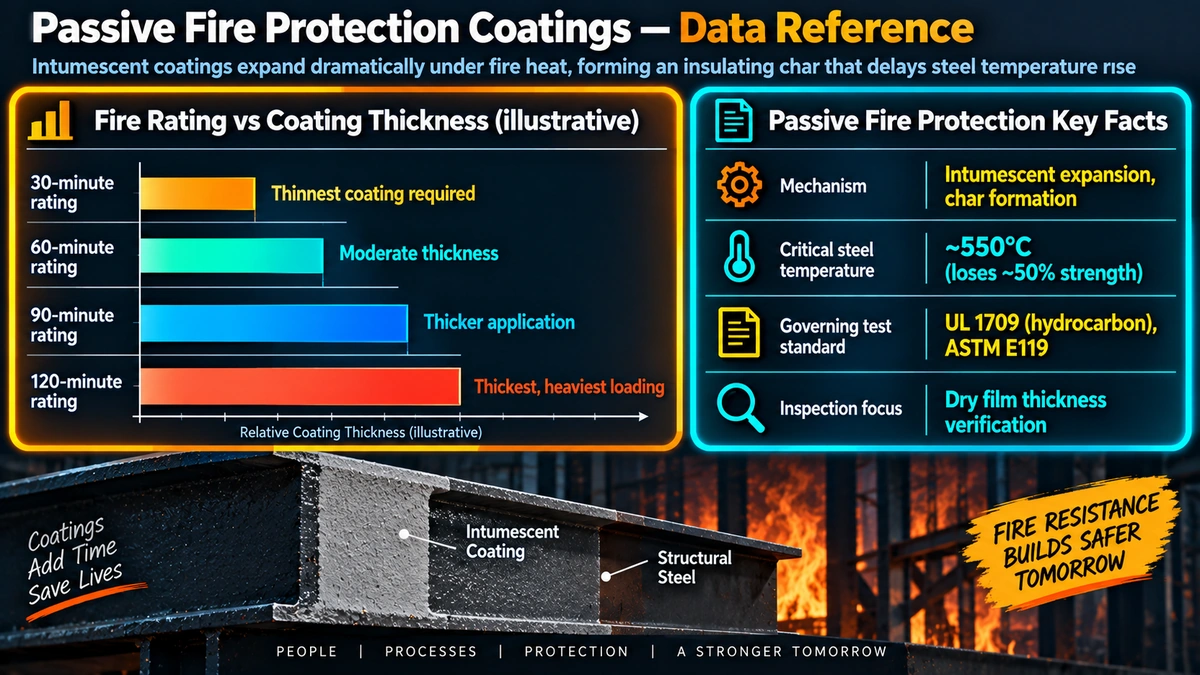
Fire resistance for structural steel is generally expressed as a rating in minutes, indicating how long the protected member is expected to maintain structural performance under a standard fire exposure before reaching its critical failure condition.
| Rating Class | Typical Application |
|---|---|
| 30 minutes | Lower-risk occupancies, some industrial structures |
| 60 minutes | Common commercial and industrial structural steel rating |
| 90 minutes | Higher-occupancy buildings, critical structural members |
| 120 minutes and above | High-rise cores, critical infrastructure, high life-safety risk |
| Standard | Scope |
|---|---|
| ASTM E119 | Standard fire test method for building construction and materials (cellulosic fire curve) |
| UL 263 | Fire tests of building construction and materials, closely aligned with ASTM E119 |
| BS 476 Parts 20-22 | UK fire resistance test methods for elements of construction |
| EN 13381-8 | European test method for reactive (intumescent) fire protection of steel members |
| UL 1709 | Rapid rise (hydrocarbon pool fire) test, used for petrochemical and offshore structural steel |
Quality Control and Common Field Issues
- Verifying dry film thickness against the section factor and rating actually required for that specific member, not a single blanket DFT applied uniformly across a structure with mixed section sizes.
- Checking substrate surface preparation and primer compatibility before fireproofing application, since adhesion failure of the fireproofing itself defeats the entire system regardless of thickness.
- Confirming topcoat compatibility on intumescent systems, since some topcoats can interfere with the coating’s ability to swell correctly if applied outside the manufacturer’s tested thickness or product combination.
- Measuring thickness correctly for the coating type: magnetic or eddy-current DFT gauges for thin intumescent films, and depth or comb gauges for thick cementitious SFRM, since using the wrong instrument for the coating type gives unreliable readings.
- Protecting fireproofing from mechanical damage during subsequent construction trades (electrical, mechanical, and piping installation routinely working around already-fireproofed steel), and repairing any damage per the manufacturer’s approved repair procedure before handover.