Piping Color Coding Standards Guide
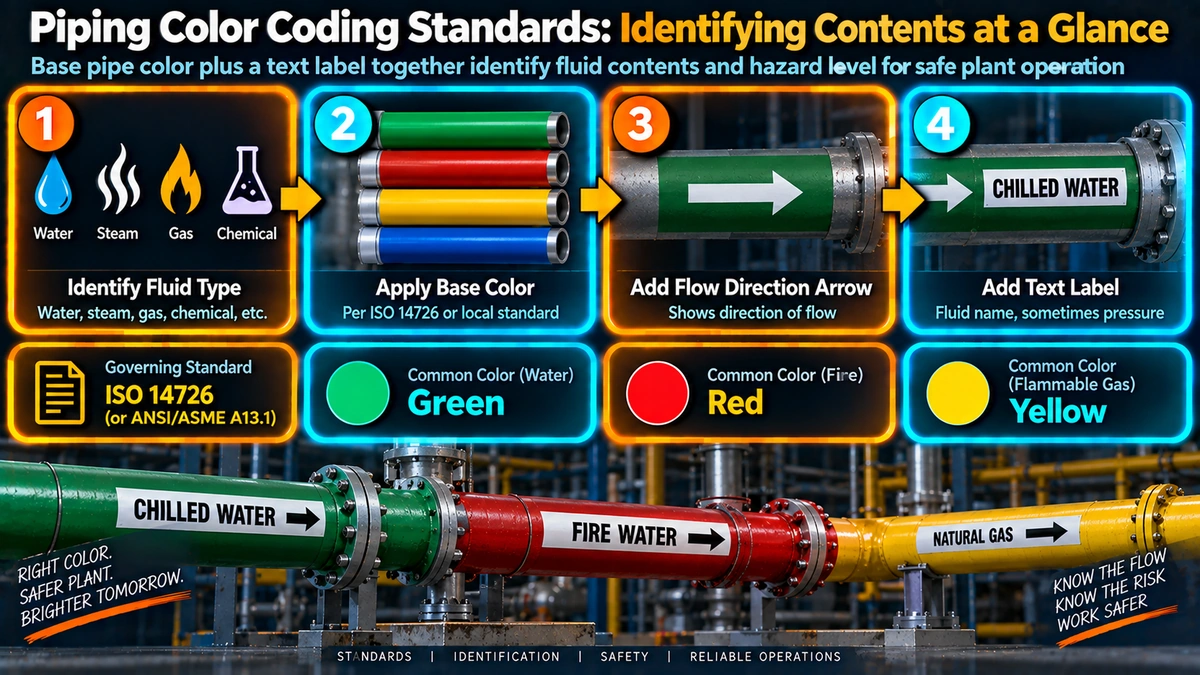
Piping color coding standards exist to answer one question instantly, without anyone having to trace a line on a drawing: what is inside this pipe, and how dangerous is it. In a process plant with hundreds or thousands of individual pipe runs, color coding is one of the simplest and most effective safety systems available, letting operators, maintenance crews, and emergency responders identify hazardous contents at a glance from across a unit.
This guide covers the major piping color coding systems in use today: ASME A13.1 for hazard identification of in-service piping, PFI ES-22 for material grade identification during fabrication, IS 2379 for the Indian standard widely used across Indian refineries and process plants, and BS 1710 as the British reference many international specifications are built on. You will also find a free calculator for sizing ASME A13.1 pipe labels based on your pipe outside diameter.
Whether you are a QA/QC engineer writing a piping identification procedure, a painter applying a plant-wide color scheme, or a fabrication shop supervisor trying to prevent a P11 pipe being welded into a P22 line by mistake, this page gives you the reference tables and reasoning behind the color you are looking at.
ASME A13.1 Pipe Label Size Calculator
Why Piping Color Coding Matters
A pipe wall gives no clue to its contents. Without a consistent, plant-wide color and labeling system, identifying what is flowing through a given line means either reading an often out-of-reach stencil, tracing the line back on a P&ID, or asking someone who may not be immediately available — none of which is fast enough in an emergency, a maintenance isolation, or a hot work permit review near an unfamiliar line. Consistent color coding, combined with text legends and directional flow arrows, lets anyone walking through a unit identify hazard class at a glance.
This matters just as much before a pipe is ever put into service. During fabrication, storage, and construction, individual joints of pipe, fittings, and flanges of visually similar but metallurgically different material grades sit side by side in laydown yards and spool shops. A single mixed-up joint of the wrong alloy welded into a high-temperature or sour-service line can create a serious integrity risk that may not surface for years. This is exactly the gap that material grade color coding, separate from hazard-class color coding, is designed to close.
ASME A13.1 — Scheme for the Identification of Piping Systems
ASME A13.1 organises hazardous piping contents into a small number of fixed hazard classes, each assigned a standard color, plus several user-defined colors reserved for services the standard does not explicitly cover. The current edition recognises five hazard categories: flammable, combustible, oxidizing, toxic and corrosive, and fire quenching.
| Hazard Category | Meaning | Typical Color |
|---|---|---|
| Flammable | Fluids or vapours that can ignite and sustain combustion in air | Brown |
| Combustible | Fluids that can burn but do not meet the flammable definition | Brown |
| Oxidizing | Gases or liquids that can promote or intensify combustion of other materials | Yellow |
| Toxic / Corrosive | Fluids that are toxic or corrosive, or become so when released | Orange |
| Fire Quenching | Water, foam, CO2, and similar fluids used in fire protection systems | Red |
| Low hazard (water, etc.) | Materials that present a low hazard when released | Green |
| Compressed air | Plant and instrument air systems | Blue |
| User-defined | Reserved colors for facility-specific services not otherwise covered | Facility legend |
ASME A13.1 Label Sizing
The standard also sets minimum sizes for the colored field and the legend text, scaled to the pipe’s outside diameter, so labels remain legible from a reasonable viewing distance on both small instrument lines and large process headers.
| Pipe OD Range | Colour Field Length | Minimum Letter Height |
|---|---|---|
| 19-32 mm (3/4-1 1/4 in) | 200 mm (8 in) | 13 mm (1/2 in) |
| 38-51 mm (1 1/2-2 in) | 200 mm (8 in) | 19 mm (3/4 in) |
| 64-150 mm (2 1/2-6 in) | 300 mm (12 in) | 32 mm (1 1/4 in) |
| 200-250 mm (8-10 in) | 600 mm (24 in) | 64 mm (2 1/2 in) |
| Over 250 mm (over 10 in) | 800 mm (32 in) | 89 mm (3 1/2 in) |
PFI ES-22 — Color Coding of Piping Materials
PFI ES-22, published by the Pipe Fabrication Institute, addresses a different problem entirely: distinguishing between visually similar pipe, fitting, and flange material grades during fabrication, storage, and construction. Carbon steel, various chrome-moly alloy grades, and multiple stainless steel grades can look nearly identical to the naked eye once mill markings have worn off or been cut away, so PFI ES-22 assigns a combination of solid and intermittent color bands, applied to the pipe end or component body, to each common material grade.
| Material | Common Grade | PFI ES-22 Band |
|---|---|---|
| Carbon steel, ERW | API / A53 Gr. B | 1 solid white |
| Carbon steel, killed steel | A106 Gr. B | 1 solid green |
| Carbon steel, low temperature | A333 Gr. 6 | 1 solid red |
| C-Mo steel | A335 Gr. P1 | 1 solid orange |
| 1 1/4 Cr-1/2 Mo steel | A335 Gr. P11 | 1 solid yellow |
| 2 1/4 Cr-1 Mo steel | A335 Gr. P22 | 1 solid blue |
| 9 Cr-1/2 Mo steel | A335 Gr. P9 | 2 solid orange |
| Stainless 304 | A312 TP304 | 1 solid black |
| Stainless 304L | A312 TP304L | 2 solid black |
| Stainless 316 | A312 TP316 | 1 solid grey |
| Stainless 316L | A312 TP316L | 2 solid grey |
| Stainless 321 | A312 TP321 | 1 solid pink |
| Stainless 347 | A312 TP347 | 1 solid brown |
| Inconel 625 | Nickel alloy | 1 solid blue, 1 solid pink |
| Monel 400 | Nickel-copper alloy | 1 solid black, 1 solid yellow |
Where PFI ES-22 Bands Are Applied
Bands are typically painted near the pipe end, on fitting bodies, and on flange faces, positioned clear of weld bevels and gasket seating surfaces so they do not interfere with fit-up, welding, or sealing. On long pipe joints, an additional band is often applied at the mid-length or at intervals so the grade remains identifiable even after the joint is cut into shorter fabrication lengths. Welded pipe carries an additional white stripe alongside the material grade bands under the standard, distinguishing it from seamless product of the same grade.
IS 2379 — Indian Standard for Pipeline Identification
IS 2379 is the Indian Standard governing pipeline identification color coding, closely aligned in structure with BS 1710. It uses a ground (base) color to indicate the general substance category, combined with one or two narrower color bands to identify the specific service, plus a text legend and directional arrow. It is widely applied across Indian refineries, fertiliser plants, and process industries.
| Substance Category | Ground Colour |
|---|---|
| Water | Sea green |
| Steam | Aluminium |
| Mineral, vegetable, animal oils; combustible liquids | Light brown |
| Acids | Dark violet |
| Air | Sky blue |
| Gases | Canary yellow |
| Alkalies | Smoke grey |
| Hydrocarbons / organic compounds | Dark admiralty grey |
Common IS 2379 Service Examples
| Service | Ground Colour | First Band | Second Band |
|---|---|---|---|
| Cooling water | Sea green | French blue | – |
| Boiler feed water | Sea green | Gulf red | – |
| Drinking water | Sea green | French blue | Signal red |
| Plant air | Sky blue | Silver grey | – |
| High pressure steam | Aluminium | French blue | – |
| Low pressure steam | Aluminium | Canary yellow | – |
| Nitrogen | Canary yellow | Black | – |
| Oxygen | Canary yellow | White | – |
| Hydrogen | Canary yellow | Signal red | French blue |
| LPG (liquid) | Dark admiralty grey | Brilliant green | Dark violet |
BS 1710 — British Standard for Pipeline Identification
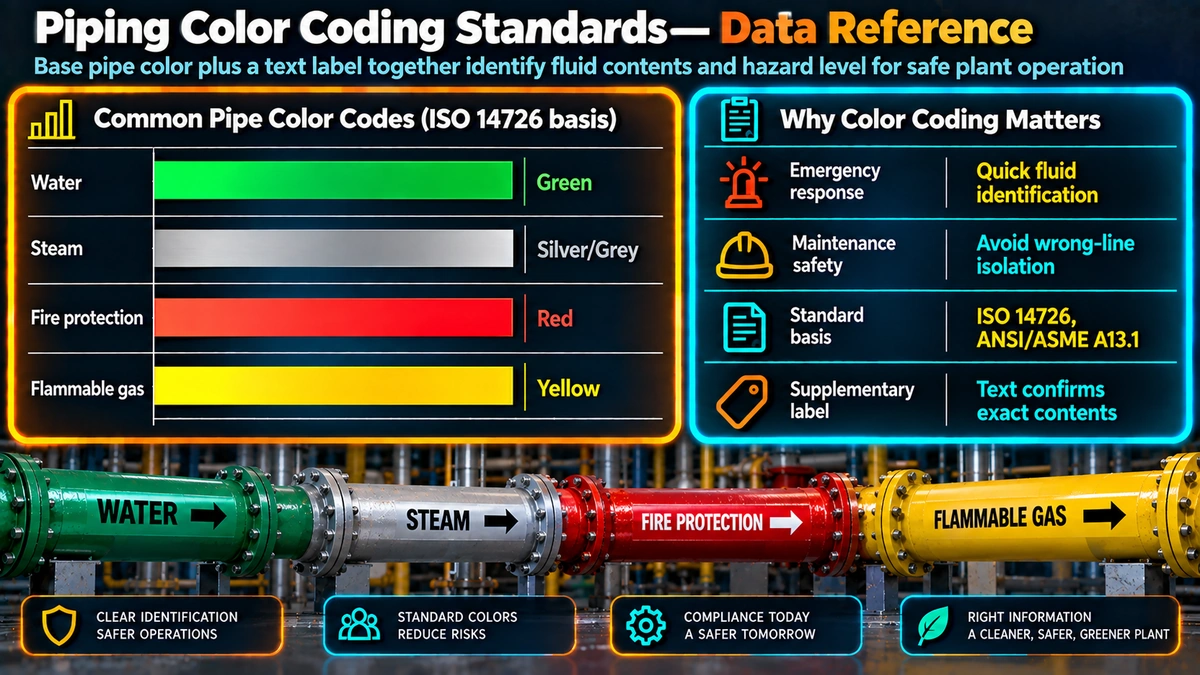
BS 1710 uses a similar base-colour-plus-safety-colour structure to IS 2379 and remains a common reference point for projects built on British and Commonwealth design practice. It specifies minimum band widths scaled to pipe diameter, both for schemes using only the basic identification colour and for schemes that combine a basic colour with an additional safety colour band.
| Pipe Diameter | Basic Colour Band (alone) | Basic Colour Band (with safety colour) | Safety Colour Band |
|---|---|---|---|
| Up to 50 mm | 130 mm | 50 mm | 30 mm |
| 50-100 mm | 275 mm | 100 mm | 75 mm |
| Above 100 mm | 450 mm | 150 mm | 150 mm |
Marking Locations — Where to Place Bands and Labels
All the major standards converge on similar practical guidance: labels and bands need to be visible from the normal approach path, and repeated often enough that nobody has to walk far to find one.
- At battery limits and unit tie-in points
- Close to valves, flanges, and other points where a line could be isolated or opened
- At changes of direction and at branch connections
- Where pipes pass through walls, floors, or pipe culverts
- At regular intervals along long straight runs — commonly every 50 metres for yard piping under IS 2379, and at similarly practical intervals under ASME A13.1 and BS 1710
- At the start and termination points of a pipeline or piping run
Common Mistakes in Piping Color Coding
- Mixing hazard-class color coding (ASME A13.1 / IS 2379 / BS 1710) with material grade color coding (PFI ES-22) as if they were the same system, leading to confusion between what a color means on a finished, painted line versus an unpainted fabrication-yard joint.
- Relying on color alone without the required text legend, which fails colorblind personnel and anyone unfamiliar with the specific facility’s exact color assignments.
- Applying a custom, facility-specific color for a service without documenting it in a posted legend, leaving new personnel and visiting contractors unable to interpret it correctly.
- Painting over PFI ES-22 material bands during final coating without a plan to reapply or otherwise preserve material traceability before the piping is installed.
- Inconsistent color use across different units of the same site, often the result of merging color schemes from separate legacy projects without a full site-wide reconciliation.