By WeldFabWorldAugust 17, 2026Updated: September 28, 2026
19 min read
Pinhole Detector Testing for Coatings — Selection Guide | WeldFabWorld
Pinhole Detector Testing for Coatings
Painting & Coatings | By WeldFabWorld | Updated August 2026 | 14 min read
Pinhole detector testing for coatings is only as reliable as the instrument doing the testing and the voltage it is set to. Two crews can follow the exact same holiday testing procedure and still get very different results if one is using a worn-out wet sponge on a fixed setting and the other is running a calibrated high-voltage unit set at the correct voltage for the actual measured film thickness. Choosing, setting up, and maintaining the right detector is a separate skill from simply knowing that holiday testing exists.
This guide focuses on the equipment side of pinhole detection: how to pick between wet sponge and high-voltage spark detectors, how to calculate the correct test voltage from dry film thickness using the widely used DuPont formula, what to look for in electrode type and instrument features, how calibration and daily verification work, and how to buy and maintain a detector that will hold up on an active coating project. If you want the underlying pass/fail testing procedure itself, see our companion piece on coating and painting inspection tests, which covers the full method per ASTM D5162 and NACE SP0188.
Whether you are speccing a detector for a new inspection kit, troubleshooting inconsistent holiday test results, or training a junior inspector on equipment use, this page gives you the numbers and selection logic behind the instrument itself.
Holiday Detector Voltage Selector
—
Recommended Method
—
Calculated Test Voltage
—
Within Detector Rating
Scope note
This calculator applies the commonly cited DuPont formula (V = 1250 x square root of t, t in mils) for high-voltage spark testing guidance, and the ASTM D5162 / NACE SP0188 general 500-micron threshold for choosing between wet sponge and high-voltage methods. Always confirm the actual voltage against your detector manufacturer’s chart and the governing project specification before testing — this tool is for planning and cross-checking, not a substitute for the specification.
Wet Sponge vs. High-Voltage Detectors
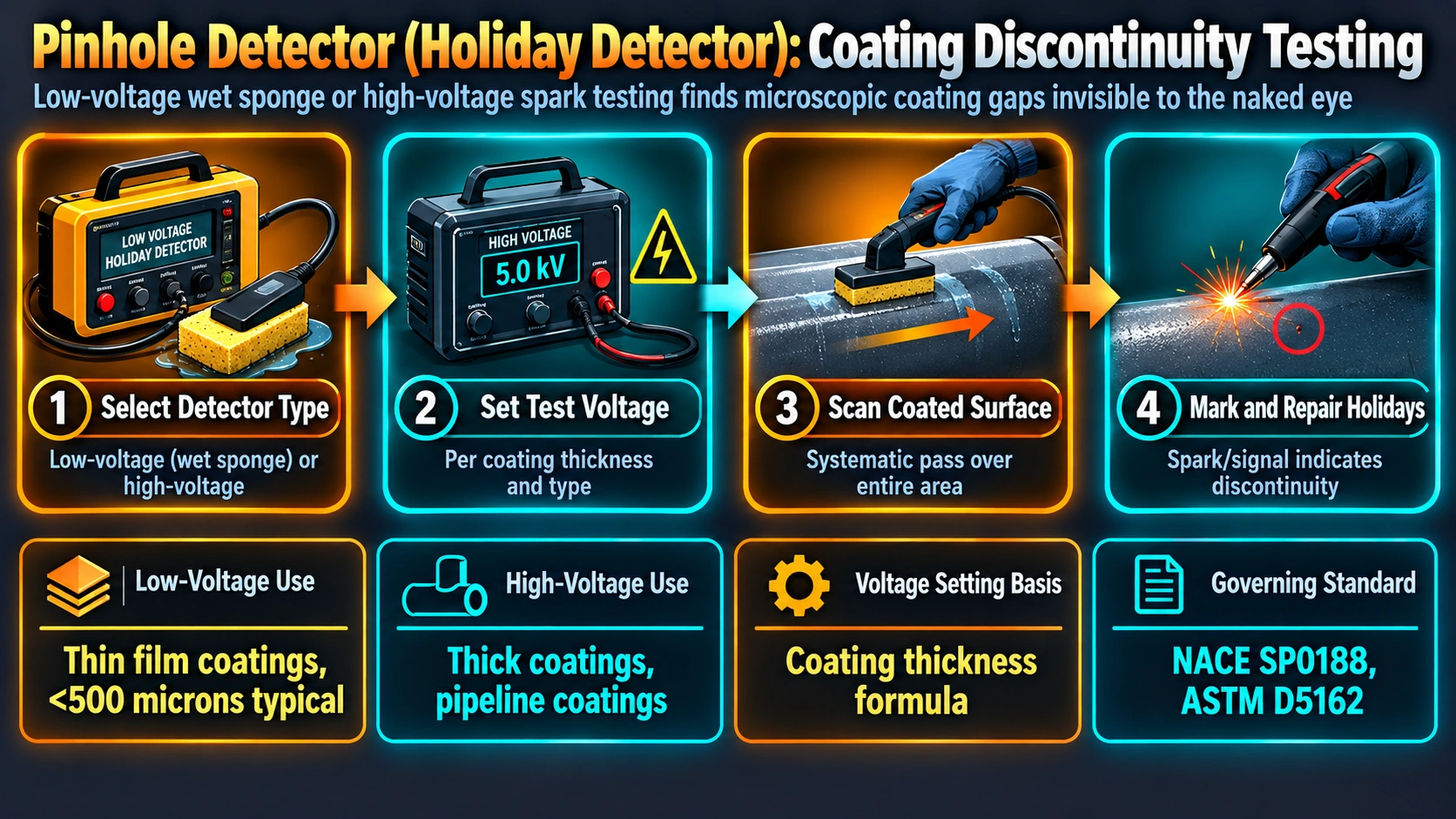
The first decision in pinhole detector testing is which detection principle fits the coating being tested. Both rely on the same underlying physics — a coating is an electrical insulator over a conductive steel substrate, so any discontinuity in that insulating film creates a path for current or a spark to reach the grounded metal — but they are built and rated very differently.
Low-Voltage Wet Sponge Detectors
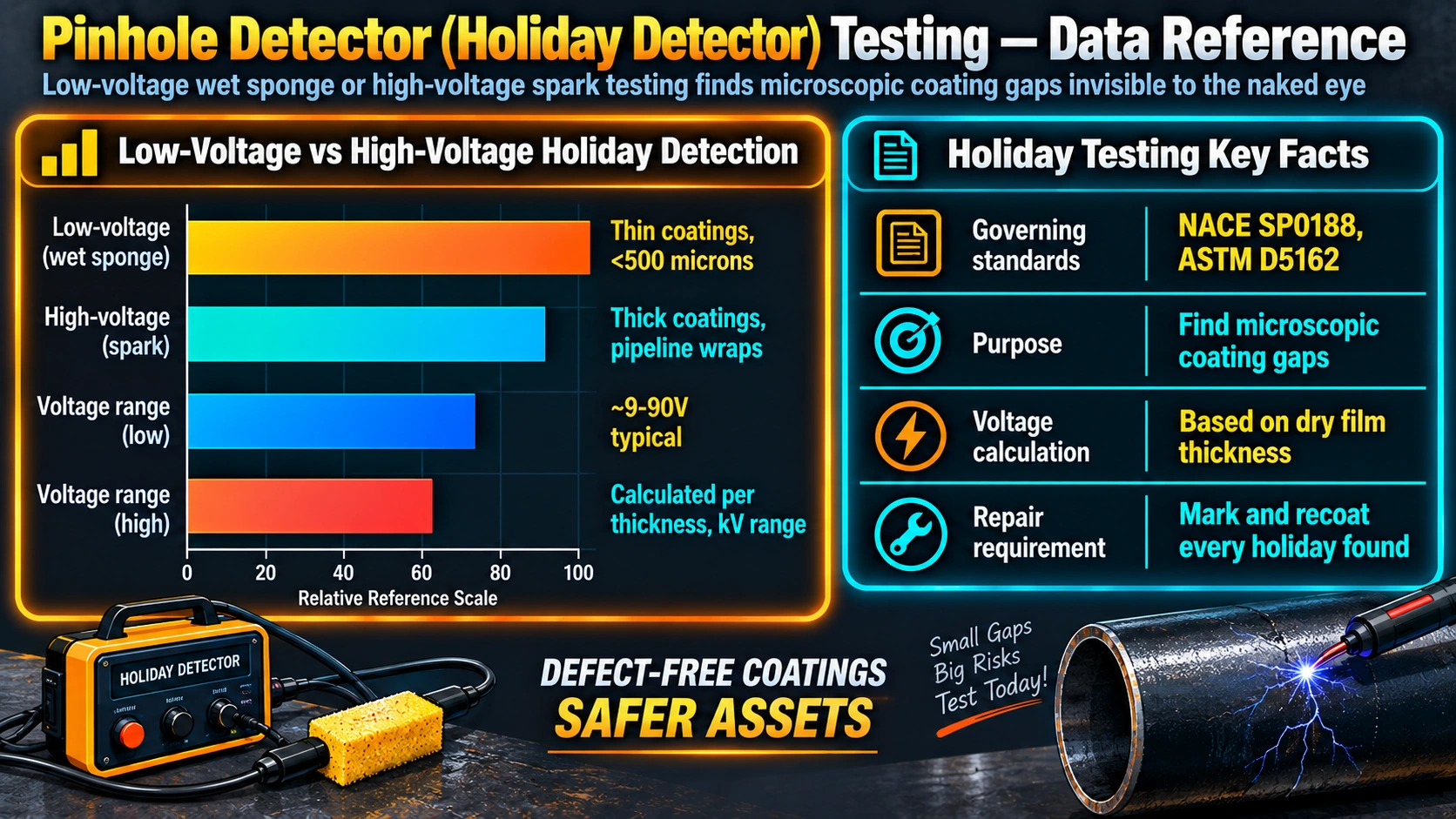
A wet sponge detector applies a low DC voltage, commonly in the 9 to 90 volt range with 67.5 to 90 volts widely used in practice, through a sponge electrode soaked in a mildly conductive wetting solution. As the sponge passes over a pinhole or thin spot, moisture bridges the gap to the grounded substrate, completing the circuit and triggering an audible or visual alarm. This method is standard for thinner coatings, typically up to about 500 microns (20 mils), and is generally regarded as the lower-risk option for confined space and tank interior work at that thickness range.
High-Voltage Spark Detectors
For thicker film builds and lining systems, a high-voltage spark tester applies a DC voltage, often measured in kilovolts, through a dry electrode — commonly a wire brush, coil spring, or conductive rubber probe — passed across the coating surface. Where a holiday exists, the applied voltage is sufficient to ionise the air gap and jump a visible spark through the discontinuity to the grounded substrate. Because the required voltage scales with coating thickness, high-voltage units must be set correctly for the actual film build being tested; too low and holidays will be missed, too high and sound coating can be punctured.
The most widely cited field formula for setting high-voltage spark test voltage is often referred to as the DuPont formula. It relates the recommended test voltage directly to the measured dry film thickness of the coating being tested.
DuPont FORMULA — High-Voltage Spark TestV = 1250 x sqrt(t)V = recommended test voltage in volts DCt = dry film thickness in mils (1 mil = 25.4 microns)METRIC FORM (t in microns)V = 1250 x sqrt(t / 25.4)Always cross-check the calculated value against your detector manufacturer’s voltage chart and the project specification
Worked Example
An inspector needs to holiday-test a pipeline lining with a measured dry film thickness of 800 microns (31.5 mils), using a high-voltage detector rated to 20 kV.
Givent = 800 microns = 31.5 mils, detector max rating = 20,000 VStep 1 — Convert and apply formulaV = 1250 x sqrt(31.5) = 1250 x 5.61 = 7,013 V (approx. 7.0 kV)Step 2 — Check against detector rating7.0 kV is well within the 20 kV detector ratingResult: Set the detector to approximately 7.0 kV before testing; confirm against manufacturer chart
Voltage caution
Never test at a voltage significantly above the calculated or manufacturer-recommended value “to be sure.” Excess voltage can burn through sound coating, creating new holidays rather than finding existing ones. If a coating is thicker than your detector’s rated output, use a higher-rated instrument rather than exceeding the rated maximum of the one on hand.
Figure 1 — Basic circuit of a high-voltage holiday detector: current returns to the power source through the ground clamp only when the probe finds a discontinuity in the coating.
Detector Types and Electrode Selection
Electrode Type
Best Suited For
Notes
Wetted sponge
Flat and curved surfaces, thin film
Low voltage only; needs regular re-wetting with fresh solution
Wire brush (steel or phosphor-bronze)
Large flat plate, tank walls
Even contact on flat surfaces; wears over time and needs replacement
Coil spring electrode
Pipe and curved surfaces
Conforms around pipe OD, common for pipeline lining inspection
Conductive rubber / neoprene
Coatings sensitive to metallic marking
Reduces risk of leaving metal residue on soft or uncured films
Single-pass rule
Pass the electrode over each area once at a steady speed, typically around 0.3 m per second (roughly 1 ft/sec), as recommended in common holiday testing guidance. Repeated passes over the same spot can behave like charging a capacitor and trigger false alarms, or in some coatings, mask real holidays.
Calibration and Daily Verification
A holiday detector is only trustworthy if its actual output matches its displayed setting. Most quality programmes require two separate checks:
Formal Calibration
The instrument’s output voltage is checked against a certified reference meter, typically on an annual basis or per the manufacturer’s recommended interval, and a calibration certificate is issued and kept with the QA documentation. Any instrument outside its certified tolerance is taken out of service until repaired and recalibrated.
Daily Functional Verification
Before each shift, the detector is checked against a known reference: a certified holiday standard, a calibrated shim with a deliberate through-hole at a known coating thickness, or the manufacturer’s supplied test piece. The detector must correctly alarm on the known defect and correctly pass the sound area around it. A detector that fails this daily check should not be used until the issue is resolved.
Figure 2 — Recommended high-voltage spark test voltage rises with the square root of dry film thickness per the DuPont formula, not proportionally with thickness.
Buying a Holiday Detector — What to Look For
Voltage range matched to your work: A unit rated 0-15 kV covers most industrial coating thicknesses; pipeline lining or thick-film subsea work may need 20-40 kV units.
Adjustable, calibrated output with digital readout: Analog dial-only units are harder to set precisely and to verify; digital readouts with a calibration certificate are preferred for formal QA work.
Pulsed DC option: Useful on damp, dirty, or slightly conductive surfaces where continuous DC would cause excessive false alarms.
Battery life and field durability: Look for a rugged housing, replaceable or rechargeable battery packs, and a visible low-battery warning, since a detector that fades mid-shift can miss holidays without any obvious sign.
Interchangeable electrodes: A unit that accepts brush, coil, and rubber electrodes offers more flexibility across different coating types and surface geometries than a single fixed probe.
Recommended Equipment and Reference Reading
High-Voltage Holiday Detector (0-15 kV)
Adjustable-output spark tester suited to mid-to-thick film coatings and pipeline lining inspection work.
Disclosure: WeldFabWorld participates in the Amazon Associates programme (StoreID: neha0fe8-21). If you purchase through these links, we may earn a small commission at no extra cost to you. This helps support free technical content on this site.
Frequently Asked Questions
What is the difference between a pinhole detector, a holiday detector, and a spark tester?
These three terms all refer to the same category of instrument. A holiday is the industry term for any discontinuity in a coating film, including a pinhole, void, thin spot, or crack, so a pinhole detector, holiday detector, and spark tester are functionally the same class of equipment, differing mainly in whether they use the low-voltage wet sponge principle or the high-voltage spark principle to find the discontinuity.
Which type of detector do I need for my coating thickness?
As a general rule, low-voltage wet sponge detectors are used for coatings up to about 500 microns (20 mils) dry film thickness, while high-voltage spark testers are used for thicker film and lining systems above that threshold. Some detectors combine both modes in one unit. Always confirm the exact threshold and voltage settings against the coating manufacturer’s data sheet and the governing project specification rather than relying on the general rule alone.
How is the correct spark test voltage calculated?
The most widely cited field formula, often called the DuPont formula, is V = 1250 x square root of t, where V is the test voltage in volts and t is the dry film thickness in mils. Many holiday detector manufacturers and standards such as NACE SP0188 and ASTM D4787 provide their own voltage tables or built-in calculators on the instrument itself, and where these differ from the general formula, the specific manufacturer or specification guidance should be followed.
Can high-voltage spark testing damage a good coating?
Yes, if the voltage is set too high for the actual film thickness, or if the probe is passed over the same area multiple times in quick succession, the applied voltage can puncture sound coating and create a new holiday rather than simply detecting an existing one. This is why voltage must always be calculated or looked up based on the actual measured dry film thickness before testing, and why a single, steady pass at the correct speed is recommended over repeated passes.
Is holiday detector testing safe in a confined space or explosive atmosphere?
High-voltage spark testing generates a visible spark by design and must never be performed in an atmosphere containing flammable vapours or gases, such as inside a freshly coated tank that has not been adequately ventilated and gas-freed. Low-voltage wet sponge testing is generally considered safer for confined space work at appropriate coating thickness, but confined space entry procedures, gas testing, and ventilation requirements still apply regardless of which detector type is used.
How often should a holiday detector be calibrated or verified?
Most quality programmes require formal calibration of the output voltage against a certified reference at a fixed interval, commonly annually, along with a functional verification check at the start of each work shift using a known reference holiday or a calibration shim of certified thickness. Any instrument that fails a daily functional check should be taken out of service and either recalibrated or replaced before testing resumes.
What electrode type should I use with a high-voltage detector?
Electrode selection depends on the surface geometry and coating type: a phosphor-bronze or stainless steel wire brush electrode suits large flat areas and gives good, even contact, a coil spring electrode is preferred for pipe and curved surfaces since it conforms to the profile, and a conductive rubber or neoprene electrode is often specified for coatings sensitive to metallic contact or with a slightly conductive filler. The coating manufacturer or project specification will usually state the required electrode type.