FBE coating pipeline specifications start from one idea: a 100% solids epoxy powder is melted onto preheated, blast-cleaned steel and cured into a continuous, strongly bonded film. That film is the corrosion barrier on most buried and submerged line pipe. This guide explains how it is applied, which standards govern it, how it is inspected and where its limits are, and it sits beside our broader anti-corrosive coating selection guide.
An FBE coating pipeline system is a thermosetting epoxy powder applied electrostatically to steel blasted to Sa 2-1/2 and preheated to about 225 to 245 °C, where it melts and cures into a film typically 350 to 500 micrometres (14 to 20 mils) thick. It is specified under CSA Z245.20 and ISO 21809-2 and is normally used with cathodic protection.
It is written for coating, pipeline and QA/QC engineers, inspectors and procurement teams who specify or accept plant-applied pipe coating. More coating guides are in the Painting & Coatings section of this site.
Process values below are typical industry figures from published standards summaries and manufacturer and training sources. The pipe coating specification, the powder data sheet and the applicable standard edition always govern.
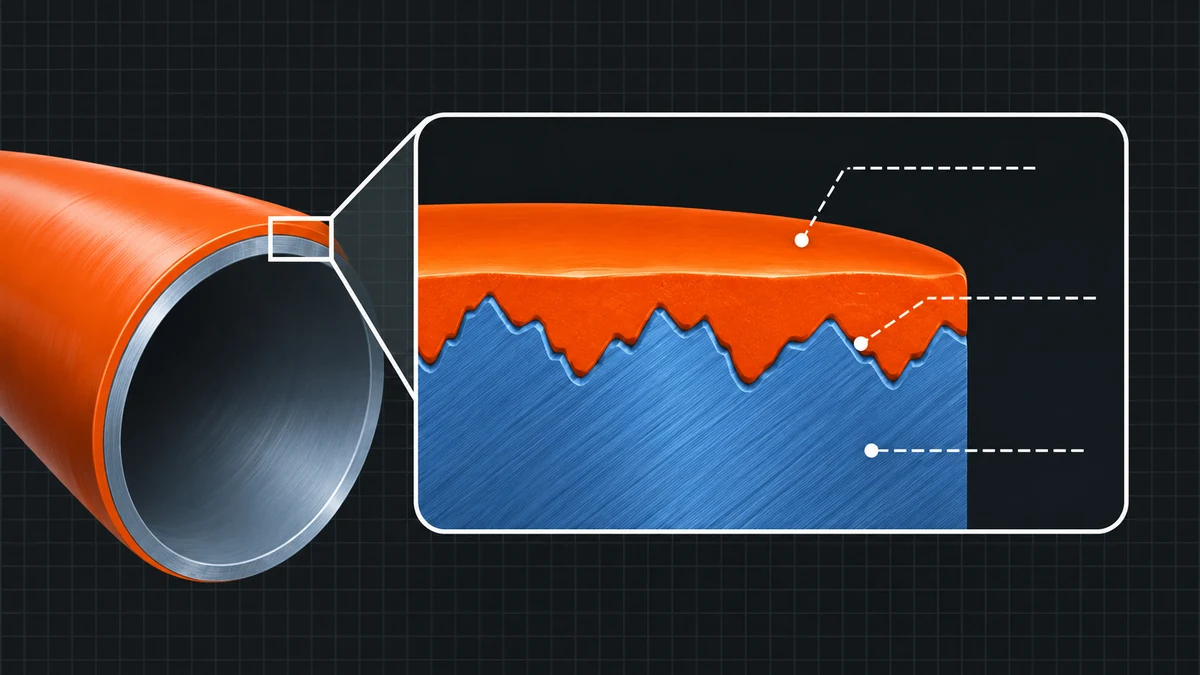
- FBE is a primerless, one-part, heat-curing epoxy powder applied to preheated pipe, giving both chemical and physical bonding to the steel.
- Typical surface preparation is abrasive blasting to Sa 2-1/2 (NACE No. 2 equivalent) with a 50 to 100 micrometre (2 to 4 mil) anchor profile.
- Typical application temperature is 225 to 245 °C, and typical film thickness is 350 to 500 micrometres (14 to 20 mils).
- CSA Z245.20 and ISO 21809-2 are the main specifications, and plant tests include holiday detection, thickness, cure and cathodic disbondment.
- Standard FBE is generally limited to about 85 °C service, while high-temperature grades are qualified at higher temperatures.
- FBE has limited impact and abrasion resistance, so dual-layer FBE or three-layer polyolefin systems are used where mechanical damage is likely.
What Is Fusion Bonded Epoxy (FBE) Pipeline Coating?
Fusion bonded epoxy (FBE) is a thermosetting epoxy powder coating applied electrostatically to preheated steel, melting, flowing and curing into a continuous corrosion-resistant film. It is a primerless, 100% solids coating used mainly on the outside of buried and submerged line pipe, usually together with cathodic protection.
The name comes from the process. The powder contacts hot steel, melts, flows and cross-links in place, which produces a bond that is both chemical and physical. Because no solvent evaporates, the film forms without the carrier losses of liquid paint.
FBE is also used on pipe fittings, on the inside of pipe, on rebar and on other steel parts. This guide concentrates on external plant-applied FBE for line pipe, which is the main use.
Why Is FBE Coating Pipeline Protection Used and How Does It Compare?
FBE is used on pipelines because it adheres strongly to steel, resists corrosion and chemical attack, and is applied in a controlled factory process. It is compatible with cathodic protection, so it is widely paired with it on buried lines.
| System | Structure | Main strengths | Main limits |
|---|---|---|---|
| Single-layer FBE | One epoxy layer, typically 350 to 500 micrometres | Excellent adhesion, corrosion and chemical resistance; suited to buried and submerged pipe | Limited impact and abrasion resistance; temperature limited for standard grades |
| Dual-layer FBE (2LFBE) | FBE base layer plus an abrasion-resistant overcoat | Better gouge and abrasion resistance than single-layer FBE | Higher cost and a second application stage |
| Three-layer PE or PP (3LPE, 3LPP) | FBE primer, adhesive layer and an outer polyolefin layer of roughly 2 mm | High impact and abrasion resistance; complete barrier | Highest cost; field joints need compatible materials |
In a three-layer system the FBE still does the corrosion work against the steel, and the polyethylene or polypropylene layer gives mechanical protection. Choosing between these systems depends on the temperature, soil, installation method and handling risk, which is the same logic our guide to marine and offshore coating systems applies where cathodic protection changes the coating requirement.
How Is FBE Applied in the Coating Plant?
FBE is applied in an automated plant line that cleans, blasts, heats, coats, cures and quenches each pipe joint. Cure is governed by the heat input, so temperature and line speed control the film as much as the powder does.
- Clean and dry the pipe. Remove oil, grease and moisture so the blast media and the powder meet bare steel.
- Abrasive blast the surface. Blast to Sa 2-1/2 (equivalent to NACE No. 2) and a 50 to 100 micrometre (2 to 4 mil) anchor profile, chosen to suit the film thickness.
- Remove dust and soluble salts. Brush or blow off dust, and apply any acid wash and water rinse that the specification requires.
- Preheat the pipe. Heat the steel uniformly with a non-contaminating source such as induction to the powder’s application temperature, typically 225 to 245 °C.
- Apply the powder electrostatically. Spray the powder onto the hot pipe so it melts, flows and gels at the specified thickness.
- Cure and quench. Allow the film to cure for the time and temperature on the powder data sheet, then cool it with water.
- Inspect and repair. Check thickness, appearance and holidays, and repair defects by the approved method.
Surface preparation is the most decisive step. Blast cleanliness is checked against visual standards, covered in our guide to blast cleanliness comparators, and the anchor profile is measured as described in our surface profile measurement guide. Soluble salt left on the steel causes blisters and disbondment, so the Bresle test for salt contamination is a key hold point.
Which Standards and Thicknesses Apply to FBE?
CSA Z245.20 and ISO 21809-2 are the main specifications for plant-applied FBE on line pipe. Other standards apply to specific products or sectors, and the project specification states which one governs.
| Standard | Scope |
|---|---|
| CSA Z245.20 | Plant-applied external fusion bond epoxy and related coatings for steel pipe (Series-22 is the 2022 edition) |
| ISO 21809-2 | Single-layer fusion-bonded epoxy external coatings for buried or submerged pipelines |
| AMPP (NACE) SP0394 | Application, performance and quality control of plant-applied FBE external pipe coating |
| AWWA C213 | Fusion-bonded epoxy coating for the interior and exterior of steel water pipe |
| ISO 21809-1 | Polyolefin external coatings (3LPE and 3LPP), where FBE is the primer layer |
What Film Thickness Is Typical?
Typical FBE film thickness for line pipe is 350 to 500 micrometres (14 to 20 mils), and the project specification sets the minimum. Thicker films add impact absorption but reduce flexibility, so the range balances the two. The table converts common values.
| Micrometres (um) | Mils | Note |
|---|---|---|
| 350 | 13.8 | Lower end of the typical range |
| 400 | 15.7 | Common nominal value |
| 450 | 17.7 | Mid range |
| 500 | 19.7 | Upper end of the typical range |
How Much Powder Does a Pipe Joint Need?
The real consumption depends on powder recovery and on the actual thickness applied, so plants track it against this theoretical figure.
How Is FBE Coating Quality Tested?
FBE quality is checked before, during and after application. The table lists the main tests, and CSA Z245.20 sets the acceptance criteria for production and qualification.
| Test or check | What it verifies | When |
|---|---|---|
| Surface cleanliness and profile | Sa 2-1/2 and 50 to 100 micrometre anchor profile | After blasting |
| Soluble salts | Chloride and salt contamination on the blasted steel | Before heating |
| Pipe surface temperature | Preheat within the powder’s application range | Before spray |
| Film thickness | Dry film thickness against the specified minimum | After cure |
| Holiday detection | Pinholes and discontinuities in the film | After cure, every joint |
| Degree of cure | Full cross-linking, often by thermal analysis of a sample | Qualification and production |
| Cathodic disbondment | Resistance to loss of adhesion at a holiday under cathodic protection | 24 h production test at 65 °C; 28 day qualification tests at 65 °C and 95 °C |
| Flexibility, impact and gouge | Mechanical toughness of the film; flexibility is tested at -30 °C | Qualification |
In a typical cathodic disbondment test, a 3 mm artificial holiday is drilled through the coating, a cell holds a 3% sodium chloride solution, and the specimen is held at the test temperature with an applied potential of -1.5 V. After the test period, the coating is levered off from the holiday and the radius of disbondment is measured. Holiday detection follows AMPP SP0188, and our guide to pinhole detector testing for coatings explains the practical side.
Powder quality is checked at the batch level through properties such as gel time. Incoming material checks are covered in our guide to paint batch testing and quality control.
How Are Girth Welds and Damage Coated and Repaired?
Girth weld areas are left uncoated at the pipe ends and are coated in the field after welding. FBE can be applied to the field joint by specialised induction heating and rotating spray equipment, or other compatible materials such as heat-shrink sleeves and liquid epoxy can be used.
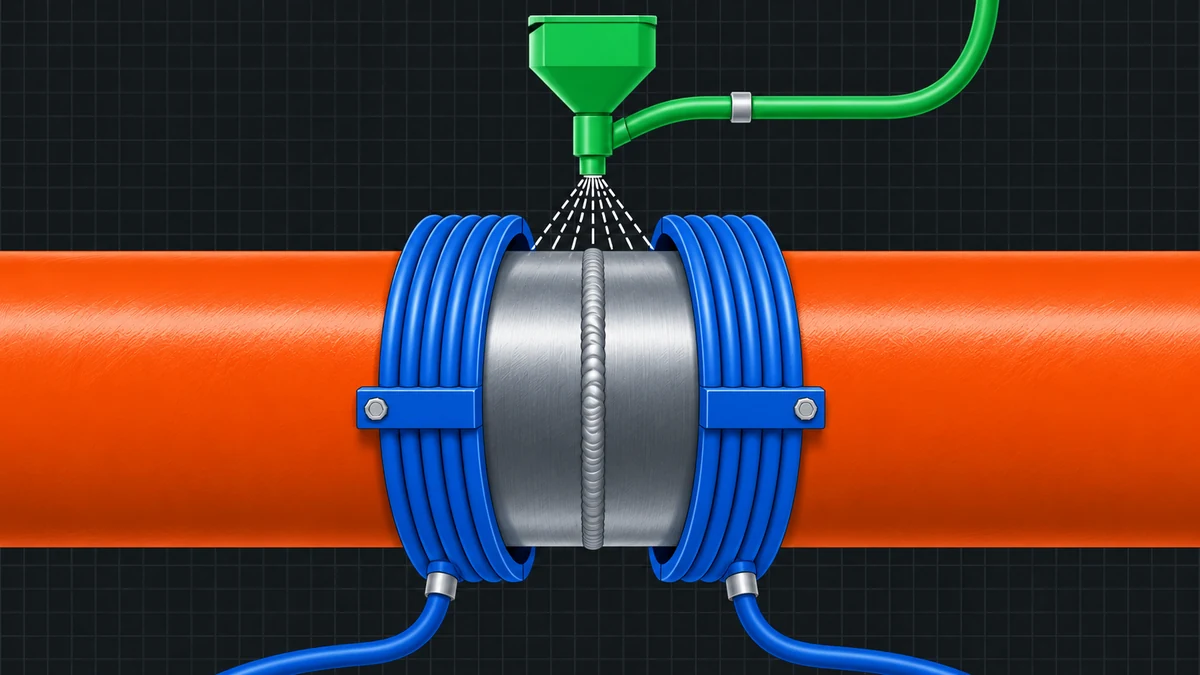
- Weld area preparation: the bare steel and weld are blasted to Sa 2-1/2 with a defined profile, and adjacent sound coating is lightly abraded so the repair coating bonds to it.
- Compatibility: the field joint material must match the line coating, for example a three-layer line needs a three-layer-compatible field joint.
- Damage repair: small defects are commonly repaired with a liquid epoxy, and larger areas are re-coated by an approved procedure and tested.
The girth welds themselves are made and inspected before coating. Our guide to pipeline welding for cross-country transmission lines covers that stage and the field conditions around it.
What Are the Limits and Failure Modes of FBE?
FBE’s main limits are service temperature, mechanical damage and exposure before burial. Failures usually trace back to preparation, cure or handling rather than to the epoxy chemistry.
- Temperature: standard FBE is generally used to about 85 °C, because above that the film can degrade and absorb water. High-temperature grades are qualified by cathodic disbondment testing at 95 °C, and the manufacturer’s data sets the limit.
- Impact and abrasion: single-layer FBE has limited resistance to gouging and rock damage, so dual-layer FBE or 3LPE is used where backfill or installation is severe.
- UV exposure: epoxy chalks under prolonged sunlight, so coated pipe should not be stored uncovered for long periods before burial.
- Surface contamination: salts and dust under the film cause blisters and disbondment later, which is why they are controlled before heating.
- Cathodic protection conditions: very negative potentials or high temperature can increase disbondment, so the protection design and the coating grade must match.
Our guide to coating defects, types and causes describes blistering, chalking and underfilm corrosion, and the coating breakdown and failure analysis case studies show how investigators trace a failure to its cause. Buried pipe also faces microbial attack, covered in our article on microbiologically influenced corrosion.
How Do You Select a Pipeline Coating?
Select a pipeline coating from the operating temperature, the installation and backfill conditions, and the handling risk. The flowchart gives the usual order of questions, and the project specification has the final say.
For the wider logic of matching a coating to its environment, use the ISO 12944 approach described in the selection guide linked in the introduction.
Quick Reference: FBE Pipeline Coating Numbers at a Glance
This cheat sheet collects typical values. Confirm each against the pipe coating specification and the powder data sheet.
| Item | Typical value |
|---|---|
| Coating type | Thermosetting epoxy powder, 100% solids, primerless |
| Surface cleanliness | Sa 2-1/2 (NACE No. 2 equivalent) |
| Anchor profile | 50 to 100 micrometres (2 to 4 mils) |
| Application temperature | 225 to 245 °C (437 to 473 °F) |
| Film thickness | 350 to 500 micrometres (14 to 20 mils) |
| Main standards | CSA Z245.20, ISO 21809-2, AMPP SP0394, AWWA C213 |
| Cathodic disbondment | 24 h at 65 °C (production); 28 d at 65 °C and 95 °C (qualification) |
| Standard service temperature | About 85 °C; high-temperature grades higher |
| Mechanical protection | Dual-layer FBE or 3LPE/3LPP where damage is likely |
What Are the Common Mistakes?
Most FBE problems come from preparation and process control rather than from the powder itself. The mistakes below recur on pipe coating projects.
- Leaving salts on the steel. Soluble salts cause blisters and disbondment, even when the blast grade looks correct.
- Getting the cure wrong. Cure is governed by heat input, so wrong preheat or line speed gives an under- or over-cured film.
- Relying on holiday tests alone. A holiday test finds pinholes but not poor cure or weak adhesion.
- Using standard FBE in hot service. Above its temperature limit the film can absorb water and lose adhesion.
- Expecting single-layer FBE to resist impact. Rocky backfill and rough handling call for an abrasion-resistant overcoat.
- Mismatching the field joint. The field joint coating must be compatible with the line coating and tested.
This guide gives typical process values and general selection logic. Requirements depend on the standard edition, coating specification and operator practice applicable to your project, and the coating engineer must confirm the system, process and test plan for any specific pipeline.
Frequently Asked Questions
What is FBE coating on a pipeline?
FBE is fusion bonded epoxy, a thermosetting epoxy powder that is applied electrostatically to blast-cleaned, preheated steel pipe. The powder melts, flows and cures into a continuous film that bonds chemically and physically to the steel. It is a primerless, 100% solids coating used mainly on the outside of buried and submerged pipelines. It is normally used together with cathodic protection.
How thick is FBE pipeline coating?
Typical FBE film thickness for line pipe is 350 to 500 micrometres, which is 14 to 20 mils. The project specification sets the actual minimum, and thicker films add impact absorption but reduce flexibility. The film is checked with a dry film thickness gauge after cure. Dual-layer and three-layer systems are thicker overall.
What temperature is FBE applied at?
Stand-alone FBE is typically applied at a pipe surface temperature of 225 to 245 °C (437 to 473 °F). The pipe is heated uniformly with a non-contaminating source such as induction before the powder is sprayed on. Cure is governed by the heat input, so the exact temperature and time follow the powder data sheet. Different powders and thicknesses can use somewhat different windows.
What is the maximum operating temperature of FBE coating?
Standard FBE is generally used up to about 85 °C, above which the film can degrade and absorb water. High-temperature FBE grades are qualified at higher temperatures, with CSA Z245.20 including cathodic disbondment tests at 95 °C. The limit depends on the grade, the soil and the cathodic protection conditions. Always take the limit from the manufacturer’s data and the project specification.
What is the difference between FBE and 3LPE coating?
Single-layer FBE is one epoxy layer about 350 to 500 micrometres thick. 3LPE is a three-layer system with an FBE primer, an adhesive layer and an outer polyethylene layer of roughly 2 mm. FBE gives excellent adhesion and corrosion resistance, while the polyethylene adds impact and abrasion resistance. 3LPE costs more and needs compatible field joints.
How is FBE tested for cathodic disbondment?
A 3 mm artificial holiday is drilled through the coating, and a cell is filled with a 3% sodium chloride solution. The specimen is held at the test temperature, commonly 65 °C, with an applied potential of -1.5 V. After the test period, usually 24 hours for production tests and 28 days for qualification, the coating is levered off and the disbondment radius is measured. The acceptance limits come from CSA Z245.20 or the project specification.
How are FBE girth welds coated in the field?
Girth welds are coated after welding because the pipe ends are left uncoated at the plant. FBE can be applied to the field joint with induction heating and specialised rotating spray equipment, and heat-shrink sleeves or liquid epoxy are common alternatives. The weld area is blasted to Sa 2-1/2 with a defined profile first. The field joint material must be compatible with the line coating.
Key Terms
- Fusion bonded epoxy (FBE)
- A thermosetting epoxy powder coating applied to preheated steel, where it melts, flows and cures.
- Anchor profile
- The roughness left by abrasive blasting that gives the coating a mechanical key to the steel.
- Holiday
- A pinhole or discontinuity in a coating that exposes the steel.
- Cathodic disbondment
- Loss of coating adhesion around a holiday under cathodic protection, measured as a disbondment radius.
- Gel time
- The time a powder takes to gel from melt at a given temperature, used to control the process and check batches.
- Dual-layer FBE (2LFBE)
- An FBE base layer with an abrasion-resistant epoxy overcoat applied in sequence.
- 3LPE and 3LPP
- Three-layer systems with an FBE primer, an adhesive and an outer polyethylene or polypropylene layer.
Conclusion
FBE coating pipeline systems work because a clean, correctly profiled, correctly heated steel surface bonds directly to a cured epoxy film. Control the blast grade and profile, remove salts, hold the preheat and cure, and verify thickness, holidays and cathodic disbondment under CSA Z245.20 or ISO 21809-2. Match the system to the temperature and damage risk, document each hold point on the inspection and test plan, and confirm every value against the coating specification and powder data sheet. As a next step, review the inspection sequence in our coating and painting tests guide and apply it to your own pipe coating inspection plan.
This guide was prepared by the WeldFabWorld technical team from the standards and sources listed in Standards and References. Verify every requirement against the standard edition and specification applicable to your project.
Standards and References
- CSA Z245.20 Series-22, Plant-applied external coatings for steel pipe, CSA Group
- ISO 21809-2, Petroleum and natural gas industries, External coatings for buried or submerged pipelines used in pipeline transportation systems, Part 2: Single layer fusion-bonded epoxy coatings, ISO
- ISO 21809-1, External coatings for buried or submerged pipelines, Part 1: Polyolefin coatings (3-layer PE and 3-layer PP), ISO
- AMPP (NACE) SP0394, Standard Practice for Application, Performance, and Quality Control of Plant-Applied, Fusion-Bonded Epoxy External Pipe Coating
- AMPP (NACE) SP0188, Discontinuity (Holiday) Testing of New Protective Coatings on Conductive Substrates
- AWWA C213, Fusion-Bonded Epoxy Coating for the Interior and Exterior of Steel Water Pipelines
- ASTM G8, Standard Test Methods for Cathodic Disbonding of Pipeline Coatings, ASTM International
- ISO 8501-1, Preparation of steel substrates before application of paints and related products, Visual assessment of surface cleanliness, ISO