Salt Contamination Testing: Bresle Test Method
The Bresle test is the standard field method for quantifying soluble salt contamination on a steel surface before coating, and it is one of the most consequential checks in the entire surface preparation sequence. Chlorides and sulfates left behind after blasting cannot be seen, cannot be brushed away, and will not show up in a visual surface preparation grade check — yet they are one of the leading causes of osmotic blistering and premature coating failure in marine, offshore, and industrial atmospheric environments.
This guide covers the Bresle patch method per ISO 8502-6, the conductivity-to-salt conversion in ISO 8502-9, and the acceptance limits used across major specifications including NACE SP0508. You will find a free calculator that converts a conductivity meter reading into a sodium chloride equivalent surface concentration, a fully worked example, a step-by-step field procedure, and a comparison against alternative salt-testing methods.
If you are a coating inspector filling in a QA record, an applicator trying to understand why a job was held for re-cleaning, or a QA/QC engineer writing a surface preparation procedure, this page gives you both the numbers and the reasoning behind the 20 microgram per square centimetre rule you have probably already heard quoted on site.
Bresle Test Salt Contamination Calculator
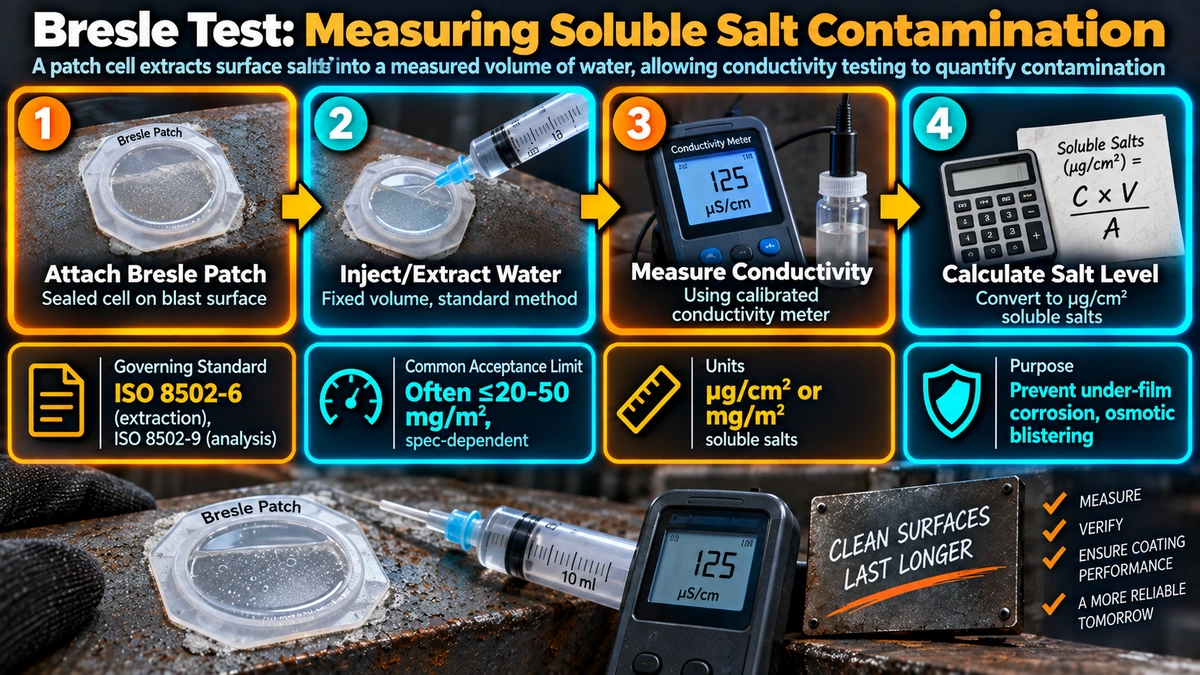
Why Soluble Salts Are a Coating Killer
Soluble salts, mainly chlorides and to a lesser extent sulfates and nitrates, are hygroscopic: they actively draw moisture through even a well-cured, low-permeability coating film. Once trapped between the coating and the substrate, the salt-water solution builds osmotic pressure that pulls in more water over time, eventually lifting the film from the inside in a pattern known as osmotic blistering. Because this happens beneath an intact coating, it is often invisible until the blisters burst, revealing corrosion that may already be well advanced.
This failure mode is different from ordinary under-film corrosion caused by poor surface preparation or low film thickness — a coating can be applied at correct dry film thickness, over a correctly profiled surface, and still fail early if soluble salt contamination was not checked and controlled beforehand. This is why salt contamination testing sits alongside dew point and humidity checks as a mandatory pre-coating hold point on most specifications, not an optional extra.
The Bresle Patch Method — ISO 8502-6
The Bresle method uses a small self-adhesive patch, typically enclosing an area of either 1250 mm² (12.5 cm²) or 2500 mm² (25 cm²), pressed firmly onto the cleaned steel surface to form a sealed reservoir. A measured volume of distilled or deionised water is injected through a self-sealing septum using a syringe, gently agitated against the surface for a specified contact time (commonly 60-90 seconds, per the patch manufacturer’s instructions), and then withdrawn back into the same syringe.
The extracted solution now contains whatever soluble salts were present on the tested patch of steel, dissolved into a known volume of water. Measuring the electrical conductivity of this extract, and knowing the exact patch area and water volume, allows the total surface salt loading to be calculated as a sodium chloride equivalent concentration.
Conductivity Measurement — ISO 8502-9
ISO 8502-9 covers the conductivity measurement itself: the extracted solution is checked with a calibrated conductivity meter, and the reading (in microsiemens per centimetre) is converted to a chloride concentration, conventionally expressed as an NaCl equivalent, since chloride ions dominate the conductivity signal in most field contamination and other soluble ions are treated as if they contributed the same conductivity per unit mass as sodium chloride.
Worked Example
An inspector runs a Bresle test on a blasted deck plate using a 1250 mm² (12.5 cm²) patch, injecting 3.0 mL of distilled water with a background conductivity of 2 uS/cm. After the specified contact time, the extracted solution reads 42 uS/cm on a calibrated conductivity meter. The project specification calls for the standard 20 µg/cm² acceptance limit.
Notice that a fairly high-looking conductivity reading of 42 uS/cm still converts to a comfortable pass margin, because the patch area and water volume both influence the final surface concentration. This is exactly why the raw conductivity number on its own is not a pass/fail figure — it must always be converted using the actual patch area and injected volume used in that specific test.
Acceptance Limits by Service and Specification
| Service / Specification Type | Typical NaCl Equivalent Limit | Governing Reference | Status |
|---|---|---|---|
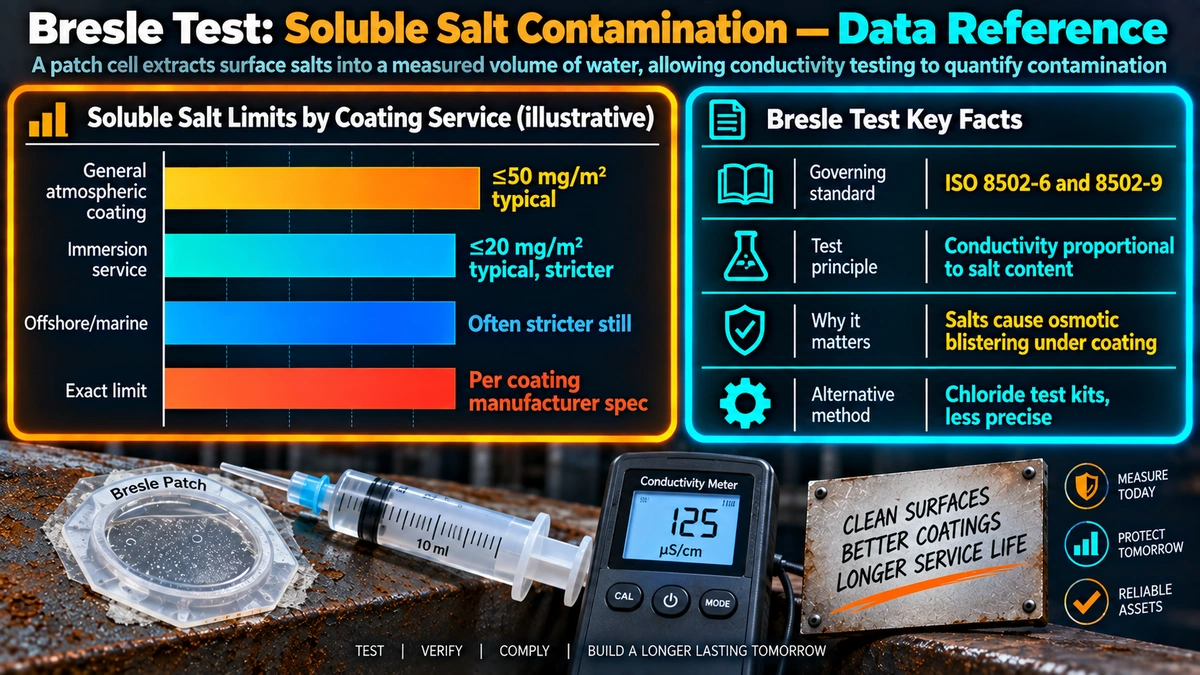
| General atmospheric service | 20 ug/cm2 (200 mg/m2) | ISO 8502-6/-9, NACE SP0508 guidance | Widely used |
| Offshore structures / splash zone | 5-10 ug/cm2 | Shell DEP, Aramco SAES-H, project specs | Stricter |
| Immersion / tank lining service | 5 ug/cm2 or lower | NACE SP0108, owner lining specs | Stricter |
| IMO PSPC (ballast tanks, void spaces) | 50 mg/m2 (5 ug/cm2) | IMO Performance Standard for Protective Coatings | Stricter |
| Coating manufacturer TDS | Product-specific, may exceed generic guide | Always the governing document where stricter | Always check |
Alternative Salt Testing Methods
Direct Conductivity Swab / Sponge Test
Instead of a sealed patch, a pre-wetted swab or sponge of known area is wiped over the test surface, and the resulting solution is measured directly for conductivity. This method is faster for screening large areas but is generally considered less precise and less repeatable than the sealed Bresle patch, since sample recovery and contact time are harder to standardise.
Ion-Specific Test Strips and Kits
Colorimetric chloride test strips and small field kits (such as titration-based chloride test kits) give a quick chloride-specific reading without needing a conductivity meter. These are useful for rapid go/no-go screening but are typically less accurate than a calibrated conductivity-based Bresle test and are usually not accepted as the sole method for formal contractual acceptance testing.
Laboratory Ion Chromatography
Where individual ion speciation matters, such as distinguishing chloride from sulfate contamination for a corrosion investigation, extract samples can be sent to a laboratory for ion chromatography. This gives precise individual ion concentrations but is far slower and more expensive than field conductivity testing, so it is reserved for investigative work rather than routine QA acceptance testing.
| Method | Speed | Precision | Typical Use |
|---|---|---|---|
| Bresle patch + conductivity (ISO 8502-6/-9) | Moderate (5-10 min per test) | High, repeatable | Formal QA acceptance testing |
| Direct swab/sponge conductivity | Fast | Moderate | Large-area screening |
| Colorimetric chloride strips | Very fast | Low-moderate | Rapid go/no-go field checks |
| Laboratory ion chromatography | Slow (off-site) | Very high | Failure investigation, ion speciation |
Common Field Mistakes
- Using the raw conductivity reading as a pass/fail number without converting it using the actual patch area and injected water volume for that specific test.
- Reusing syringes between tests without adequate flushing, cross-contaminating readings between locations.
- Testing too soon after washing or rain without allowing the surface to dry, which can dilute or wash away contamination and give a falsely low reading.
- Not recording a fresh blank conductivity reading for the distilled water batch in use, especially when water containers have been open for extended periods.
- Failing to re-test after an overnight hold, rain event, or change in weather between surface preparation and coating application.
- Applying the generic 20 ug/cm2 default when the project specification or coating manufacturer TDS calls for a stricter limit.