How to Stick Weld Stainless Steel (SMAW): A Beginner’s Guide
Learning how to stick weld stainless steel comes down to choosing the right electrode and controlling heat, because stainless steel reacts to welding very differently from carbon steel. Done well, a stick weld keeps the corrosion resistance of the parent metal; done badly, it causes porosity, distortion and rust.
Quick Answer: To stick weld stainless steel, match the electrode to the base metal (E308L-16 for 304L, E316L-16 for 316L), run DC electrode-positive at low amperage, hold a short arc with a slight drag angle, and use stringer beads with a low interpass temperature. Clean the joint, keep electrodes dry, and chip slag between every pass.
This beginner’s guide explains how shielded metal arc welding applies to austenitic stainless steel, how to read an SMAW electrode classification, and how to set up, weld and inspect a joint. It also covers heat input, interpass temperature, defects and safety.
The advice follows AWS A5.4 and typical industry practice. Where values vary between codes and manufacturers, the text says so and points you to the governing document.
Key Takeaways
- Stainless stick electrodes are classified in AWS A5.4, and the electrode alloy must match the base metal.
- E308L-16 suits 304L, E316L-16 suits 316L, E347-16 suits 321 and 347, and E309L-16 joins stainless to carbon steel.
- Stainless steel stick welding uses DC electrode positive at lower amperage than carbon steel because of high electrical resistance.
- A short arc, stringer beads and interpass temperature commonly limited to 150 degrees C reduce distortion and weld decay risk.
- Clean joints, dry electrodes and dedicated stainless tools prevent porosity and iron contamination.
What Is Stick Welding of Stainless Steel and When Should You Use It?
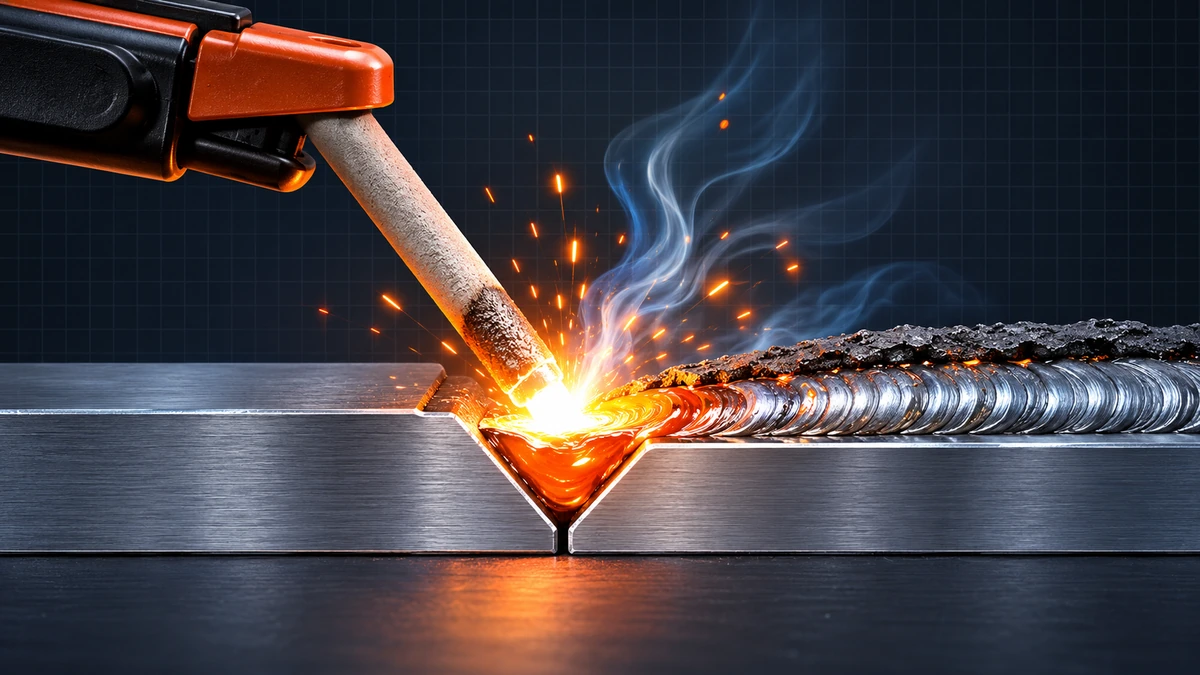
Shielded metal arc welding (SMAW) of stainless steel is a manual arc process that joins corrosion-resistant chromium steels using flux-covered electrodes. The electrode coating produces shielding gas and a protective slag, so no external gas cylinder is needed. Within the wider group of welding processes this makes stick welding the practical choice on site, in wind and on repair work.
Can you stick weld stainless steel?
Yes. Stainless steel can be stick welded with AWS A5.4 stainless electrodes, provided the electrode matches the base metal, the joint is clean, and heat is controlled. Stick welding suits plate and pipe fill passes from about 3 mm (1/8 in) thick, outdoors and in awkward positions. Thin sheet, food-grade and pharmaceutical work normally call for TIG instead.
How does stick welding compare with TIG and MIG on stainless?
Stick welding trades weld cleanliness and speed for portability and wind tolerance. For a wider comparison of all three processes, see MIG vs TIG vs stick welding; for root passes and thin sections, the gas tungsten arc welding (GTAW) guide covers the alternative.
| Criterion | Stick (SMAW) | TIG (GTAW) | MIG (GMAW) |
|---|---|---|---|
| Shielding | Coating gas and slag | Argon gas | Argon-rich mixed gas |
| Wind tolerance | Good | Poor | Poor |
| Weld cleanliness | Moderate, slag removal needed | Highest | Good |
| Sheet below 1.5 mm | Not recommended | Preferred | Possible with pulsed transfer |
| Site and repair work | Well suited | Limited by gas and setup | Limited by gas and setup |
| Typical use on stainless | Plate, pipe fill, repairs | Roots, thin wall, hygienic | Higher-deposition fabrication |
Scope note. This guide covers austenitic stainless steels such as 304L and 316L. Duplex, martensitic and high-alloy grades need qualified procedures beyond a beginner setup.
Which Stainless Steel Electrode Should You Use?
The correct electrode is the one whose alloy matches the base metal and whose carbon content protects corrosion resistance. Stainless stick electrodes are classified in AWS A5.4 (ASME SFA-5.4), and the label tells you the alloy, carbon level and coating. The full system is explained in the SMAW electrode nomenclature guide.
How do you match the electrode to the base metal?
Match the electrode to the base grade first, then confirm the L or stabilised requirement. Using an unstabilised, high-carbon electrode on an L-grade base metal invites sensitisation, described in the guide to stainless steel weld decay. Wider selection logic is in the welding consumable selection guide.
| Base metal | Electrode | Approx. nominal deposit (Cr / Ni / Mo) | Notes |
|---|---|---|---|
| 304 / 304L | E308L-16 | 18-21 / 9-11 / – | General purpose; controlled ferrite |
| 316 / 316L | E316L-16 | 17-20 / 11-14 / 2-3 | Molybdenum resists pitting; never substitute E308L |
| 321 / 347 | E347-16 | 18-21 / 9-11 / Nb stabilised | Niobium-stabilised; see why E347 beats E321 |
| Stainless to carbon or low-alloy steel | E309L-16 | 22-25 / 12-14 / – | Extra alloy absorbs dilution from the carbon steel |
| 2205 duplex | E2209-16 | Duplex chemistry | Qualified procedure only; see duplex stainless steel welding |
Molybdenum content is the practical reason 316L needs its own electrode. Pitting resistance in chlorides is compared using the pitting resistance equivalent number, which the PREN calculator computes for common grades.
What do the -15, -16 and -17 coating codes mean?
The two-digit suffix states coating type, usable current and welding position. Most beginners should choose a -16 electrode because the rutile coating gives a smooth arc and easily removed slag.
| Suffix | Coating type | Current | Positions |
|---|---|---|---|
| -15 | Lime (basic) | DC electrode positive only | All positions |
| -16 | Titania (rutile) | DC electrode positive or AC | All positions |
| -17 | Titania with silica | DC electrode positive or AC | All positions |
Electrodes ending in -25 and -26 are for flat and horizontal fillet welds only and are not covered here. Base metals and filler groupings for procedure qualification follow the P-Number, F-Number and A-Number guide, where austenitic stainless base metals fall under P-No. 8 in ASME Section IX.
Field tip. Check the electrode class printed on the flux end and the package before striking an arc. Mixed-up carbon and stainless electrodes are a common cause of failed positive material identification (PMI) checks.
What Machine Setup, Polarity and Amperage Work Best?
Stainless steel stick welding runs on DC electrode positive (DCEP) at lower current than carbon steel. Stainless core wire has high electrical resistance, so the electrode heats up quickly and must not be run at carbon steel amperage. Table 4 lists typical starting ranges for -16 electrodes; the datasheet and WPS always take priority.
| Electrode diameter | Typical current (A) | Typical plate thickness |
|---|---|---|
| 2.0 mm (5/64 in) | 40 – 60 | 1.5 – 3 mm |
| 2.5 mm (3/32 in) | 50 – 80 | 2 – 4 mm |
| 3.2 mm (1/8 in) | 70 – 110 | 3 – 8 mm |
| 4.0 mm (5/32 in) | 100 – 150 | 6 mm and above, multipass |
Use the low end for vertical and overhead work and for thin material. Test on scrap of the same grade, and watch the electrode: a coating that glows red or cracks near the holder means the current is too high.
| Property | Carbon steel | Austenitic stainless (304) | Welding consequence |
|---|---|---|---|
| Thermal conductivity | about 45 – 50 W/m·K | about 15 – 16 W/m·K | Heat stays in the joint; use lower current |
| Thermal expansion | about 12 µm/m·K | about 17 µm/m·K | More distortion; tack closely |
| Electrical resistivity | about 0.17 µΩ·m | about 0.72 µΩ·m | Electrode overheats; reduce amperage |
Regional note. In humid coastal or monsoon conditions, and in hot Gulf climates, electrodes pick up moisture quickly and interpass temperature rises fast. Keep electrodes in heated holding ovens or sealed tins and check joint temperature more often.
How Do You Prepare Stainless Steel for Stick Welding?
Preparation for stainless steel means removing oil, moisture and iron contamination while setting a joint gap that suits low-current welding. Poor cleaning causes porosity and later corrosion. Joint geometry choices are covered in welding joint types explained.
- Degrease: wipe with acetone or another non-chlorinated solvent. Chlorinated solvents can leave residues that harm the weld.
- Use dedicated tools: stainless steel wire brushes and iron-free grinding discs marked for stainless only. Carbon steel tools embed iron that later shows as rust spots.
- Bevel thick sections: a V-groove of roughly 60 to 70 degrees included angle with a small root face and gap is typical, but the WPS controls the dimensions.
- Tack closely: tack weld at about half the spacing used for carbon steel because of the higher thermal expansion.
- Dry the consumables: follow the manufacturer’s drying and storage instructions printed on the package.
Caution. On pipe, a stick-welded root without an internal argon purge oxidises on the inside (sugaring). Many procedures use a GTAW root with purge and stick welding for the fill and cap passes.
How to Stick Weld Stainless Steel Step by Step
Stick welding stainless steel follows one rule: short arc, steady travel, low heat. The steps below form a repeatable routine for a beginner working from a written procedure.
- Confirm the WPS and electrode. Read the WPS or job instruction, confirm the base metal grade, and select the matching AWS A5.4 electrode and diameter.
- Dry and prepare the consumables. Take electrodes from a sealed or heated container, inspect the coating for cracks, and use only dry, undamaged electrodes.
- Clean and fit the joint. Degrease with a non-chlorinated solvent, brush with a dedicated stainless steel brush, set the root gap and tack weld at close spacing.
- Set the machine. Select DC electrode positive, set amperage from the electrode datasheet, and test on scrap of the same grade.
- Strike the arc inside the joint. Strike on the groove or a run-on tab, never on the surrounding plate, and establish a short arc no longer than the core wire diameter.
- Travel with a slight drag angle. Hold a 90 degree work angle and a 10 to 15 degree drag angle, and advance steadily with a stringer bead or narrow weave.
- Fill the crater and stop. Pause briefly at the end of the bead to fill the crater before breaking the arc, which avoids crater cracks.
- Clean between passes. Chip the slag, brush with a stainless wire brush and inspect the bead before the next pass.
- Control interpass temperature. Let the joint cool below the WPS interpass limit, commonly 150 degrees C (300 degrees F) maximum, before the next pass.
- Finish, clean and inspect. Remove spatter and heat tint, pickle and passivate if specified, and complete the visual inspection.

What arc length, angle and bead width should you use?
Keep the arc no longer than the core wire diameter, hold a 10 to 15 degree drag angle, and limit any weave to about 2.5 times the core diameter. A long arc lets nitrogen and oxygen enter the pool, causing porosity and loss of chromium. Wide weaves add heat and lengthen time in the sensitisation range.
Which welding positions suit beginners?
Begin in the flat position, then progress to horizontal, vertical-up and overhead. Rutile -16 electrodes handle all positions, but the puddle sags more easily because stainless steel weld metal is sluggish. Position designations and qualification limits are explained in the welding positions as per ASME Section IX guide.
How Do You Control Heat Input and Interpass Temperature?
Heat input is the electrical energy delivered per unit length of weld, and austenitic stainless steel needs it kept low. The standard relationship is shown below, followed by a worked example with stated inputs.
V = arc voltage (V), I = current (A), S = travel speed (mm/min) Worked example: 3.2 mm E308L-16, 90 A, 24 V, travel 130 mm/minHI = (24 x 90 x 60) / (130 x 1000)
HI = 129,600 / 130,000
HI = 1.00 kJ/mm (approx. 25.3 kJ/in) With arc efficiency 0.8 for SMAW (thermal-input basis, EN 1011-1)HI = 0.8 x 1.00 = 0.80 kJ/mm (approx. 20.3 kJ/in)
Many specifications limit austenitic stainless heat input to around 1.5 kJ/mm (about 38 kJ/in), and this example sits below that. ASME Section IX supplementary heat input variables use the un-corrected form, so state which basis your WPS uses.
What interpass temperature should you use?
Interpass temperature is the temperature of the weld area immediately before the next pass starts. For austenitic stainless steel it is commonly limited to 150 degrees C (300 degrees F) maximum, and no preheat is normally required. Let the joint cool between passes and confirm the limit in your WPS. Prolonged exposure to roughly 425 to 815 degrees C (800 to 1500 degrees F) causes chromium carbide precipitation, the cause of weld decay.
What Defects Occur and How Do You Fix Them?
Most stainless stick welding defects trace back to moisture, contamination, wrong current or poor cleaning between passes. Table 6 links each defect to its usual cause and fix.
| Defect | Usual causes | Remedy |
|---|---|---|
| Porosity | Damp electrode, long arc, oil or moisture on joint | Dry electrodes, shorten arc, degrease joint |
| Slag inclusions | Slag left between passes, wide weave, low current | Chip and brush every pass, narrow the weave |
| Hot cracking | High restraint, low ferrite weld metal, crater not filled | Use correct electrode, fill craters, reduce restraint |
| Crater cracks | Arc broken abruptly at bead end | Pause to fill crater before breaking arc |
| Excess spatter | Current too high, long arc, damp coating | Lower amperage, shorten arc, dry electrodes |
| Heat tint and sugaring | Excess heat, no back purge | Lower heat input, purge, pickle and passivate |
| Distortion | High expansion, low conductivity, wide weaves | Close tacks, balanced sequence, backing bars |
| Rust spots after welding | Iron contamination from carbon steel tools | Dedicated stainless tools; pickle and passivate |
Common Mistakes and Limits of Stick Welding Stainless Steel
The most common mistakes come from treating stainless steel like carbon steel. The list below applies to typical beginner practice; requirements always depend on the code edition and contract specification applicable to your project.
- Running carbon steel current levels and overheating the electrode.
- Substituting E308L on 316L base metal and losing molybdenum in the deposit.
- Striking the arc on the parent metal, which leaves arc strikes that can start corrosion.
- Using carbon steel wire brushes or grinding discs on stainless surfaces.
- Leaving heat tint in place on corrosion-critical service, where pickling and passivation per ASTM A380 or A967 is specified.
- Stick welding sheet thinner than about 1.5 mm, where TIG gives better control.
Limits. Stick welding is slower and produces more slag than TIG or MIG, and it cannot match TIG cleanliness for hygienic or high-purity service. Procedure qualification under ASME Section IX, or AWS D1.6 governs code work; this guide does not replace it.
Quick Reference: Stainless Stick Welding Cheat Sheet
This cheat sheet condenses the article into one selection chart and one parameter table for use at the bench.
| Parameter | Guideline |
|---|---|
| Electrode | AWS A5.4, matched to base metal; L grade for 304L and 316L |
| Polarity | DC electrode positive (DCEP) |
| Current | Lower than carbon steel; see Table 4 |
| Arc length | No longer than core wire diameter |
| Drag angle | 10 to 15 degrees, 90 degree work angle |
| Weave width | Stringer or up to about 2.5 x core diameter |
| Interpass | Commonly 150 degrees C (300 degrees F) maximum |
| Heat input | Commonly below about 1.5 kJ/mm (38 kJ/in) |
| Cleaning | Dedicated stainless brush, chip slag every pass |
What Safety Precautions Apply to Stainless Steel Welding Fumes?
Stainless steel welding fume contains hexavalent chromium and nickel compounds, and exposure must be controlled. Use local exhaust ventilation at the arc, position your head out of the plume, and wear respiratory protection selected by a risk assessment. Follow the exposure limits set by the regulator in your country, and use standard arc protection: auto-darkening helmet, insulated gloves and flame-resistant clothing.
Frequently Asked Questions
Can you stick weld stainless steel with a normal carbon steel electrode?
What is the best polarity for stick welding stainless steel?
Why do stainless steel electrodes turn red hot while welding?
What amperage should a beginner use for a 3.2 mm (1/8 in) E308L-16 electrode?
Can I stick weld thin stainless sheet?
How do you prevent weld decay when stick welding stainless steel?
Is a stainless steel weld bead magnetic?
Key Terms
- SMAW
- Shielded metal arc welding, an arc process using a flux-covered consumable electrode.
- DCEP
- Direct current electrode positive, the polarity used for stainless steel stick electrodes.
- Sensitisation
- Precipitation of chromium carbides at grain boundaries that reduces corrosion resistance.
- Interpass temperature
- The weld area temperature immediately before the next pass begins.
- Delta ferrite
- A body-centred cubic iron phase retained in austenitic weld metal that resists hot cracking.
- Heat tint
- The oxide colour band next to a stainless weld caused by heating in air.
- Passivation
- A chemical treatment that restores the protective chromium oxide film on stainless steel.
Conclusion
To stick weld stainless steel reliably, choose an AWS A5.4 electrode that matches the base metal, keep the electrode dry, run DC electrode positive at moderate amperage, and hold a short arc with stringer beads. Clean the joint with dedicated stainless tools, limit interpass temperature, and remove slag after every pass. Follow the qualified procedure for code work and reserve TIG for thin sheet and hygienic service. As a next step, estimate your welding parameters with the WeldFabWorld calculation tools, which include a heat input calculator for SMAW.
About This Guide
This guide was prepared by the WeldFabWorld technical team from the standards listed in the References section. Verify all requirements against the code edition and specification applicable to your project.
Standards and References
- AWS A5.4/A5.4M – Specification for Stainless Steel Electrodes for Shielded Metal Arc Welding. American Welding Society (AWS).
- ASME SFA-5.4 – Specification for Stainless Steel Electrodes for Shielded Metal Arc Welding. ASME Boiler and Pressure Vessel Code, Section II Part C.
- ASME BPVC Section IX – Welding, Brazing, and Fusing Qualifications. American Society of Mechanical Engineers (ASME).
- AWS D1.6/D1.6M – Structural Welding Code – Stainless Steel. American Welding Society (AWS).
- ASTM A262 – Standard Practices for Detecting Susceptibility to Intergranular Attack in Austenitic Stainless Steels. ASTM International.
- ASTM A380/A380M – Standard Practice for Cleaning, Descaling, and Passivation of Stainless Steel Parts, Equipment, and Systems. ASTM International.
- ASTM A967/A967M – Standard Specification for Chemical Passivation Treatments for Stainless Steel Parts. ASTM International.
- ISO 3581 – Welding consumables – Covered electrodes for manual metal arc welding of stainless and heat-resisting steels – Classification. International Organization for Standardization (ISO).
- EN 1011-1 – Welding – Recommendations for welding of metallic materials – General guidance for arc welding. European Committee for Standardization (CEN).
Official sources: American Welding Society, ASME and ASTM International.