Welding SS321: Why E347 is a Better Choice than E321
Welding SS321 (Type 321 austenitic stainless steel) correctly requires a thorough understanding of why this grade was developed and what happens to its protective stabilising chemistry during arc welding. SS321 is a titanium-stabilised austenitic stainless steel designed to resist sensitisation — the precipitation of chromium carbides at grain boundaries — during exposure to elevated temperatures in service. The critical question for any welding engineer is: does the weld metal retain the same stabilisation protection as the parent plate, and if not, how do you restore it?
The answer lies in the behaviour of titanium through the welding arc. Titanium, the element responsible for stabilising SS321 against intergranular corrosion, oxidises rapidly and is largely lost during arc welding processes. This means that E321 electrodes — which rely on titanium as their stabilising element — cannot reliably deliver a weld deposit with the stabilisation protection needed for long-term service. E347 electrodes, which use niobium (Nb) instead of titanium as the stabiliser, transfer their alloying element efficiently through the arc and consistently produce weld metal with the required protection against sensitisation.
This article covers the full technical background: the mechanism of sensitisation in austenitic stainless steels, the behaviour of Ti and Nb in the welding arc, the ASME SFA-5.4 and SFA-5.9 code requirements for each electrode type, practical welding procedure guidance for SS321, and a worked comparison of E321 and E347 chemical composition effects on weld metal corrosion resistance. Whether you are writing a welding procedure specification (WPS), selecting consumables for a purchase order, or preparing for a welding procedure qualification test, this guide provides the technical depth you need.
Understanding SS321: Composition and Design Intent
SS321 (UNS S32100) is an 18Cr-10Ni austenitic stainless steel to which titanium has been added at a minimum of 5 times the carbon content (Ti ≥ 5 × C%) but not exceeding 0.70 wt%. This titanium addition is the defining feature of the grade — it exists for one specific purpose: to combine preferentially with carbon to form titanium carbide (TiC), thereby preventing carbon from combining with chromium to form chromium carbide (Cr₃C₆) at grain boundaries during exposure to the sensitisation temperature range.
The sensitisation temperature range for austenitic stainless steels is approximately 450 to 850 °C (840 to 1560 °F). Any time SS316 or SS304 (the non-stabilised grades) is held in or slowly cooled through this range — as happens in the heat-affected zone (HAZ) of welds, during stress relief heat treatment, or in high-temperature service — chromium carbides precipitate along grain boundaries. This locally depletes the adjacent matrix of chromium below the passive threshold of approximately 10.5 wt%, creating narrow corrosion-prone zones. The resulting failure mode, intergranular corrosion (weld decay), can cause catastrophic loss of structural integrity in aggressive service environments.
SS321 avoids this failure mode in the parent plate — provided the titanium content is maintained. The problem is that arc welding introduces a severe thermal excursion that challenges this chemistry in two locations: the HAZ of the parent plate (which may briefly enter the sensitisation range) and, more critically, the weld deposit itself.
Typical Chemical Composition of SS321 (ASTM A240)
| Element | Min (wt%) | Max (wt%) | Role |
|---|---|---|---|
| Carbon (C) | — | 0.08 | Controlled to limit carbide formation |
| Chromium (Cr) | 17.00 | 19.00 | Passivation — minimum 10.5% required for corrosion resistance |
| Nickel (Ni) | 9.00 | 12.00 | Austenite stabiliser, toughness |
| Manganese (Mn) | — | 2.00 | Austenite former, deoxidiser |
| Silicon (Si) | — | 0.75 | Deoxidiser |
| Phosphorus (P) | — | 0.045 | Impurity — limit for weldability |
| Sulfur (S) | — | 0.030 | Impurity — limit for corrosion resistance |
| Titanium (Ti) | 5 × C min | 0.70 | Stabiliser — ties up carbon as TiC |
Why Titanium Burns Off During Arc Welding
Titanium has an extremely high affinity for oxygen and nitrogen. Its standard free energy of oxide formation (ΔG⁰ for TiO₂) is substantially more negative than that of chromium oxide, meaning titanium oxidises preferentially and vigorously even in atmospheres with only trace levels of oxygen. During arc welding, the electrode tip and droplet transfer zone are exposed to temperatures between approximately 3,000 and 20,000 °C, where this oxidation reaction is essentially instantaneous.
The result is that the titanium in an E321 electrode tip oxidises before it can be transferred to the weld pool as metallic Ti. Instead, it forms TiO₂ or complex titanate compounds that either volatilise or are incorporated into the slag. The weld deposit therefore receives little or no metallic titanium, and the resulting weld metal is effectively an unstabilised austenitic stainless steel with 19.5Cr-9.5Ni chemistry — similar in behaviour to SS304 weld metal, but without the low carbon content advantage of SS304L.
Titanium vs. Niobium: Arc Transfer Behaviour Compared
Titanium (E321 / ER321)
- Extremely high oxygen affinity (forms TiO₂ readily)
- Oxidises at arc temperatures (>3000 °C) before droplet transfer
- Recovery in SMAW weld deposit: typically <10% of original Ti
- Recovery in GTAW weld deposit: ~30–50% of original Ti
- SAW: near-zero recovery due to flux oxidation environment
- Result: effectively unstabilised weld metal in most processes
Niobium (E347 / ER347)
- Moderate oxygen affinity — lower than titanium
- Transfers through the arc efficiently as metallic Nb
- Recovery in SMAW weld deposit: typically >85%
- Recovery in GTAW weld deposit: >90%
- SAW: acceptable recovery in most flux systems
- Result: fully stabilised weld metal with NbC precipitation
The Sensitisation Mechanism — What Goes Wrong Without Stabilisation
When carbon is not tied up by a stabilising element (Ti or Nb), it remains in solid solution in the austenite matrix. During exposure to the sensitisation range — which includes slow cooling from PWHT, high-temperature service, or extended HAZ thermal cycles — carbon diffuses to grain boundaries and reacts with chromium to form M₃C₆-type carbides (predominantly Cr₃₆C₆). Each unit of Cr₃₆C₆ formed consumes 23 chromium atoms, locally stripping chromium from the grain boundary region.
The depleted zone extends roughly 0.1 to 1 micrometre on each side of the boundary and drops in chromium content to below the passive threshold of approximately 10.5 wt%. In a corrosive environment — acids, chlorides, high-temperature oxidising gases — this narrow band becomes an anodic cell relative to the chromium-rich grain interior, and intergranular corrosion (also called weld decay when it occurs in the HAZ) propagates along the grain boundary network. In severe cases, entire grains can drop out, causing material loss with no macroscopic plastic deformation or warning.
For a full treatment of this mechanism, see the dedicated article on stainless steel weld decay on WeldFabWorld.
E347 and E321: ASME SFA-5.4 and SFA-5.9 Requirements
E347 — Niobium-Stabilised (SMAW Covered Electrode)
As defined in ASME SFA-5.4 (equivalent to AWS A5.4), E347 has a nominal composition of 20 Cr, 10 Ni with niobium added as the stabilising element at a content of at least 8 times the carbon content (Nb ≥ 8 × C%) and not exceeding 1.00 wt%. Although the designation uses “Nb,” tantalum (Ta) is invariably co-present in the ore from which niobium is extracted (columbite-tantalite), and both elements are essentially equally effective in stabilising carbon and contributing to elevated temperature strength. The Ta content is not separately specified but is included in the Nb+Ta combined limit.
Niobium transfers efficiently through all common arc welding processes and is well recovered in the weld deposit regardless of the shielding or flux system used. This makes E347 suitable for SMAW, GTAW, GMAW, FCAW, and SAW (with appropriate flux selection). The resulting weld deposit is fully stabilised against sensitisation, with NbC (niobium carbide) providing the same protective function as TiC does in the parent SS321 plate.
E321 — Titanium-Stabilised (SMAW Covered Electrode)
E321 has a nominal composition of 19.5 Cr, 9.5 Ni with titanium added as the stabiliser. The titanium addition is chemically effective in the parent plate but fails to survive the arc transfer process in most welding conditions. ASME SFA-5.4 contains the explicit limitation that E321 is not suitable for submerged arc welding because only a small fraction of the titanium is recovered in the weld deposit. The same limitation applies in practice to SMAW and FCAW, where the arc atmosphere and flux system are insufficiently inert to prevent titanium oxidation.
E321 electrodes also present a practical challenge in GTAW: while argon shielding significantly reduces oxidation compared with SMAW or SAW, the high arc temperature still causes some titanium loss, and recovery varies with arc length, travel speed, and shielding gas purity. The ER321 bare wire (SFA-5.9) is therefore primarily of academic interest — most engineers default to ER347 even for GTAW of SS321.
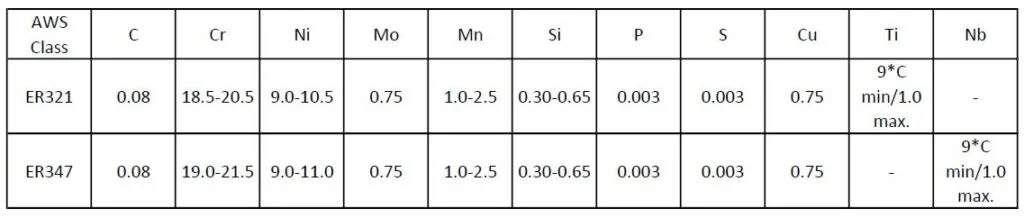
Chemical Composition Comparison — E321 vs E347 (ASME SFA-5.4)
| Element | E321 (wt%) | E347 (wt%) | Significance |
|---|---|---|---|
| Carbon (C) | 0.08 max | 0.08 max | Carbon content drives sensitisation risk — both grades rely on stabilisation |
| Chromium (Cr) | 18.0 – 21.0 | 18.0 – 21.0 | Passivation element — must remain >10.5% throughout |
| Nickel (Ni) | 9.0 – 10.5 | 9.0 – 11.0 | Austenite stabiliser; slightly wider range in E347 |
| Manganese (Mn) | 0.5 – 2.5 | 0.5 – 2.5 | Deoxidiser, austenite former |
| Silicon (Si) | 0.90 max | 0.90 max | Deoxidiser |
| Titanium (Ti) | Min 5×C, max 0.70 | Not specified | Stabiliser in E321 — largely lost in arc |
| Niobium (Nb+Ta) | Not specified | Min 8×C, max 1.00 | Stabiliser in E347 — efficiently transferred through arc |
| Delta Ferrite (FN) | Typically 3 – 8 FN | Typically 3 – 8 FN | Controls solidification cracking risk — verify per Schaeffler/WRC diagram |
The Submerged Arc Welding Prohibition for E321
The prohibition on using E321 for submerged arc welding (SAW) deserves specific attention because SAW is commonly used for thick-section pressure vessel fabrication in the industries where SS321 is most frequently specified — chemical processing, petrochemical, and power generation. In SAW, the electrode wire is submerged beneath a granular flux that creates both the arc shielding and the slag system. The flux is inherently oxidising relative to titanium, and the larger weld pool with longer time at temperature ensures near-complete titanium oxidation before the metal solidifies.
An engineer who specified E321 wire for SAW of an SS321 pressure vessel shell would be producing weld metal with essentially no titanium — a fully unstabilised 19.5Cr-9.5Ni deposit. Any subsequent service exposure in the 450–850 °C range, any PWHT, or even slow cooling from operating temperature could sensitise this weld metal and cause intergranular corrosion failure. For SAW of SS321, ER347 wire with a compatible neutral or slightly basic flux is the unambiguous correct choice. Consult the submerged arc welding guide on WeldFabWorld for SAW parameter selection principles.
Practical Welding Procedure Guidance for SS321 with E347
Preheat and Interpass Temperature
SS321 does not require preheat under normal ambient conditions. Because it is an austenitic stainless steel, it does not undergo martensitic transformation on cooling and is not susceptible to hydrogen-induced cracking in the conventional sense. The primary interpass temperature concern is the opposite: do not overheat. The maximum recommended interpass temperature is 175 °C (350 °F). Exceeding this limit prolongs the time the HAZ spends in the sensitisation range during each weld pass.
Heat Input Control
Controlling heat input is critical for two reasons: it limits sensitisation risk in the HAZ, and it controls distortion in austenitic stainless steel, which has approximately 50% higher thermal expansion coefficient and 30% lower thermal conductivity than carbon steel. Low to moderate heat inputs are preferred. For SMAW on SS321, typical heat inputs are 0.5 to 1.5 kJ/mm. For GTAW, 0.3 to 1.0 kJ/mm. For GMAW, 0.5 to 1.2 kJ/mm in spray or pulsed mode.
HI (kJ/mm) = (V × A × 60) / (1000 × WS)
where V = arc voltage (V), A = welding current (A), WS = travel speed (mm/min)
Multiply by arc efficiency factor: GTAW = 0.60, SMAW = 0.80, GMAW = 0.85
Example — SMAW on SS321, 4 mm E347 electrode:
V = 25 V, A = 140 A, WS = 200 mm/min, efficiency = 0.80
HI = (25 × 140 × 60) / (1000 × 200) × 0.80
HI = 210,000 / 200,000 × 0.80 = 1.05 × 0.80
HI = 0.84 kJ/mm — within acceptable range for SS321
Shielding Gas for GTAW and GMAW
For GTAW (TIG welding) of SS321 with ER347 wire, 100% argon or argon + 2% nitrogen shielding is standard. Pure argon provides the cleanest arc with the lowest oxidation. When welding the root pass in pipe, back purging with 100% argon is essential to prevent root side oxidation and loss of corrosion resistance. For GMAW (MIG welding) with ER347 wire, argon + 1–2% O₂ or argon + CO₂ mixtures are used. Avoid high CO₂ percentages (>5%) as these increase oxidation of the weld pool and can promote porosity.
Weld Sequence and Distortion Control
Due to the high thermal expansion of austenitic stainless steel, distortion management is more demanding than for carbon steel fabrications of equivalent geometry. Balanced welding sequences (backstep, alternating sides), strong-back fixtures, and chill bars are commonly employed. Avoid excessive weld reinforcement — excess weld metal adds residual stress and may require grinding that risks disturbing the passive surface layer.
- Verify delta ferrite in the weld deposit by Schaeffler or WRC-1992 diagram before proceeding with qualification. Aim for 3–8 FN.
- Clean joint faces and filler wire with acetone or isopropyl alcohol before welding to remove organic contamination that can cause porosity and carbon pickup.
- Use dedicated stainless steel wire brushes — never use a carbon steel brush on stainless, as it embeds iron particles that cause rust staining and localised corrosion.
- Back purge pipe root passes with 100% argon at a flow rate sufficient to maintain oxygen content below 0.1% (use an oxygen analyser).
- Record actual interpass temperatures on the weld record — do not rely on estimates.
- For PREN-sensitive applications, use the PREN calculator to verify the weld metal’s corrosion resistance index after dilution.
Delta Ferrite in SS321 Weld Metal
Controlling delta ferrite content in austenitic stainless steel weld metal is important for resistance to solidification hot cracking. A small percentage of delta ferrite (3 to 8 Ferrite Number, or FN) in the weld deposit promotes a two-phase solidification mode (FA mode — ferrite then austenite) that accommodates the segregation of low-melting impurities like sulfur and phosphorus, preventing them from forming continuous intergranular liquid films that cause hot cracking.
E347 at its standard 20Cr-10Ni nominal composition places the weld deposit comfortably within this desirable ferrite range on the Schaeffler and WRC-1992 diagrams. However, significant dilution from an SS321 base metal (which shifts the composition toward the austenite region) can reduce ferrite below the safe minimum. This is most likely to occur in root passes with high dilution in narrow groove joints. For any application where crack sensitivity is a concern, use the delta ferrite guide on WeldFabWorld and calculate the expected FN before proceeding with the qualification weld.
Process Suitability Summary: E321 vs E347 for SS321 Welding
| Welding Process | E321 (Ti-stabilised) | E347 (Nb-stabilised) | Recommendation |
|---|---|---|---|
| GTAW (TIG) — argon shielded | Marginal — partial Ti recovery (~30–50%) | Suitable — Nb >90% recovered | Use ER347; ER321 may be used with caution |
| GMAW (MIG) — argon/O₂ mix | Not Recommended — Ti <20% recovered | Suitable — Nb well recovered | Use ER347 only |
| SMAW — covered electrode | Not Suitable — Ti <10% in deposit | Suitable — Nb >85% recovered | Use E347 only |
| SAW — submerged arc | Prohibited — per ASME SFA-5.4 | Suitable — with compatible flux | Use ER347 wire only; select neutral/basic flux |
| FCAW — flux-cored arc | Not Suitable — flux atmosphere oxidises Ti | Suitable — E347T classifications | Use E347T-1 or E347T-4 flux-cored wire |
Post-Weld Heat Treatment Considerations
Conventional stress-relief PWHT in the 600–700 °C range — standard practice for carbon and low-alloy steels — is not appropriate for SS321 weldments because this temperature falls squarely within the sensitisation range. Holding or slow cooling through 450–850 °C will precipitate Cr₃₆C₆ in any weld metal zones that have insufficient stabilisation and will sensitise even partially stabilised deposits. If the application requires stress relief, the correct treatment is a full solution anneal above 1050 °C followed by rapid water quench. This dissolves all chromium carbides, homogenises the chemistry, and restores full corrosion resistance — but it also eliminates any cold-work hardening and can cause distortion in complex fabrications.
In most cases, SS321 weldments are used in the as-welded condition, relying on the E347 weld metal’s built-in stabilisation rather than any thermal treatment to maintain corrosion resistance. Confirm PWHT requirements with the applicable code (ASME B31.3, ASME Section VIII, etc.) and the engineering specification for the specific service.
Recommended Books on Stainless Steel Welding
Frequently Asked Questions
Why is E347 preferred over E321 for welding SS321 stainless steel?
E347 is preferred because its stabilising element, niobium (Nb), transfers efficiently through the welding arc and is fully recovered in the weld metal. E321 uses titanium (Ti) as its stabiliser, but titanium oxidises preferentially at arc temperatures and is largely lost before it reaches the weld pool. The resulting E321 weld metal is effectively unstabilised and susceptible to sensitisation — chromium carbide precipitation at grain boundaries — and intergranular corrosion in service. E347’s niobium forms NbC in the deposit, providing the same protection that TiC provides in the SS321 parent plate. For the mechanism of weld decay and sensitisation, see the dedicated WeldFabWorld guide.
What is sensitisation and why does it matter for SS321?
Sensitisation is the precipitation of chromium carbides (Cr₃₆C₆) at austenite grain boundaries when stainless steel is exposed to temperatures in the range 450–850 °C. This depletes chromium from the adjacent matrix below the passive threshold (~10.5 wt%), creating narrow zones vulnerable to intergranular corrosion. SS321 was developed specifically to prevent sensitisation in the parent plate by using titanium to tie up carbon as TiC. However, if weld metal loses its stabilisation through titanium burn-off in the arc, the protection is lost and the weld deposit behaves like an unstabilised 304 grade — prone to sensitisation during any subsequent thermal exposure in the critical range.
Can E321 ever be used for welding SS321?
E321 (ER321) may be used with GTAW (TIG welding) in argon shielding, where titanium recovery is higher than in other processes — though still only partial (30–50%). It is explicitly prohibited for submerged arc welding (SAW) by ASME SFA-5.4 due to near-complete titanium loss in the flux environment. For SMAW, GMAW, and FCAW applications, E321 is not suitable because titanium recovery is too low to provide meaningful stabilisation. In practice, most welding engineers specify E347 for all processes when welding SS321, as it eliminates any uncertainty about stabilisation.
What is the role of niobium in E347?
Niobium (Nb) in E347 acts as a preferential carbide former — it combines with carbon to form NbC (niobium carbide) rather than allowing chromium to form Cr₃₆C₆ at grain boundaries. The minimum Nb content of 8 × carbon percentage ensures enough niobium is present to tie up essentially all available carbon. Niobium also contributes to elevated temperature strength through precipitation hardening at service temperatures above 500 °C, making E347 weld metal superior to E321 in creep-limited applications as well. Tantalum (Ta), which co-exists with niobium in Type 347 alloys, is equally effective as a stabiliser and high-temperature strengthener.
What ASME classification covers E347 and E321 electrodes?
Covered electrodes (SMAW) for E347 and E321 are classified under ASME SFA-5.4 (equivalent to AWS A5.4). Bare wire and rods for GTAW and GMAW are classified under ASME SFA-5.9 as ER347 and ER321 respectively. Under ASME Section IX procedure qualification, both fillers are F-Number 6 and A-Number 8 (austenitic stainless steel weld metal). SS321 base metal is P-Number 8, Group 1. See the P-Number, F-Number, and A-Number guide for full qualification range implications, and use the ASME Section IX quiz to test your knowledge.
What interpass temperature should be maintained when welding SS321?
The recommended maximum interpass temperature for welding SS321 is 175 °C (350 °F). Exceeding this limit prolongs the time the heat-affected zone and surrounding weld metal spend in the sensitisation range (450–850 °C) during the post-weld cooling cycle of each pass. Low heat input combined with strict interpass temperature control provides the best protection against sensitisation and preserves corrosion resistance across the entire weld joint, even in multipass thick-section applications.
Is post-weld heat treatment (PWHT) required for welded SS321?
Conventional PWHT in the 600–700 °C range is not recommended for SS321 weldments because this temperature range overlaps with the sensitisation range and will cause chromium carbide precipitation in any insufficiently stabilised zones. If stress relief is required, full solution annealing above 1050 °C followed by rapid water quench is the correct treatment — this dissolves all carbides and restores full corrosion resistance. In most applications, SS321 weldments are used in the as-welded condition, relying on the E347 weld metal stabilisation rather than thermal treatment to maintain integrity. Always confirm PWHT requirements against the applicable fabrication code.
What is the significance of delta ferrite in SS321 weld metal?
A delta ferrite content of 3 to 8 Ferrite Number (FN) in E347 weld metal promotes solidification in the ferrite-austenite (FA) mode, which is more resistant to solidification hot cracking than fully austenitic solidification. The ferrite phase accommodates low-melting impurities (S, P) without forming continuous liquid films at grain boundaries. At the standard E347 composition, FN is typically within this range. High dilution from the SS321 base metal can shift the deposit toward the fully austenitic region, increasing crack sensitivity. For high-dilution root passes, verify the expected FN using the delta ferrite guide.