Marine and Offshore Coating Systems Guide
Marine and offshore coating systems have to do more than survive a corrosive atmosphere — they have to survive constant wave impact, tidal wetting and drying cycles, biofouling, and decades without practical re-access once a structure is installed. Our companion guide, Coating Systems: Atmospheric vs Immersion vs Splash Zone, covers how those exposure zones are classified. This guide goes a level deeper into the actual chemistry and system decisions engineers face once the zone is known: when to specify a metallic duplex system over paint alone, how cathodic protection changes coating requirements, where antifouling fits in, and how offshore-specific standards like NORSOK M-501 layer on top of ISO 12944.
You will find a zone-based system selector tool, a comparison of duplex versus organic-only systems, cathodic protection interaction, antifouling considerations for static structures, and a look at why flanges and welds remain the most common failure points on real offshore assets, drawn from published long-term field performance data rather than laboratory testing alone.
Whether you are specifying a coating system for an offshore platform, a jacket structure, or a wind turbine monopile, or reviewing an existing specification for gaps, this guide gives you the chemistry-level reasoning behind the zone classification.
Offshore Zone Coating System Selector
Why Offshore Zones Need Different Coating Logic, Not Just Thicker Paint
It is tempting to treat offshore coating selection as simply “apply the C5 or CX system, but thicker.” In practice, the dominant failure mechanisms genuinely differ by zone. The splash zone corrodes fastest of all because it is repeatedly wetted and dried, keeping the steel well supplied with both moisture and dissolved oxygen while receiving mechanical impact from waves and floating debris. Cathodic protection, which works well on the fully submerged zone, cannot reach the splash zone because the surface is not reliably immersed in the electrolyte, and is only intermittently effective in the tidal band. This is why the splash zone consistently shows the highest general corrosion rates on marine structures, and why coating systems in this specific band are treated differently from either the atmospheric zone above or the submerged zone below.
| Zone | Dominant Degradation Driver | Cathodic Protection Effectiveness |
|---|---|---|
| Atmospheric | UV, salt deposition, wet/dry cycling, wind-driven spray | Not applicable |
| Splash / Tidal | Wave impact, wet/dry cycling, high oxygen availability, abrasion | Largely ineffective |
| Submerged | Continuous immersion, biofouling, reduced oxygen at depth | Effective, standard practice |
Duplex Systems: Metallic Spray Plus Organic Topcoat
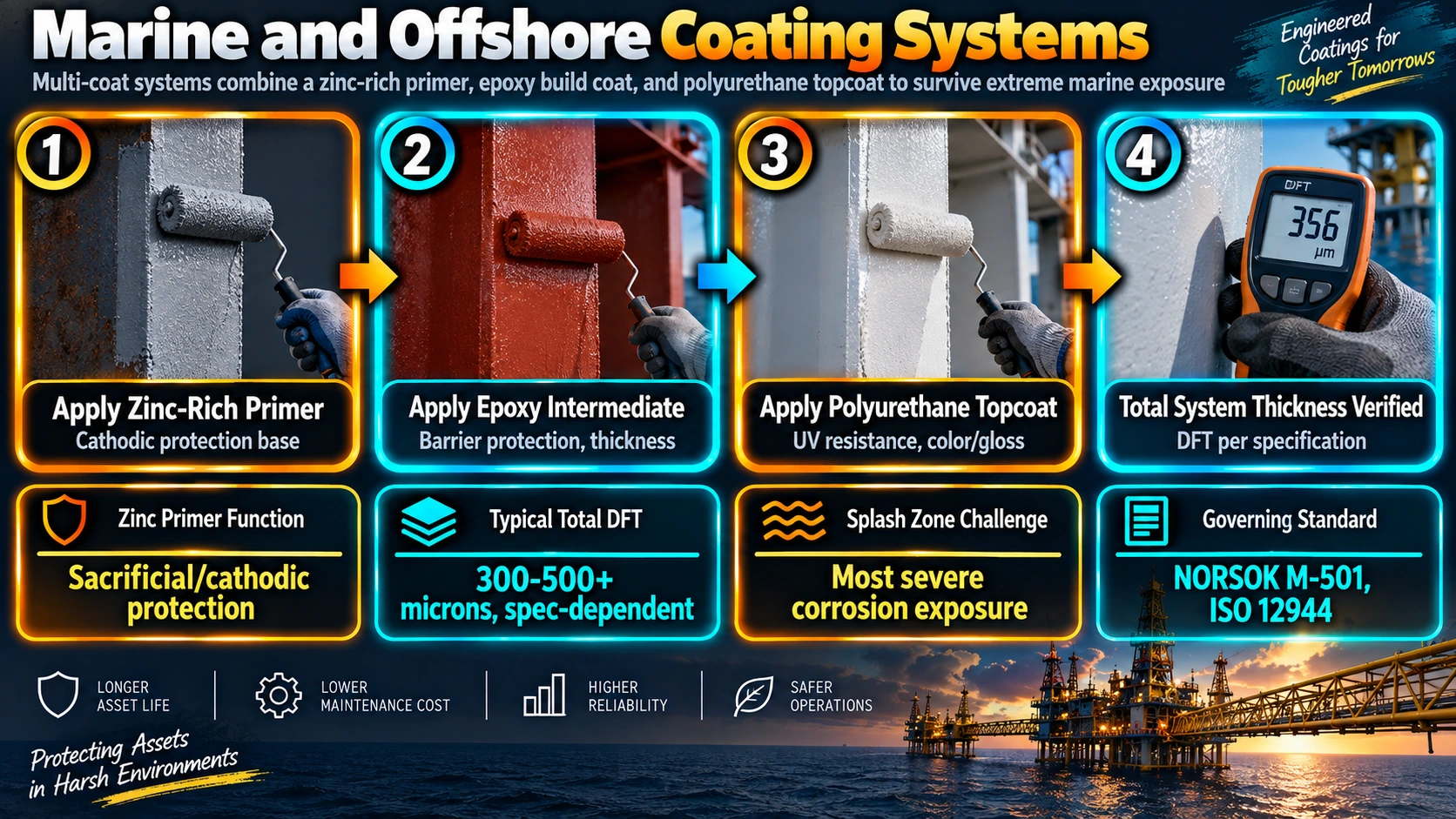
For atmospheric and splash zone service where the longest possible service life is required, duplex systems combining thermal spray aluminum (TSA) or a zinc/aluminum alloy metallic layer with an organic sealer and topcoat are among the best-documented long-life options. The metallic layer provides galvanic protection that continues working even where the topcoat is locally damaged, while the organic topcoat seals the somewhat porous sprayed metal layer and adds barrier protection and color/UV stability. Field studies following coating performance on offshore wind structures over multiple years in real North Sea conditions have specifically identified duplex systems, using zinc/aluminum spray metallization with an epoxy intermediate and polyurethane topcoat, as providing the strongest anti-corrosive performance among the systems tested, including in the demanding splash zone.
| System Type | Typical Components | Relative Strength |
|---|---|---|
| Organic-only (paint) system | Zinc-rich epoxy primer + epoxy intermediate + PU topcoat | Good, cost-effective; relies entirely on coating film integrity |
| Duplex (metallic + organic) | TSA or Zn/Al spray + epoxy sealer + PU topcoat | Best documented long-term performance; higher initial cost and specialized application |
| Cementitious / concrete overlay | Used in some submerged or splash applications for abrasion resistance | High mechanical/abrasion resistance; heavier, different application logistics |
Cathodic Protection and Coating Interaction
On submerged structures, coatings and cathodic protection (CP) are designed to work together, not as alternatives to one another. The coating reduces the total bare steel area exposed to seawater, which directly reduces the electrical current the CP system must supply to protect that area, in turn allowing a smaller and longer-lasting sacrificial anode system, or a smaller impressed current system, than would be needed on fully uncoated steel. A poorly performing or rapidly degrading coating on a submerged structure increases CP current demand over time and can shorten sacrificial anode life well below its original design.
Antifouling for Static Offshore Structures
Biofouling is not only a ship-hull problem. On static offshore structures such as platform jackets, monopiles, and subsea infrastructure, fouling growth in the submerged and tidal zones adds substantial hydrodynamic drag and mass loading, which matters for structural and hydrodynamic design, and can also promote localized corrosion beneath fouling colonies through differential aeration and microbial activity at the coating surface. Antifouling coatings or foul-release systems are commonly specified for these zones on static structures for exactly this reason, though the product chemistry requirements, environmental regulations, and release-rate mechanisms often differ meaningfully from antifouling systems designed for a moving ship hull.
NORSOK M-501 and ISO 12944 CX — Using Both
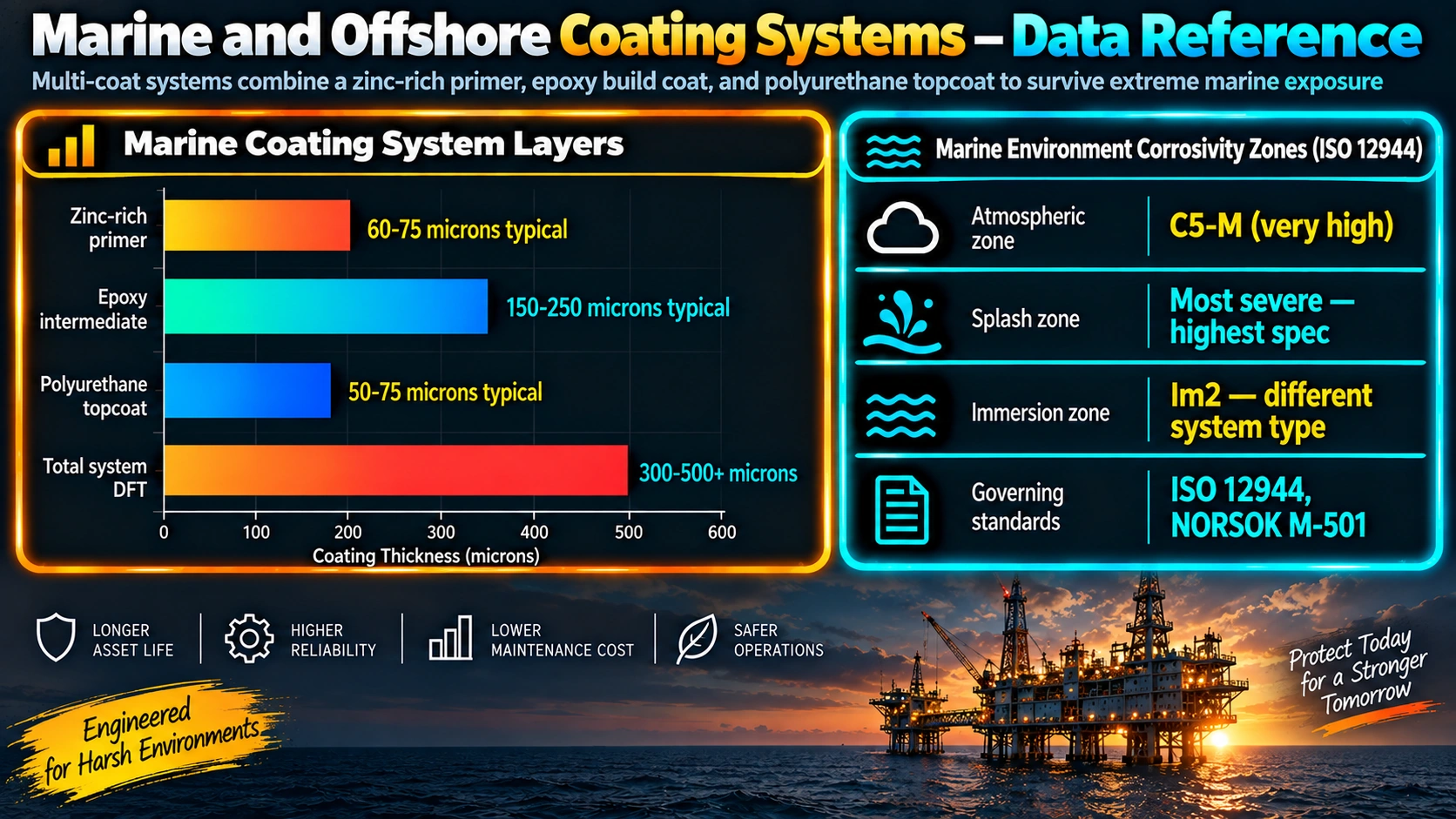
ISO 12944 CX classifies offshore atmospheric exposure severity and gives general system examples. NORSOK M-501, a Norwegian offshore industry standard widely referenced on North Sea and other major international offshore projects, goes further by requiring specific coating systems to be pre-qualified through accredited laboratory testing before they can be used on a project, rather than accepting a system on the basis of generic category compliance alone. Many offshore project specifications reference both standards together, and it is common for a coating manufacturer to hold NORSOK M-501 pre-qualification certificates for specific, named products and film builds rather than for a coating type in general.
Flanges, Welds, and Other Critical Detailing Points
Long-term offshore coating performance studies consistently flag flange connections, weld caps, and other geometric discontinuities as common early failure locations, more so than flat plate surfaces. These areas are harder to blast to a consistent profile, harder to coat to uniform film thickness around sharp edges and crevices, and more prone to trapping moisture and salts in gaps between mating surfaces. Edge retention of coating film, stripe coating of welds and edges before the full system is applied, and close DFT verification around these details are standard quality practices specifically because flat-surface DFT compliance alone does not guarantee protection at these higher-risk locations.