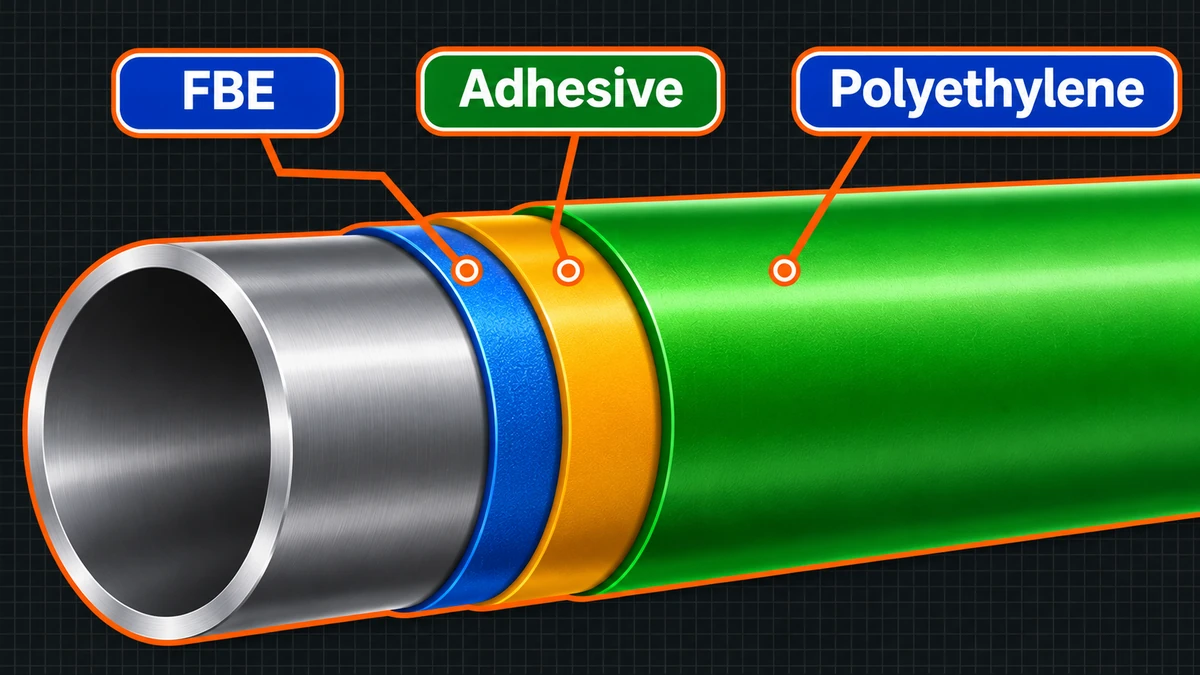
3LPE coating is a widely used external corrosion protection for buried steel pipelines, combining an epoxy primer, an adhesive layer and a tough polyethylene jacket in one factory-applied system. Each layer does a different job, and the system performs only as well as its weakest link, which is usually surface preparation or the field joint.
Quick Answer
3LPE coating is a three-layer polyethylene pipeline coating system made of a fusion bonded epoxy (FBE) primer for adhesion and corrosion resistance, a copolymer adhesive, and a thick polyethylene topcoat for mechanical and moisture protection. It is applied in a plant to buried or submerged steel pipe and is normally used together with cathodic protection.
This guide explains the three layers, plant application, standards, thickness, field joints, testing and failure modes, with a worked quantity example. For how coatings are chosen for other exposures, see our anti-corrosive coating selection guide by environment, and for how pipelines are welded and joined in the field, see pipeline welding for cross-country transmission lines.
Thickness, temperature and test limits vary between standards, editions and manufacturers. Treat the figures below as engineering orientation, and use the governing standard and the project specification for acceptance.
Key Takeaways
- 3LPE has three layers: an FBE primer for adhesion and corrosion resistance, a copolymer adhesive, and a polyethylene topcoat of roughly 2 to 4 mm.
- Coating is applied in a plant to blasted steel, and the pipe ends are left bare so that girth welds can be made and then coated in the field.
- ISO 21809-1 and DIN 30670 are the main standards, and ISO 21809-3 covers field joint coatings.
- 3LPE is typically limited to about 60 to 80 °C, while 3LPP is used for hotter lines.
- Field joints and holidays are the usual weak points, so inspection, testing and cathodic protection design matter as much as the coating itself.
What Is 3LPE Coating?
3LPE coating is a factory-applied pipeline coating of fusion bonded epoxy, copolymer adhesive and polyethylene layers that protects buried steel pipe from corrosion and mechanical damage.
The name means three layers with a polyethylene (PE) outer layer. A related system uses polypropylene instead of polyethylene (3LPP) for higher temperatures. Onshore oil, gas and water pipelines are the main users, and the coating is normally paired with cathodic protection. For broader guidance on coating categories and durability, browse the Painting & Coatings articles.
| Layer | Material | Typical thickness | Main job |
|---|---|---|---|
| 1. Primer | Fusion bonded epoxy (FBE) powder | About 150 to 250 microns | Chemical adhesion to steel, corrosion and cathodic disbondment resistance |
| 2. Adhesive | Grafted polyethylene copolymer | About 150 to 400 microns | Bonds the epoxy to the polyethylene |
| 3. Topcoat | HDPE or MDPE | About 2 to 4 mm | Impact, abrasion, moisture and soil stress protection |
| Total system | Three layers combined | About 2.5 to 4 mm | Complete external protection with cathodic protection |
How Do the Three Layers Work Together?
Each layer covers a weakness of the others: epoxy bonds well but is thin, polyethylene is tough but bonds poorly to steel, and the adhesive joins them.
Fusion bonded epoxy is applied as a powder to steel heated to roughly 200 to 240 °C. The powder melts, flows and cures into a thin, hard film that bonds chemically to the blasted surface. It is a barrier coating, which works as described in the epoxy primer versus zinc-rich primer comparison.
The adhesive is applied while the epoxy is still curing, so that it bonds chemically to the epoxy. The polyethylene is then extruded over the adhesive and quenched. The result is a jacket that resists impact from rocks, abrasion during installation and long-term water absorption.
Polyethylene has a very high electrical resistance, so cathodic protection current cannot pass through an intact jacket. If the polyethylene disbonds from the steel, it can shield the steel from that current, so the FBE primer must resist cathodic disbondment.
How Is 3LPE Coating Applied in the Plant?
3LPE is applied in a plant on a continuous line, where the pipe is cleaned, heated, coated layer by layer and cooled in a controlled sequence.
- Surface preparation: abrasive blasting to Sa 2 1/2 per ISO 8501-1 is commonly the minimum, with an anchor profile in the range typically specified for FBE. Profile measurement is covered in the surface profile measurement guide, and visual grades in blast cleanliness comparators and visual standards.
- Salt and dust control: soluble salts left on the steel cause blistering and loss of adhesion, so they are measured with the method in the Bresle test for salt contamination guide.
- Pre-treatment: some specifications call for a chemical wash or conversion treatment before the epoxy is applied.
- Heating and coating: induction heating brings the pipe to the epoxy application temperature, then epoxy powder, adhesive and polyethylene are applied one after another.
- Cooling and finishing: a water quench cools the coating, then holiday detection, thickness checks and cutting of the end cutbacks complete the process.
Which Standards Govern 3LPE Coating?
ISO 21809-1 is the main international standard for 3LPE and 3LPP, and many specifications also reference DIN 30670 or national and company standards.
| Standard | Title | Scope |
|---|---|---|
| ISO 21809-1 | External coatings for buried or submerged pipelines, Part 1: Polyolefin coatings (3-layer PE and 3-layer PP) | Plant-applied 3LPE and 3LPP |
| ISO 21809-3 | External coatings for buried or submerged pipelines, Part 3: Field joint coatings | Girth weld coating systems |
| DIN 30670 | Polyethylene coatings for steel pipes and fittings | PE coating requirements and testing |
| CAN/CSA Z245.21 | External polyethylene coating for pipe | Canadian PE coating standard |
| NF A 49-710 | External three-layer polyethylene based coating applied by extrusion | French 3LPE standard |
| ISO 15589-1 | Cathodic protection of pipeline systems, Part 1: On-land pipelines | Cathodic protection design |
The International Organization for Standardization publishes ISO 21809. Project specifications often add requirements on top of the standard, so always read the contract documents together with the standard.
What Are the Design Limits of 3LPE Coating?
3LPE is limited mainly by operating temperature, storage conditions, handling damage and the installation method.
- Temperature: continuous service is typically limited to about 60 to 80 °C depending on the polyethylene grade and the standard. Hotter lines move to 3LPP or another high-temperature system.
- Storage and UV: polyethylene is carbon-black stabilized, but standards and manufacturers still limit outdoor storage time and require pipe supports that do not damage the coating.
- Handling: lifting, stringing and lowering need padded slings and clean trench bottoms so that rocks do not cut the polyethylene.
- Installation method: directional drilling and road bores can abrade the coating, and some projects add an abrasion-resistant overcoat or a thicker duty class.
- Soil stress: shifting soils can pull on the coating, which is one reason adhesion testing is part of acceptance.
Offshore atmospheric and splash zone service needs a different approach, which is described in the marine and offshore coating systems guide.
How Are 3LPE Field Joints Coated?
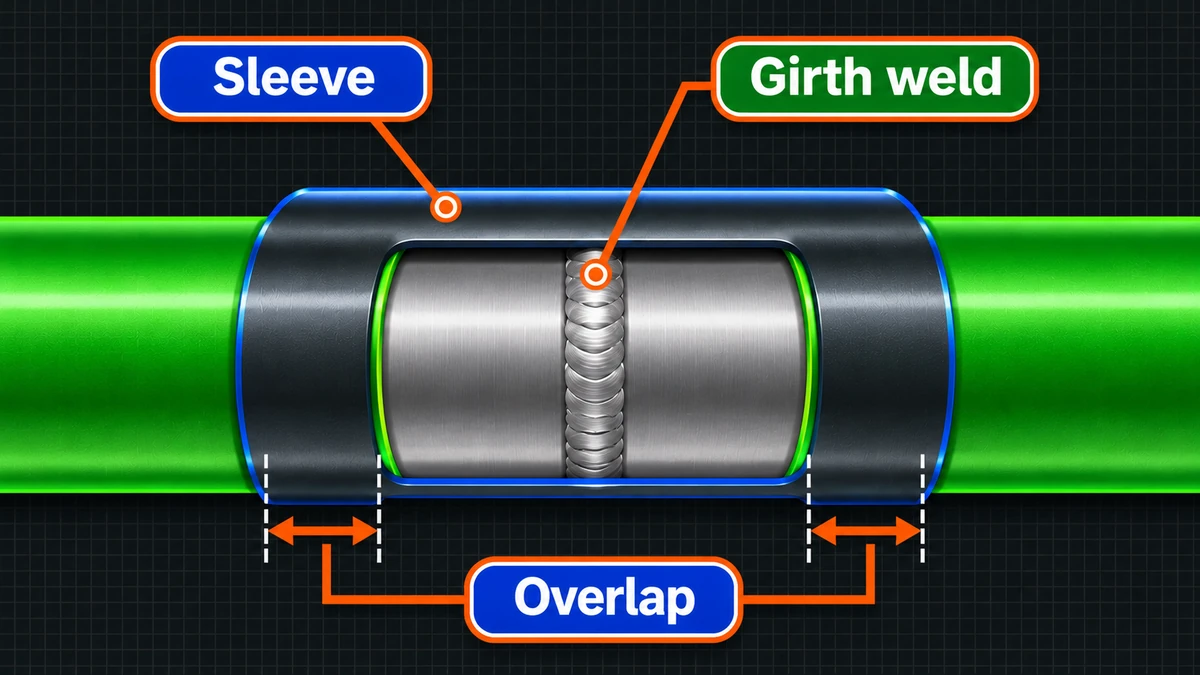
Field joint coating restores the coating over the bare girth weld area, and it must bond to both the pipe steel and the factory coating so that the system is continuous.
At each pipe end the plant leaves a bare cutback so that the girth weld can be made without burning the coating. After welding, the weld area is blast cleaned and a field joint coating is applied. ISO 21809-3 covers these systems.
| System | How it works | Typical note |
|---|---|---|
| Heat shrink sleeve | Polyethylene backing with adhesive, shrunk onto a preheated joint | Common for 3LPE; needs correct preheat and overlap |
| Field-applied FBE | Epoxy powder sprayed onto an induction-heated joint | Strong adhesion; needs equipment on site |
| Liquid epoxy or polyurethane | Two-part coating applied by brush or spray | Useful for repairs and fittings; sensitive to weather and mixing |
Field joints are a small share of the surface but need the same inspection as the factory coating. Surface preparation, salts and dew point control matter as much in the field as in the plant, and the limits are explained in the guide to coating application weather restrictions.
How Is 3LPE Coating Inspected and Tested?
3LPE is inspected at every stage, from steel cleanliness before coating to holiday detection on the finished pipe, and the tests are listed in the standard and the project specification.
| Test | Purpose | Stage |
|---|---|---|
| Visual cleanliness and profile | Confirm the blast grade and anchor profile | Before coating |
| Soluble salts | Detect contamination that causes blistering | Before coating |
| FBE degree of cure | Confirm the epoxy has cured correctly, often by thermal analysis | Qualification and production |
| Thickness | Verify total and layer thickness against the standard | Production |
| Holiday detection | Find pinholes and defects with a high-voltage detector | Final inspection |
| Peel strength | Verify adhesion of the coating to the steel | Qualification and production |
| Cathodic disbondment | Verify the coating resists disbonding under protection | Qualification |
| Impact and indentation | Verify resistance to mechanical damage | Qualification |
Holiday detection is explained in the pinhole detector testing for coatings guide, and the full test sequence for coating systems is in the coating and painting tests guide. Cathodic disbondment tests follow methods such as those published by ASTM International (ASTM G8 and G95) or the test methods in ISO 21809-1.
How Does 3LPE Compare With Other Pipeline Coatings?
3LPE trades a thicker build and a shielding risk for strong mechanical and moisture protection, while single-layer FBE, 3LPP and legacy coal tar enamel suit different conditions.
| System | Build | Main strength | Main limitation |
|---|---|---|---|
| Single-layer FBE | One epoxy layer | Excellent adhesion and cathodic protection compatibility | Less protection against impact and abrasion |
| 3LPE | FBE, adhesive and polyethylene | Mechanical and moisture protection in buried service | Cathodic protection shielding if disbonded; temperature limit |
| 3LPP | FBE, adhesive and polypropylene | Higher temperature capability | Higher cost and stiffer coating |
| Coal tar enamel | Hot-applied bituminous enamel | Long service history on existing lines | Environmental and health concerns; mostly legacy |
The choice depends on temperature, installation method, soil and the cathodic protection design. For a wider view of coating types by environment, see the environment-based selection guide and the corrosion types and mechanisms article.
How Much Coating Does a Pipeline Need? Worked Example
A coating quantity estimate multiplies the external surface area by the layer thickness and density, which helps check supplier quotations and plan field joint materials.
The example estimates the 3LPE material and field joint area for 1 km of NPS 24 pipe. All inputs are assumptions for illustration, and process losses are ignored.
SURFACE AREA A = pi x D x L = 3.1416 x 0.6096 x 1,000 A = 1,915.1 m2 per km
COATING MATERIAL PE + adhesive volume = 1,915.1 x 0.0028 = 5.36 m3 PE + adhesive mass = 5.36 x 950 = about 5,094 kg FBE volume = 1,915.1 x 0.0002 = 0.383 m3 FBE mass = 0.383 x 1,400 = about 536 kg
FIELD JOINTS Joints = 1,000 / 12 = 83 per km Area per sleeve = 3.1416 x 0.6096 x 0.4 = 0.766 m2 Field joint area = 83 x 0.766 = 63.6 m2, or 3.3% of the surface
Field joints are only about 3 percent of the area, yet they are the most common place for coating problems to start, so they need the same inspection effort as the factory coating. Weight estimates for the steel pipe itself can be made with the pipe weight calculator.
Example Only
This is a teaching example. Real quantities depend on the actual layer thicknesses, density data, application losses and field joint design in your specification.
How Do You Specify a 3LPE Coating System?
A good specification fixes the standard, thickness class, surface preparation, field joint system and testing in one place. The numbered procedure follows that order.
- Define the pipeline service conditions. Record the operating temperature, soil and water conditions, installation method such as trenching or directional drilling, and the cathodic protection design.
- Select the standard and duty class. Choose the governing standard, such as ISO 21809-1 or DIN 30670, and the thickness or duty class that matches pipe diameter and installation severity.
- Specify surface preparation and pre-treatment. State the blast cleanliness grade, anchor profile, soluble salt limit and any chemical pre-treatment before the epoxy is applied.
- Specify the field joint coating system. Select the field joint coating, such as heat shrink sleeve, FBE or liquid epoxy, with its surface preparation, overlap and qualification requirements.
- Define inspection, testing and repair. List the holiday detection voltage, thickness, adhesion, cathodic disbondment and cure tests, with acceptance limits and repair procedures.
- Plan handling, storage and installation. Set rules for lifting, storage duration, padding of the trench, backfill quality and final coating inspection before burial.
What Causes 3LPE Coating Failures?
Most 3LPE failures start at holidays, field joints or disbonded areas, and surface preparation is a root cause in many of them.
- Poor surface preparation: residual salts, dust or low profile reduce adhesion and cause blisters.
- Holidays and mechanical damage: cuts from handling or backfill expose steel to groundwater.
- Field joint failures: incorrect preheat, overlap or contamination on sleeves lets water in at the weld.
- Disbonding and shielding: disbonded polyethylene can shield cathodic protection current, leaving steel unprotected.
- Microbial attack: water trapped under disbonded coating can support microbially influenced corrosion, as described in the microbiologically influenced corrosion guide.
The general failure modes of coatings, including blistering and disbondment, are described in the coating defects guide.
Quick Reference: Which Pipeline Coating for Which Condition?
The table summarizes common practice and does not replace the project specification.
| Condition | Typical choice | Reason |
|---|---|---|
| Buried onshore line at moderate temperature | 3LPE | Mechanical and moisture protection with cathodic protection |
| Hot buried line | 3LPP | Higher temperature capability |
| Gas line or short crossing | FBE | Strong adhesion and cathodic protection compatibility |
| Directional drilling crossing | FBE with abrasion overcoat or heavy-duty 3LPE | Withstands abrasion during pull-in |
| Offshore atmospheric and splash zone | Duplex or marine coating system | Different failure modes from buried service |
| Girth weld area | Heat shrink sleeve or field FBE | Restores continuity after welding |
What Are the Common Mistakes With 3LPE Coating?
Most problems come from skipping controls at the joints and the preparation steps, not from the coating material.
- Treating field joints as an afterthought instead of qualifying the joint system and the crew.
- Ignoring salt contamination after blasting, especially near the coast.
- Applying coating in poor weather without dew point and surface temperature control.
- Using 3LPE above its temperature limit without confirming the product qualification.
- Skipping holiday testing before the pipe goes into the trench.
- Using sharp or unscreened backfill that cuts the polyethylene.
Edition and Contract Notice
Thickness classes, test limits and temperature ratings change between editions and manufacturers. The edition cited in your contract governs, not the values in this guide.
Key Terms
- FBE (fusion bonded epoxy)
- A thermosetting epoxy powder that melts and cures on hot steel to form a thin, hard coating.
- Cutback
- The bare length at each pipe end left uncoated so that the girth weld can be made.
- Holiday
- A pinhole or defect in a coating that exposes the steel.
- Cathodic disbondment
- Loss of coating adhesion at a defect caused by the cathodic protection reaction.
- Cathodic protection shielding
- A disbonded high-resistance coating that blocks protection current from reaching the steel.
- Heat shrink sleeve
- A wrap-around polymer sleeve that shrinks onto a girth weld when heated, used as a field joint coating.
- Anchor profile
- The roughness created by blasting that gives the coating a mechanical key to the steel.
Standards and References
- ISO 21809-1, Petroleum and natural gas industries – External coatings for buried or submerged pipelines used in pipeline transportation systems – Part 1: Polyolefin coatings (3-layer PE and 3-layer PP), ISO.
- ISO 21809-3, Petroleum and natural gas industries – External coatings for buried or submerged pipelines used in pipeline transportation systems – Part 3: Field joint coatings, ISO.
- DIN 30670, Polyethylene coatings for steel pipes and fittings – Requirements and testing, DIN.
- CAN/CSA Z245.21, External polyethylene coating for pipe, CSA Group.
- NF A 49-710, Steel tubes – External three-layer polyethylene based coating – Application by extrusion, AFNOR.
- ISO 15589-1, Petroleum, petrochemical and natural gas industries – Cathodic protection of pipeline systems – Part 1: On-land pipelines, ISO.
- ISO 8501-1, Preparation of steel substrates before application of paints and related products – Visual assessment of surface cleanliness, ISO.
- ISO 8502-6 and ISO 8502-9, Tests for the assessment of surface cleanliness – extraction and conductometric determination of water-soluble salts, ISO.
- ASTM G8, Standard Test Methods for Cathodic Disbonding of Pipeline Coatings, ASTM International.
- ASTM G95, Standard Test Method for Cathodic Disbondment Test of Pipeline Coatings (Attached Cell Method), ASTM International.
Frequently Asked Questions
What does 3LPE mean in pipeline coating?
3LPE stands for three-layer polyethylene. The system has a fusion bonded epoxy (FBE) primer on the steel, a copolymer adhesive layer, and an outer polyethylene (PE) layer. It is applied in a plant to buried or submerged steel pipe and is normally used together with cathodic protection.
What is the difference between 3LPE and FBE coating?
Single-layer FBE is one thin epoxy film that bonds strongly to steel and works well with cathodic protection. 3LPE adds an adhesive and a thick polyethylene jacket over an FBE primer, which gives much better resistance to impact, abrasion and soil stress. The cost of that protection is a thicker build and a risk of cathodic protection shielding if the polyethylene disbonds. The barrier mechanism of epoxy is explained in the epoxy primer versus zinc-rich primer comparison.
What is the difference between 3LPE and 3LPP?
Both use an FBE primer and an adhesive, but 3LPE has a polyethylene topcoat and 3LPP has a polypropylene topcoat. Polypropylene tolerates higher operating temperatures, so 3LPP is chosen for hot lines, while 3LPE is the usual choice for pipelines near ambient temperature. Both are covered by ISO 21809-1.
What is the temperature limit of 3LPE coating?
Continuous service is typically limited to about 60 to 80 degrees C, depending on the polyethylene grade and the governing standard. Lines operating hotter than that normally move to 3LPP or another high-temperature system. Always confirm the limit from the standard and the manufacturer’s qualification data for the actual product.
How thick is 3LPE coating?
Total thickness is commonly about 2.5 to 4 mm, made of an FBE primer of roughly 150 to 250 microns, an adhesive layer of about 150 to 400 microns, and a polyethylene layer of about 2 to 4 mm. The required minimums depend on the pipe diameter and the duty class in ISO 21809-1 or DIN 30670, and the project specification sets the final values.
How are 3LPE field joints coated?
The pipe ends are left bare at each end so the girth weld can be made, and the weld area is coated after welding. Common options are heat shrink sleeves, field-applied FBE and two-part liquid epoxy or polyurethane. The surface is blast cleaned, the sleeve or coating overlaps the factory coating, and the joint is holiday tested. Weather limits for field application are covered in the coating application weather restrictions guide.
Can 3LPE be used with cathodic protection?
Yes, and the two are normally used together. The coating is the primary barrier and cathodic protection protects steel at any holiday. Polyethylene has a very high electrical resistance, so if it disbonds from the steel it can shield the steel from cathodic protection current. That is why the FBE primer must resist cathodic disbondment and why holiday and adhesion testing matter.
Conclusion
3LPE coating gives buried steel pipelines a tough, three-layer barrier of FBE, adhesive and polyethylene, and it works best with cathodic protection and a well-controlled field joint system. Specify the standard and duty class, control surface preparation and salts, qualify the field joint coating, and test every pipe for holidays before burial. Choose 3LPP or another system when temperatures exceed the 3LPE limit, and remember that field joints, although a small share of the surface, are where many failures begin. Keep inspection records for every stage so that any defect can be traced and repaired before the line is buried. As a next step, estimate the steel pipe mass for your line with the pipe mass estimator and confirm the coating details against your project specification.
About This Guide
This guide was prepared by the WeldFabWorld technical team from the standards listed in Standards and References. Verify every requirement against the code edition and specification that apply to your project.