The aluminium alloy series is the first thing to understand before you choose, machine or weld any aluminium part, because the four-digit code tells you the main alloying element and, by extension, the strength, corrosion resistance and weldability to expect. Two alloys that look identical can behave very differently under an arc.
Quick Answer
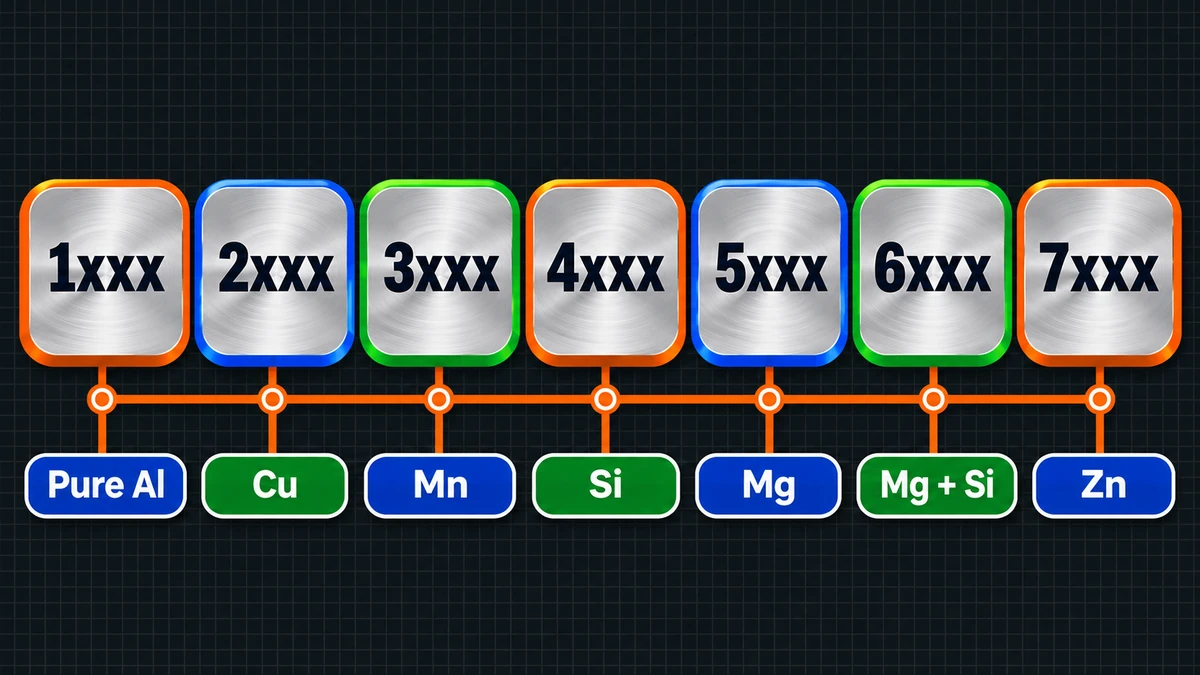
The aluminium alloy series system groups wrought alloys by the first digit of a four-digit code, which names the main alloying element: 1xxx pure aluminium, 2xxx copper, 3xxx manganese, 4xxx silicon, 5xxx magnesium, 6xxx magnesium and silicon, and 7xxx zinc. The series decides strength, corrosion resistance and whether the alloy responds to heat treatment and fusion welding.
This guide explains each series, the temper system, typical properties, weldability, filler metal choice, and how welding changes strength. It builds on our material guides for carbon steel classes and the stainless steel families, so you can compare aluminium with the metals it often replaces.
Welding adds two recurring problems to every series: hydrogen porosity, covered in our guide to preventing porosity in aluminium welds, and strength loss in the heat-affected zone. Chemical limits, temper availability and design values also change between editions, so confirm the figures below against the product standard and your project specification.
Key Takeaways
- The first digit of a wrought aluminium alloy code identifies the series and its main alloying element, and the temper after the hyphen sets the strength.
- The 1xxx, 3xxx, 4xxx and 5xxx series are non-heat-treatable, while 2xxx, 6xxx and 7xxx respond to heat treatment.
- The 5xxx and 6xxx series are the main weldable structural families, and 2xxx and 7xxx alloys are mostly not suitable for arc welding.
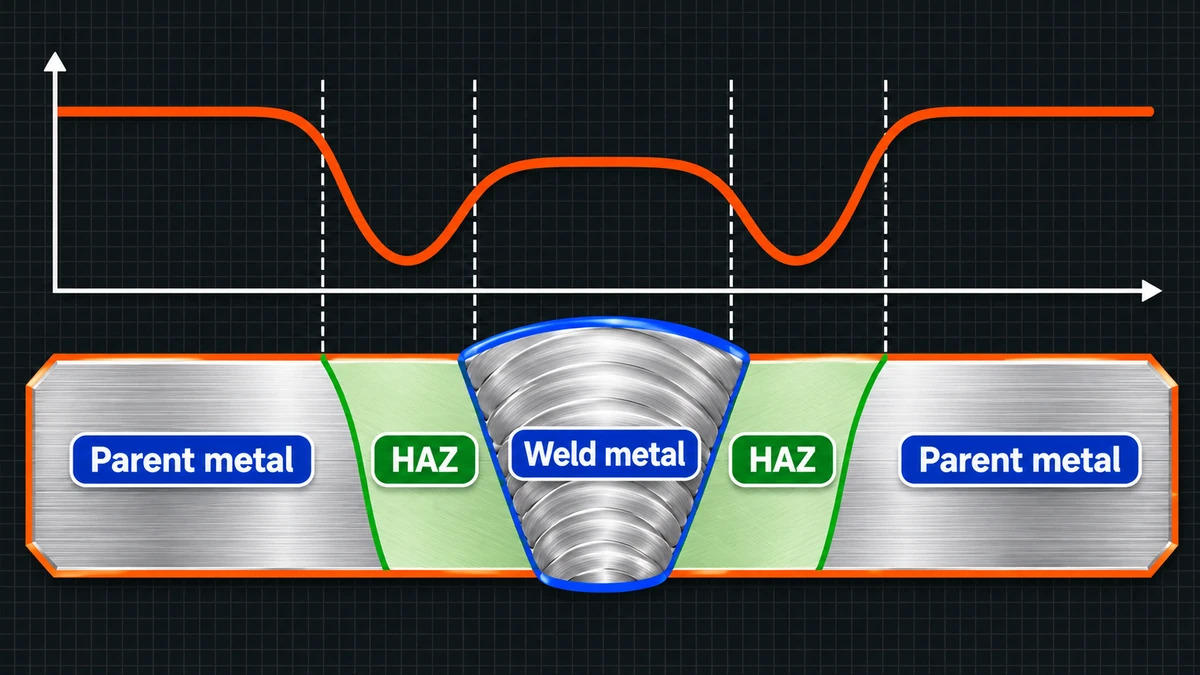
- Welding can reduce the strength of 6061-T6 in the heat-affected zone by more than 40 percent, so always design with as-welded values.
- Filler choice depends on the base alloy, finish and service temperature, and 4xxx filler must not be used on high-magnesium 5xxx alloys.
What Is the Aluminium Alloy Series System?
The aluminium alloy series system is a four-digit designation in which the first digit identifies the principal alloying element, such as copper in the 2xxx series or magnesium in the 5xxx series.
The system is maintained by The Aluminum Association and published as ANSI H35.1. The second digit shows modifications of the original alloy, and the last two digits identify the specific alloy. In the 1xxx series the last two digits give the purity, so 1050 is 99.50 percent aluminium and 1100 is at least 99.00 percent. Cast alloys use a different three-digit system with a decimal, such as A356.0. The Aluminum Association publishes the registered designations and chemical limits.
| Series | Main alloying element | Heat-treatable | Typical alloys | Typical uses |
|---|---|---|---|---|
| 1xxx | 99.00% or more aluminium | No | 1050, 1100, 1350 | Chemical equipment, electrical conductors, foil |
| 2xxx | Copper | Yes | 2024, 2219 | Aircraft structures and high-strength parts |
| 3xxx | Manganese | No | 3003, 3004 | Cookware, roofing, beverage cans |
| 4xxx | Silicon | Mostly no | 4043, 4047 | Welding and brazing filler |
| 5xxx | Magnesium | No | 5052, 5083, 5086 | Marine hulls, tanks, pressure vessels |
| 6xxx | Magnesium and silicon | Yes | 6061, 6063 | Extrusions, frames, machined parts |
| 7xxx | Zinc | Yes | 7005, 7075 | Aerospace and highly stressed parts |
| 8xxx | Other elements (iron, lithium) | Varies | 8011, 8090 | Foil and aerospace lithium alloys |
For more guidance on metals and selection, see the Material Properties & Selection articles.
What Does Each Aluminium Alloy Series Offer?
Each series trades strength, corrosion resistance, formability and weldability differently, so the right choice depends on how the part will be made and used.
What Is 1xxx Series Aluminium?
The 1xxx series is commercially pure aluminium with at least 99.00 percent aluminium. It has excellent corrosion resistance and very high electrical and thermal conductivity, but low strength: alloy 1100-H14 has a typical tensile strength of about 110 MPa (16 ksi). It is strengthened only by cold work. It welds easily, and filler of the same purity is normally preferred.
What Is 2xxx Series Aluminium?
The 2xxx series is alloyed mainly with copper and is heat-treatable. Alloy 2024-T3 reaches a typical tensile strength near 480 MPa (70 ksi) and is a classic aircraft structural alloy. Corrosion resistance is lower than other series, and most 2xxx alloys crack when fusion welded. The weldable exception is 2219, welded with 2319 filler.
What Is 3xxx Series Aluminium?
The 3xxx series is alloyed with manganese and is non-heat-treatable. It is moderately strong, formable and corrosion resistant. Alloy 3003-H14 has a typical tensile strength of about 150 MPa (22 ksi) and is used for cookware, heat exchangers and roofing. It welds readily with 4043 or 5356 filler.
What Is 4xxx Series Aluminium?
The 4xxx series is alloyed with silicon, which lowers the melting point and improves fluidity. It is used mainly as welding and brazing filler rather than as structural material. Filler 4043 contains about 4.5 to 6.0 percent silicon, and 4047 contains about 11 to 13 percent silicon.
What Is 5xxx Series Aluminium?
The 5xxx series is alloyed with magnesium and is non-heat-treatable, strengthened by solid solution and strain hardening. It combines good weldability with excellent resistance to seawater, so it is the main marine and tank alloy family. Alloy 5052-H32 has a typical tensile strength near 230 MPa (33 ksi), and 5083-H116 has a minimum of about 305 MPa (44 ksi). Alloys with more than about 3 percent magnesium, such as 5083, 5086 and 5456, are not recommended for sustained service above about 65 °C (150 °F) because of sensitization and stress corrosion cracking.
What Is 6xxx Series Aluminium?
The 6xxx series is alloyed with magnesium and silicon, forming magnesium silicide that gives heat-treatable strength. Alloy 6061-T6 has a typical tensile strength of about 310 MPa (45 ksi), and 6063 is the usual architectural extrusion alloy. It is weldable and corrosion resistant, but welds need filler metal because autogenous welds crack, and the heat-affected zone loses strength.
What Is 7xxx Series Aluminium?
The 7xxx series is alloyed with zinc and is the strongest aluminium family. Alloy 7075-T6 has a typical tensile strength of about 570 MPa (83 ksi). Copper-bearing alloys such as 7075 are not suitable for arc welding, but copper-free alloys such as 7005 are weldable and used in welded structures.
What About 8xxx and Cast Alloys?
The 8xxx series covers alloys with other elements, such as 8011 foil and aluminium-lithium aerospace alloys. Cast aluminium alloys, such as A356.0, are mainly aluminium-silicon alloys and are chosen for casting fluidity rather than for wrought strength.
What Do Aluminium Temper Designations Mean?
A temper designation, written after a hyphen, describes the thermal or mechanical treatment that gave the alloy its properties, and for most alloys the temper matters as much as the alloy number.
| Temper | Meaning | Applies to |
|---|---|---|
| F | As fabricated, with no control of strength | All alloys |
| O | Annealed, the softest condition | All alloys |
| H14 | Strain hardened to half-hard | Non-heat-treatable alloys |
| H32 | Strain hardened and stabilized, quarter-hard | Non-heat-treatable alloys |
| H116 | Strain hardened with corrosion testing for marine use | High-magnesium 5xxx alloys |
| T4 | Solution heat treated and naturally aged | Heat-treatable alloys |
| T6 | Solution heat treated and artificially aged | Heat-treatable alloys |
Heat treatment is explained in the heat treatment practice guide. The key point for fabricators is that welding destroys the temper in the heat-affected zone of both strain-hardened and heat-treated alloys.
How Do the Series Compare in Strength and Weight?
Aluminium alloys have about one-third the density and one-third the stiffness of steel, with strength that ranges from far below mild steel in 1xxx to above it in 7xxx.
| Alloy and temper | Series | Typical yield, MPa (ksi) | Typical tensile, MPa (ksi) |
|---|---|---|---|
| 1100-H14 | 1xxx | 105 (15) | 110 (16) |
| 3003-H14 | 3xxx | 145 (21) | 150 (22) |
| 5052-H32 | 5xxx | 195 (28) | 230 (33) |
| 5083-H116 | 5xxx | 215 (31) | 305 (44) |
| 6061-T6 | 6xxx | 275 (40) | 310 (45) |
| 2024-T3 | 2xxx | 345 (50) | 480 (70) |
| 7075-T6 | 7xxx | 505 (73) | 570 (83) |
Density is about 2,700 kg/m³ for most alloys, compared with 7,850 kg/m³ for steel, and the elastic modulus is about 69 GPa compared with about 200 GPa for steel. The lower stiffness means aluminium sections often need more depth to limit deflection. Minimum values for design come from ASTM B209 for sheet and plate and ASTM B221 for extrusions, and tensile testing is described in the mechanical testing guide.
Which Aluminium Series Are Weldable?
The 1xxx, 3xxx, 5xxx and 6xxx series are routinely welded, while most 2xxx and 7xxx alloys are not suitable for arc welding because they crack in the weld or lose strength.
| Series | Arc weldability | Main concern | Typical filler |
|---|---|---|---|
| 1xxx | Good | Low strength, porosity | 1100 or 4043 |
| 2xxx | Poor (2219 exception) | Hot cracking, low corrosion resistance | 2319 for 2219 |
| 3xxx | Good | Strain-hardened strength lost in HAZ | 4043 or 5356 |
| 5xxx | Good | Temperature limit for high magnesium | 5356, 5183, 5556 |
| 6xxx | Good with filler | HAZ softening, autogenous cracking | 4043 or 5356 |
| 7xxx | Poor (7005 exception) | Hot cracking, stress corrosion cracking | 5356 or 5183 for 7005 |
Hydrogen is the cause of porosity in aluminium welds, because molten aluminium dissolves hydrogen that it cannot hold when it solidifies. Degreasing and oxide removal immediately before welding are essential, as covered in the aluminium porosity prevention guide. AC gas tungsten arc welding is the usual process for sheet and critical joints, as described in the GTAW process guide.
Aluminium weldments are qualified under AWS D1.2 for structures or ASME Section IX for pressure equipment, and the base metals fall into the aluminium P-Number groups explained in the P-Number and F-Number grouping guide. The American Welding Society publishes the filler metal and structural welding specifications.
How Do You Choose Filler Metal for Each Series?
Filler metal is chosen from the base alloy first, then from the finish, the service temperature and the joint type. The most common fillers are 4043 and 5356.
| Base alloy | Common filler | Note |
|---|---|---|
| 1100 | 1100 or 4043 | Match the purity for corrosion or conductivity |
| 3003 | 4043 or 5356 | 4043 is the general choice |
| 5052 | 5356, or 4043 as an exception | 5052 is the only common 5xxx alloy welded with 4043 |
| 5083, 5086 | 5183, 5356 or 5556 | Never 4xxx filler on magnesium above about 2.5% |
| 6061, 6063 | 4043 or 5356 | 5356 if the part will be anodized |
| 2219 | 2319 | The weldable copper alloy |
| 7005 | 5356 or 5183 | Copper-free zinc alloy |
- Anodizing: 4043 turns dark grey after anodizing, while 5356 gives a closer color match.
- Service temperature: 4043 is suitable above about 65 °C (150 °F), while 5356 is not recommended for sustained service above that limit.
- Shear strength: 5356 has noticeably higher shear strength than 4043, which matters for fillet welds.
- Cracking: 4043 is less crack sensitive and is often preferred for crack-prone 6xxx joints.
Manual electrode welding is possible with E4043 on alloys such as 1100, 3003, 5052, 6061 and 6063, as explained in the stick welding aluminum technical guide. Filler classifications are decoded in welding consumable nomenclature.
How Much Strength Does Welding Remove? Worked Example
Welding removes the temper from the heat-affected zone, so the joint is weaker than the base metal, and the loss is largest in heat-treated alloys such as 6061-T6.
The example compares the tensile capacity of a 10 mm thick, 100 mm wide plate in the base metal condition with the as-welded condition. The values are rounded design-style values, so confirm them with the current Aluminum Design Manual and your project specification.
6061-T6 CAPACITY Base metal = 290 MPa x 1,000 mm2 = 290,000 N = 290 kN As welded = 165 MPa x 1,000 mm2 = 165,000 N = 165 kN Loss = (290 – 165) / 290 = 43.1% Thickness to match base capacity = 10 mm x 290 / 165 = 17.6 mm (1.76 times)
OTHER ALLOYS, SAME METHOD 5083-H116: (305 – 275) / 305 = 9.8% loss, factor 1.11 3003-H14: (150 – 95) / 150 = 36.7% loss 1100-H14: (110 – 75) / 110 = 31.8% loss
The 5xxx alloys lose less because most of their strength comes from magnesium in solid solution, which welding does not remove. Designers either increase the thickness at the weld, move welds to low-stress locations, or choose a temper that matches the weld. Use the as-welded value for welded members, and use the base value only where the weld is not in the load path.
Example Only
This is a teaching example with rounded values. Real design must use the values in the governing code or design manual and the alloy, temper and filler combination in your qualified procedure.
What Corrosion and Service Limits Apply?
Aluminium resists corrosion through a thin oxide film, but each series has particular weaknesses that must be checked against the service environment.
- Marine and chloride service: 5xxx and 6xxx alloys perform well, but pitting can still occur, as explained in the pitting corrosion guide.
- High-magnesium 5xxx: avoid sustained service above about 65 °C (150 °F) because of sensitization.
- 2xxx and 7xxx: susceptible to stress corrosion cracking and exfoliation in some tempers, which is described in the corrosion types and prevention guide.
- Dissimilar metals: aluminium is anodic to steel and stainless steel, so isolation is needed, as covered in the galvanic corrosion in dissimilar metal welds article.
How Do You Select an Aluminium Alloy Series?
Select the series from the joining method and service first, then the alloy and temper, then the filler. The numbered procedure follows that order.
- Define the strength and service requirement. State the required yield and tensile strength, the operating temperature, the corrosion environment and whether the part will be formed, machined or welded.
- Decide how the part will be joined. Choose a weldable series, mainly 1xxx, 3xxx, 5xxx or 6xxx, if fusion welding is required, and avoid most 2xxx and 7xxx alloys for welded parts.
- Pick the alloy and temper together. Select the alloy and temper, such as 5083-H116 or 6061-T6, from the product standard, because the temper sets the strength.
- Check welded strength and corrosion limits. Use as-welded design values for the strength of welded joints and check limits such as the 65 degrees C service limit for high-magnesium 5xxx alloys.
- Select the filler metal and record it in the procedure. Choose the filler from the base alloy, service and finish requirements, for example 4043 or 5356 for 6061, and state it in the qualified welding procedure.
Quick Reference: Which Alloy for Which Application?
The table summarizes common practice and does not replace the project specification.
| Application | Typical alloy | Reason |
|---|---|---|
| Marine hulls and welded tanks | 5083-H116, 5086 | Weldable, strong, resistant to seawater |
| General sheet metalwork and formed parts | 5052-H32, 3003-H14 | Good formability and corrosion resistance |
| Structural frames and machined parts | 6061-T6 | Heat-treatable, weldable with filler |
| Architectural extrusions | 6063-T5, T6 | Easy to extrude, good finish |
| Aircraft and highly stressed parts | 2024, 7075 | Highest strength, joined mechanically |
| Chemical equipment and conductors | 1100, 1350 | Purity, conductivity, corrosion resistance |
| Pressure vessels | 5083, 5086, 6061 | Listed in ASME Section VIII Division 1, Part UNF |
What Are the Common Mistakes With Aluminium Alloys?
Most failures come from treating all aluminium as one material, or from ignoring the temper and the weld zone.
- Welding a 2xxx or 7xxx alloy without confirming it is a weldable grade such as 2219 or 7005.
- Using the base metal strength for a welded joint instead of the as-welded value.
- Using 4043 on high-magnesium 5xxx alloys, which gives a brittle weld.
- Using 5356 where anodizing and service above 65 °C are both required without checking the limits.
- Ignoring the temper when ordering, for example specifying 6061 without T6 or T651.
- Skipping cleaning and oxide removal, which causes hydrogen porosity.
- Accepting material without checking the certificate against the alloy, temper and product standard, as described in the incoming material checking rules.
Edition and Contract Notice
Alloy limits, design values and filler charts change between editions. The edition cited in your contract governs, not the values in this guide.
Key Terms
- Wrought alloy
- An alloy worked into sheet, plate, extrusion, bar or forging, designated by a four-digit code.
- Temper
- The thermal or mechanical condition of an alloy, shown after a hyphen, such as T6 or H14.
- Heat-treatable alloy
- An alloy that gains strength through solution treatment and aging, such as 2xxx, 6xxx and 7xxx.
- Non-heat-treatable alloy
- An alloy strengthened by alloying and cold work, such as 1xxx, 3xxx and 5xxx.
- Heat-affected zone (HAZ)
- The base metal next to a weld whose properties are changed by welding heat.
- Sensitization
- A change in high-magnesium 5xxx alloys on long hot exposure that makes them prone to stress corrosion cracking.
- Autogenous weld
- A weld made without filler metal, which cracks in many 6xxx alloys.
Standards and References
- ANSI H35.1/H35.1M, American National Standard Alloy and Temper Designation Systems for Aluminum, The Aluminum Association.
- International Alloy Designations and Chemical Composition Limits for Wrought Aluminum and Wrought Aluminum Alloys, The Aluminum Association.
- Aluminum Design Manual, The Aluminum Association.
- ASTM B209/B209M, Standard Specification for Aluminum and Aluminum-Alloy Sheet and Plate, ASTM International.
- ASTM B221/B221M, Standard Specification for Aluminum and Aluminum-Alloy Extruded Bars, Rods, Wire, Profiles, and Tubes, ASTM International.
- ASTM B928/B928M, Standard Specification for High Magnesium Aluminum-Alloy Sheet and Plate for Marine Service and Similar Environments, ASTM International.
- AWS A5.10/A5.10M, Specification for Bare Aluminum and Aluminum-Alloy Welding Electrodes and Rods, American Welding Society.
- AWS A5.3/A5.3M, Specification for Aluminum and Aluminum-Alloy Electrodes for Shielded Metal Arc Welding, American Welding Society.
- AWS D1.2/D1.2M, Structural Welding Code – Aluminum, American Welding Society.
- ASME Boiler and Pressure Vessel Code, Section II Part B (Nonferrous Material Specifications), Section VIII Division 1 Part UNF and Section IX, ASME.
- ISO 209, Aluminium and aluminium alloys – Chemical composition, International Organization for Standardization.
- EN 573-3, Aluminium and aluminium alloys – Chemical composition and form of wrought products, CEN.
Frequently Asked Questions
What do the numbers in aluminium alloy 6061-T6 mean?
The first digit, 6, identifies the series and its main alloying elements, magnesium and silicon. The second digit, 0, shows the original alloy with no modification, and the last two digits, 61, identify the specific alloy within the series. The letter and number after the hyphen, T6, is the temper, meaning the alloy was solution heat treated and artificially aged. The temper is as important as the alloy number because it sets the strength.
Which aluminium alloy series is best for welding?
The 5xxx, 3xxx and 1xxx series are the easiest to weld, because they are non-heat-treatable and keep good ductility. The 6xxx series welds well with the correct filler but loses strength in the heat-affected zone. Most 2xxx and 7xxx alloys crack when fusion welded, with exceptions such as 2219 and 7005. Hydrogen porosity affects every series, so follow the practical guide to preventing porosity in aluminium welds.
What is the strongest aluminium alloy series?
The 7xxx series, alloyed mainly with zinc, is the strongest. Alloy 7075-T6 has a typical tensile strength of about 570 MPa (83 ksi), which is higher than many mild steels. The 2xxx series, alloyed with copper, is next. Both families are mainly joined by riveting, bolting or adhesives, because most of them are not suitable for conventional arc welding.
Is 6061 or 5052 aluminium better?
Neither is better in every case. Alloy 6061-T6 is stronger and heat-treatable, so it suits machined parts and structural extrusions. Alloy 5052 is non-heat-treatable, forms easily, resists corrosion in marine air and loses less strength in the weld zone. Choose 6061 when strength and machining matter, and 5052 when forming, corrosion resistance and welded ductility matter more.
Can you stick weld aluminium?
Yes, but with difficulty. The common electrode is E4043, which suits base alloys such as 1100, 3003, 5052, 6061 and 6063, and it works best on material about 4 mm (5/32 in) or thicker. Moisture in the flux coating is a major cause of porosity, so electrodes must be kept dry. Details are in the technical guide to stick welding aluminum.
Why can’t 7075 aluminium be welded?
Alloy 7075 contains zinc, magnesium and copper, which give very high strength but also a wide freezing range that causes hot cracking in the weld. The heat-affected zone also loses strength and becomes sensitive to stress corrosion cracking. Designers normally join 7075 with fasteners or adhesives. Weldable 7xxx alloys without copper, such as 7005, are used in welded structures. The mechanism of cracking in service is explained in the stress corrosion cracking guide.
What does the T6 temper mean on aluminium?
T6 means the alloy was solution heat treated, quenched and then artificially aged to reach peak strength. T4 is solution heat treated and naturally aged, giving lower strength but better formability. The H tempers, such as H14, are for non-heat-treatable alloys and describe strain hardening. Heat treatment principles are covered in the heat treatment guide for fabricators.
Conclusion
The aluminium alloy series tells you what to expect before you pick up a torch: 1xxx and 3xxx for formability and conductivity, 5xxx for welded marine and tank work, 6xxx for extrusions and machined parts, and 2xxx and 7xxx for high strength where welding is not needed. Always specify the alloy together with the temper, design welded joints with as-welded strength, and choose the filler for the base alloy, finish and service temperature. Keep surfaces clean and dry to avoid hydrogen porosity. As a next step, read how to stick weld aluminum when TIG or MIG is not available, and confirm the final alloy, temper and filler with your project specification.
About This Guide
This guide was prepared by the WeldFabWorld technical team from the standards listed in Standards and References. Verify every requirement against the code edition and specification that apply to your project.