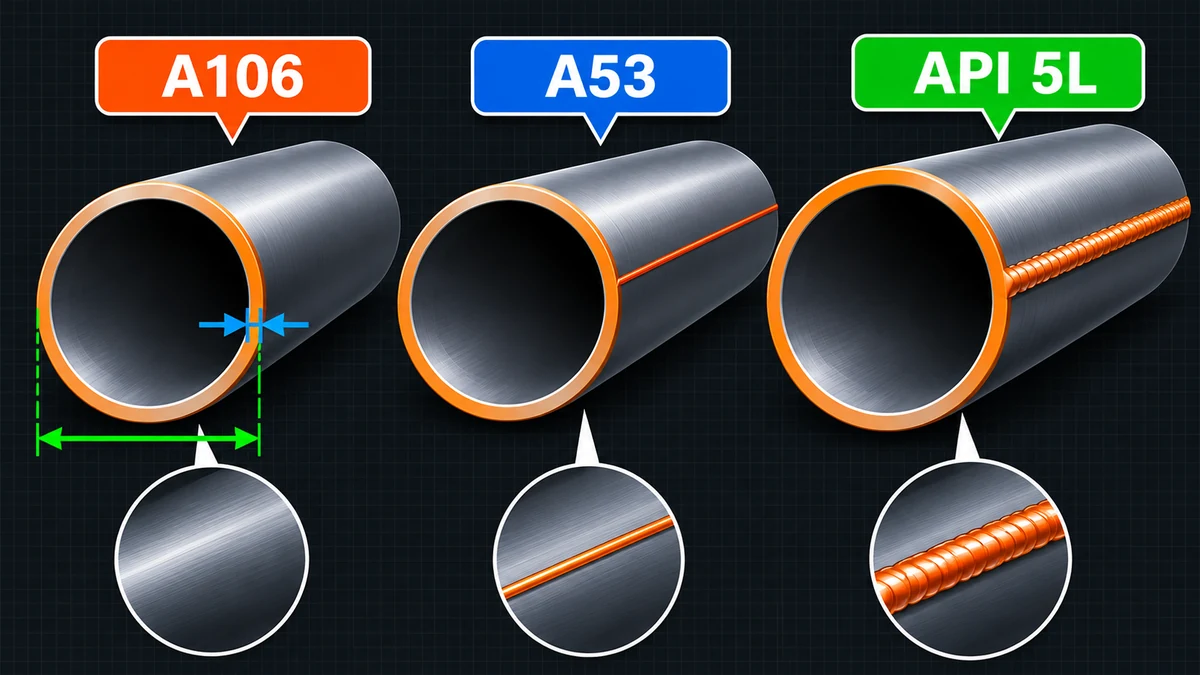
ASTM A106 vs A53 vs API 5L is one of the most common specification questions in carbon steel piping, because all three standards cover plain carbon steel pipe in similar sizes and a very similar Grade B strength level. Each standard was written for a different job, however, and swapping one for another can change the weld joint quality factor, the required tests and code compliance.
Quick Answer
In the A106 vs A53 vs API 5L comparison, ASTM A106 covers seamless carbon steel pipe for high-temperature service, ASTM A53 covers general-purpose black and galvanized pipe that may be seamless or welded, and API 5L covers line pipe for pipeline transport in PSL1 and PSL2 levels. At Grade B, all three share about 240 MPa (35 ksi) minimum yield and 415 MPa (60 ksi) tensile.
This guide compares the three specifications on manufacture, grades, chemistry, mechanical properties, testing and code use. It builds on our explanation of the difference between pipe and tube, which covers NPS and schedule sizing, and on the carbon steel types guide for the underlying metallurgy.
You will also find a worked ASME B31.3 wall thickness calculation, a quick reference table, a step-by-step selection procedure and answers to common questions. Requirements always depend on the code edition and the contract specification, so treat this article as technical orientation and not as a replacement for either.
Key Takeaways
- ASTM A106 is seamless only, ASTM A53 may be seamless (Type S), electric-resistance welded (Type E) or furnace-butt welded (Type F), and API 5L covers seamless and several welded routes.
- Grade B pipe in all three standards has a minimum yield strength near 240 MPa (35 ksi) and a minimum tensile strength of 415 MPa (60 ksi).
- API 5L adds X-grades from X42 to X80 and a second quality level, PSL2, with mandatory toughness testing and tighter chemistry.
- ASME B31.3 applies a lower longitudinal weld joint quality factor to A53 Type E (0.85) and Type F (0.60) than to seamless pipe (1.00), which can increase the required wall.
- Pipe certified to several standards at once is valid only when it meets every requirement of each listed standard.
What Are ASTM A106, ASTM A53 and API 5L Pipe?
ASTM A106 is a seamless carbon steel pipe specification that governs pipe intended for high-temperature service in refineries, chemical plants and power stations.
ASTM International publishes it as A106/A106M, “Standard Specification for Seamless Carbon Steel Pipe for High-Temperature Service”. It covers Grades A, B and C in NPS 1/8 to NPS 48, with dimensions normally taken from ASME B36.10M. The ASME Boiler and Pressure Vessel Code adopts it as SA-106 in Section II Part A.
ASTM A53/A53M is the general-purpose alternative. It covers black and hot-dip zinc-coated steel pipe in NPS 1/8 to NPS 26, in three types: Type F (furnace-butt welded), Type E (electric-resistance welded) and Type S (seamless). Grades A and B apply, and Type F is limited to Grade A. Typical uses include steam, water, gas and air lines, and structural or mechanical applications.
API Specification 5L, published by the American Petroleum Institute (API), covers line pipe for transporting petroleum, natural gas and water. It is technically aligned with ISO 3183. It defines two Product Specification Levels (PSL1 and PSL2) and a long list of grades, from A and B up to X70, X80 and beyond. The ASTM International standards and API 5L overlap most strongly at Grade B.
| Item | ASTM A106 | ASTM A53 | API 5L |
|---|---|---|---|
| Issuing body | ASTM International | ASTM International | American Petroleum Institute (API) |
| Product covered | Seamless carbon steel pipe for high-temperature service | Black and hot-dip galvanized steel pipe, welded and seamless | Line pipe for pipeline transportation systems |
| Sizes covered | NPS 1/8 to NPS 48 | NPS 1/8 to NPS 26 | Wide range, including large-diameter welded pipe |
| Manufacture | Seamless only | Type S, Type E or Type F | Seamless and welded processes |
| ASME BPVC equivalent | SA-106 | SA-53 | None (cited directly by piping codes) |
| Primary role | High-temperature process and power piping | General-purpose pressure and mechanical pipe | Pipeline transport of oil, gas and water |
For more material selection guidance, browse the Material Properties & Selection articles on WeldFabWorld.
A106 vs A53 vs API 5L: What Are the Key Differences?
The key differences between A106, A53 and API 5L are the manufacturing route, the intended service and the quality controls. A106 is seamless pipe for high temperature, A53 allows welded pipe for general service, and API 5L adds higher-strength grades and PSL2 toughness controls for pipelines. Grade B chemistry and strength are otherwise very close.
| Parameter | ASTM A106 | ASTM A53 | API 5L |
|---|---|---|---|
| Manufacture | Seamless only | S, E or F | Seamless and welded |
| Grades | A, B, C | A, B (Type F: Grade A only) | A, B, X42 to X80 and higher |
| Minimum yield, Grade B | 240 MPa (35 ksi) | 240 MPa (35 ksi) | About 245 MPa (35.5 ksi) |
| Minimum tensile, Grade B | 415 MPa (60 ksi) | 415 MPa (60 ksi) | 415 MPa (60.2 ksi) |
| Maximum carbon, Grade B | 0.30% | 0.30% | 0.28% PSL1, 0.24% PSL2 (seamless) |
| Maximum manganese, Grade B | 1.06% | 1.20% | 1.20% |
| Maximum phosphorus | 0.035% | 0.050% | 0.030% PSL1, 0.025% PSL2 |
| Maximum sulfur | 0.035% | 0.045% | 0.030% PSL1, 0.015% PSL2 |
| Silicon | 0.10% minimum | Not specified | Depends on PSL and process |
| Mandatory impact test | No | No | PSL2 only |
| Zinc coating | No (black pipe) | Optional hot-dip galvanizing | Not typical |
| Typical codes | B31.3, B31.1 | B31.3 utilities, B31.1 within limits | B31.4, B31.8, B31.3 |
Read the table by service, not by price. If the line is a high-temperature process or steam line, the seamless route and the silicon minimum of A106 matter. If the line is a utility header, the lower cost and galvanizing option of A53 matter. If the line is a pipeline, the strength grades and PSL2 controls of API 5L matter.
How Is Each Pipe Manufactured?
The manufacturing route is the most important practical difference, because it sets the longitudinal weld joint quality factor and the inspection that the pipe needs.
Seamless pipe starts as a solid billet. The billet is heated, pierced to form a hollow shell, then elongated and rolled to the final outside diameter and wall. A106 allows hot-finished or cold-drawn seamless pipe. There is no longitudinal weld, so the pipe wall is uniform around the circumference.
Electric-resistance welded (ERW) pipe is made by forming flat strip into a cylinder and joining the longitudinal edges by resistance heating and pressure. ASTM A53 Type E and the high-frequency welded (HFW) grade of API 5L use this route. Furnace-butt welded pipe (A53 Type F) is formed from heated skelp and pressed together in a furnace, which is the lowest-cost route and has the lowest joint factor.
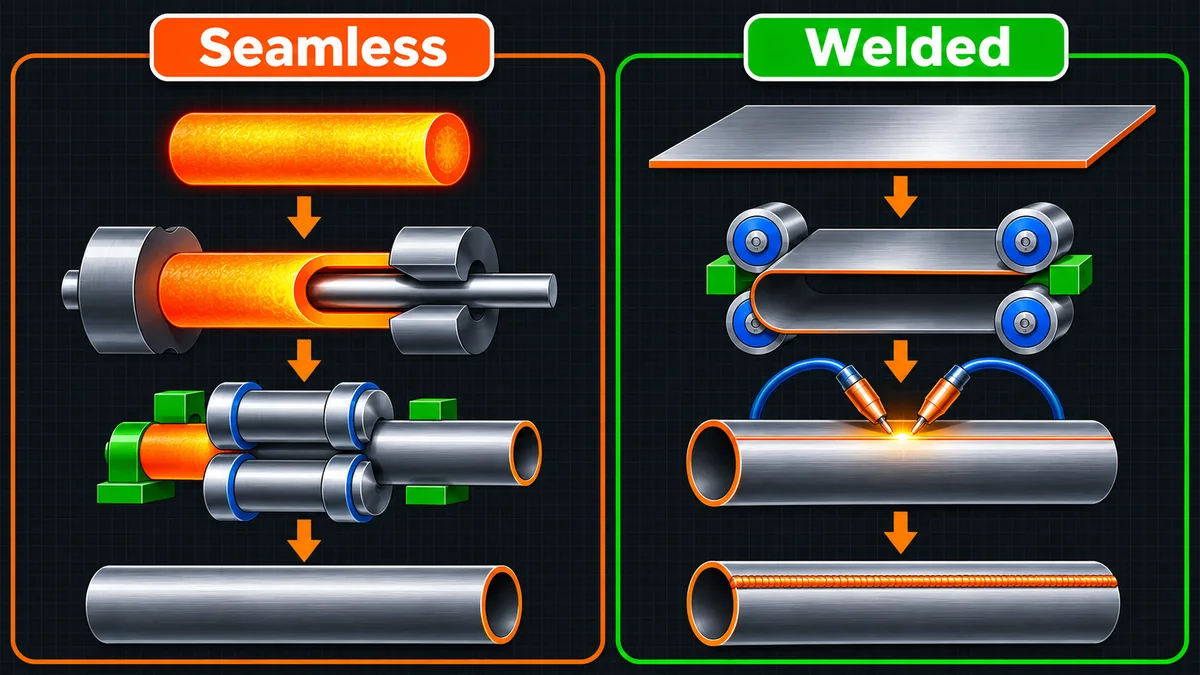
Large-diameter API 5L pipe is commonly made by submerged arc welding (SAW), either as longitudinal-seam (LSAW) or helical-seam (HSAW) pipe. SAW pipe is produced in sizes that seamless mills cannot reach economically.
The seam is a metallurgical discontinuity in the wall. Older low-frequency ERW pipe has a documented history of seam-related defects, so many project specifications permit only seamless or high-frequency welded pipe. When you prepare pipe ends for field joining, the choice of bevel and root geometry follows the butt joint and bevel preparation rules in the welding procedure.
What Grades and Mechanical Properties Does Each Standard Offer?
Grade B at about 240 MPa minimum yield and 415 MPa minimum tensile is the common ground, while API 5L extends well above it with X-grades whose number states the minimum yield strength in ksi.
A106 and A53 each define a small family: Grades A and B for A53, and Grades A, B and C for A106. Grade C has the highest carbon limit and the highest strength of the three common A106 grades. API 5L grade names such as X52 and X65 are read directly: X52 means 52 ksi (about 360 MPa) minimum yield strength.
| Standard and grade | Minimum yield, MPa (ksi) | Minimum tensile, MPa (ksi) |
|---|---|---|
| ASTM A106 Grade A | 205 (30) | 330 (48) |
| ASTM A106 Grade B | 240 (35) | 415 (60) |
| ASTM A106 Grade C | 275 (40) | 485 (70) |
| ASTM A53 Grade A | 205 (30) | 330 (48) |
| ASTM A53 Grade B | 240 (35) | 415 (60) |
| API 5L Grade B | about 245 (35.5) | 415 (60.2) |
| API 5L X42 | 290 (42.1) | 415 (60.2) |
| API 5L X52 | 360 (52.2) | 460 (66.7) |
| API 5L X60 | 415 (60.2) | 520 (75.4) |
| API 5L X65 | 450 (65.3) | 535 (77.6) |
| API 5L X70 | 485 (70.3) | 570 (82.7) |
Higher yield strength reduces the required wall only in codes that base design on specified minimum yield strength (SMYS), such as ASME B31.4 and B31.8 for pipelines. ASME B31.3 uses a tabulated allowable stress for each material, so moving from Grade B to a higher-strength pipe saves wall only if the code table credits it. Tensile, bend and impact tests used to prove these properties are explained in the tensile, Charpy and hardness tests guide.
How Do Chemistry and Weldability Compare?
All three standards describe carbon-manganese steels, so weldability depends mainly on carbon equivalent, wall thickness and restraint, not on the specification name.
| Pipe and grade | Carbon max | Manganese | Phosphorus max | Sulfur max |
|---|---|---|---|---|
| A106 Grade A | 0.25 | 0.27 to 0.93 | 0.035 | 0.035 |
| A106 Grade B | 0.30 | 0.29 to 1.06 | 0.035 | 0.035 |
| A106 Grade C | 0.35 | 0.29 to 1.06 | 0.035 | 0.035 |
| A53 Grade A (Type S, E) | 0.25 | 0.95 max | 0.050 | 0.045 |
| A53 Grade B (Type S, E) | 0.30 | 1.20 max | 0.050 | 0.045 |
| API 5L Grade B PSL1 (seamless) | 0.28 | 1.20 max | 0.030 | 0.030 |
| API 5L Grade B PSL2 (seamless) | 0.24 | 1.20 max | 0.025 | 0.015 |
The lower phosphorus and sulfur limits of PSL2 improve toughness and reduce the risk of inclusion-related defects. A106 Grade C has the highest carbon limit, so it needs more attention to preheat and hydrogen control than Grade B.
Which Welding Procedure Groups Apply?
Grade B pipe in all three standards is carbon steel in P-No. 1 of ASME Section IX, so one qualified procedure often covers more than one pipe specification. Higher API 5L grades and A106 Grade C need individual checking against the base metal tables, as explained in the guide to P-Number and F-Number grouping.
How Do You Control Cracking Risk?
Use the heat analysis on the mill test certificate to calculate carbon equivalent with the carbon equivalent (CE) calculator, then set preheat from the code and the qualified procedure. Low-hydrogen consumables are standard practice for thick or restrained joints. For filler selection, see decoding E7018 and ER70S classifications.
- Manual root and fill passes are often made with SMAW with low-hydrogen electrodes.
- High-quality open roots on process pipe are usually made with GTAW root passes.
- Thick-wall joints may need stress relief, and the post-weld heat treatment practice guide explains the cycles.
What Is the Difference Between API 5L PSL1 and PSL2?
PSL1 is the standard quality level of API 5L, while PSL2 adds tighter chemistry, carbon equivalent limits, strength ranges, mandatory Charpy toughness testing and more extensive nondestructive examination.
| Requirement | PSL1 | PSL2 |
|---|---|---|
| Chemistry | Standard limits | Tighter carbon, phosphorus and sulfur limits |
| Carbon equivalent | Less restrictive | Mandatory limits by grade and thickness |
| Strength limits | Minimum values | Minimum and maximum yield and tensile |
| Charpy toughness | Not required unless agreed | Mandatory |
| Nondestructive examination | Basic | More extensive |
| Traceability | Basic | Enhanced heat and test-unit traceability |
Offshore pipelines, sour service lines and many onshore transmission lines specify PSL2 for this reason. Sour service adds hardness and cracking limits that are covered in the sour service requirements guide. Plant piping that is dual certified usually follows PSL1 Grade B. See the American Petroleum Institute at api.org for the current edition of API 5L.
Which Piping Codes Use A106, A53 and API 5L?
ASME B31.3 Process Piping, B31.1 Power Piping, B31.4 and B31.8 each list or reference these pipe specifications, and allowed specifications, joint factors and temperature limits depend on the code edition.
| Code | Typical pipe specification | Note |
|---|---|---|
| ASME B31.3 Process Piping | A106 Grade B most common | A53 and API 5L are listed, with joint factors that depend on type |
| ASME B31.1 Power Piping | A106 Grade B or C for steam and feedwater | A53 and API 5L permitted within code limits |
| ASME B31.4 Liquids and Slurries | API 5L | Design based on specified minimum yield strength |
| ASME B31.8 Gas Transmission | API 5L | Design factors depend on location class |
Pipeline girth welds are normally qualified to API 1104, while plant piping welds follow ASME Section IX. For power piping, PWHT thresholds are summarized in the ASME B31.1 PWHT requirements guide. In India, steam piping within the scope of the Indian Boiler Regulations (IBR) needs IBR certification in addition to the normal mill certificates. The American Society of Mechanical Engineers (ASME) publishes the piping codes.
Temperature Limit
Carbon steel in prolonged service above about 425 °C (800 °F) can suffer graphitization, and creep strength falls quickly. Designers then move to chromium-molybdenum pipe such as ASTM A335 P11, P22 or P91. The P91 welding requirements explain the extra controls that these alloys need.
Can A53 or API 5L Replace A106?
ASTM A53 or API 5L can replace A106 only when the project specification, the design code and the purchase order allow it and the substitute pipe meets every requirement of the original specification.
Seamless pipe is often certified to A106 Grade B, A53 Grade B and API 5L Grade B at the same time. That is valid when the heat analysis, mechanical properties, tests and marking satisfy all three standards together. The strictest limit of each requirement governs, including the A106 silicon minimum.
Substitution Checklist
- Confirm the pipe is seamless when the original specification was A106.
- Check the grade, heat analysis and silicon content on the mill test certificate.
- Confirm the hydrostatic test or nondestructive electric test was performed as ordered.
- Check the wall thickness against the calculated minimum, including mill under-tolerance.
- Confirm the certificate type, for example EN 10204 Type 3.1, matches the order.
- Apply the correct weld joint quality factor if any substituted pipe is welded.
Practical receipt checks are covered in the incoming material checking rules guide. Piping material specifications on refinery and offshore projects commonly name seamless A106 Grade B for process hydrocarbon lines, and often allow A53 or API 5L for utility services, but the rule is always project specific.
How Does the Pipe Type Change the Wall Thickness? Worked Example
Wall thickness calculation shows why the manufacturing route matters: under ASME B31.3, the same NPS 6 line needs a thicker wall in welded A53 Type E than in seamless A106 Grade B.
The example uses the ASME B31.3 straight-pipe pressure design equation for internal pressure, para. 304.1.2, Eq. (3a): t = P D / [2 (S E W + P Y)]. The inputs are assumed for illustration, and you must take the real allowable stress and quality factor from Table A-1 and Table A-1B of the code edition that governs your project.
CASE 1: A106 GRADE B SEAMLESS (E = 1.00) t = (7.0 x 168.3) / [2 x (138 x 1.00 x 1.0 + 7.0 x 0.4)] t = 1,178.1 / [2 x (138 + 2.8)] = 1,178.1 / 281.6 t = 4.18 mm (pressure design thickness) tm = (4.18 + 1.5) / (1 – 0.125) = 5.68 / 0.875 Required nominal wall = 6.50 mm, so Schedule 40 (7.11 mm) is acceptable
CASE 2: A53 GRADE B TYPE E, ERW (E = 0.85) t = 1,178.1 / [2 x (138 x 0.85 x 1.0 + 7.0 x 0.4)] t = 1,178.1 / [2 x (117.3 + 2.8)] = 1,178.1 / 240.2 t = 4.90 mm (pressure design thickness) tm = (4.90 + 1.5) / 0.875 = 6.40 / 0.875 Required nominal wall = 7.32 mm, so Schedule 40 (7.11 mm) is NOT enough; use Schedule 80 (10.97 mm) Check: t is less than D/6 = 28.05 mm, so Eq. (3a) applies in both cases.
The welded pipe needs about 17 percent more pressure design thickness for the same service, and in this case the extra wall pushes the selection up one schedule. Seamless API 5L Grade B has the same quality factor of 1.00 as A106 and would give the same result. Use the burst pressure calculator to compare these results with Barlow-type estimates, and use the pipe weight calculator to compare the mass of the two schedules.
Example Only
This is a teaching example. The allowable stress, quality factors, corrosion allowance and tolerances must come from your design basis and the code edition in force.
How Do You Choose Between A106, A53 and API 5L?
Choose by service and code first, then by manufacturing route and strength, and finally by supplementary requirements such as toughness. The numbered procedure below follows that order.
- Confirm the governing code and service. Identify the design code (ASME B31.3, B31.1, B31.4 or B31.8), the fluid, the design pressure and the design temperature range.
- Decide whether seamless pipe is required. Select seamless pipe for high-temperature, high-pressure, cyclic or critical service, or when the weld joint quality factor must be 1.00.
- Match the grade to strength and wall thickness. Choose Grade B for typical plant piping, or an API 5L X-grade for pipelines, and calculate the wall thickness with the correct allowable stress and quality factor.
- Check supplementary requirements. Confirm any need for PSL2, Charpy toughness, sour service compliance, carbon equivalent limits or low-temperature materials such as ASTM A333.
- Write the full call-out in the purchase order. State the standard, grade, type, PSL level, NPS, schedule, end finish, test options and certificate type, and check them against the piping material specification.
Quick Reference: Which Carbon Steel Pipe Specification for Which Service?
The table below is a rule-of-thumb summary of common practice. It is not a substitute for the project specification.
| Service | Typical choice | Reason |
|---|---|---|
| Refinery and chemical process lines, elevated temperature | A106 Gr B | Seamless, killed steel, long service history in B31.3 |
| Steam and feedwater power piping | A106 Gr B or C | SA-106 listing and high-temperature strength |
| Utility water, air and nitrogen | A53 Gr B | Lower cost, galvanizing and threading available |
| Fire water and low-pressure fluids | A53 or API 5L Gr B | Depends on the project piping material specification |
| Onshore oil and gas transmission | API 5L X52 to X70 | High strength reduces wall and weight on long lines |
| Offshore and sour service lines | API 5L PSL2 | Controlled chemistry, toughness and hardness |
| Low-temperature service | ASTM A333 | None of the three is intended for low-temperature toughness duty |
| Structural and mechanical uses | A53 | General-purpose product with coating options |
What Are the Common Mistakes When Specifying These Pipes?
Most specification errors come from treating Grade B as interchangeable across standards. The common mistakes below cause rework, rejected certificates and incorrect wall thickness.
- Ignoring the joint quality factor. Welded A53 Type E or Type F carries a lower factor than seamless pipe and can require a thicker wall.
- Using A53 for high-temperature process service when the specification calls for seamless A106.
- Accepting a multi-standard certificate without checking chemistry, silicon content and tests against each listed standard.
- Quoting an API 5L grade without the PSL level. X52 PSL1 and X52 PSL2 are different products.
- Leaving out purchase order options such as the nondestructive electric test, hydrostatic test pressure and certificate type.
- Forgetting corrosion and temperature limits. Carbon steel needs a corrosion allowance, and the corrosion mechanisms guide explains why.
Edition and Contract Notice
Limits, joint factors and allowed specifications change between editions of ASTM, API and ASME documents. The edition cited in your contract and design basis governs, not the values in this guide.
Key Terms
- NPS (Nominal Pipe Size)
- A North American size designation for pipe in which the outside diameter is fixed for each NPS and does not equal the number for sizes below NPS 14.
- Schedule
- A designation that sets the nominal wall thickness for a given NPS, tabulated in ASME B36.10M.
- SMYS
- Specified minimum yield strength, the minimum yield value that a pipe grade must meet.
- PSL
- Product Specification Level, the API 5L quality tier, either PSL1 or PSL2.
- Seamless pipe
- Pipe formed from a pierced billet with no longitudinal weld seam.
- ERW (Electric Resistance Welded)
- Pipe formed from strip with the longitudinal seam joined by resistance heating and pressure.
- SAW (Submerged Arc Welded)
- Large-diameter pipe whose seam is welded by the submerged arc process, either longitudinal or helical.
Standards and References
- ASTM A106/A106M, Standard Specification for Seamless Carbon Steel Pipe for High-Temperature Service, ASTM International.
- ASTM A53/A53M, Standard Specification for Pipe, Steel, Black and Hot-Dipped, Zinc-Coated, Welded and Seamless, ASTM International.
- ASTM A333/A333M, Standard Specification for Seamless and Welded Steel Pipe for Low-Temperature Service and Other Applications with Required Notch Toughness, ASTM International.
- ASTM A335/A335M, Standard Specification for Seamless Ferritic Alloy-Steel Pipe for High-Temperature Service, ASTM International.
- API Specification 5L, Line Pipe, American Petroleum Institute.
- API Standard 1104, Welding of Pipelines and Related Facilities, American Petroleum Institute.
- ISO 3183, Petroleum and natural gas industries – Steel pipe for pipeline transportation systems, International Organization for Standardization.
- ASME B36.10M, Welded and Seamless Wrought Steel Pipe, ASME.
- ASME B31.3, Process Piping, ASME.
- ASME B31.1, Power Piping, ASME.
- ASME B31.4, Pipeline Transportation Systems for Liquids and Slurries, ASME.
- ASME B31.8, Gas Transmission and Distribution Piping Systems, ASME.
- ASME Boiler and Pressure Vessel Code, Section II Part A (Ferrous Material Specifications) and Section IX (Welding, Brazing, and Fusing Qualifications), ASME.
- ISO 15156 (NACE MR0175), Petroleum and natural gas industries – Materials for use in H2S-containing environments in oil and gas production, ISO.
- EN 10204, Metallic products – Types of inspection documents, European Committee for Standardization (CEN).
Frequently Asked Questions
What is the main difference between A106 and A53 pipe?
The main difference is the manufacturing route and the intended service. ASTM A106 covers seamless carbon steel pipe for high-temperature service in Grades A, B and C. ASTM A53 covers black and hot-dip galvanized pipe in seamless or welded form for general-purpose use, in Grades A and B. Because A53 can be welded pipe, ASME B31.3 applies a lower weld joint quality factor to Type E and Type F, which can increase the required wall thickness. A106 also requires a minimum silicon content, which A53 does not.
Can ASTM A53 be used instead of A106?
Sometimes, but only when the design code, the piping material specification and the purchase order allow it. The substitute should be seamless Type S Grade B, and the service should not demand A106 specifically, as high-temperature process lines often do. Welded A53 Type E or Type F is not a like-for-like replacement because the weld joint quality factor drops. Verify the mill test certificate during incoming material checking before accepting any substitution.
Is API 5L Grade B the same as A106 Grade B?
They are close but not identical. Both specify a minimum yield strength near 240 MPa (35 ksi) and a minimum tensile strength of 415 MPa (60 ksi). API 5L Grade B has no minimum silicon requirement like A106, and its PSL1 and PSL2 chemistry limits differ from the A106 limits. API 5L also covers welded pipe, so the product form must be checked. Seamless pipe is often certified to both standards when it meets every requirement of each.
What does X52 mean in API 5L?
X52 is an API 5L grade whose number gives the minimum specified yield strength in ksi, which is 52 ksi or about 360 MPa. The minimum tensile strength is about 460 MPa (66.7 ksi). Higher numbers such as X60, X65 and X70 give higher strength. In PSL2 pipe there are also maximum strength limits and mandatory toughness tests, so always quote the PSL level with the grade. Tensile and Charpy tests are explained in the mechanical testing guide for welding engineers.
What is the difference between API 5L PSL1 and PSL2?
PSL stands for Product Specification Level. PSL1 is the standard quality level, while PSL2 adds tighter chemistry limits, carbon equivalent limits, both minimum and maximum strength values, mandatory Charpy toughness testing and more extensive nondestructive examination. PSL2 is the usual choice for offshore pipelines, sour service and demanding onshore lines. For wet H2S service, PSL2 pipe must also satisfy the project’s sour service material requirements.
Can one pipe be certified to A106, A53 and API 5L at the same time?
Yes, provided the pipe meets every requirement of every standard listed on the certificate. In practice this means seamless pipe, because A106 allows only seamless product. The chemistry must satisfy the strictest limits of each standard, including the A106 silicon minimum, and the mechanical and test requirements must also be met. The mill test certificate should state each standard, grade and edition. Treat a multi-standard certificate as a claim to be checked, not as proof.
Does A106 Grade B need preheat before welding?
The specification itself does not set preheat. The requirement depends on carbon equivalent, thickness, restraint, ambient temperature and any mandatory preheat tables in the governing code. Use the heat analysis from the mill test certificate in the carbon equivalent calculator to judge cracking risk, and state preheat in the qualified welding procedure specification. Post-weld heat treatment above the code thickness threshold is covered in the heat treatment guide for fabricators.
Conclusion
The A106 vs A53 vs API 5L decision comes down to manufacture, service and code. Specify ASTM A106 seamless pipe for high-temperature process and power piping, ASTM A53 for general-purpose and utility lines where welded pipe and galvanizing are acceptable, and API 5L, usually PSL2 for demanding duty, for pipelines and high-strength line pipe. Grade B strength is almost identical across all three, so the real differences are the weld joint quality factor, toughness controls, chemistry limits and certification. State the standard, grade, type, PSL level and test options in the purchase order and check them against the project specification. As a next step, estimate the mass per metre of your selected NPS and schedule with our pipe mass calculator.
About This Guide
This guide was prepared by the WeldFabWorld technical team from the standards listed in Standards and References. Verify every requirement against the code edition and specification that apply to your project.