ASME B31.1 PWHT Requirements: Table 132 Guide for Power Piping
Last updated:
ASME B31.1 PWHT requirements decide whether a power piping weld must be heat treated after welding, at what temperature, and for how long. The answers sit in two tables: Table 132 for holding temperature and time, and Table 132.2 for exemptions. Getting either one wrong can mean a rejected joint, a cut-out weld or an unplanned furnace cycle.
Quick Answer
ASME B31.1 PWHT requirements are set by Table 132 and Table 132.2. Table 132 gives the holding temperature range and minimum holding time for each listed P-Number, for example 595–650 °C (1,100–1,200 °F) for P-No. 1 carbon steel at 1 hr per 25 mm. Table 132.2 lists exemptions by P-Number, thickness, chemistry and preheat. Designer or WPS requirements override exemptions.
This guide walks through both tables, shows how the control thickness drives the hold time, and works two examples with every step shown. It also explains the P-No. 1 exemption that changed in the 2014 edition, and how the B31.1 approach differs from B31.3 and Section VIII. For the calculation itself, use the PWHT soak time calculator, and review preheat requirements in welding because preheat decides several exemptions below.
Key Takeaways
- Table 132 sets the holding temperature range and minimum holding time by P-Number; Table 132.2 sets the exemptions.
- P-No. 1 carbon steel is held at 595–650 °C (1,100–1,200 °F) for 1 hr per 25 mm of control thickness, with a 15 minute minimum.
- Since the 2014 edition, P-No. 1 welds can be exempt at any thickness if the preheat and multi-layer conditions are met.
- No exemption applies when the designer or the WPS requires PWHT.
- P-No. 15E (P91 type) steel has its own range of 730–775 °C (1,350–1,425 °F) and a 30 minute minimum hold.
- Code editions and project specifications differ, so confirm every value against the edition in your contract.
What Are ASME B31.1 PWHT Requirements?
ASME B31.1 PWHT requirements are the rules in the American Society of Mechanical Engineers (ASME) B31.1 Power Piping code that control postweld heat treatment of pressure-retaining welds in power, steam and boiler external piping. They cover which welds need PWHT, the temperature range, the minimum holding time and the exemptions.
Postweld heat treatment (PWHT) is a controlled heating cycle that tempers welded joints and reduces residual stress after welding. In ferritic piping it also softens the hard heat-affected zone (HAZ) and improves resistance to cracking in service. The material is heated below its lower critical temperature, held, then cooled in a controlled way.
B31.1 groups base metals by the ASME Section IX P-Number. If you are unsure which number your pipe falls under, check the ASME P-Number table first. Everything else in the PWHT decision follows from that number.
Code scope note
B31.1 applies to power piping. Process piping falls under ASME B31.3, and vessels under ASME Section VIII. Each code has its own PWHT tables, so never apply B31.1 values to a B31.3 or Section VIII job.
What Does B31.1 Table 132 Specify?
Table 132 lists, for each P-Number and group, the holding temperature range and the minimum holding time at temperature based on the control thickness. The table below summarizes the carbon and low-alloy rows most often met on power plant jobs. Confirm every entry against the table in your edition of the code.
| P-Number | Typical material | Holding range, °C (°F) | Minimum holding time |
|---|---|---|---|
| P-No. 1, Groups 1–3 | Carbon steel pipe (for example A106 Gr. B) | 595–650 (1,100–1,200) | 1 hr per 25 mm (1 in.) up to 50 mm (2 in.), 15 min minimum; over 50 mm: 2 hr plus 15 min for each additional 25 mm (1 in.) |
| P-No. 3, Groups 1–2 | C-1/2Mo and 1/2Cr-1/2Mo steels | 595–650 (1,100–1,200) | |
| P-No. 4, Groups 1–2 | 1Cr-1/2Mo and 1-1/4Cr-1/2Mo steels | 650–705 (1,200–1,300) | |
| P-No. 5A, Group 1 | 2-1/4Cr-1Mo steel (for example P22) | 675–760 (1,250–1,400) | Same rule as above |
| P-No. 15E, Group 1 | 9Cr-1Mo-V steel (P91 type) | 730–775 (1,350–1,425) | Read the P-No. 15E row for the full rule; 30 min minimum |
Is the upper temperature limit a hard limit?
No. The upper limit of the Table 132 range is a recommended value. It may be exceeded provided the actual metal temperature stays below the lower critical temperature of the materials being joined. The lower limit is the one that governs acceptance, because a joint held below it has not received the code PWHT. For high-alloy steels such as P91, many specifications fix a tighter band than the code, so follow the stricter project limit. Review the P91 welding requirements for the reasons behind that tight window.
Can a lower temperature with a longer hold be used?
For some P-Numbers, B31.1 allows an alternate PWHT at a lower holding temperature with a longer hold, given in Table 132.1. Treat it as a controlled option: it applies only to listed materials, and the procedure and the owner’s specification must accept it. The effect of time and temperature on tempering is explained in the guide to tempering curves in heat treatment.
When Is PWHT Required or Exempt Under B31.1?
PWHT is required when the weld falls in a P-Number listed in Table 132 and no exemption in Table 132.2 applies, or when the designer or WPS calls for it. Table 132.2 sets exemptions by P-Number, thickness, chemistry limits and preheat, and no exemption applies when the designer or the WPS requires PWHT.
What changed for P-No. 1 in the 2014 edition?
The 2014 edition of B31.1 removed the old thickness-based PWHT requirement for P-No. 1 carbon steel. Under Table 132.2, a P-No. 1 weld is exempt from PWHT at any thickness provided the conditions in the table are met. Two conditions matter on site:
- A minimum preheat of 95 °C (200 °F) must be applied before welding when the nominal material thickness exceeds 25 mm (1 in.).
- Multi-layer welding must be used when the nominal material thickness exceeds about 5 mm (3/16 in.).
The code also allows the exemption to be judged on actual chemical composition from ladle or product analysis rather than only on specified limits. Where the real chemistry exceeds a limit, the weld loses the exemption.
Caution
An exemption in Table 132.2 is not an instruction to skip PWHT. If the piping design specification, the WPS or service conditions require PWHT, the weld must be heat treated. Always check those documents before relying on the table.
What about alloy steels and P91?
Exemptions for P-No. 3, 4, 5A and higher-alloy steels are narrow. They depend on thickness, specified carbon or alloy content and preheat, so the safe approach is to read the exact Table 132.2 entry. For P-No. 15E (P91 type) steel, treat PWHT as required unless the P-No. 15E entry in your edition clearly permits an exemption for your joint. Hard, untempered martensite in a P91 weld is the reason most specifications allow no exceptions. Cracking risk during PWHT in creep-resistant steels is covered in the article on reheat cracking in Cr-Mo steels.
Worked exemption check
A106 Grade B pipe (P-No. 1), 30 mm (1.2 in.) wall, butt weld. Thickness is above 25 mm, so a 95 °C (200 °F) minimum preheat is required. Thickness is above 5 mm, so multi-layer welding is required. If both are met and no document requires PWHT, Table 132.2 exempts the weld. If preheat or multi-layer welding is not achieved, the weld goes to Table 132 and receives PWHT at 595–650 °C.
How Do You Calculate the Minimum Holding Time?
The minimum holding time is 1 hour per 25 mm (1 in.) of control thickness up to 50 mm (2 in.), with a 15 minute minimum. Above 50 mm, the hold is 2 hours plus 15 minutes for each additional 25 mm (1 in.). This rule applies to the carbon and low-alloy rows of Table 132; P-No. 15E carries its own entry.
Control thickness is the governing thickness defined in the notes to Table 132 and Table 132.2, and it depends on the joint type (butt weld, branch connection, fillet or attachment weld). Take the definition for your joint directly from the code, because using the wrong thickness is a common source of short holds.
How to determine B31.1 PWHT for a weld, step by step
- Identify the Section IX P-Number and group of the base metals being joined.
- Confirm whether the piping design specification, the WPS or the service conditions require PWHT.
- Check the Table 132.2 entry for the P-Number, thickness, chemistry and preheat conditions.
- If PWHT is required, read the holding range and the hold-time rule for the P-Number in Table 132.
- Determine the control thickness for the joint and calculate the minimum holding time.
- Run the heating, hold and cooling cycle under the written procedure and keep the chart as the record.
Worked example 1: P-No. 5A pipe, 50 mm control thickness
Worked example 2: P-No. 1 pipe, 75 mm control thickness, PWHT required
The PWHT soak time calculator performs this arithmetic for the common codes. Run your own thickness through it, then confirm the result against the code text for your edition.
How Is B31.1 PWHT Performed and Controlled?
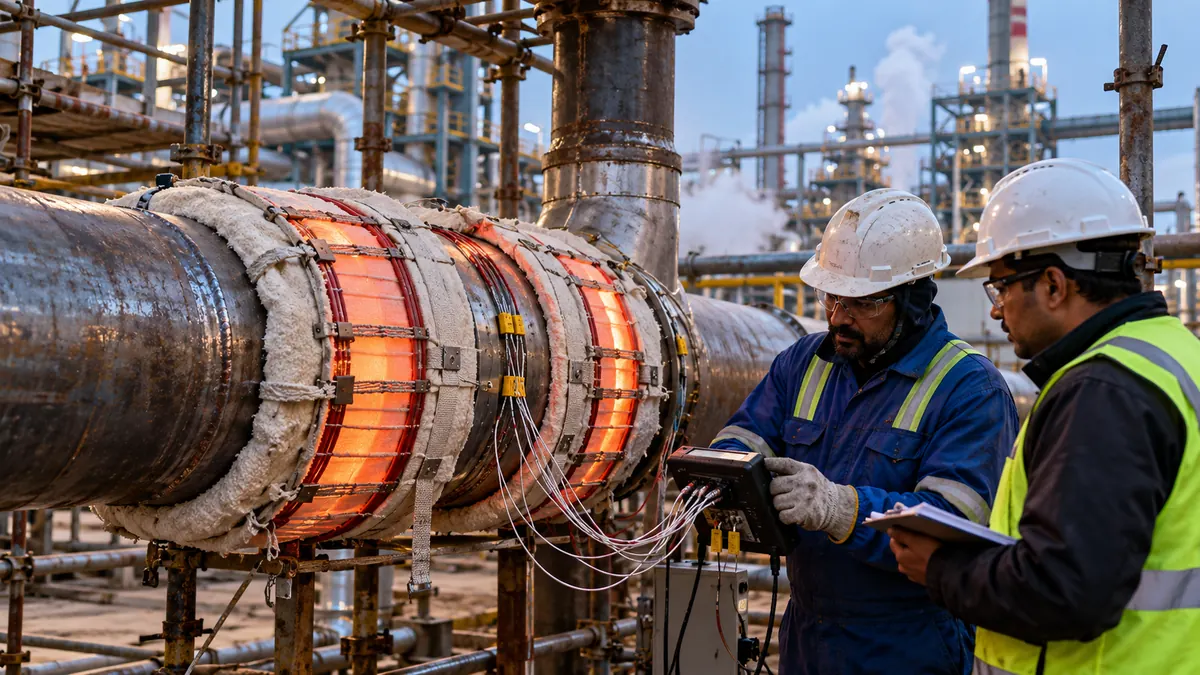
B31.1 PWHT is performed either in a furnace or locally with electric resistance or induction heaters on the weld and an adjacent band of pipe. The cycle has three controlled stages: heating, holding within the Table 132 range, and controlled cooling.
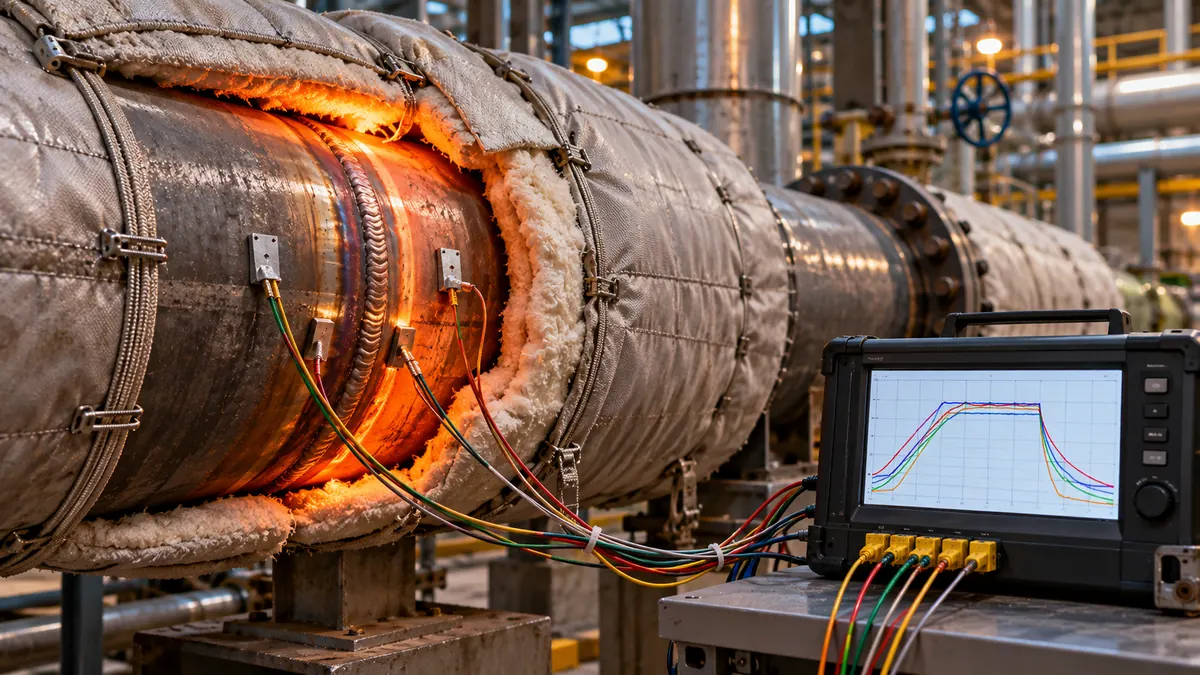
The code controls the details through the heat treatment paragraphs: heating and cooling rates, uniform temperature across the heated band, and temperature measurement. Rates are tied to thickness so that thick sections do not develop damaging thermal gradients. The written PWHT procedure turns those rules into numbers for the job, and the inspector checks the recorded chart against it.
What does the inspector check?
- Thermocouples are attached at the locations required by the procedure, and the instruments are in calibration.
- The recorded temperature stays inside the Table 132 range for the full minimum holding time.
- Heating and cooling rates stay within the procedure limits.
- The heated band and insulation cover the weld and the required width of adjacent pipe.
- The chart is identified to the weld joint and signed off as a quality record.
Is hardness testing required after PWHT?
The general hardness testing requirement that earlier editions attached to PWHT was removed in the 2014 edition of B31.1. Many owner specifications still require hardness checks, particularly for P91 and for service with a cracking risk, so follow the project specification. Convert readings between scales with the hardness conversion calculator. When a post-weld heat treatment is not practical in repair work, controlled deposition may be an option, as covered in temper bead welding; confirm that the code and the owner accept it.
The other quality checks on the finished weld are separate from PWHT. See the acceptance limits in visual examination under B31.1.
How Does B31.1 Compare With B31.3 and Section VIII?
B31.1, ASME B31.3 Process Piping and ASME Section VIII Division 1 each have their own PWHT rules. The principles are the same: P-Number, thickness, chemistry and preheat decide the requirement. The tables, notes and thresholds are not interchangeable.
| Item | ASME B31.1 | ASME B31.3 | ASME Section VIII Div. 1 |
|---|---|---|---|
| Applies to | Power piping | Process piping | Pressure vessels |
| Where PWHT is defined | Table 132 and Table 132.2 | Chapter V heat treatment tables | UCS-56 and its tables |
| Basis of the requirement | P-Number, thickness, chemistry, preheat | P-Number, thickness, chemistry, preheat | P-Number, thickness, chemistry, preheat |
| Higher requirement from design | Designer or WPS can require PWHT | Designer can require PWHT | Design specification can require PWHT |
Vessel PWHT follows its own paragraph rules, described in the pressure vessel fabrication guide. For the qualification rules that feed every one of these codes, start with the ASME Section IX introduction.
Quick Reference: B31.1 PWHT Cheat Sheet
| Question | Where to look | Typical answer |
|---|---|---|
| Is PWHT required? | Design spec, WPS, then Table 132.2 | Yes if specified; otherwise check the exemption entry |
| P-No. 1 exemption | Table 132.2 | Exempt with 95 °C preheat above 25 mm and multi-layer welding above 5 mm |
| P-No. 1 temperature | Table 132 | 595–650 °C (1,100–1,200 °F) |
| P-No. 5A temperature | Table 132 | 675–760 °C (1,250–1,400 °F) |
| P-No. 15E temperature | Table 132 | 730–775 °C (1,350–1,425 °F) |
| Hold time up to 50 mm | Table 132 | 1 hr per 25 mm, 15 min minimum |
| Hold time above 50 mm | Table 132 | 2 hr plus 15 min per extra 25 mm |
| Upper temperature limit | Table 132 notes | Recommended value; stay below the lower critical temperature |
Common Mistakes and Limitations
Most PWHT problems on site trace back to a small set of repeat errors. Requirements also depend on the code edition and the contract specification that apply to your project.
- Using an old edition. The P-No. 1 thickness rule changed in 2014; older procedures may still carry the earlier limit.
- Applying the exemption without the conditions. Preheat and multi-layer welding are conditions, not options. Without them the exemption does not hold.
- Ignoring the WPS and design specification. Table 132.2 does not override a requirement written elsewhere.
- Wrong control thickness. A short hold from the wrong thickness is a nonconformance that is only found when the chart is reviewed.
- Exceeding the lower critical temperature. Going above it risks transformation and loss of the tempered structure.
- Copying values between codes. A B31.3 or Section VIII hold time is not a B31.1 hold time.
- Treating P91 like carbon steel. Its narrow range, long hold and hardness controls need a dedicated procedure.
Limits of this guide
This article summarizes the code for learning and planning. It does not replace the code text, and no table value here should be used for a live job without checking the current edition of ASME B31.1.
Frequently Asked Questions About B31.1 PWHT
What is the PWHT temperature for carbon steel under ASME B31.1?
Is PWHT mandatory for carbon steel pipe in ASME B31.1?
What is the minimum holding time for PWHT in ASME B31.1?
Does ASME B31.1 require hardness testing after PWHT?
How does B31.1 PWHT differ from B31.3 and ASME Section VIII?
Does P91 steel always need PWHT under ASME B31.1?
Can the designer require PWHT when Table 132.2 says it is exempt?
Key Terms
- PWHT (postweld heat treatment)
- A controlled heating cycle applied after welding to temper the weld and HAZ and relieve residual stress.
- P-Number
- An ASME Section IX grouping of base metals with similar composition and weldability, used by B31.1 to set PWHT rules.
- Control thickness
- The governing thickness, defined by the code for each joint type, that sets the minimum holding time.
- Holding temperature range
- The metal temperature band in Table 132 within which the weld must be held for the required time.
- Lower critical temperature
- The temperature at which steel begins to transform to austenite on heating; PWHT stays below it.
- Heat-affected zone (HAZ)
- The base metal next to the weld whose microstructure changed during welding.
- Preheat
- The minimum metal temperature applied before welding, which also conditions the P-No. 1 PWHT exemption.
Conclusion
ASME B31.1 PWHT requirements come down to two tables and one check. Table 132.2 decides whether PWHT can be skipped, Table 132 gives the holding range and minimum time when it cannot, and the designer or WPS can override the exemption. For P-No. 1 carbon steel, the range is 595–650 °C and the hold is 1 hr per 25 mm. Since 2014 the thickness limit on the P-No. 1 exemption is gone, but the preheat and multi-layer conditions remain.
As a next step, enter your control thickness in the PWHT soak time calculator and compare the result with your WPS. Browse more code guides in the ASME Codes & Standards category.
Standards and References
- ASME B31.1, Power Piping, American Society of Mechanical Engineers (ASME). Official publisher: asme.org.
- ASME B31.3, Process Piping, ASME.
- ASME Boiler and Pressure Vessel Code, Section VIII, Division 1, Rules for Construction of Pressure Vessels, ASME.
- ASME Boiler and Pressure Vessel Code, Section IX, Welding, Brazing, and Fusing Qualifications, ASME.
- Pressure equipment safety regulator information on code adoption and bulletins: ABSA (Alberta).
About This Guide
This guide was prepared by the WeldFabWorld technical team from the standards listed above. Verify every value against the code edition and project specification that apply to your work.