Welding Engineering Courses and Diplomas in India: Routes, Institutes and Eligibility
A welding engineering course in India can begin at an ITI trade and run up to an M.Tech, and the right choice depends on your current qualification and the credential you need. This guide lists the verified diplomas, degrees and certificate programmes, the institutes that deliver them and who can apply. Salary and job-market questions are left to our welding engineer career guide for 2026, and the international diploma is explained in our IWE and IWS qualification guide.
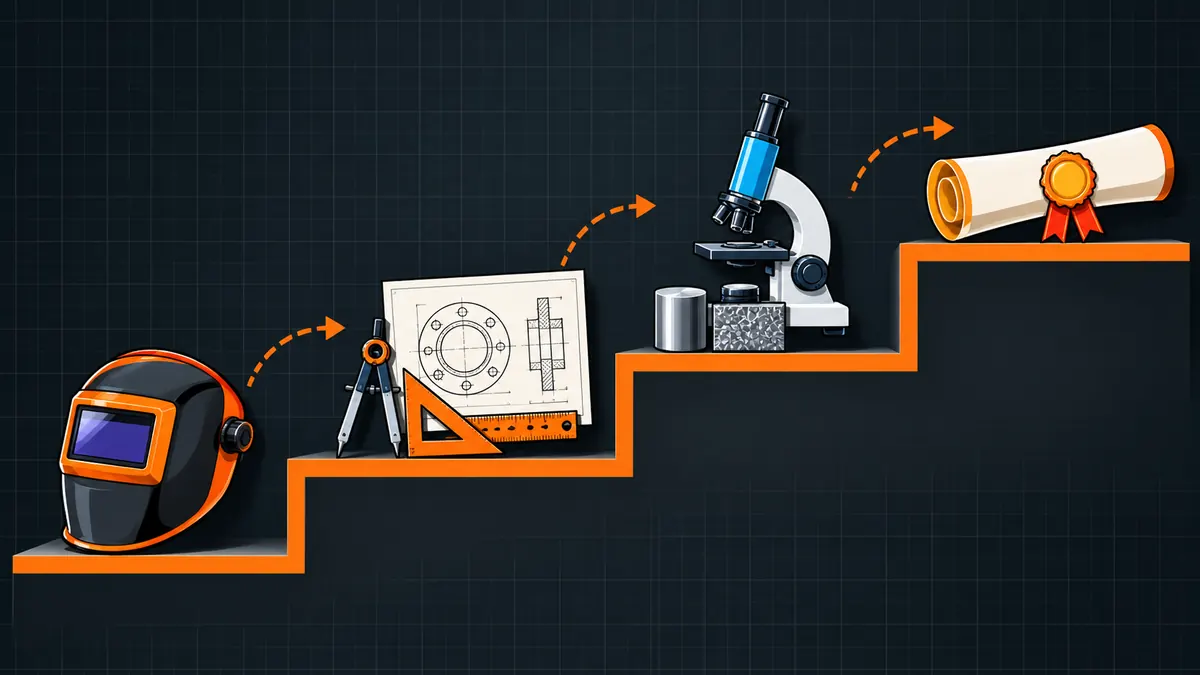
A welding engineering course in India usually follows one of four routes: IIW diplomas (IWE and IWT) from IIW-India and its approved training bodies, postgraduate programmes such as NIT Tiruchirappalli’s M.Tech (Welding Engineering) and the PSG-BHEL PG Certificate, the AM-IIW examination for the National Welding Engineer title, or entry-level ITI and polytechnic courses.
The guide is written for engineering students, diploma holders, working fabricators and QA/QC staff who want to move into welding coordination or welding engineering. Related career topics sit in the Career & Certification section of this site.
Programme details were checked against official institute and awarding-body pages in October 2026. Intake dates, fees and seat numbers change every year, so fees are deliberately not quoted here. Confirm them with the institute before you apply.
- IIW-India is the only Authorised Nominated Body (ANB) in India for IWE and IWT diplomas, and it appoints the training bodies that teach them.
- The approved training bodies listed for IWE and IWT in India are Cornerstone Academy (Chennai) and FCRIT Weld Academy (Navi Mumbai).
- The AM-IIW examination leads to Associate Membership of IIW-India and the National Welding Engineer title; it is not an AICTE-recognised degree for candidates registered after 31 May 2013.
- NIT Tiruchirappalli offers an M.Tech (Welding Engineering) with BHEL’s Welding Research Institute, and PSG Tech runs a one-year PG Certificate in Welding and Quality Engineering with BHEL.
- The ITI Welder trade is a one-year NCVT course open after Class 8, with some institutes asking for Class 10.
- Always verify that an institute is on the awarding body’s current approved list before you pay.
What Is a Welding Engineering Course?
A welding engineering course is a structured programme that teaches welding processes, metallurgy, design of weldments and quality control, leading to a diploma, degree or professional certificate. In India the term covers very different levels, from a one-year trade course to a two-year postgraduate degree, so the first step is to match the course level to your own entry qualification.
Two things separate the options. The first is the awarding body, such as the National Council for Vocational Training (NCVT), a university, or the International Institute of Welding (IIW) through its Indian member society. The second is the access condition, which may be a school pass, an engineering diploma or a degree.
Welding engineering knowledge is also what supports the welding coordinator role described in ISO 14731. Our guide to welding coordinator roles and responsibilities explains what that competence involves, which is the same ground the IIW diplomas are designed to cover.
Which Routes Lead to Welding Engineering in India?
Nine routes cover almost everything on offer, and they differ in length, entry level and awarding body. The table below summarises each one, and the sections that follow give the detail and the source for each.
| Route | Typical entry | Duration | Awarding or regulating body |
|---|---|---|---|
| ITI Welder trade | Class 8 pass; some institutes ask for Class 10 with science and maths | 1 year (2 semesters) | NCVT, National Trade Certificate |
| Polytechnic diploma in welding (example: Diploma in Mechanical Welding and Sheet Metal Engineering) | After Class 10; state eligibility rules apply | 3 years | State technical education board; AICTE-approved |
| IWT diploma | Higher technical diploma level | About 360 hours, standard route | IIW-India (ANB) through approved training bodies |
| IWE diploma | Engineering degree or equivalent | About 448 hours, standard route | IIW-India (ANB) through approved training bodies |
| AM-IIW examination | IIW-India membership; final-year diploma or 3rd/4th-year degree students | Registration valid six years | IIW-India |
| PG Certificate in Welding and Quality Engineering | B.E./B.Tech in mechanical, production, metallurgy and allied branches | 1 year, full time | PSG Tech with BHEL Educational Society |
| M.Tech (Welding Engineering) | B.E./B.Tech; GATE-based admission | 2 years (4 semesters) | NIT Tiruchirappalli |
| M.E. Welding Technology | B.E./B.Tech; GATE or CEETA-PG through CEAP | 2 years | Anna University affiliated colleges, for example GCE Salem |
| Advanced Course on Welding Technology (online) | Aspiring welding coordinators and interested professionals | About 100 hours | IIW-India Welding Education Committee |
How Do the IWE and IWT Diplomas Work in India?
The Indian Institute of Welding (IIW-India) is the only Authorised Nominated Body (ANB) for the International Institute of Welding in India. It awards the International Welding Engineer (IWE) and International Welding Technologist (IWT) diplomas, and it also certifies companies to ISO 3834 as the ANB for Company Certification. Our overview of the ISO 3834 welding quality system explains that side of its work.
IIW-India appoints Approved Training Bodies (ATBs) after an audit, controls admission to the standard route, and conducts the written, oral and practical examinations. The curriculum follows the IIW guideline IAB-252, which sets about 448 teaching hours for IWE and about 360 hours for IWT on the standard route. The IWE and IWS guide linked in the introduction covers the four modules and the entry conditions in detail.
| Institute | Location | Qualification offered |
|---|---|---|
| Cornerstone Academy Pvt. Ltd. | Kovilambakkam, Chennai, Tamil Nadu | IWE and IWT, standard route |
| FCRIT Weld Academy (Agnel Education and Social Development Foundation) | Fr. C. Rodrigues Institute of Technology, Vashi, Navi Mumbai, Maharashtra | IWE and IWT, standard route |
| Don Bosco Technical Institute | Vaduthala, Kochi, Kerala | International Welder qualification |
| Ador Welding Limited, Training Division | Akurdi, Chinchwad, Pune, Maharashtra | International Welder qualification |
The list is maintained on the IIW-India approved training institute page. Check it before enrolling, because ATB status can change and only listed bodies can run the standard route.
What Are the Standard, Alternative and Transition Routes?
IIW-India offers three routes to the diplomas. The standard route needs attendance at an ATB course. The alternative route is meant for experienced professionals who meet the access qualification and are currently practising in India; it does not require a regular course, but an ANB assessment and examinations still apply. The transition route is open only to people whose qualification and experience were already in place on or before 3 January 2011.
What Other Courses Does IIW-India Run?
IIW-India also schedules an online Advanced Course on Welding Technology for aspiring welding coordinators and other interested professionals. It covers four modules aligned with IAB-252, runs for about 100 hours across 40 topics and is described by IIW-India as purely for knowledge and competency development, not a qualification. The 2026 edition was scheduled from 10 June to 12 September.
The transition-route refresher course covers 20 topics in 20 online lessons of two hours, spread over 15 days. IIW-India says the refresher is open to all welding professionals as a student candidate, even though it was designed for the transition route.
What Is the AM-IIW Examination?
The AM-IIW examination is IIW-India’s own education programme and certification examination in welding engineering. Passing every paper makes the candidate an Associate Member of the Institute and entitles the candidate to the title National Welding Engineer. The re-introduced format includes theory papers, project work, practical work and a viva voce.
- Membership: the candidate must be an individual member of IIW-India in any category.
- Education: students in the final year of a 3-year engineering diploma, or in the 3rd or 4th year of a 4-year engineering degree, may register.
- Validity: a registration is valid for six years.
- Exemptions: diploma students get no exemption in any paper, while a B.E. candidate may claim exemption in papers already passed during the degree, based on documents.
IIW-India states that candidates registered on or after 1 June 2013 receive the AM-IIW certificate without AICTE recognition. Treat it as a professional certification from the Institute, not as an AICTE-recognised degree equivalent, and check what an employer or university accepts.
Which Postgraduate Welding Programmes Are Available?
Three postgraduate options were verified for this guide: an M.Tech at NIT Tiruchirappalli, a one-year certificate run by PSG Tech with BHEL, and an M.E. in Welding Technology in the Anna University system. All three expect an engineering degree and weight practical exposure to welding and testing.
| Programme | Institute | Duration | Entry and selection | Notes |
|---|---|---|---|---|
| M.Tech (Welding Engineering) | NIT Tiruchirappalli, in collaboration with BHEL Welding Research Institute | 4 semesters | B.E./B.Tech; admission through GATE per admission portals | Covers welding processes, welding metallurgy, codes and standards, electrical aspects of welding and design of weldments |
| PG Certificate in Welding and Quality Engineering | PSG College of Technology, Coimbatore, with BHEL Educational Society | 1 year, full time | B.E./B.Tech in mechanical, production, metallurgy, automobile, manufacturing, mechatronics and allied branches; all-India entrance test at PSG each May | Theory in the first quarter at PSG, then internship at BHEL Tiruchirappalli; about 20 to 25 students per batch |
| M.E. Welding Technology | Government College of Engineering, Salem (Anna University) | 2 years | B.E./B.Tech in mechanical and allied branches; GATE or CEETA-PG through CEAP per admission portals | Check the college for the current intake and syllabus |
What Does the PSG-BHEL Certificate Add?
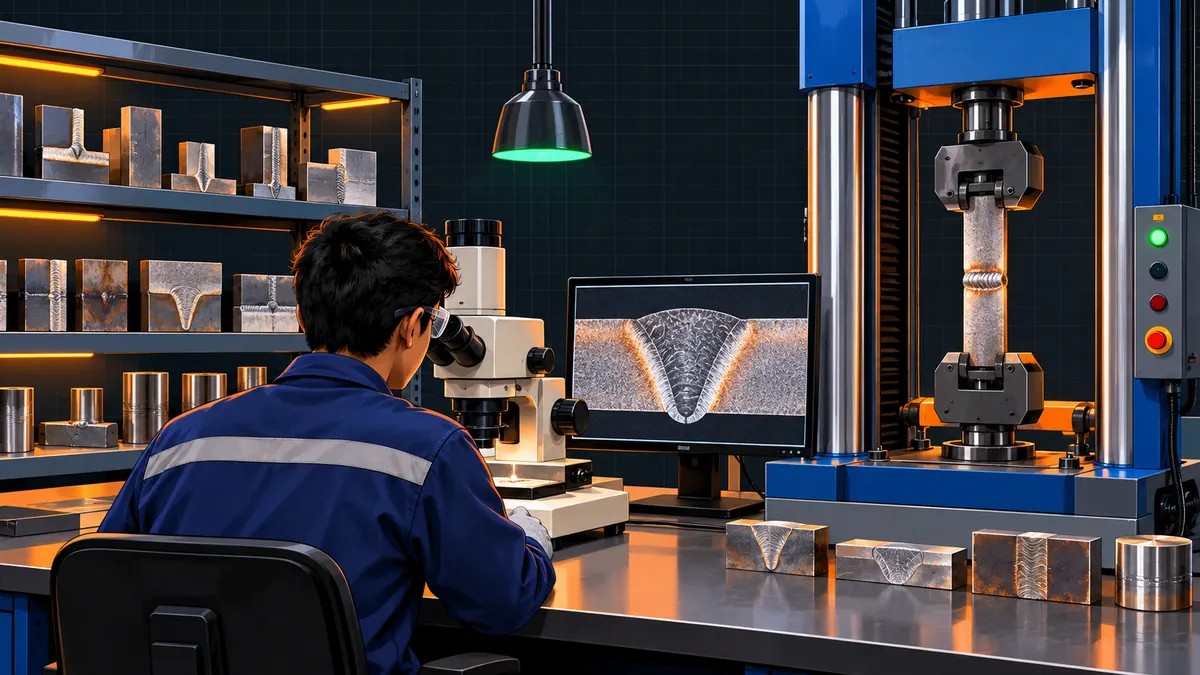
According to the BHEL Welding Research Institute (WRI) programme page, the PG Certificate includes an ASNT NDT Level II certification programme in all four NDT techniques and the Certified Welding Inspector (CWI) examination of WRI. NDT inspection is a large part of the syllabus, and our NDT method selection guide compares the methods in practical terms. WRI itself was established on 1 November 1975 with UNIDO/UNDP assistance under BHEL, and the programme details are on the BHEL WRI PG Certification page.
NIT Tiruchirappalli publishes the M.Tech (Welding Engineering) programme on its official welding programme page. The department is Metallurgical and Materials Engineering, and the subjects reflect the standards used in fabrication such as the base metal groupings in our P-Number and F-Number grouping guide.
Which Diplomas and Trade Courses Suit Entry-Level Learners?
Entry-level routes start from a school pass and give practical welding skills with a recognised certificate. They suit learners who want to work as welders, supervisors or technicians first and add engineering qualifications later.
What Does the ITI Welder Trade Offer?
The ITI Welder trade is a one-year course under the Craftsman Training Scheme (CTS) of the Directorate General of Training, regulated by NCVT. It has two semesters, and graduates receive a National Trade Certificate (NTC). Eligibility is generally a Class 8 pass, although some institutes require Class 10 with science and mathematics. The academic session usually starts in August.
What Is the Craft Instructor Training Scheme?
The Craft Instructor Training Scheme (CITS) trains welding instructors in one year at National Skill Training Institutes. For example, NSTI Ludhiana lists a Welder trade at NSQF Level 6 with 50 seats, admission through an all-India entrance test run by DGT, and eligibility of NTC/NAC, a diploma or a degree in a relevant engineering branch.
Are There Polytechnic Diplomas in Welding?
Welding-specific polytechnic diplomas are offered by only some institutes. One verified example is the Diploma in Mechanical Welding and Sheet Metal Engineering at SJ Government Polytechnic, Bengaluru: a three-year, AICTE-approved course run under the Karnataka Department of Technical Education. State eligibility and domicile rules apply, so check the current admission notice.
How Do Welders Get Certified Within IIW-India?
IIW-India runs its National Welding Training and Certification Scheme (NWTCS), which trains and certifies welders to the level of standards such as IS 7310, IBR, ISO 9606-1, ASME Section IX and AWS D1.1. Welder qualification itself follows the rules in our guide to ASME Section IX Article IV welder qualification. IIW-India’s Approved Training Bodies for the International Welder qualification are Ador Welding (Pune) and Don Bosco Technical Institute (Kochi).
Which Inspection Courses Sit Alongside Welding Engineering?
Inspection certifications are separate from engineering diplomas but are often taken by the same people. They cover visual and weld inspection rather than welding coordination, and they are examined by different bodies.
- NWICS (IIW-India): the National Welding Inspectors’ Certification Scheme, designed to meet the qualification criteria for welding inspectors under IS 18224 (CWI-S), with entry tied to education and years of experience.
- CSWIP (TWI): TWI’s published schedule for late 2026 lists CSWIP Welding Inspector and Senior Welding Inspector courses at Indian venues including Chennai, Cochin, Pune and Trichy. See the TWI welding inspection courses page for current dates.
- WRI Certified Welding Inspector: part of the PG Certificate at BHEL WRI, as described above.
The difference between an engineer, a QA/QC engineer and an inspector is covered in our comparison of welding engineer, QA/QC engineer and welding inspector roles. Independent inspection by client-appointed bodies is explained in our guide to third party inspection in welding.
How Do You Choose and Verify a Course?
Choose by starting qualification first, then by the credential you need, and verify the institute before you pay. The table below maps common starting points to routes verified in this guide.
| Your starting point | Routes to consider | Why |
|---|---|---|
| Class 8 or 10 pass, want hands-on welding skills | ITI Welder trade, then NWTCS or International Welder certification | Lowest entry barrier and a recognised trade certificate |
| Engineering diploma student or holder | AM-IIW examination; IWT through an approved training body | Final-year diploma students may register for AM-IIW; IWT is the technologist-level diploma |
| B.E./B.Tech student or graduate without welding experience | PSG-BHEL PG Certificate; M.Tech (Welding Engineering) via GATE; IWE through an approved training body | Structured teaching plus practical exposure |
| Working engineer with welding experience | IWE alternative route; IIW-India Advanced Course | No regular course is needed on the alternative route, and the Advanced Course builds knowledge |
| Welder or QC staff moving toward inspection | NWICS; CSWIP through TWI | These certify inspection competence directly |
How Do You Verify a Welding Course Before Paying?
- Identify the awarding body. Find out who actually issues the certificate: NCVT, a university, IIW-India or another body.
- Check the approved list. For IWE, IWT and International Welder courses, confirm that the institute appears on the IIW-India approved training institute page.
- Check the entry conditions. Compare your qualification and experience with the published access conditions for that route.
- Check approval or affiliation. For diplomas and degrees, confirm NCVT affiliation or AICTE approval, as relevant to the course.
- Ask for the syllabus and exam calendar. IIW diplomas follow IAB-252, so the syllabus should map to its four modules and the examinations should be run by the ANB.
- Get costs and terms in writing. Obtain the current fee sheet, intake dates and refund terms from the institute rather than relying on third-party listings.
After enrolling, practise the code knowledge these courses assume. Our guide to QW-200 WPS variables is a good place to start with the basics.
Quick Reference: Welding Courses in India at a Glance
This cheat sheet condenses the verified facts. Confirm each against the institute or awarding body before acting.
| Item | Fact | Source |
|---|---|---|
| ANB for IIW diplomas in India | IIW-India, the only ANB | IIW-India |
| IWE and IWT approved training bodies | Cornerstone Academy (Chennai); FCRIT Weld Academy (Navi Mumbai) | IIW-India list, May 2026 |
| IWE and IWT teaching hours, standard route | About 448 and about 360 | IAB-252 |
| Transition route cut-off date | Eligibility attained by 3 January 2011 | IIW-India |
| AM-IIW registration validity | Six years | IIW-India |
| PG Certificate, PSG with BHEL | 1 year; B.E./B.Tech entry; entrance test each May | BHEL WRI |
| M.Tech Welding Engineering | NIT Tiruchirappalli, 4 semesters | NIT Tiruchirappalli |
| ITI Welder trade | 1 year; Class 8 pass (some institutes Class 10) | DGT, NCVT |
| Advanced Course on Welding Technology | Online, about 100 hours, 4 modules | IIW-India |
What Are the Common Mistakes and Limits?
Most problems come from skipping verification and from relying on outdated listings. The points below are the ones that cause the most wasted time and money.
- Assuming any institute teaching IWE is authorised. Only Approved Training Bodies on the IIW-India list can run the standard route.
- Treating IWE as a degree. It is an IIW diploma issued through the ANB, and the IWE entry condition itself assumes an engineering degree.
- Assuming AM-IIW has AICTE recognition. Candidates registered after 31 May 2013 receive the certificate without it.
- Using the transition route today. It requires qualification and experience attained by 3 January 2011.
- Relying on aggregator fees and seat counts. Listing sites differ and age quickly. Use the institute’s current notice.
- Confusing inspection certificates with engineering diplomas. CSWIP, NWICS and the WRI CWI examination certify inspection competence, not welding coordination.
This guide covers the programmes and bodies verified in October 2026. It is not a complete directory of every welding institute in India, and it does not quote fees. Intake dates, entry conditions and approved-body lists change, so confirm everything with the awarding body.
Frequently Asked Questions
Which welding engineering courses are available in India?
India offers welding courses at several levels. These include the one-year ITI Welder trade, three-year polytechnic diplomas, IIW IWE and IWT diplomas through approved training bodies, the AM-IIW examination, and postgraduate programmes such as NIT Tiruchirappalli’s M.Tech (Welding Engineering) and the PSG-BHEL PG Certificate. An M.E. in Welding Technology is also listed at Government College of Engineering, Salem. The right option depends on your entry qualification.
Who issues the IWE diploma in India?
IIW-India, the Indian Institute of Welding, is the only Authorised Nominated Body for the International Institute of Welding in India. It awards the IWE and IWT diplomas after examinations. Teaching on the standard route is delivered by approved training bodies, and the listed IWE and IWT bodies are Cornerstone Academy in Chennai and FCRIT Weld Academy in Navi Mumbai. Always check the current list on the IIW-India website.
Can I get an IWE diploma without attending a full course?
Yes, in some cases. The alternative route is meant for experienced professionals who meet the access qualification and work in India, and it does not require a regular course at an approved training body. The transition route is limited to people whose qualification and experience were attained on or before 3 January 2011. Both routes still involve assessment and examinations, so read how the IWE standard and alternative routes work before applying.
What is the AM-IIW examination?
AM-IIW is IIW-India’s education programme and examination in welding engineering. Passing all papers makes the candidate an Associate Member of the Institute and entitles the candidate to the title National Welding Engineer. Candidates must be IIW-India members, and final-year diploma students or 3rd and 4th-year degree students may register. The certificate is issued without AICTE recognition for candidates registered after 31 May 2013.
What is the PSG-BHEL PG Certificate in Welding and Quality Engineering?
It is a one-year full-time postgraduate certificate run by PSG College of Technology and the BHEL Educational Society. Theory is taught at PSG in the first quarter, and the remaining period is an internship at BHEL Tiruchirappalli. Entry needs a B.E. or B.Tech in mechanical, production, metallurgy, automobile, manufacturing, mechatronics or allied branches, and selection is by an all-India entrance test held in May. The programme includes ASNT NDT Level II training and the Welding Research Institute CWI examination.
Can I study welding engineering after Class 10 or Class 12?
After Class 8 or 10 you can join the one-year ITI Welder trade, and after Class 10 you can join a three-year polytechnic diploma where a welding diploma is offered. The programmes verified for this guide at engineering level need a diploma or degree first. A common route is a B.E. or B.Tech in mechanical, production or metallurgical engineering, followed by IWE, a PG certificate or an M.Tech.
Which course suits an ITI welder who wants to progress?
An ITI welder can build credentials through IIW-India’s welder certification scheme (NWTCS) and the International Welder qualification at approved bodies such as Ador Welding in Pune and Don Bosco Technical Institute in Kochi. Moving into engineering roles generally needs an engineering diploma or degree first. Diploma students in their final year can then register for AM-IIW, and diploma holders can consider the IWT diploma.
Key Terms
- ANB (Authorised Nominated Body)
- The national body appointed by the International Institute of Welding to award IIW diplomas, which is IIW-India in India.
- ATB (Approved Training Body)
- An institute audited and approved by the ANB to teach and run the standard route to an IIW diploma.
- IAB-252
- The IIW guideline that sets the curriculum, hours and examinations for welding coordination personnel.
- IWE and IWT
- The International Welding Engineer and International Welding Technologist diplomas for welding coordination personnel.
- AM-IIW
- IIW-India’s examination for Associate Membership and the National Welding Engineer title.
- NCVT and NTC
- The National Council for Vocational Training and the National Trade Certificate it awards for ITI trades.
- GATE
- The Graduate Aptitude Test in Engineering, an entrance score used for several M.Tech and M.E. admissions.
Conclusion
A welding engineering course in India is best chosen by working backwards from your qualification: ITI and polytechnic routes for school leavers, AM-IIW and IWT for diploma holders, and IWE, the PSG-BHEL PG Certificate or the NIT Tiruchirappalli M.Tech for engineering graduates. The most important check is the awarding body, because only approved bodies can run IIW diploma courses, and fees and intakes change every year. Verify each programme with the institute before paying. For what the roles pay and where they lead, read the career guide linked at the top of this page, then test your code knowledge with our ASME Section IX practice quiz.
This guide was prepared by the WeldFabWorld technical team from the official sources listed in Sources and References. Verify every detail with the institute or awarding body before applying.
Sources and References
- Indian Institute of Welding (IIW-India), Personnel Qualification and Certification pages, list of approved training institutes, routes to qualification, ANB examination calendar and Advanced Course on Welding Technology
- IIW-India, AM-IIW Examination eligibility criteria and general information
- IIW-India, National Welding Training and Certification Scheme and National Welding Inspectors’ Certification Scheme brochures
- IIW guideline IAB-252, Personnel with Responsibility for Welding Coordination, as summarised in our IWE guide
- BHEL Welding Research Institute, Tiruchirappalli, PG Certification Programme page and WRI course calendar 2026-27
- PSG College of Technology and BHEL Educational Society, PG Certificate Programme in Welding and Quality Engineering brochure, 2026-27 admissions
- National Institute of Technology Tiruchirappalli, M.Tech (Welding Engineering) programme page and academic programmes list
- Directorate General of Training (DGT), Welder trade and Craft Instructor Training Scheme information, NSTI Ludhiana
- TWI Training, CSWIP Welding Inspector course availability, India
- FCRIT Weld Academy, Fr. C. Rodrigues Institute of Technology, Navi Mumbai