A193 B7 vs B8 is the first choice every flange bolting specification has to make: a high-strength chromium-molybdenum steel stud, or a corrosion-resistant austenitic stainless steel stud. The decision sets the preload the joint can reach, the temperature range it can see and the environments it survives. This guide compares the grades, explains the matching A194 nuts and shows how to choose, with the flange side covered in our guide to flange types, faces and grades.
A193 B7 is quenched and tempered chromium-molybdenum alloy steel with a minimum yield strength of 105 ksi (720 MPa) up to 2-1/2 in, paired with A194 2H nuts for general flange bolting. A193 B8 is Type 304 stainless steel with a Class 1 minimum yield of only 30 ksi (205 MPa), paired with A194 8 nuts, and is chosen for corrosion resistance and low temperature.
It is written for piping and welding engineers, QA/QC and inspection staff, and procurement teams who specify or receive flange bolting. Related guides on material behaviour and selection are in the Material Properties & Selection section of this site.
Strength and hardness values below are the minimums given in ASTM A193/A193M and A194/A194M as published in supplier and industry data tables. Always confirm them against the specification edition and the project specification.
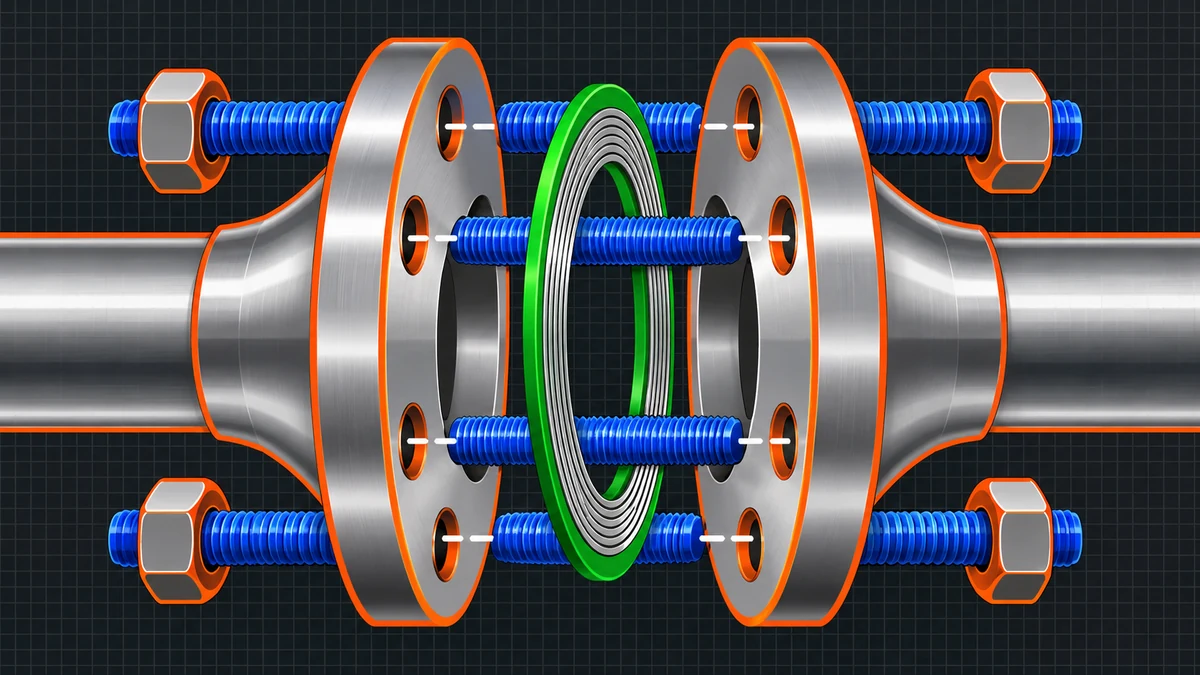
- B7 is the default carbon steel flange stud: 125 ksi minimum tensile and 105 ksi minimum yield up to 2-1/2 in, with a 321 HBW maximum hardness.
- B8 Class 1 (Type 304) has only 75 ksi tensile and 30 ksi yield, so it gives much lower preload than B7 unless strain-hardened Class 2 is used.
- B7M is the lower-hardness version of B7 for sour (H2S) service, limited to 235 HBW (22 HRC), and it must be paired with A194 2HM nuts.
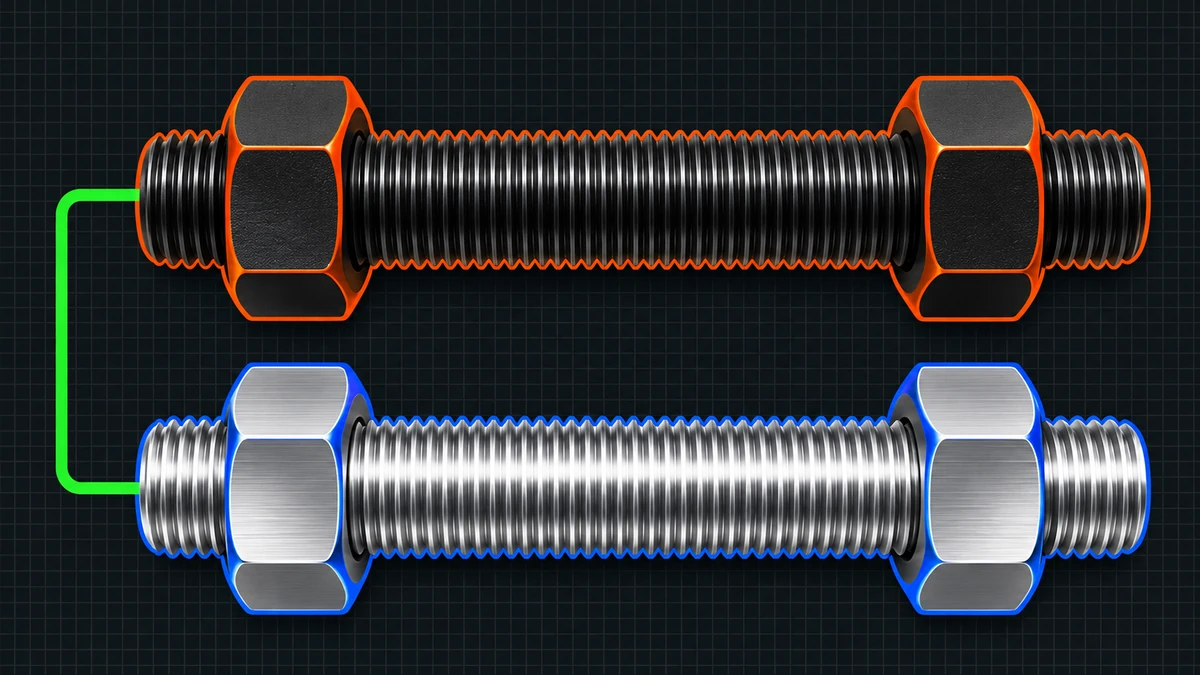
- The standard nut pairings are B7 with 2H, B7M with 2HM, B8 with 8 and B8M with 8M.
- B7 is commonly used from -29 °C to about 427 °C, while B8 covers -196 °C to about 538 °C and resists corrosion.
- Mixing grades is a real hazard because B7 and B7M, or 2H and 2HM, look the same without checking markings and certificates.
What Are ASTM A193 and A194?
ASTM A193 is the specification for alloy steel and stainless steel bolting used in pressure vessels, valves, flanges and fittings at high temperature, high pressure or other special service. ASTM A194 is the companion specification for the carbon, alloy and stainless steel nuts used with it.
A193 covers ferritic grades such as B7, B7M and B16, which are heat-treated for strength, and austenitic stainless grades such as B8 and B8M, which are carbide solution treated. Both specifications are published by ASTM International and are referenced by flange and piping standards such as ASME B16.5 and ASME B31.3. The matching ASME material specifications are listed in our ASME Section II Part A reference guide.
B7 is made from chromium-molybdenum steel of the 4140 or 4142 type, quenched and tempered with a minimum tempering temperature of 1100 °F (593 °C). The effect of chromium and molybdenum on hardenability is explained in our guide to alloying elements in steel.
What Is the Difference Between A193 B7 and B8?
B7 is a high-strength ferritic alloy steel stud, while B8 is an austenitic stainless steel stud with much lower strength but far better corrosion resistance and low-temperature toughness. The table compares the common grades side by side.
| Property | B7 | B8 Class 1 | B8M Class 2 |
|---|---|---|---|
| Material | Cr-Mo alloy steel, quenched and tempered | Type 304 stainless steel, carbide solution treated | Type 316 stainless steel, strain hardened |
| Minimum tensile strength | 125 ksi (860 MPa) up to 2-1/2 in | 75 ksi (515 MPa), all sizes | 110 ksi (760 MPa) up to 3/4 in |
| Minimum yield strength (0.2% offset) | 105 ksi (720 MPa) up to 2-1/2 in | 30 ksi (205 MPa), all sizes | 95 ksi (655 MPa) up to 3/4 in |
| Minimum elongation | 16% | 30% | 15% |
| Maximum hardness | 321 HBW or 35 HRC | 223 HBW or 96 HRB | 321 HBW or 35 HRC |
| Typical temperature range | -29 °C to about 427 °C | -196 °C to about 538 °C | -196 °C to about 538 °C |
| Corrosion resistance | Low; needs coating or protection | Good in many environments | Better in chlorides than B8 |
| Matching A194 nut | 2H | 8 | 8M |
The strength gap is the main reason B7 is the default for carbon steel flanges. Minimum yield strength is the figure that sets the achievable bolt preload, a point explained in our guide to mechanical properties of metals. Class 1 stainless bolts also depend on carbide solution treatment, so they should not be sensitised by heat; see our guide to weld decay in stainless steel for the mechanism.
Which A193 Grades Exist and What Are They For?
A193 includes ferritic alloy grades for strength and heat and austenitic stainless grades for corrosion and low temperature. The table lists the grades used most often in flange and valve bolting.
| Grade | Material | Typical use |
|---|---|---|
| B7 | Cr-Mo alloy steel (AISI 4140/4142), quenched and tempered | General flange, valve and pressure vessel bolting on carbon steel piping |
| B7M | Same chemistry as B7, tempered at 1150 °F (620 °C) minimum with hardness limited to 235 HBW (99 HRB) | Sour (H2S) service under NACE MR0175 / ISO 15156 |
| B16 | Cr-Mo-V alloy steel | Higher-temperature service such as boilers and steam turbines |
| B8 | Type 304 stainless steel (Class 1 solution treated, Class 2 strain hardened) | Corrosive environments and low-temperature service |
| B8M | Type 316 stainless steel (Class 1 or Class 2) | Chloride, marine and chemical service |
| B8C and B8T | Type 347 and Type 321 stabilised stainless steels | Elevated-temperature service where sensitisation is a concern |
What Do Class 1 and Class 2 Mean for Stainless Bolting?
Class 1 bolting is carbide solution treated and is the weak, ductile form. Class 2 bolting is solution treated and then strain hardened in the finished condition, which raises strength but reduces ductility, and the strength falls as diameter increases. For B8 Class 2, the minimum yield falls from 100 ksi up to 3/4 in to 50 ksi for diameters over 1-1/4 in up to 1-1/2 in, so size matters when you specify it.
Which A194 Nut Pairs with Which A193 Bolt?
The standard pairings are B7 with A194 2H, B7M with 2HM, B16 with 4 or 7, B8 with 8 and B8M with 8M. These are starting pairings and the governing joint design and project specification still decide the final choice.
| A194 grade | Material | Pairs with | Hardness and proof load (inch series, typical) |
|---|---|---|---|
| 2H | Medium carbon steel, quenched and tempered | A193 B7 | 248-327 HBW through 1-1/2 in; 175 ksi proof load |
| 2HM | Medium carbon steel, controlled hardness | A193 B7M | 159-235 HBW; 150 ksi proof load |
| 4 or 7 | Cr-Mo alloy steel, quenched and tempered | A193 B16 (7 also used with B7) | About 248-352 HBW; 175 ksi proof load |
| 8 | Type 304 stainless steel | A193 B8 | Proof stress about 80 ksi for the ordinary condition in published tables |
| 8M | Type 316 stainless steel | A193 B8M | As for grade 8 |
Nuts are furnished as heavy hex by default, with dimensions in ASME B18.2.2. Marking shows the grade, so a 2H nut is stamped 2H, and a nut machined from bar carries a B suffix, as in 2HB. Nut hardness and bolt hardness are tested to the same discipline; our guide to mechanical testing of materials describes the hardness methods behind these limits.
How Do You Choose Between B7, B7M and B8?
Choose B7M with 2HM for sour service, B8 or B8M for corrosive or very cold service, and B7 with 2H for ordinary carbon steel flange bolting. The flowchart gives the order of the questions, and the project specification has the final say.
When Is B7M with 2HM Required?
In sour service, hardness limits prevent sulfide stress cracking. NACE MR0175 / ISO 15156 caps bolting hardness at 22 HRC (235 HBW), and standard B7 can reach 35 HRC, so B7 is not acceptable; the standard nut for the job is 2HM, because 2H can also reach 35 HRC. Our guide to sour service requirements explains the hardness rule and where it comes from. The standard is maintained by AMPP (formerly NACE).
What About Corrosion, Coatings and Insulation?
B7 has little corrosion resistance and is commonly coated or plated, while stainless B8 and B8M resist corrosion but are prone to galling, so threads need suitable lubricant. Bolting under insulation corrodes as readily as the pipe, which is covered in our guide to corrosion under insulation. Coatings have their own temperature limits, so check them when the bolting is hot.
How Does Bolt Grade Affect Flange Joint Tightening?
The bolt grade sets the maximum preload because preload is limited to a fraction of the bolt’s yield strength. A stronger bolt can be tightened harder, and a weak Class 1 stainless bolt cannot reach the preload needed to seat a spiral wound gasket on a high-pressure flange.
Allowable stress values for bolting come from ASME BPVC Section II Part D, Table 3, which are the same values listed for B31.3 bolting. See our overviews of ASME B31.3 process piping and ASME Section VIII Division 1 for how those codes use them. Joint assembly practice is covered by ASME PCC-1, which gives guidance on tightening pattern and target stress.
These figures are illustrative. The nut factor K can vary widely with lubricant, surface and thread condition, so use the joint assembly procedure, the gasket maker’s seating stress and ASME PCC-1 for real work. The result shows why B8 Class 2 or a different gasket is often needed when stainless bolting is used on high-pressure flanges. The pressure and temperature limits of the flange itself come from the ASME B16.5 rating tables.
How Do You Verify A193 and A194 Bolting on Receipt?
Verify bolting by matching markings, certificates and hardness to the order before the parts reach the joint. Mixed grades are the most common bolting non-conformance, and they are invisible once installed.
- Check the markings. Confirm the grade symbol and manufacturer identification on each stud, and the grade (2H, 2HM, 8 or 8M) on each nut.
- Match the order. Compare grade, class, diameter, length, thread series and coating with the purchase order and project specification.
- Review the certificate. Check heat number, chemistry, tensile and yield results, hardness and heat treatment against the A193 or A194 requirements.
- Check hardness where it matters. For sour service, confirm that studs and nuts meet 235 HBW (22 HRC) maximum.
- Identify the alloy. Use positive material identification to separate stainless from alloy steel and to catch wrong grades.
- Store and tag by grade. Keep B7 and B7M, and 2H and 2HM, in separate labelled bins to prevent mix-ups.
Our guides to positive material identification testing and incoming material checking give practical checklists for this step.
Quick Reference: A193 and A194 Numbers at a Glance
This cheat sheet collects the values used most often when specifying flange bolting. Verify each against the specification edition in your contract.
| Item | Value |
|---|---|
| B7 strength up to 2-1/2 in | 125 ksi (860 MPa) tensile, 105 ksi (720 MPa) yield, 321 HBW max |
| B7 strength 2-5/8 to 4 in | 115 ksi tensile, 95 ksi yield |
| B7 strength 4-1/8 to 7 in | 100 ksi tensile, 75 ksi yield |
| B7M | 100 ksi (690 MPa) tensile, 80 ksi (550 MPa) yield up to 4 in, 235 HBW max |
| B8 and B8M Class 1 | 75 ksi (515 MPa) tensile, 30 ksi (205 MPa) yield, 223 HBW or 96 HRB max |
| B8 Class 2, up to 3/4 in | 125 ksi tensile, 100 ksi yield, 321 HBW max |
| B8M Class 2, up to 3/4 in | 110 ksi tensile, 95 ksi yield, 321 HBW max |
| Standard pairings | B7 with 2H; B7M with 2HM; B8 with 8; B8M with 8M |
| 2H and 2HM hardness | 248-327 HBW and 159-235 HBW (through 1-1/2 in, typical) |
| Typical temperature range | B7: -29 to about 427 °C; B8: -196 to about 538 °C |
| Sour service hardness limit | 22 HRC (235 HBW) for bolts and nuts |
What Are the Common Mistakes and Limits?
Most bolting failures come from the wrong grade, the wrong nut or the wrong tightening assumption. The mistakes below recur on projects.
- Using B7 or 2H in sour service. The hardness limit rules them out, and B7M must be paired with 2HM.
- Mixing B7 with B7M, or 2H with 2HM. They look alike, so markings and certificates must be checked.
- Using B8 Class 1 where preload is needed. Its 30 ksi yield limits tightening and may not seat the gasket.
- Ignoring Class 2 size effects. Strain-hardened strength falls as the diameter grows.
- Treating torque as exact. The nut factor varies with lubricant and condition, so torque alone does not guarantee preload.
- Ignoring coating limits and galling. Coatings have temperature limits, and stainless threads gall without proper lubrication.
Values here are the published minimums for common sizes and may differ for other diameters or editions. Requirements depend on the code edition and project specification applicable to your project, and the responsible engineer must confirm the bolting grade, nut grade and tightening procedure for any joint.
Frequently Asked Questions
What is the difference between A193 B7 and B8?
B7 is quenched and tempered chromium-molybdenum alloy steel with a minimum yield strength of 105 ksi (720 MPa) up to 2-1/2 in. B8 is Type 304 stainless steel, and in Class 1 its minimum yield is only 30 ksi (205 MPa). B7 is used for general carbon steel flange bolting, while B8 is used where corrosion resistance or very low temperature matters. The two also use different nuts, A194 2H for B7 and A194 8 for B8.
What nut goes with A193 B7?
The standard nut for A193 B7 is A194 Grade 2H, a heavy hex nut made of quenched and tempered medium carbon steel. B7M pairs with 2HM, B8 with grade 8, and B8M with grade 8M. The nut hardness is typically 248 to 327 HBW for 2H through 1-1/2 in. Alloy grades 4 and 7 are also used with B7 or B16 where the specification allows.
What is A193 B7M used for?
A193 B7M is the controlled-hardness version of B7, used for sour (H2S) service under NACE MR0175 / ISO 15156. Its hardness is limited to 235 HBW or 99 HRB (about 22 HRC), compared with 321 HBW for B7, and its minimum yield is 80 ksi. It must be paired with A194 2HM nuts, because a standard 2H nut can reach 35 HRC. The lower hardness reduces the risk of sulfide stress cracking.
Is B8 stronger than B7?
No, not in Class 1. B8 Class 1 has a minimum tensile strength of 75 ksi and a minimum yield strength of 30 ksi, well below B7. Class 2 B8 is strain hardened and reaches 125 ksi tensile and 100 ksi yield up to 3/4 in, but that strength falls as the diameter increases. B8 is chosen for corrosion resistance and low-temperature toughness rather than strength.
What temperature range can B7 bolts be used in?
B7 is commonly used from -29 °C to about 427 °C (-20 °F to 800 °F). The allowable stress is taken from ASME Section II Part D, and the code that governs the equipment sets the limit. For lower temperatures, low-temperature bolting such as A320 grades or stainless steel B8 is used instead. Coated bolts have their own lower temperature limits.
Why is a 2H nut not allowed for sour service?
A standard 2H nut can have a hardness up to 35 HRC, and NACE MR0175 / ISO 15156 limits bolting and nut hardness to 22 HRC (235 HBW) for sour service. At higher hardness, the steel is more susceptible to sulfide stress cracking. A 2HM nut is made to a controlled hardness range of 159 to 235 HBW instead. For B7M studs, the matching nut must also be 2HM.
Can I use B7 bolts on stainless steel flanges?
It is common practice in mild environments, because B7 gives high preload and ASME B16.5 lists it for many flange materials. In corrosive or marine environments the bolting needs coating or a stainless grade, and the project specification decides. The bolt must also provide the strength the gasket needs. Always check the flange standard and the owner specification before mixing bolting and flange materials.
Key Terms
- Stud bolt
- A fully threaded rod used with two nuts to join flanges.
- Heavy hex nut
- A nut with larger across-flats dimensions than a standard hex nut, defined in ASME B18.2.2 and supplied by default under A194.
- Proof load
- The load a nut must withstand without thread stripping or permanent deformation during testing.
- Class 1 and Class 2
- Stainless bolting conditions: Class 1 is carbide solution treated, and Class 2 is also strain hardened for higher strength.
- Carbide solution treatment
- A heat treatment that dissolves chromium carbides in austenitic stainless steel and quenches to keep them in solution.
- Sulfide stress cracking (SSC)
- Brittle cracking of hard steel in the presence of hydrogen sulfide, controlled by hardness limits.
- Nut factor (K)
- A coefficient that relates tightening torque to bolt preload and varies with lubricant and surface condition.
Conclusion
A193 B7 vs B8 comes down to strength against corrosion and temperature: B7 with 2H nuts is the default high-strength flange stud, B7M with 2HM covers sour service, and B8 or B8M with 8 or 8M nuts covers corrosive and very cold service at much lower strength in Class 1. Match the nut grade to the stud, check markings and certificates on every delivery, and never assume torque equals preload. Always confirm the grade against the code and project specification. As a next step, use our flange pressure-temperature rating calculator to check the flange that your bolting will hold together.
This guide was prepared by the WeldFabWorld technical team from the standards and sources listed in Standards and References. Verify every requirement against the code edition and specification applicable to your project.
Standards and References
- ASTM A193/A193M, Alloy-Steel and Stainless Steel Bolting for High Temperature or High Pressure Service and Other Special Purpose Applications, ASTM International
- ASTM A194/A194M, Carbon Steel, Alloy Steel, and Stainless Steel Nuts for Bolts for High Pressure or High Temperature Service, or Both, ASTM International
- ASTM A962/A962M, Common Requirements for Bolting Intended for Use at Any Temperature from Cryogenic to the Creep Range, ASTM International
- ASME B16.5, Pipe Flanges and Flanged Fittings, and ASME B18.2.2, Nuts for General Applications, ASME
- ASME PCC-1, Pressure Boundary Bolted Flange Joint Assembly, ASME
- ASME BPVC Section II Part D, Properties (Customary), Table 3 bolting allowable stress, ASME
- ASME B31.3, Process Piping, ASME
- NACE MR0175 / ISO 15156, Petroleum and natural gas industries, Materials for use in H2S-containing environments in oil and gas production, AMPP and ISO