Positive Material Identification (PMI) Testing — Complete Guide
Positive Material Identification testing is the field verification step that stands between a Material Test Certificate and the actual metal sitting in front of an inspector. In refineries, pressure vessel shops, and pipeline spreads, the wrong alloy bolted, welded, or installed into the wrong location is one of the most common — and most preventable — causes of in-service failure. PMI testing closes that gap by confirming, on the spot, that a component’s elemental chemistry matches the grade called out on the drawing.
This guide covers what PMI testing actually measures, the two dominant field methods (XRF and OES), the standards that govern PMI programs such as API RP 578 and ASTM E572, acceptance criteria, common sources of error, and a worked verification example. Whether you are a QA/QC engineer writing a PMI procedure, a welding inspector witnessing material verification on a fabrication shop floor, or a piping engineer trying to understand why your client specification mandates 100 percent PMI on alloy joints, this article will give you a working command of the topic.
Scope note: PMI testing verifies elemental composition against a known alloy specification. It does not measure mechanical properties, hardness, or microstructure — those require separate tests such as mechanical testing or hardness surveys, which are covered in their own dedicated guides on this site.
What Is PMI Testing?
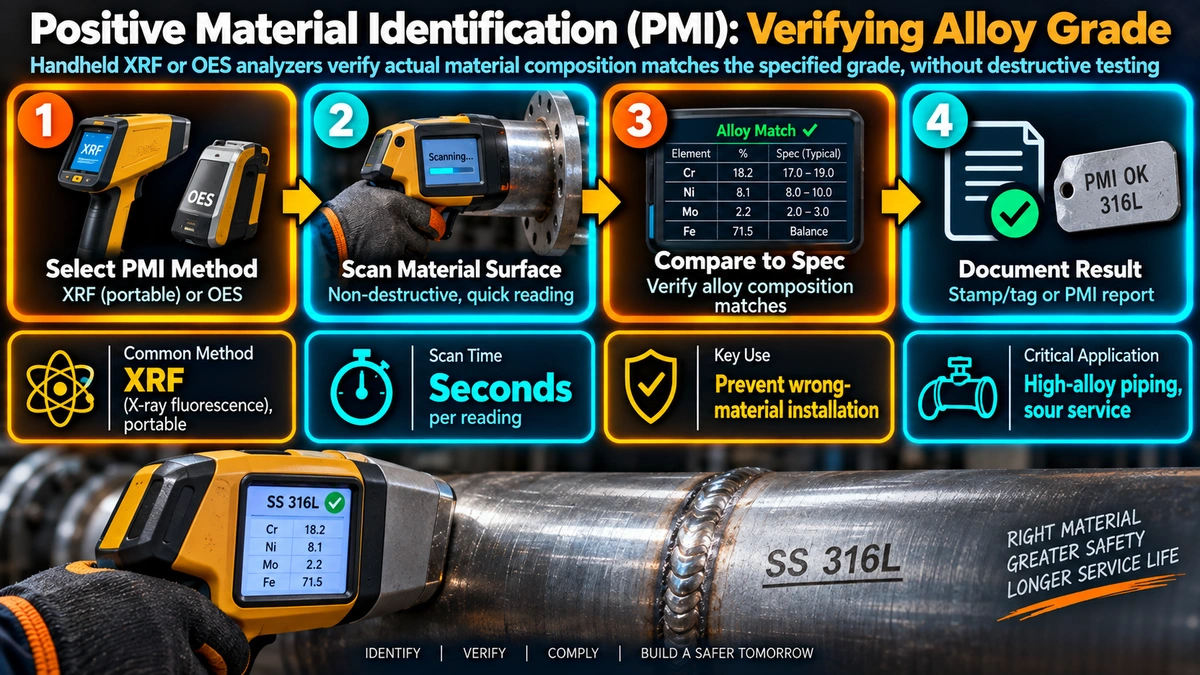
Positive Material Identification is a non-destructive, semi-quantitative test that determines the elemental composition of a metallic component and compares the result against a target alloy specification — for example, confirming that a pipe spool marked “316L” actually contains the chromium, nickel, and molybdenum levels expected of UNS S31603, and not, say, carbon steel or a lower alloy grade that has been mislabeled or accidentally substituted during fabrication or installation.
PMI is fundamentally a verification tool, not a certification tool. It answers one question reliably: “does this physical piece of metal match what it is supposed to be?” It does not replace the original chemical analysis on a Material Test Certificate, and in most quality systems it is performed in addition to, not instead of, document-based material traceability review.
Why PMI Testing Matters
Material mix-ups happen for mundane reasons: a mill mis-tags a heat, a warehouse mixes pipe spools from two different purchase orders, a fitter grabs the wrong fitting from an unmarked bin, or filler metal of the wrong alloy class is loaded into a welding machine. In carbon steel service, the consequences may be limited to reduced design margin. In alloy and corrosion-critical service, the consequences can be severe.
- Sour service: A carbon steel component substituted into NACE-governed sour service piping can crack in hydrogen sulphide environments within months.
- High-temperature creep service: Substituting a lower-alloy grade for P91 material in a steam header can lead to creep rupture far short of design life.
- Pitting and crevice corrosion resistance: A duplex or super-duplex component swapped with standard 316 stainless can fail rapidly in chloride-rich service — directly relevant to duplex stainless steel applications and tracked using the PREN calculator.
- Intergranular corrosion: Mix-ups between stabilized and non-stabilized stainless grades increase susceptibility to weld decay, normally screened using ASTM G48 pitting/crevice testing.
Industry note: Multiple major refinery incidents investigated by the U.S. Chemical Safety Board have traced root cause directly to wrong-material installation that a properly executed PMI program would have caught before commissioning. This is the single biggest driver behind mandatory 100 percent PMI clauses in modern owner specifications.
PMI Testing Methods
Two technologies dominate field PMI work: handheld X-ray fluorescence (XRF) and optical emission spectroscopy (OES), sometimes called spark-OES. A third, older method — wet chemical spot testing — is still used for rapid screening of specific elements such as molybdenum or nickel.
X-Ray Fluorescence (XRF)
An XRF analyzer fires low-energy X-rays at the test surface. Atoms in the sample absorb this energy and re-emit (fluoresce) X-rays at characteristic wavelengths specific to each element. The analyzer’s detector reads these wavelengths and intensities, then matches the resulting elemental fingerprint against a library of known alloy grades.
XRF is fast, leaves no mark on the surface, and is the dominant method for stainless steel, nickel alloy, and non-ferrous verification in the field. Its key limitation is that it cannot reliably quantify light elements — carbon, sulphur, phosphorus, and boron — because their fluorescence yield is too weak to detect through standard handheld windows.
Optical Emission Spectroscopy (OES)
An OES analyzer strikes a brief electrical spark or arc between an electrode and the test surface, vaporising a tiny amount of metal into a plasma. The plasma emits light at wavelengths specific to each excited element, which a built-in spectrometer reads and converts into elemental percentages — including carbon.
OES is the method of choice whenever carbon content is a critical acceptance parameter: distinguishing 316 from 316L, verifying carbon-restricted grades for sour service, or confirming P91/P92 chemistry where carbon, vanadium, and niobium all fall within narrow specified bands. The trade-off is a small visible burn mark and the need for a clean, flat contact surface.
Chemical Spot Testing
Spot tests use reagent drops that change colour in the presence of a specific element, most commonly used as a quick molybdenum or nickel screen to distinguish, for instance, 304 from 316 stainless before committing to a full XRF or OES reading. Spot tests are qualitative only and are typically used as a screening step, not a final acceptance record.
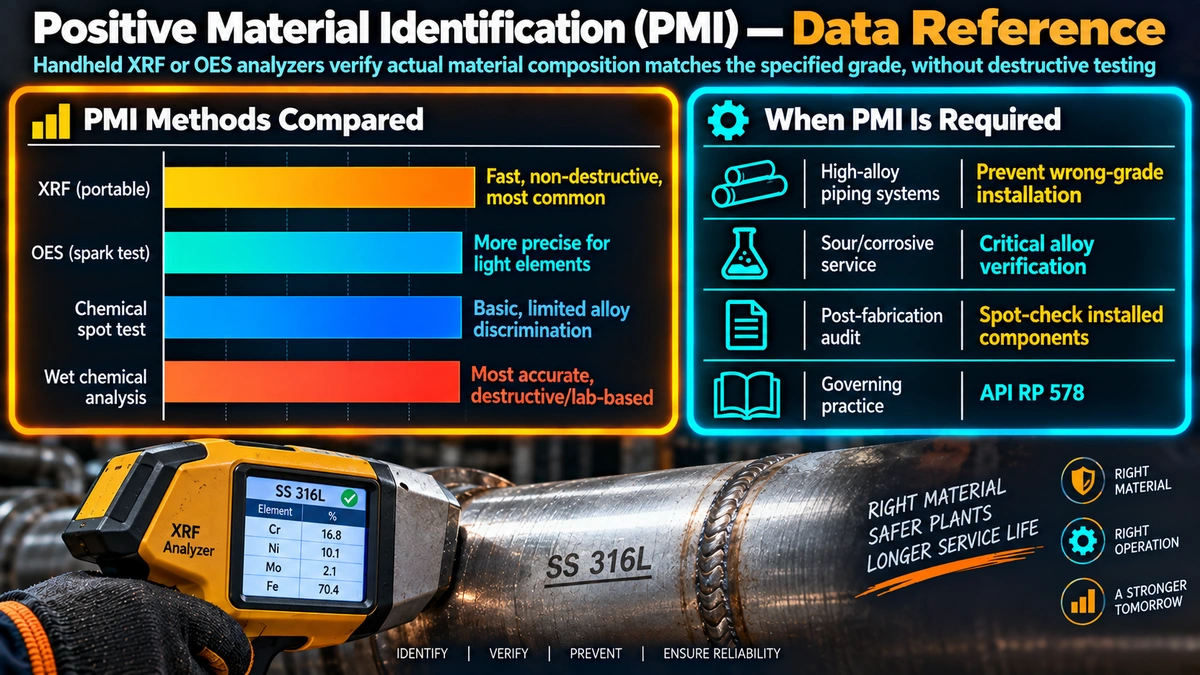
| Method | Carbon Detection | Speed | Surface Mark | Typical Use |
|---|---|---|---|---|
| XRF | No | 5-15 seconds | None | Stainless, nickel alloy, non-ferrous screening |
| OES (Spark) | Yes | 2-5 seconds | Small burn mark | Carbon-critical grades, P91/P92, low-carbon variants |
| Chemical Spot Test | No | 30-60 seconds | Minor stain | Rapid Mo/Ni screening, grade family screening |
| Lab Wet Chemistry | Yes | Hours-days | Destructive sample | Full certified chemistry, dispute resolution |
Standards and Specifications Governing PMI
API RP 578 — “Guidelines for a Material Verification Program (MVP) for New and Existing Alloy Piping Systems” is the primary risk-based framework used by refineries and petrochemical owners. It defines four Risk Categories (A through D) that set the required PMI testing percentage based on consequence of failure, and explicitly addresses sour service and high-temperature hydrogen attack risk components.
- ASTM E572 — Standard test method for OES analysis of carbon and low-alloy steel.
- ASTM E1476 — Standard test method for OES analysis of nickel, cobalt, and high-temperature alloys.
- ASTM E1085 / E1621 — Standard guides for XRF spectrometric analysis of metals and ores.
- ASME Section II Part A/C — Material specifications that define the accepted chemistry ranges PMI results are compared against, referenced throughout the P-Number, F-Number, and A-Number classification system.
- NACE MR0175 / ISO 15156 — Where sour service material restrictions apply, PMI is frequently the field verification mechanism used to confirm compliant chemistry before commissioning.
PMI Testing Procedure — Step by Step
Worked Verification Example
A fabricator receives a flange marked as ASTM A182 Grade F316L for a sour service line. The PMI inspector tests the flange face using OES, since carbon content verification is required for the “L” (low-carbon) designation.
Had the carbon reading returned 0.055 percent, the component would match standard 316 (0.08% C max) rather than the low-carbon 316L variant — a rejection that XRF alone could never have detected, since XRF cannot quantify carbon at all. This is precisely why carbon-critical and sour-service material control plans mandate OES, not XRF, as the qualifying PMI method.
Acceptance Criteria and Common Limitations
Practical tip: Always test at minimum three separate spots on critical components — base metal, weld metal, and the heat-affected zone — since filler metal chemistry can differ meaningfully from base metal even when both are nominally the same grade family.
Common Sources of Error
- Inadequate surface prep: Mill scale, paint, galvanizing, or surface oxide will skew or invalidate a reading.
- Overlapping grade families: 316 versus 317, or 321 versus 304, can show similar XRF spectra and require careful library matching or OES confirmation.
- Expired calibration: Analyzers drift over time and require documented daily calibration verification against certified reference coupons.
- Testing only one location: A single good reading on a long pipe spool does not confirm the entire length is the same heat — risk-based sampling plans define minimum test frequency per linear length.
- Confusing PMI with full chemistry: PMI readings are semi-quantitative; for contractual or metallurgical disputes, samples should be sent for certified laboratory analysis.
Documentation tip: Every PMI reading should be logged against a unique component identifier, drawing/line number, heat number where available, analyzer serial number, calibration status, operator name, and date/time — forming a traceable record that ties back into the overall material and corrosion control documentation package for the project.
Recommended Reference Material
Metallurgy for the Non-Metallurgist
Practical alloy chemistry and microstructure fundamentals for QA/QC and inspection engineers.
View on AmazonASM Metals Handbook (Alloy Phase Diagrams)
Reference-grade alloy composition and phase data used alongside PMI grade verification.
View on AmazonAPI RP 578 Material Verification Program
The governing industry document for risk-based PMI programs in alloy piping systems.
View on AmazonHandheld XRF Analyzer Calibration Coupons
Certified reference standards for daily PMI analyzer calibration verification.
View on AmazonDisclosure: WeldFabWorld participates in the Amazon Associates programme (StoreID: neha0fe8-21). If you purchase through these links, we may earn a small commission at no extra cost to you. This helps support free technical content on this site.
Frequently Asked Questions
What is PMI testing in welding and piping?
Positive Material Identification (PMI) testing is a non-destructive verification method used to confirm that a metallic component’s alloy chemistry matches its specified grade, before or after fabrication. It is most commonly performed using handheld X-ray fluorescence (XRF) or optical emission spectroscopy (OES) guns on pipes, fittings, plates, and welds to catch material mix-ups before they reach service.
Which standard governs PMI testing requirements?
API RP 578 is the primary industry standard for PMI programs in petroleum and petrochemical facilities, defining risk-based PMI levels and acceptance criteria. ASTM E572 and ASTM E1476 cover OES test methods, while ASTM E1085 and E1621 cover XRF methods. Project specifications typically reference these alongside ASME Section II Part A for chemical composition limits.
Can PMI testing detect carbon content?
Standard handheld XRF analyzers cannot reliably detect carbon, because carbon’s atomic number is too low for X-ray fluorescence to excite a usable signal. This means XRF cannot distinguish a low-carbon grade like 316L from standard 316, or confirm carbon content for P91 qualification. Optical emission spectroscopy (OES) can detect carbon and is required wherever carbon content is a critical acceptance parameter.
Is PMI testing destructive?
No. Both XRF and OES PMI methods are non-destructive in practical terms. XRF leaves no visible mark on the surface. OES spark testing leaves a small burn mark, typically a few millimetres across, which is considered acceptable on most piping and structural components but may need approval on thin-wall or high-finish surfaces.
What is the difference between PMI and a full chemical analysis?
PMI is a rapid, semi-quantitative screening test intended to confirm or reject an alloy grade against a known specification, typically completed in under a minute per location. A full chemical analysis, performed in a certified laboratory, provides quantitative results traceable to a calibrated standard and is used for original Material Test Certificates, weld procedure qualification, and dispute resolution. PMI is a verification tool, not a replacement for laboratory chemical analysis.
When is 100 percent PMI testing required?
100 percent PMI testing is typically mandated for alloy components in sour service, hydrogen service, high-temperature creep service such as P91 and P92 piping, and any application where a wrong-material failure could be safety-critical. API RP 578 Risk Category A facilities, and most owner specifications for refinery and petrochemical alloy piping, require 100 percent verification of every alloy joint, fitting, and component before final acceptance.
Can PMI testing replace a Material Test Certificate?
No. A Material Test Certificate (MTC) issued under EN 10204 or similar remains the primary traceable record of a material’s certified chemistry and mechanical properties. PMI testing is a field verification step used to confirm that the physical component on site actually matches its MTC, and is not a substitute, mix-up, or counterfeit part. Both documents are typically required together in a complete material traceability file.
What are the most common PMI testing errors?
Common PMI errors include testing on scaled, painted, or oxidised surfaces without proper grinding, using an uncalibrated or expired-calibration analyzer, misreading similar alloys with overlapping element ranges such as 316 versus 317, and failing to test heat-affected zones or filler metal separately from base metal. Surface preparation and analyzer calibration verification are the two most frequent root causes of PMI rejection or rework.