Mechanical Testing of Materials — The Complete Engineering Guide
Mechanical testing of materials is the foundation of safe and reliable engineering. Every pressure vessel, pipeline, rotating shaft, structural weld, or machine component that enters service in the oil and gas, power generation, or heavy fabrication industries has been subjected to one or more forms of mechanical testing before it is trusted to carry load, contain pressure, or transmit force. Without these tests, engineering decisions rest on assumptions. With them, they rest on evidence.
This guide covers all nine major mechanical testing methods in depth — what each test measures, how it works, what the results mean, which standards govern it, and where it is used in industry. Whether you are preparing for a CWI, CSWIP, or API inspection examination, reviewing for a materials or welding engineering role, or simply building a solid understanding of how material properties are verified, this is the reference you need.
Overview of Mechanical Test Methods
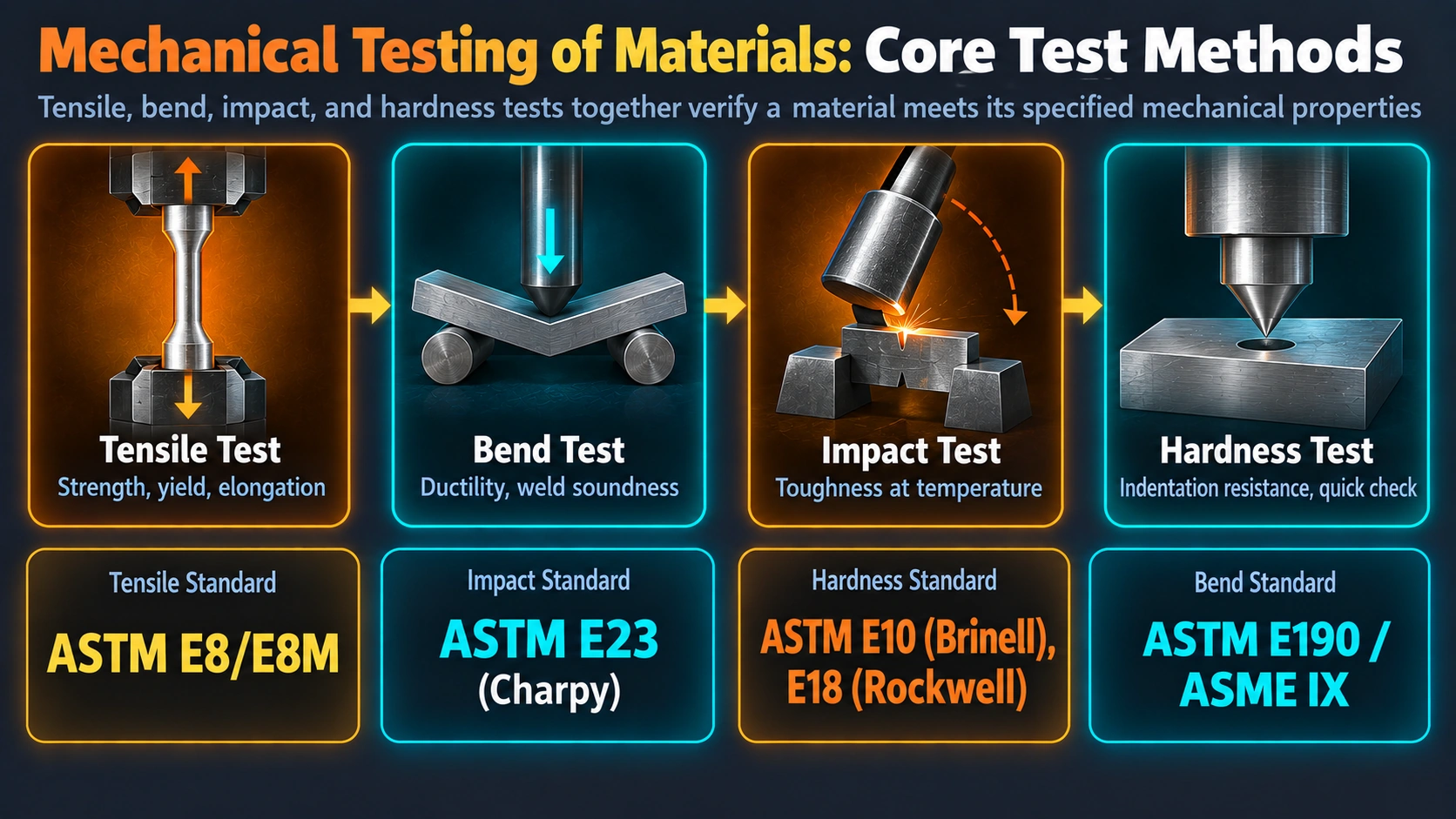
1. Tensile Test
How the Tensile Test Works
The tensile test is the most fundamental and widely specified mechanical test. A machined specimen — round or flat — is gripped at both ends in a universal testing machine and pulled in tension at a controlled rate until it fractures. The machine continuously records the applied load and the extension of a defined gauge length, and from these two measurements, the complete engineering stress-strain curve is generated.
Specimen geometry is standardised: for round specimens, a 12.7 mm diameter with a 50 mm gauge length is the ASTM standard; flat specimens have a width-to-thickness relationship governed by the product form (plate, sheet, pipe wall). The gauge length is marked on the specimen before testing and measured after fracture to calculate elongation.
Properties Measured
- Ultimate Tensile Strength (UTS): Maximum load divided by original cross-sectional area
- Yield Strength (0.2% proof stress): Stress at the onset of permanent plastic deformation
- Percentage Elongation: (Final gauge length − original gauge length) / original gauge length × 100
- Percentage Reduction in Area: (Original area − final area) / original area × 100
- Modulus of Elasticity (Young’s Modulus): Slope of the elastic portion of the stress-strain curve
Industrial Applications
- Raw material certification against ASTM A516, A106, A333 and similar specifications
- Welding procedure qualification test coupons (ASME Section IX, ISO 15614)
- Design of machine elements and structural components
- Quality control of castings, forgings, and heat-treated components
- Weld metal qualification — all-weld-metal tensile tests
Strain: ε = ΔL / L₀ (Engineering strain: extension ΔL divided by gauge length L₀)
Elastic Modulus: E = σ / ε (Valid only in the elastic region; for steel E ≈ 200 GPa)
% Elongation: A% = [(Lⁱ − L₀) / L₀] × 100
| Material | UTS (MPa) | Yield (MPa) | Elongation (%) |
|---|---|---|---|
| A516 Gr 70 (carbon steel) | 485–620 | 260 min | 17 min |
| 316L Stainless Steel | 485 min | 170 min | 40 min |
| P91 (Cr-Mo steel) | 585–760 | 415 min | 18 min |
| 6061-T6 Aluminium | 310 | 276 | 12 |
2. Hardness Test
Hardness Testing Methods
Hardness is a material’s resistance to permanent surface deformation under a localised indenting force. Unlike tensile or impact tests, hardness testing is essentially non-destructive (the indentation is very small) and extremely rapid, making it the workhorse of production quality control and post-weld inspection. Three primary hardness scales are used in engineering.
| Method | Indenter | Load Range | Measurement | Best For | Weld Use |
|---|---|---|---|---|---|
| Brinell (HB) | Hardened steel or tungsten carbide ball | 500–3000 kgf | Indentation diameter | Castings, coarse-grained materials | Limited |
| Rockwell (HR) | Diamond cone or steel ball | Minor + Major | Depth of indentation (direct readout) | Rapid production QC | Moderate |
| Vickers (HV) | Diamond pyramid (136°) | 1–100 kgf | Diagonal of indentation | Thin sections, weld HAZ, coatings | Preferred |
Hardness testing is also used to verify post-weld heat treatment (PWHT). After PWHT of alloy steels such as Cr-Mo grades, hardness traverses confirm that the tempered martensite microstructure has been achieved and that weld zone hardness has been reduced to within specification. Hardness correlates approximately with tensile strength — for carbon steel, UTS (MPa) ≈ 3.3 × HV — providing a rapid indirect verification of strength.
3. Impact Test
Charpy and Izod Impact Testing
The impact test measures the energy absorbed by a notched specimen when fractured by a single blow from a swinging pendulum. This energy, measured in Joules (J), is a direct measure of the material’s toughness — its ability to absorb energy before fracturing. The crucial importance of toughness is that it determines whether a material will fail in a ductile manner (with significant deformation and warning) or in a brittle manner (suddenly, with little deformation and no warning). For pressure vessels and pipelines in cold-climate service, brittle fracture is the dominant concern.
Charpy V-Notch Test
- Specimen: 10 mm × 10 mm × 55 mm, V-notch at mid-length
- Mounting: simply supported at both ends (horizontal)
- Pendulum strikes the specimen from behind the notch
- Result: absorbed energy in Joules; lateral expansion; % shear fracture
- Standard: ASTM E23; ISO 148-1; EN 10045
Izod Impact Test
- Specimen: 10 mm × 10 mm × 75 mm, V-notch near one end
- Mounting: clamped vertically (cantilever) at one end
- Pendulum strikes the free end above the notch
- Result: absorbed energy in Joules
- Common in plastics and general engineering comparisons
Impact testing is also the key tool for characterising the ductile-to-brittle transition temperature (DBTT). Most ferritic steels exhibit a sharp drop in absorbed energy as temperature decreases below the transition temperature. Impact tests are therefore conducted at multiple temperatures (e.g., 0°C, −20°C, −46°C) and the absorbed energy plotted against temperature to determine the DBTT and confirm compliance with the required design minimum temperature.
| Material / Application | Test Temp | Min. Absorbed Energy | Code Reference |
|---|---|---|---|
| P-No. 1 (C-steel, pressure vessel) | MDMT | 27 J (avg) / 20 J (min) | ASME VIII UG-84 |
| A333 Gr 6 (LT service pipe) | −46°C | 34 J | ASTM A333 |
| Weld metal (WPS qualification) | Per design | Per project specification | ASME IX / ISO 15614 |
| Duplex stainless steel | −20°C or MDMT | 40 J (typical) | ISO 15614-1 |
4. Bend Test
Bend Test — Ductility and Weld Soundness
The bend test is the primary test used in welding procedure qualification (PQR) to assess weld ductility and to reveal defects at or near the weld surface. A rectangular strip cut from the weld test coupon is bent over a mandrel of specified diameter. The mandrel diameter is typically 4t (where t is the specimen thickness) for carbon and low-alloy steels. The specimen must be bent through 180° without showing open discontinuities on the tensile surface exceeding 3 mm in length (ASME IX criteria).
| Bend Type | Specimen Orientation | What It Tests | When Required |
|---|---|---|---|
| Face Bend | Weld face in tension (outer) | Root fusion, surface porosity, undercut | Thinner sections (<10 mm) |
| Root Bend | Weld root in tension (outer) | Root penetration, lack of root fusion | Thinner sections (<10 mm) |
| Side Bend | Side of weld in tension | Through-thickness fusion, laminations | Thicker sections (≥10 mm) |
The bend test is particularly useful for revealing lack-of-fusion defects that can pass visual examination and even radiography but that cause the specimen to crack during bending. It is one of the most reliable indicators of weld metallurgical quality — a weld that bends cleanly through 180° without cracking has demonstrated adequate ductility and fusion throughout its cross-section.
5. Fatigue Test
Fatigue Testing — Cyclic Loading Behaviour
Fatigue failure is responsible for the majority of structural and mechanical failures in service — estimates range from 50% to 90% of all engineering failures. Fatigue occurs when a component is subjected to repeated cyclic stresses that, individually, are well below the material’s ultimate tensile strength or even its yield strength. Over time, microscopic cracks initiate at stress concentrations — notches, weld toes, surface defects, inclusions — and propagate under each cycle until the remaining cross-section can no longer support the applied load and sudden fracture occurs.
N = number of cycles to failure | S = stress amplitude | C, m = material constants
Stress Range: Δσ = σmax − σmin
Stress Ratio: R = σmin / σmax (R = −1 for fully reversed bending; R = 0 for zero-to-tension)
The S-N curve (Wöhler curve) plots stress amplitude on the vertical axis against cycles to failure on a logarithmic horizontal scale. For ferrous metals, the curve typically flattens at the endurance limit — the stress level below which the material can withstand an infinite number of cycles. For carbon steel, the endurance limit is approximately 40–50% of the UTS. Non-ferrous metals such as aluminium and copper do not exhibit a true endurance limit and continue to fail at decreasing stress as cycles increase.
6. Creep Test
Creep Testing — Elevated Temperature Behaviour
Creep is the slow, time-dependent plastic deformation of a material under sustained stress at elevated temperature. It occurs even when the applied stress is well below the material’s room-temperature yield strength. For most engineering metals, creep becomes significant above a homologous temperature (T/Tmelt) of approximately 0.3–0.4 — which for carbon steel corresponds to roughly 370–450°C, and for nickel superalloys extends to 900°C and beyond.
Time-dependent behaviour is measured with the creep rupture test method in ASTM E139 and ISO 204.A creep test applies a constant tensile load to a specimen held at a constant elevated temperature in a controlled furnace. The elongation of the specimen is measured continuously over time — typically weeks or months. The resulting creep curve shows three distinct stages:
- Primary creep (transient): Initial rapid deformation that decelerates as the material work-hardens
- Secondary creep (steady-state): Constant minimum creep rate where work hardening and recovery are in balance — the most important region for engineering design
- Tertiary creep: Accelerating deformation due to void formation, grain boundary cracking, and neck formation, culminating in creep rupture
7. Wear Test
Wear Testing — Surface Material Loss
Wear is the progressive material loss from a solid surface as a result of relative motion against another surface or medium. It is the dominant failure mode for cutting tools, bearings, gears, pump impellers, valve seats, and any component in sliding or rolling contact. The wear test quantifies the rate at which material is removed from a specimen under controlled contact conditions.
| Wear Type | Mechanism | Test Method | Typical Applications |
|---|---|---|---|
| Abrasive Wear | Hard particles or asperities plough through softer surface | ASTM G65 (dry sand/rubber wheel) | Pump casings, pipe bends, dredging equipment |
| Adhesive Wear | Material transfer between sliding surfaces — welding and shearing of asperities | ASTM G99 (pin-on-disk) | Gears, bearings, cutting tools |
| Erosive Wear | Impact of solid particles or liquid droplets on surface | ASTM G76 | Turbine blades, impellers, flue gas ducts |
| Fretting Wear | Small-amplitude oscillatory motion between contacting surfaces | ASTM G204 | Bolted flanges, press-fitted components |
The standard pin-on-disk test (ASTM G99) uses a stationary pin pressed against a rotating disk under a controlled normal load. The wear rate is expressed as volume loss per unit sliding distance (mm3/m). Surface coatings applied by GTAW or thermal spray are routinely evaluated using wear tests to confirm that the hardface deposit will perform adequately in service.
8. Fracture Toughness Test
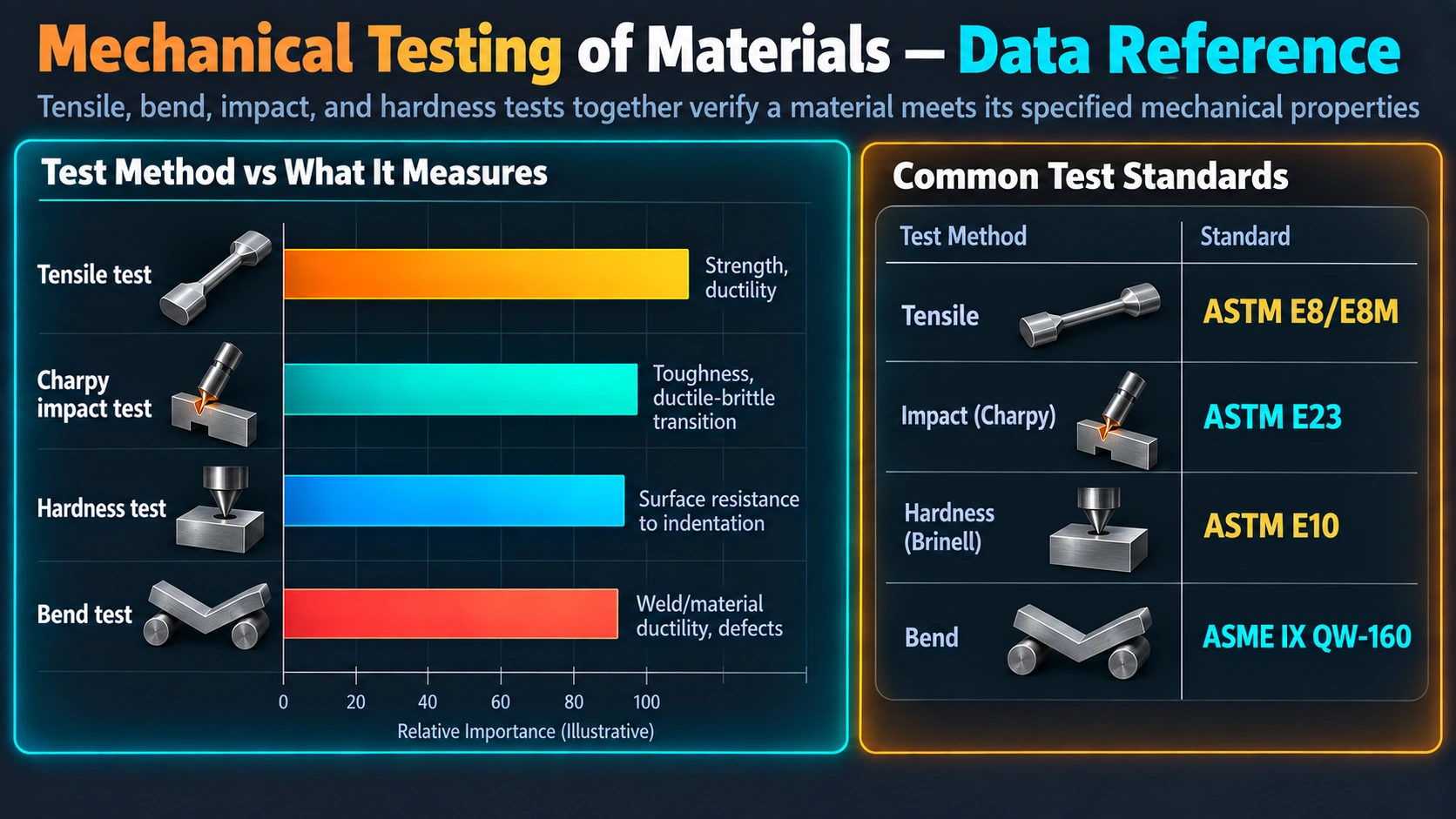
Fracture Toughness — Crack Resistance (KIc)
Fracture toughness quantifies a material’s ability to resist crack propagation when a pre-existing crack is present. Classical strength-based design assumes defect-free material. Fracture mechanics acknowledges that all real engineering components contain some cracks or crack-like defects — from weld discontinuities to material inclusions — and asks: how large can a crack be before it becomes unstable and propagates catastrophically?
The plane-strain fracture toughness KIc is measured by loading a pre-cracked specimen (compact tension or three-point bend geometry) and recording the stress intensity at the onset of crack extension. KIc is the critical value of the stress intensity factor KI in mode I (opening) loading under plane strain conditions.
Y = geometry factor | σ = applied stress | a = crack half-length
Fracture when: KI ≥ KIc
Units: MPa√m
9. Shear Test
Shear Testing — Resistance to Shear Forces
The shear test measures a material’s resistance to forces applied parallel and opposite to the cross-section being tested — forces that try to cause one part to slide relative to an adjacent part. Shear strength is distinct from tensile strength: for ductile metals, shear strength is approximately 0.6 × tensile strength (Von Mises yield criterion), while for brittle materials, shear strength can equal or exceed tensile strength.
Shear testing is critical for evaluating fasteners (bolts, rivets), welded connections, adhesive bonds, and composite material layers. In welding, lap joint and fillet weld shear tests confirm the weld throat strength. In structural engineering, the design of fillet welds under shear loading uses the shear strength of the weld metal deposited, which must meet minimum values specified in ASME Section IX or AWS D1.1.
Mechanical Tests — Master Reference Table
| Test | Property Measured | Specimen Type | Key Standard | Code Requirement | Industry Use |
|---|---|---|---|---|---|
| Tensile | UTS, Yield, Elongation, RA, E | Round / Flat | ASTM E8 / ISO 6892 | ASME IX QW-150 | Universal |
| Hardness (Vickers) | Surface resistance to indentation (HV) | Block / Polished weld section | ASTM E92 / ISO 6507 | ISO 15614, NACE MR0175 | Universal |
| Charpy Impact | Absorbed energy (J), DBTT | 10×10×55 mm V-notch | ASTM E23 / ISO 148 | ASME VIII UG-84 | LT service |
| Bend | Ductility, fusion quality | Rectangular strip | ASTM E290 / ISO 5173 | ASME IX QW-160 | Welding PQR |
| Fatigue | Endurance limit, S-N curve | Round hourglass | ASTM E466 / ISO 1099 | BS 7608, IIW | Cyclic service |
| Creep | Creep rate, rupture strength | Round bar (in furnace) | ASTM E139 / ISO 204 | ASME allowable stress | High temp |
| Wear | Volume loss, wear rate | Pin / Disk / Block | ASTM G99 / G65 | Project specification | Sliding contact |
| Fracture Toughness | KIc (MPa√m) | CT or 3PB, pre-cracked | ASTM E399 / BS 7448 | API 579 FFS | Critical vessels |
| Shear | Shear strength | Lap joint / Notched | ASTM B831 / ISO 14129 | AWS D1.1, ASME VIII | Fasteners/welds |
Mechanical Properties and Which Test Measures Them
| Property | Determined By | Key Parameter |
|---|---|---|
| Tensile Strength (UTS) | Tensile Test | Max load / original area |
| Yield Strength | Tensile Test | 0.2% proof stress or proportional limit |
| Ductility | Tensile Test, Bend Test | % Elongation, % RA, bend angle |
| Hardness | Brinell / Rockwell / Vickers Test | HB, HR, HV value |
| Toughness | Impact Test (Charpy / Izod) | Absorbed energy in Joules |
| Flexural Strength | Bend Test | Modulus of rupture |
| Fatigue Strength | Fatigue Test | Endurance limit / S-N curve |
| Creep Resistance | Creep Test | Minimum creep rate (secondary stage) |
| Wear Resistance | Wear Test | Volume loss per unit sliding distance |
| Fracture Toughness | Fracture Toughness Test | KIc in MPa√m |
| Shear Strength | Shear Test | Shear load / shear area |
Testing Requirements by Industry
Mechanical testing requirements vary by industry and regulatory framework, but the principle is consistent: every material and welded joint in safety-critical service must be verified by testing. The following table summarises the primary tests mandated or strongly recommended in each major industrial sector.
| Industry | Primary Tests Required | Governing Codes |
|---|---|---|
| Oil & Gas (pressure vessels) | Tensile, Charpy, Hardness, Bend, Fracture Toughness | ASME VIII, API 6A, NACE MR0175 |
| Power Generation | Tensile, Creep, Hardness, Charpy, Fatigue | ASME I, ASME II, EN 10216 |
| Structural Fabrication | Tensile, Charpy, Hardness, Bend | AWS D1.1, EN 1090, ISO 15614 |
| Pipelines | Tensile, Charpy, Hardness, Bend, CTOD | ASME B31.3/B31.8, API 1104, DNV OS-F101 |
| Aerospace | Tensile, Fatigue, Fracture Toughness, Creep | MIL-STD, AS9100, ASTM series |
| Nuclear | Tensile, Charpy, Hardness, Bend, Fracture Toughness | ASME III, 10 CFR 50 Appendix G |
Recommended Technical References
Frequently Asked Questions
What is the difference between the Charpy and Izod impact tests?
Both are pendulum-based impact tests using a V-notched specimen, but they differ in specimen mounting and orientation. In the Charpy test, the specimen is simply supported at both ends horizontally and the pendulum strikes the centre from behind the notch. In the Izod test, the specimen is clamped vertically at one end and the pendulum strikes the free end above the notch.
Charpy is the dominant test in pressure vessel and piping codes such as ASME BPVC and EN standards. Izod is more common in plastics testing and general engineering material comparison. In welding inspection and PQR work, Charpy V-notch (CVN) is almost universally specified.
What mechanical properties are measured by the tensile test?
The tensile test measures: Ultimate Tensile Strength (UTS), Yield Strength (0.2% proof stress), Percentage Elongation (ductility), Percentage Reduction in Area (combined indicator of ductility and toughness), and Modulus of Elasticity (from the slope of the elastic region of the stress-strain curve). These are the five core properties reported on a material test report (MTR / mill certificate).
All-weld-metal tensile tests are also required in welding procedure qualification to confirm that the deposited weld metal meets the mechanical property requirements of the applicable material specification.
Why is impact testing important for welding inspection?
Impact testing is critical for welding because the heat-affected zone (HAZ) and weld metal can exhibit a significant reduction in toughness compared to the parent material. Low toughness causes brittle fracture at sub-ambient temperatures or under dynamic loading. ASME BPVC Section VIII requires Charpy impact testing for low-temperature service under UG-84, with minimum absorbed energy requirements that both the weld metal and HAZ must satisfy.
The test is conducted at the minimum design metal temperature (MDMT). Specimens from the weld metal and HAZ of the qualification test coupon must both meet the specified minimum values to qualify the welding procedure.
What is the difference between Brinell, Rockwell, and Vickers hardness tests?
Brinell (HB) uses a hardened steel or carbide ball indenter with a load of 500–3000 kgf and measures the diameter of the indentation. It is suited to coarse-grained materials, castings, and forgings but leaves a large indentation. Rockwell (HR) measures indentation depth directly, providing a fast readout suitable for production-line QC. Vickers (HV) uses a diamond pyramid indenter and measures the diagonal of a small indentation.
In welding and fabrication, Vickers hardness (typically HV10) is specified because it can be applied precisely to thin HAZ regions, weld metal, and individual microstructural zones. Maximum weld hardness in sour service is 250 HV10 per NACE MR0175 / ISO 15156.
What does the S-N curve represent in fatigue testing?
The S-N curve (Wöhler curve) plots applied cyclic stress amplitude (S) against the number of cycles to failure (N on a log scale). It shows how fatigue life decreases as stress amplitude increases. For ferrous materials, the curve flattens at the endurance limit — the stress below which fatigue failure will not occur regardless of the number of cycles.
Welded joints have significantly lower S-N curves than parent material because of geometric stress concentrations at weld toes, tensile residual stresses, and weld defects. Design standards such as BS 7608 and IIW fatigue recommendations provide S-N curves for different weld detail categories that engineers use for fatigue-life calculations.
What is fracture toughness K_Ic and why does it matter?
Fracture toughness KIc is the plane-strain stress intensity factor at which a pre-existing crack will propagate unstably. It is measured in MPa√m. A high KIc means a material can tolerate a larger crack at a given stress before fracture — austenitic stainless steels typically have KIc > 150 MPa√m, while high-strength pressure vessel steels may be 50–80 MPa√m.
Fracture toughness is the key input for fitness-for-service (FFS) assessments per API 579, where the question is whether a known weld flaw or corrosion damage can remain in service. Without KIc data, FFS assessments must use conservative assumed values, which can lead to unnecessary shutdowns or repairs.
When is creep testing required in industrial fabrication?
Creep testing is required when materials will operate at elevated temperatures under sustained stress — typically above 30% of the melting point in absolute temperature. In practice, this means creep data are needed for power plant boilers and piping above approximately 370–400°C for carbon steel, and above 540–600°C for advanced Cr-Mo steels like P91.
ASME allowable stress tables for high-temperature service (above the temperature where creep governs) are based on fractions of the 100,000-hour creep rupture strength. Correct PWHT of P91 is therefore critical not just for hardness compliance but to preserve the creep resistance of the tempered martensitic microstructure.
What is the purpose of the bend test in weld procedure qualification?
The bend test in welding procedure qualification (PQR) assesses weld ductility and reveals surface and near-surface defects such as lack of fusion, porosity, and HAZ cracking that may not be visible on radiograph. Per ASME Section IX QW-160, specimens are bent through 180° over a mandrel of diameter 4t. Open discontinuities greater than 3 mm on the tensile surface are cause for rejection.
Side bend tests (for material ≥ 10 mm) are particularly sensitive to through-thickness lack of fusion and lamellar defects in the base material. A clean 180° side bend is one of the strongest possible demonstrations of weld quality and ductility.