ASME Section IX — Part QG: General Requirements Complete Training Guide
ASME Boiler and Pressure Vessel Code (BPVC) Section IX governs the qualification of welders, welding operators, brazers, brazing operators, and plastic fusing operators — as well as the material-joining procedures they follow. Part QG (General Requirements) is the foundational section that applies across all joining processes. Understanding QG is essential before studying any process-specific Part (QW, QB, or QF). This guide covers every QG clause in depth, followed by a timed 10-question knowledge-check quiz and a full feedback form at the bottom.
Contents — Jump to Any Section
Scope & Structure of Section IX
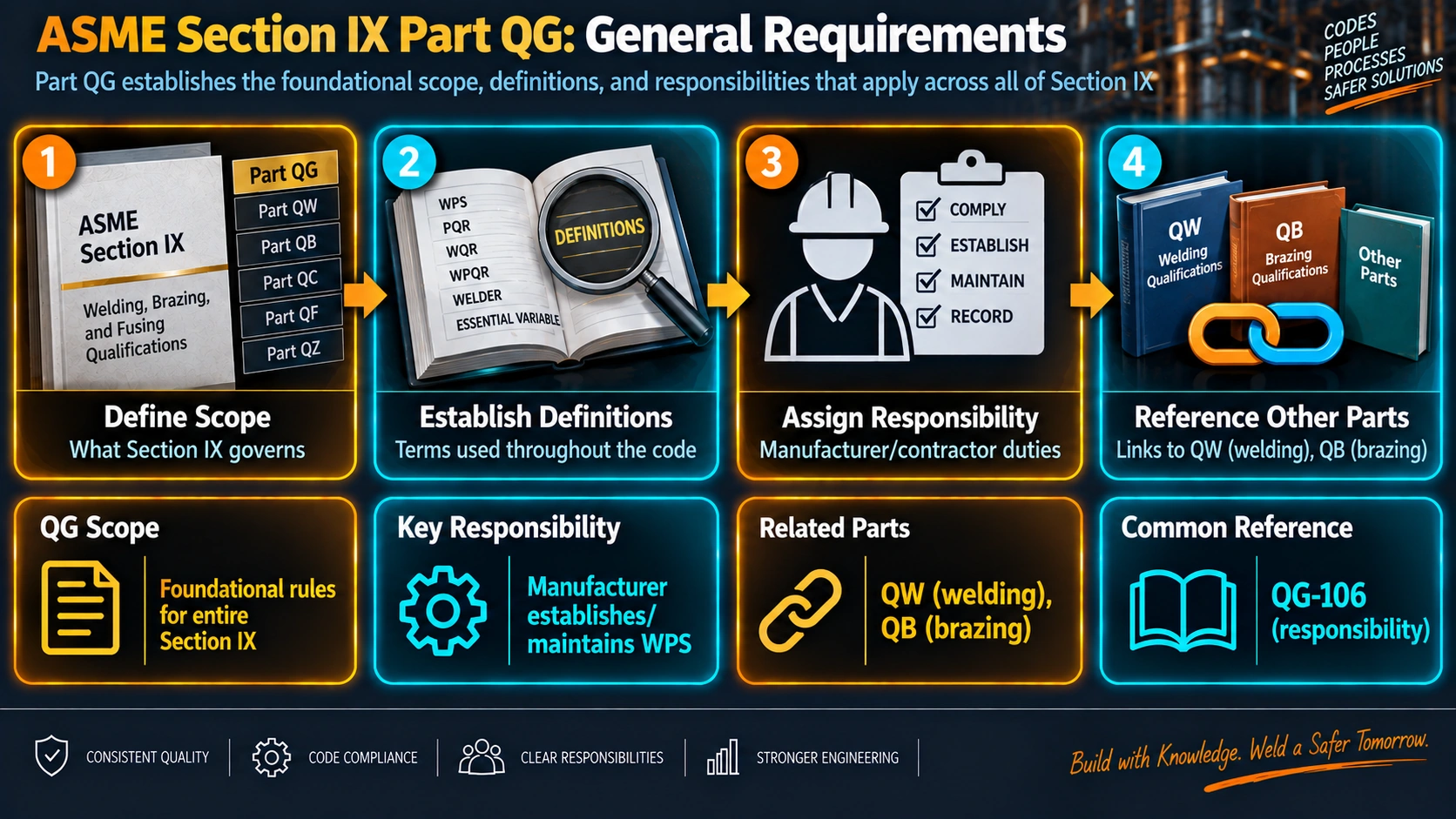
QG-100 — What Part QG governs and why it matters for all joining processes
ASME Section IX is not a design code — it is a qualification code. It tells manufacturers and contractors how to prove that their welding procedures produce joints with the required mechanical properties, and how to demonstrate that their welders and operators have the skill to execute those procedures correctly. It applies wherever a referencing Code (ASME Section VIII, ASME B31.1, ASME B31.3, and others) mandates compliance with Section IX.
Processes Covered
Qualification of welders, welding operators, brazers, brazing operators, and plastic fusing operators, plus the material-joining processes they use. Applies to components built under ASME BPVC, ASME B31 Pressure Piping Codes, and other referencing Codes.
Authority Hierarchy QG-100(b)
When a referencing Code (e.g., ASME B31.3) imposes qualification requirements different from Section IX, the referencing Code’s requirements take precedence. Section IX provides the baseline — referencing Codes may impose additional or more restrictive requirements.
| Part | Name | Scope |
|---|---|---|
| QG | General Requirements | All material-joining processes — foundational rules applicable everywhere |
| QW | Welding | All welding processes: SMAW, GTAW, GMAW, SAW, FCAW, EBW, LBW, etc. |
| QB | Brazing | Torch, furnace, induction, dip brazing, and other brazing processes |
| QF | Plastic Fusing | Butt fusion, electrofusion, sidewall fusion of PE pipe and fittings |
Edition Applicability QG-100(d)
- New editions may be used from the date of issuance — immediately on publication
- New editions become mandatory 6 months after issuance — organisations must comply
- All new qualifications must follow the current edition requirements
Code Cases
- Permitted from the date of ASME approval
- Only the latest revision of a Code Case may be applied
- Qualifications made under an annulled Code Case remain valid
- The Code Case number must be recorded on all qualification records referencing it
Section Summary — Key Takeaways
- Section IX covers welders, welding operators, brazers, brazing operators, and fusing operators — not just welders.
- When a referencing Code conflicts with Section IX, the referencing Code takes precedence QG-100(b).
- Four Parts: QG (general), QW (welding), QB (brazing), QF (plastic fusing).
- New editions may be used immediately but are not mandatory until 6 months after issuance.
- Code Cases must use only the latest revision; qualifications under an annulled Code Case remain valid.
What the PQR Demonstrates
The PQR proves that the joining process is capable of producing joints with the required mechanical properties. It is a demonstration of the process — NOT of the individual welder’s or operator’s skill. A welder who excels can pass performance qualification even with a borderline process, and vice versa.
Minimum PQR Content
- Essential procedure qualification test variables
- Supplementary essential variables (when toughness testing is required)
- Results of all required mechanical tests
- Organisation certification — signature or equivalent per quality programme
A single PQR may be used to support one or more procedure specifications. Conversely, a single procedure specification may be supported by one or more PQRs. There is no one-to-one constraint between these documents.
Availability: PQRs shall be available for review at all times — the AI may request them during any production inspection.
Certification: The organisation certifies the PQR by signature or other means described in the quality programme.
Section Summary — Key Takeaways
- The WPS/BPS/FPS is the instruction document for the joining process — available at the fabrication site at all times.
- The PQR proves the process works — it is NOT a measure of the welder’s individual skill.
- A WPS must be qualified by the organisation that uses it, or be an approved SWPS/SFPS.
- Changing a nonessential variable requires no requalification; changing an essential variable requires requalification.
- One PQR can support multiple WPS; one WPS can be supported by multiple PQRs.
Purpose of Performance Qualification
To demonstrate the person’s ability to produce a sound joint using a qualified procedure specification. Performance qualification complements — but is entirely distinct from — procedure qualification. The procedure proves the process; performance proves the person.
Dual Qualification QG-106.1(e)
When a procedure qualification test coupon is tested and found acceptable, the person who prepared it is simultaneously performance-qualified within the ranges specified by the applicable Part — without a separate performance test being required.
Minimum Required Content of the WPQ
- Essential variables for each joining process used
- Ranges of variables qualified (per QW-301.4, QB-301.4, or QF-301.4)
- Results of required testing and non-destructive examinations
- Identification of the procedure specification(s) followed during the qualification test
- Organisation statement that the test was conducted per Section IX requirements
- Certification by signature or equivalent per the quality programme
Conditions in which a change affects the mechanical properties (other than toughness) of the weld joint.
Consequence of change: The procedure specification must be requalified before use — a new PQR or additional qualification testing is required.
Conditions in which a change affects the person’s ability to produce a sound joint.
Consequence of change: The individual welder or operator must be retested and requalified for that specific changed variable.
Conditions in which a change affects toughness properties of the weld joint or HAZ.
Activation: These variables become applicable only when the referencing Code requires toughness testing (e.g., Charpy impact testing) for procedure qualification. When toughness testing is not required, supplementary essential variables are not applicable — changes to them do not require requalification.
Conditions in which a change is not considered to affect mechanical properties of the weld joint.
Must still be addressed (documented) in the procedure specification, but no requalification is required if changed — only the WPS document needs to be updated.
| Variable Type | Affects | Activated by Toughness Req.? | Change Consequence |
|---|---|---|---|
| Essential — Procedure | Mechanical properties (non-toughness) | N/A — always applicable | Requalification of procedure (new PQR) |
| Essential — Performance | Person’s ability to produce sound joint | N/A — always applicable | Individual must be retested |
| Supplementary Essential | Toughness properties | Yes — only active when required | Requalification of procedure (new PQR) |
| Nonessential | Does not affect mechanical properties | N/A | WPS update only — no requalification |
Section Summary — Key Takeaways
- Performance qualification proves the person’s skill; procedure qualification proves process capability — both are required independently.
- When a procedure test coupon passes, the welder who made it is simultaneously performance-qualified within applicable ranges QG-106.1(e).
- Essential variables (procedure) — any change triggers full WPS requalification.
- Essential variables (performance) — any change requires the individual to be retested.
- Supplementary essential variables activate only when the referencing Code mandates toughness testing.
- Nonessential variables must appear in the WPS but changes do not trigger requalification.
Qualifying Organisation Supervisors Must:
- Be formally designated by the organisation with responsibility for supervision, control, evaluation, and acceptance of qualification testing
- Have documented competence in: (1) Section IX requirements; (2) the organisation’s quality programme; and (3) the scope and nature of activities being overseen
- Have a maintained record containing objective evidence of their qualifications, training, or experience
Organisation’s Obligation
Each organisation is responsible for conducting its own procedure qualification tests for the processes it uses. Personnel producing test joints must be under the full supervision and control of the qualifying organisation.
Delegation Limits
Production of qualification test joints under the supervision of another organisation is NOT permitted (except under QG-106.4 simultaneous qualifications). Subcontracting specimen preparation, NDE, and mechanical testing is allowed — but the qualifying organisation retains full responsibility for results.
Organisations may form an association to collectively qualify individuals and share performance qualification records. This is common on large construction sites where multiple contractors employ the same trade labour pool. Key rules:
- Each participating organisation must be represented by a designated employee during the qualification testing
- Essential variables of the procedure specifications used must be identical across all participating organisations, or a single agreed-upon WPS must be reviewed by all
- When a person changes employers within the association, the new employer must verify continuity of qualifications before that person welds production welds
- If an individual’s qualifications are revoked, the employing organisation must notify all other participating organisations in the association immediately
Permitted only when expressly allowed by the referencing code, standard, or specification. Requirements when permitted:
- Each participating organisation accepts full responsibility for the qualification
- Test coupon joining is conducted under simultaneous supervision of all organisations’ representatives
- The PQR must document that it was conducted under QG-106.4 provisions
- The PQR must be certified separately by each participating organisation per QG-102
Section Summary — Key Takeaways
- Supervisors of qualification testing must be formally designated with documented competence in Section IX and the quality programme.
- Subcontracting NDE and mechanical testing is allowed for procedure qualification — but full responsibility stays with the qualifying organisation.
- Performance qualification supervision cannot be delegated to another organisation — QG-106.2 is absolute.
- Simultaneous performance qualification associations allow employers to share records — each must verify continuity when a person changes employer.
- Simultaneous procedure qualification (QG-106.4) requires express permission from the referencing code.
General Rule
Organisations may maintain effective operational control of PQRs, procedure specifications, and performance qualification records under different ownership. Multiple companies under a common ownership may use qualification records under that owner’s name.
When an Organisation Is Acquired
PQRs, WPS, and performance records may remain valid without requalification — provided ALL THREE conditions below are met simultaneously. Failing any one condition requires requalification.
| Situation | Code Requirement |
|---|---|
| Procedure and performance qualifications made under earlier editions | May be used for any construction for which the current edition is specified — no amendment required. Old qualifications are grandfathered. |
| Using an existing PQR to support a new WPS written to a later edition | Permitted — provided the essential and supplementary essential variables of the later edition were documented in the existing PQR at time of qualification. |
| All new qualifications (procedure or performance) | Must be in accordance with the current edition of Section IX — no grandfathering for new work. |
Section Summary — Key Takeaways
- When a company is acquired, existing qualifications remain valid without retesting — if all three QG-107 conditions are satisfied.
- Three conditions: (A) new owner accepts responsibility, (B) WPS updated with new owner’s name before use, (C) quality programme documents original source.
- Qualifications from earlier editions remain valid for current construction without amendment QG-108.
- An existing PQR can support a WPS under a later edition — only if that edition’s essential variables were already recorded in the original PQR.
- All new qualifications must comply with the current edition — old records are grandfathered, new work is not.
Key Definitions — QG-109
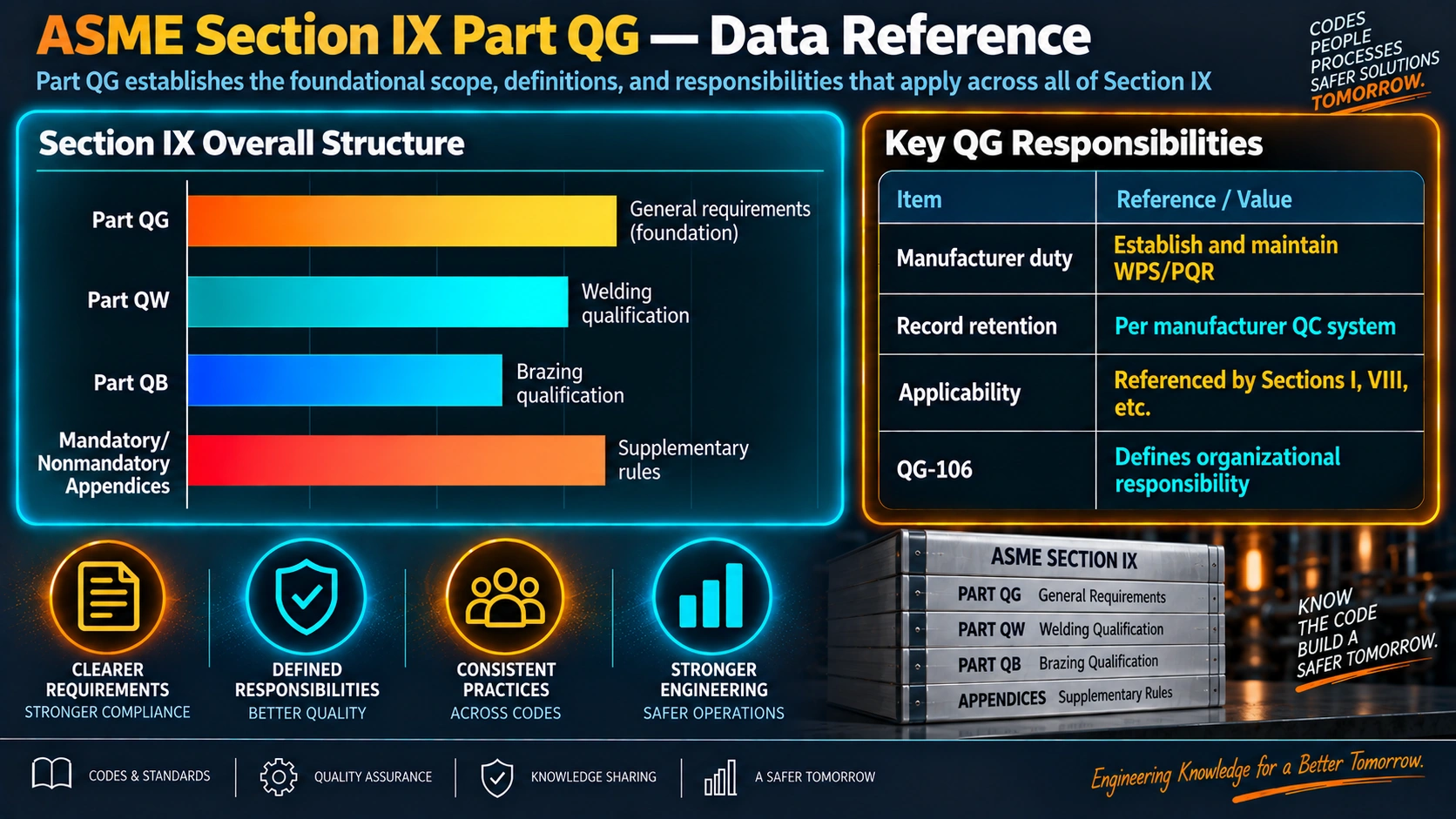
Selected terms critical to understanding Part QG and all material-joining processes
Section Summary — Key Takeaways
- A Welder performs manual/semiautomatic welding; a Welding Operator operates machine/automatic equipment — these are distinct roles with different qualification requirements.
- A Test Coupon is the whole assembly; a Test Specimen is a sample cut from it for one specific test.
- The HAZ has not melted — its properties have changed due to heat, but it is not weld metal. Do not confuse HAZ with weld metal.
- A Discontinuity is not inherently rejectable; it becomes a Defect only when it fails to meet minimum acceptance criteria.
- Always use QG-109 definitions when working under Section IX — they may differ from AWS A3.0.
Recommended References for ASME Section IX Study
Timed Knowledge Check
Test your understanding of ASME Section IX — Part QG General Requirements
Each question auto-advances if not answered within 20 seconds
✓ Feedback Submitted
Thank you! Your feedback has been recorded.