Galvanized Steel Welding Hazards and Best Practices
Galvanized steel welding hazards center on one specific problem that does not exist with bare steel: the zinc coating vaporizes long before the base metal melts, releasing zinc oxide fume directly into the welder’s breathing zone. This single fact drives almost every recommendation in this guide, from ventilation design to joint preparation to respirator selection. Fabricators who treat galvanized steel like ordinary mild steel, without adjusting technique or exposure controls, are the ones who end up with zinc fume fever, porous welds, and repeat rework.
This guide covers the fume chemistry behind galvanized welding hazards, the exposure limits that apply, ventilation and respiratory protection strategies, coating removal best practices, and process-by-process technique adjustments for GMAW, SMAW, GTAW, and FCAW on galvanized base metal. It closes with a practical PPE and controls checklist that shop supervisors can use to set up a safe galvanized welding station.
None of the hazards described here are exotic or hard to control. Zinc fume exposure is well understood, well documented in occupational health literature, and manageable with standard industrial hygiene controls. The problems arise almost entirely from skipping ventilation, skipping coating removal, or assuming galvanized steel welds exactly like uncoated steel.
Why Galvanized Steel Welding Is Different
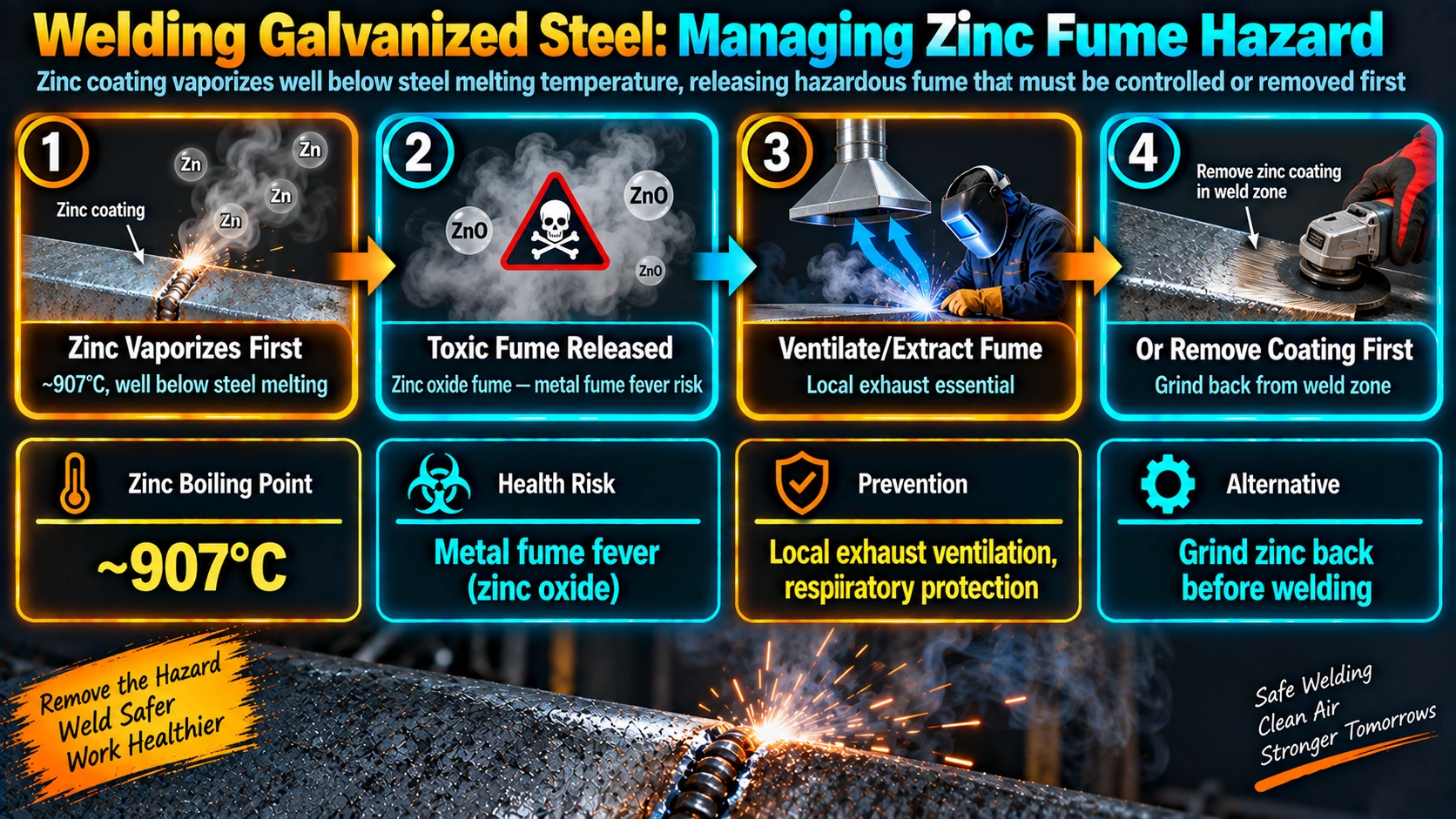
Hot-dip galvanizing applies a zinc coating, typically 45 to 100 microns thick, metallurgically bonded to the steel surface for corrosion protection. Zinc has a boiling point of roughly 1665 F (907 C), far below the melting point of steel at approximately 2500 to 2800 F (1370 to 1540 C) depending on alloy content. When the welding arc approaches the joint, the zinc coating vaporizes well before the base metal reaches fusion temperature, and the zinc vapor immediately reacts with atmospheric oxygen to form zinc oxide fume, a very fine white particulate that rises directly through the arc plume into the welder’s breathing zone.
| Property | Zinc Coating | Steel Base Metal | Practical Implication |
|---|---|---|---|
| Melting point | 787 F (419 C) | ~2500-2800 F (1370-1540 C) | Zinc melts almost instantly as the arc approaches |
| Boiling point | 1665 F (907 C) | N/A at welding temperatures | Zinc vaporizes well before steel reaches fusion temperature |
| Vapor behavior | Rapid oxidation to ZnO fume | N/A | Visible dense white fume forms directly above the arc |
| Typical coating thickness | 45-100 microns (hot-dip) | N/A | Thicker coatings generate proportionally more fume |
Zinc Fume Health Effects
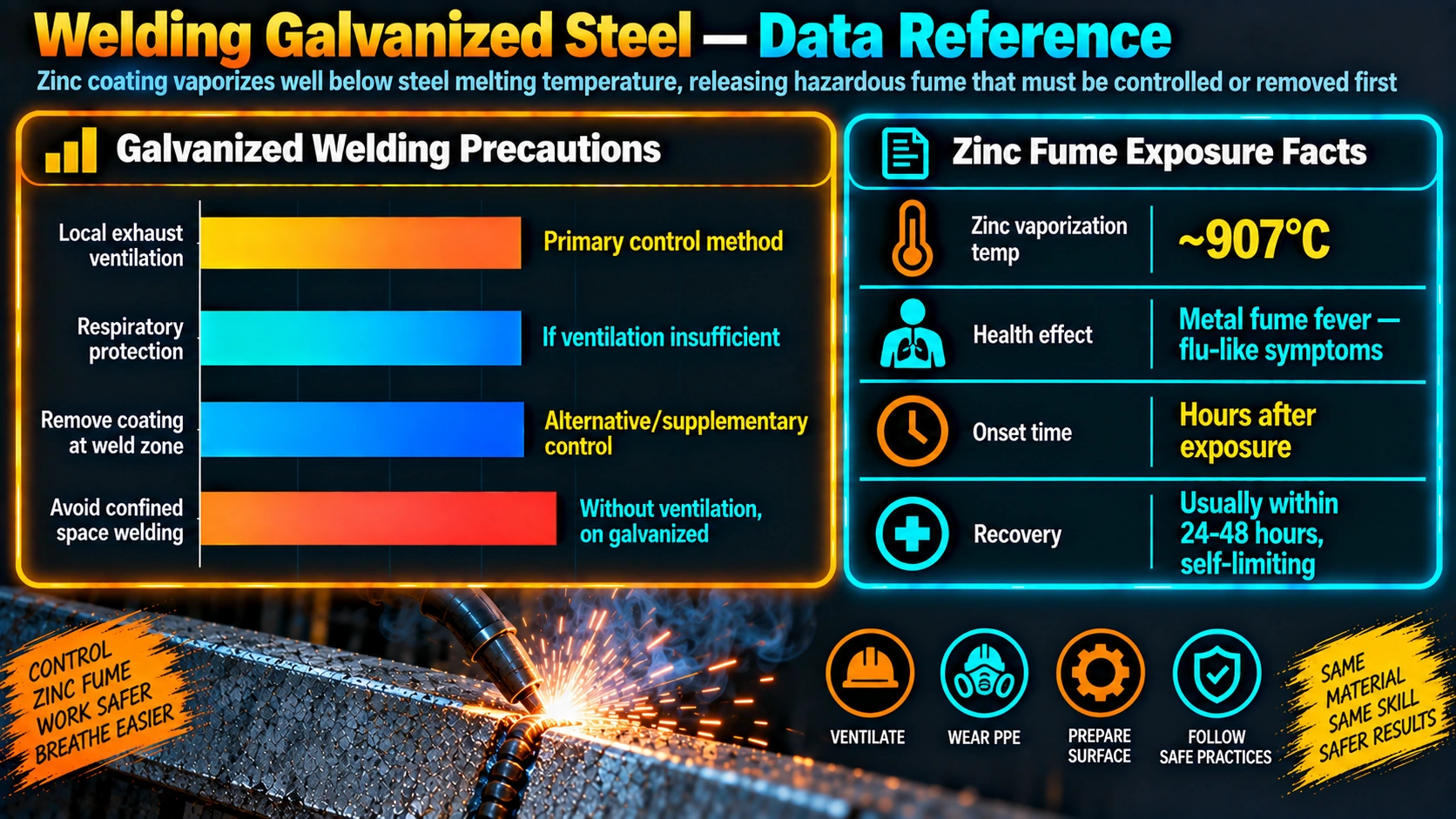
The primary acute health effect associated with galvanized steel welding is metal fume fever, commonly called zinc fume fever or “the zinc shakes” in shop terminology. It is caused by inhaling freshly formed, very fine zinc oxide particulate, and it is a well-documented, self-limiting occupational illness rather than a chronic disease, though it should still be actively prevented.
| Symptom Stage | Onset After Exposure | Typical Symptoms | Duration |
|---|---|---|---|
| Early | 1-3 hours | Metallic or sweet taste, throat dryness, mild cough | Transient |
| Acute | 3-10 hours | Fever, chills, headache, muscle aches, fatigue | 6-24 hours |
| Resolution | 24-48 hours | Symptoms subside without treatment in most cases | Self-limiting |
Occupational Exposure Limits
Zinc oxide fume exposure is regulated and guidance-limited by multiple bodies. OSHA maintains a permissible exposure limit (PEL) for zinc oxide fume, and ACGIH publishes threshold limit values (TLV) that are frequently used by industrial hygienists as a more current reference point. Fabrication shops should verify current limits with their local regulatory authority and safety data sheets, since exposure limits are periodically revised.
Ventilation and Fume Extraction
Local exhaust ventilation (LEV) positioned as close as practical to the arc is the single most effective engineering control for galvanized welding fume, far more effective than general room ventilation or dilution fans alone, because zinc oxide particulate is extremely fine and disperses quickly once it leaves the immediate source zone.
Coating Removal at the Joint
Removing the galvanized coating from the immediate joint area before welding reduces fume generation, porosity, and spatter, and is recommended practice wherever the finished part will still receive touch-up cold galvanizing compound or paint after welding.
Process-by-Process Technique Notes
| Process | Technique Adjustment | Fume Level | Notes |
|---|---|---|---|
| GMAW (MIG) | Slightly extended arc length, moderate travel speed to allow zinc to burn off ahead of the puddle | Moderate | Most common process for galvanized structural and automotive work |
| SMAW (Stick) | Slightly higher amperage, weave technique to allow zinc vapor to escape | High | Common in field repair; requires strong local ventilation |
| GTAW (TIG) | Lower heat input, careful puddle control; coating removal strongly recommended | Moderate | Best porosity control of the common processes, but slower |
| FCAW | Similar to GMAW; self-shielded flux formulations tolerate some residual zinc better | Moderate | Common on heavier structural galvanized sections |
Regardless of process, reviewing fundamentals in the GMAW guide, SMAW guide, and GTAW guide helps establish baseline parameters before adjusting for galvanized coating behavior. Correct joint type selection also affects how much coating can realistically be removed before assembly.
Respiratory Protection Selection
| Work Scenario | Recommended Protection | Basis |
|---|---|---|
| Occasional, short-duration, well-ventilated | Fit-tested N95 or P100 particulate respirator | Based on measured or estimated exposure below applicable limit |
| Sustained production welding, general shop ventilation | PAPR with particulate cartridge | Higher assigned protection factor for continuous exposure |
| Confined space or poor ventilation | Supplied-air respirator | Required when local exhaust cannot adequately control fume concentration |
Other Hazards Specific to Galvanized Welding
Reflected UV and Zinc-Enhanced Arc Glare
Zinc vapor combustion can slightly brighten the arc plume in some conditions, reinforcing the importance of correct welding position and helmet shade selection to avoid additional eye strain during extended galvanized welding sessions.
Weld Porosity and Rework
Trapped zinc vapor is the leading cause of porosity in galvanized steel welds. Where mechanical testing or visual acceptance criteria are applied, expect higher rejection rates on galvanized joints unless coating removal and travel technique are tightly controlled.
Fire and Spatter Risk from Coating Ignition
Zinc coating can ignite and produce localized bright flashes and increased spatter compared to bare steel. Standard fire watch and housekeeping precautions around flammable materials should account for this increased spatter tendency.
Confined Space and Enclosed Structure Considerations
Welding galvanized steel inside tanks, ducts, or enclosed structural members concentrates zinc oxide fume rapidly because natural dilution is limited. Confined space entry procedures should specifically flag galvanized coating on the work surface as an additional hazard requiring forced ventilation and, in most cases, supplied-air respiratory protection rather than particulate filtering alone.
Setting Up a Safe Galvanized Welding Station: Practical Checklist
Recommended Reference Reading
Welding Health and Safety Handbook
Covers fume hazards, ventilation design, and respiratory protection selection across common welding processes and coated materials.
View on AmazonPAPR Welding Respirator
Powered air-purifying respirator suited to sustained galvanized and coated-metal welding tasks with continuous fume exposure.
View on AmazonPortable Fume Extraction Unit
Local exhaust ventilation unit for source-capture extraction, positioned close to the arc during galvanized steel welding.
View on AmazonFlame Resistant Welding Jacket
Standard PPE layer for increased spatter exposure common when welding through galvanized coatings.
View on AmazonDisclosure: WeldFabWorld participates in the Amazon Associates programme (StoreID: neha0fe8-21). If you purchase through these links, we may earn a small commission at no extra cost to you. This helps support free technical content on this site.
Frequently Asked Questions
What is zinc fume fever and how serious is it?
Zinc fume fever, also called metal fume fever, is an acute flu-like illness caused by inhaling freshly formed zinc oxide fume. Symptoms typically appear 3 to 10 hours after exposure and include chills, fever, headache, muscle aches, and a metallic taste. It is not usually life-threatening and symptoms generally resolve within 24 to 48 hours, but repeated exposure should be avoided through proper ventilation and respiratory protection.
Should the zinc coating be removed before welding galvanized steel?
Yes, wherever practical. Removing the zinc coating from the joint area for at least 2 inches (50 mm) on either side of the weld, by grinding, wire brushing, or chemical stripping, significantly reduces fume generation, porosity, and the risk of zinc-related weld defects.
Can you weld galvanized steel with MIG welding?
Yes, GMAW is one of the most common processes used on galvanized steel, particularly in automotive and structural fabrication. A slightly longer arc length and adjusted travel technique help burn off zinc ahead of the puddle, reducing porosity, though local exhaust ventilation is still required. See our GMAW welding guide for baseline parameters.
What respirator is needed for welding galvanized steel?
For occasional light work with good ventilation, a properly fit-tested N95 or P100 particulate respirator may be adequate, but for sustained galvanized welding in confined or poorly ventilated spaces, a powered air-purifying respirator (PAPR) or supplied-air respirator is strongly recommended, based on an exposure assessment against the applicable occupational exposure limit.
Why does welding galvanized steel cause more porosity?
Zinc boils at approximately 1665 F (907 C), well below the melting point of steel at roughly 2500 to 2800 F (1370 to 1540 C). As the arc heats the joint, zinc vaporizes ahead of and beneath the weld pool and can become trapped as it solidifies, producing porosity unless travel speed, arc length, and joint preparation are controlled.
Is it safe to weld galvanized steel in a confined space?
Only with forced local exhaust ventilation directed at the fume source, and typically supplied-air or PAPR respiratory protection, since zinc oxide fume concentrations can rise quickly in confined spaces and natural ventilation is rarely sufficient to keep exposure below occupational limits.
Does welding galvanized steel affect weld strength?
If porosity from trapped zinc vapor is controlled through proper joint preparation, technique, and process selection, weld mechanical properties on galvanized steel are comparable to uncoated steel. Uncontrolled porosity, however, can reduce strength and toughness, which is why coating removal and technique control matter. See our mechanical testing guide for how this is typically verified.
What PPE is required beyond a respirator when welding galvanized steel?
Standard welding PPE applies in addition to respiratory protection: flame-resistant clothing, welding gloves, a welding helmet with the correct shade lens, and safety glasses under the helmet. Local exhaust ventilation or fume extraction at the source remains the primary control, with PPE as a supplementary layer.