Thermal Insulation Coating Systems Guide
Thermal insulation coating systems are the protective coatings applied to steel piping and equipment before insulation and jacketing go on, and they are frequently the single most important corrosion control decision on an insulated line. Once insulation and cladding are installed, the steel underneath effectively disappears from routine visual inspection for years at a time, so whatever coating is on that surface has to keep working, unsupervised, in one of the most corrosive micro-environments a plant can create.
This guide focuses on coating system selection for corrosion under insulation (CUI) protection: the temperature-dependent risk zones defined in NACE SP0198, the major coating families used beneath insulation (epoxy phenolic and novolac systems, thermal spray aluminum, and high-temperature silicones), and how they compare across the operating temperature range of a typical process unit. You will also find a free selector tool that recommends a coating system category based on your line’s operating temperature.
If you are a coating inspector reviewing an insulation and coating specification, a QA/QC engineer scoping a CUI mitigation programme, or a piping engineer trying to understand why the same coating cannot be specified across an entire hot and cold insulated system, this guide gives you the risk logic and the system options behind the specification.
CUI Coating System Selector
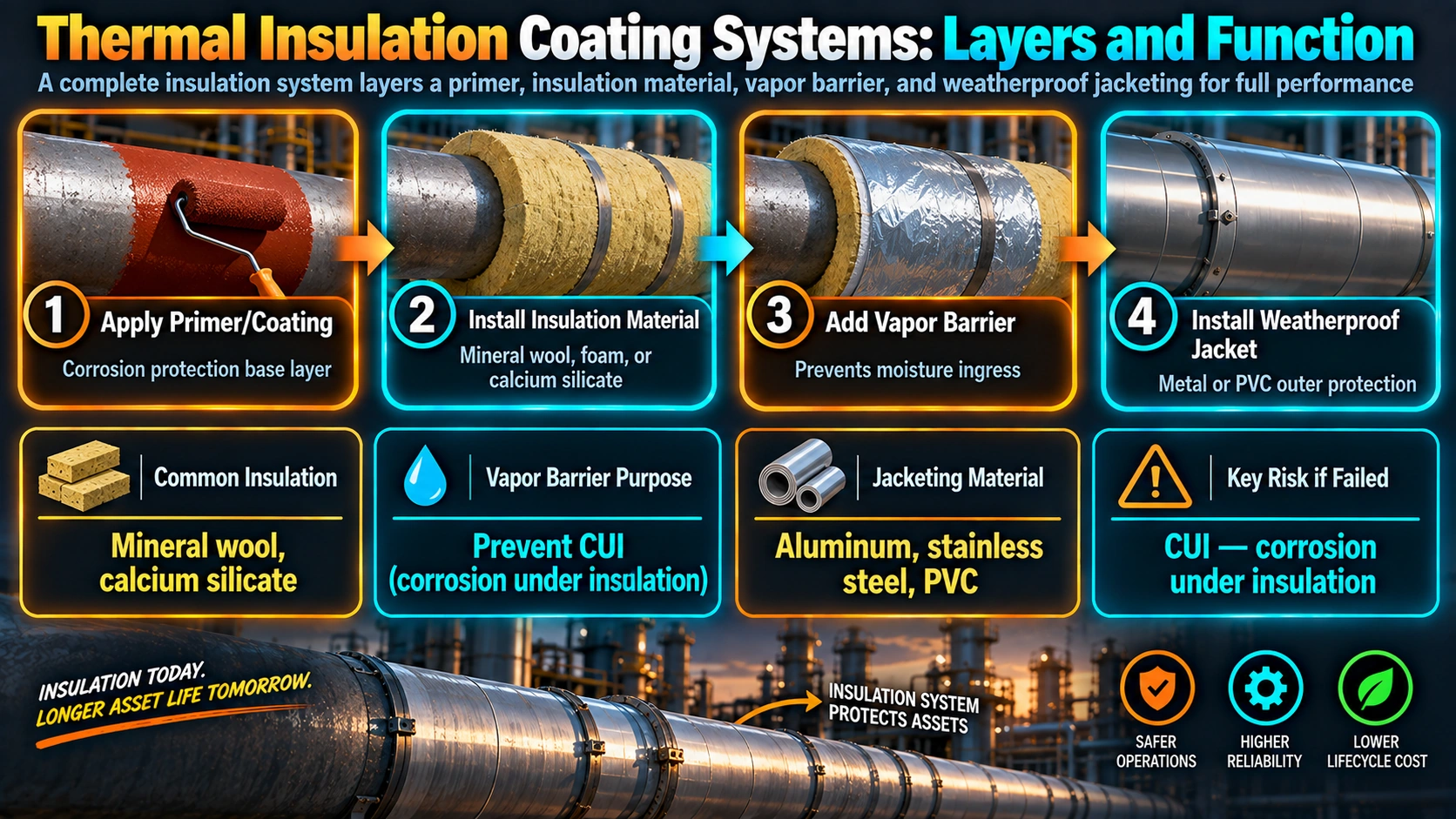
Why the Coating Under Insulation Matters So Much
Insulation and jacketing are not corrosion protection systems in their own right; they are thermal control systems that happen to also need protecting steel underneath them from whatever moisture eventually gets through. Rain, wash-down water, deluge system testing, and simple condensation all find their way past jacketing over time, through seams, penetrations, damaged cladding, and unsealed insulation ends. Once inside, that moisture is trapped against the steel by the same insulation that is supposed to be keeping heat in or out, creating a persistent wet environment that would not exist on an equivalent bare, painted pipe exposed to open air.
Because this happens out of sight, the coating beneath the insulation is frequently the only active defense the steel has for years at a stretch. This is a different design problem from standard atmospheric coating selection covered in our coating and painting inspection tests guide, and it is why CUI-rated systems, rather than a facility’s standard atmospheric primer-topcoat system, are specified for insulated lines.
CUI Risk Zones by Operating Temperature
NACE SP0198 frames CUI risk primarily around operating temperature, since temperature governs whether trapped moisture stays liquid long enough to drive corrosion, or is driven off before it can do damage.
| Approximate Temperature Range | CUI Risk Level | General Reasoning |
|---|---|---|
| Below -12 degC (10 degF) | Lower | Cold/cryogenic service; moisture that enters tends to freeze rather than sustain active corrosion, though freeze-thaw cycling and external icing bring other concerns |
| -12 to 60 degC (10-140 degF) | Moderate | Warm enough for corrosion activity, cool enough that the surface often stays wet for extended periods |
| 60-120 degC (140-250 degF) | Highest | Classic wet/dry cycling zone; warm enough to accelerate corrosion kinetics, not hot enough to keep the surface reliably dry |
| 120-175 degC (250-350 degF) | Moderate-High | Still within the general CUI-susceptible range per NACE SP0198, particularly under intermittent or cyclic service |
| Above 175 degC (350 degF) | Lower | Steel surface tends to stay dry in continuous service; risk rises sharply if the line cycles down into the moderate/high zone during shutdowns or upsets |
Coating System Options for Insulated Equipment
Epoxy Phenolic and Epoxy Novolac Systems
These liquid-applied organic coatings are among the most widely specified systems for CUI protection in the low-to-moderate temperature range, typically up to somewhere between 150 and 205 degC (300-400 degF) depending on the specific formulation. They offer strong chemical and moisture resistance and can be applied with conventional spray equipment, making them a practical choice for new construction and turnaround work where thermal spray equipment may not be readily mobilised.
Thermal Spray Aluminum (TSA)
Thermal spray aluminum is applied by flame or electric arc spraying molten aluminum onto a roughened (typically angular abrasive blasted) steel surface, forming a metallic coating that offers both a physical barrier and galvanic protection, since aluminum is anodic to steel and will preferentially corrode at coating defects. TSA can be used across an unusually wide temperature range, from cryogenic service through several hundred degrees Celsius, and is frequently specified for critical, hard-to-maintain, or very long design-life insulated systems, though it requires specialised spray equipment, stringent surface preparation, and trained applicators.
High-Temperature Silicone Coatings
For continuous service temperatures above the practical range of standard epoxy systems, silicone-based coatings are commonly used, offering good thermal stability at elevated temperatures though generally less mechanical toughness and chemical resistance than epoxy phenolic systems in the overlapping mid-temperature range.
| System | Typical Temperature Range | Key Advantage | Key Limitation |
|---|---|---|---|
| Epoxy phenolic / novolac | Ambient to ~150-205 degC | Strong chemical and moisture resistance, conventional application | Upper temperature limit versus TSA or silicone |
| Thermal spray aluminum (TSA) | Cryogenic to several hundred degC | Wide range, galvanic protection at defects | Specialised equipment, surface prep, and skilled applicators required |
| High-temperature silicone | Elevated continuous service temperatures | Good high-temperature thermal stability | Generally lower mechanical/chemical resistance than epoxy phenolic |
| Standard atmospheric epoxy/polyurethane | Not CUI-rated | Cost-effective for non-insulated exposure | Not intended for the cyclic wet/dry CUI environment |
Insulation and Jacketing Considerations
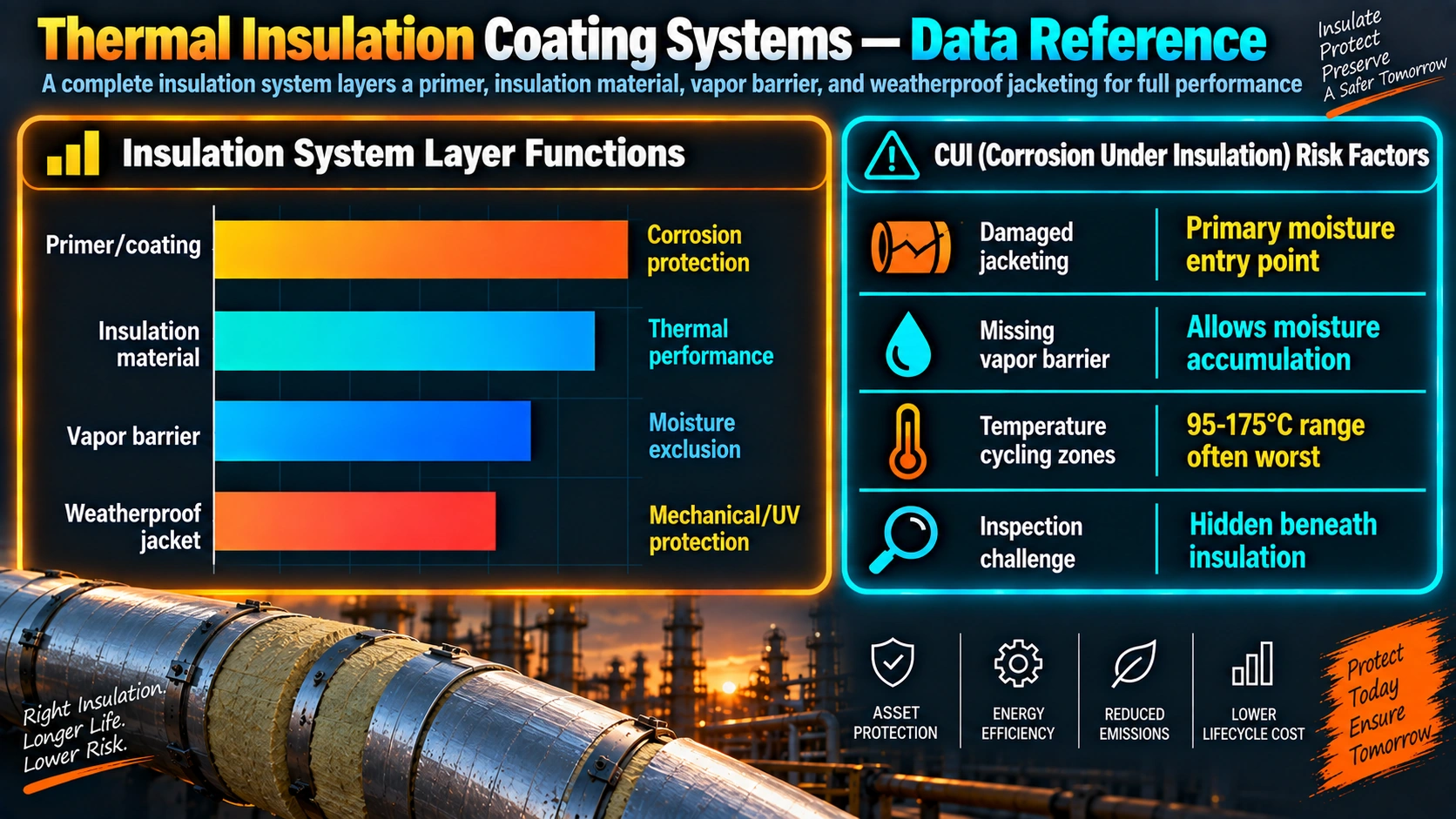
The coating is only one part of a complete CUI mitigation approach. Insulation material selection, jacketing design, and sealing details all influence how much moisture actually reaches the coated steel in the first place.
Insulation Material and Chloride Content
For austenitic stainless steel substrates, insulation materials are typically specified to a low leachable chloride limit, commonly referenced against ASTM C795, since even modest chloride concentrations combined with warmth and moisture under insulation can initiate chloride stress corrosion cracking (CSCC) in stainless steel, a distinct and often more sudden failure mode than the general corrosion typically seen on carbon steel.
Jacketing and Sealing Details
Metal jacketing systems rely heavily on correctly lapped and sealed joints, weatherproof end caps, and careful detailing around penetrations, supports, valves, and flanges, where moisture most commonly finds a way in. ASTM C1617 and related industry guidance cover recommended practices for insulation jacketing installation aimed at minimising water ingress.
Common Field Mistakes
- Specifying a standard atmospheric coating system beneath insulation instead of a CUI-rated system, often because the line’s design temperature looks “safe” without accounting for shutdown or upset cycling into the higher-risk band.
- Treating jacketing as the primary corrosion barrier and under-specifying the coating underneath, when jacketing should be considered the first layer of a two-layer defense, not the only layer.
- Insufficient surface preparation or DFT control before insulation is installed, since any defect is now inaccessible for routine inspection until insulation is removed.
- Overlooking dead legs, supports, and small-bore connections, which are common CUI initiation points but are easy to miss during specification and inspection planning.
- Using chloride-contaminated insulation material on stainless steel piping without verifying compliance with the applicable low-chloride insulation standard.