In Engineering, Procurement, and Construction (EPC) projects, protective coatings are the primary defence against corrosion for steel structures, pipelines, storage tanks, offshore platforms, and heavy equipment. One of the most critical quality checks in any coating inspection workflow is the Dry Film Thickness (DFT) test.
DFT testing confirms that the applied coating meets the specified thickness after curing. Get it wrong — too thin or too thick — and the coating can fail prematurely, costing far more in maintenance than the inspection ever would.
This guide covers everything a coating inspector, QC engineer, or EPC professional needs to know: DFT full form meaning, how it is measured, instruments used, step-by-step test procedure, acceptance criteria, and how DFT links to WFT (Wet Film Thickness).
- DFT full form & meaning
- Why DFT testing matters
- WFT vs DFT — the relationship & formula
- Instruments used for DFT testing
- Applicable international standards
- Step-by-step DFT test procedure
- Acceptance criteria (ISO 19840 & SSPC-PA 2)
- Typical DFT ranges by coat type
- Practical tips & common mistakes
- Reporting & documentation
- Recommended DFT gauges
DFT Full Form — What Does DFT Stand For?
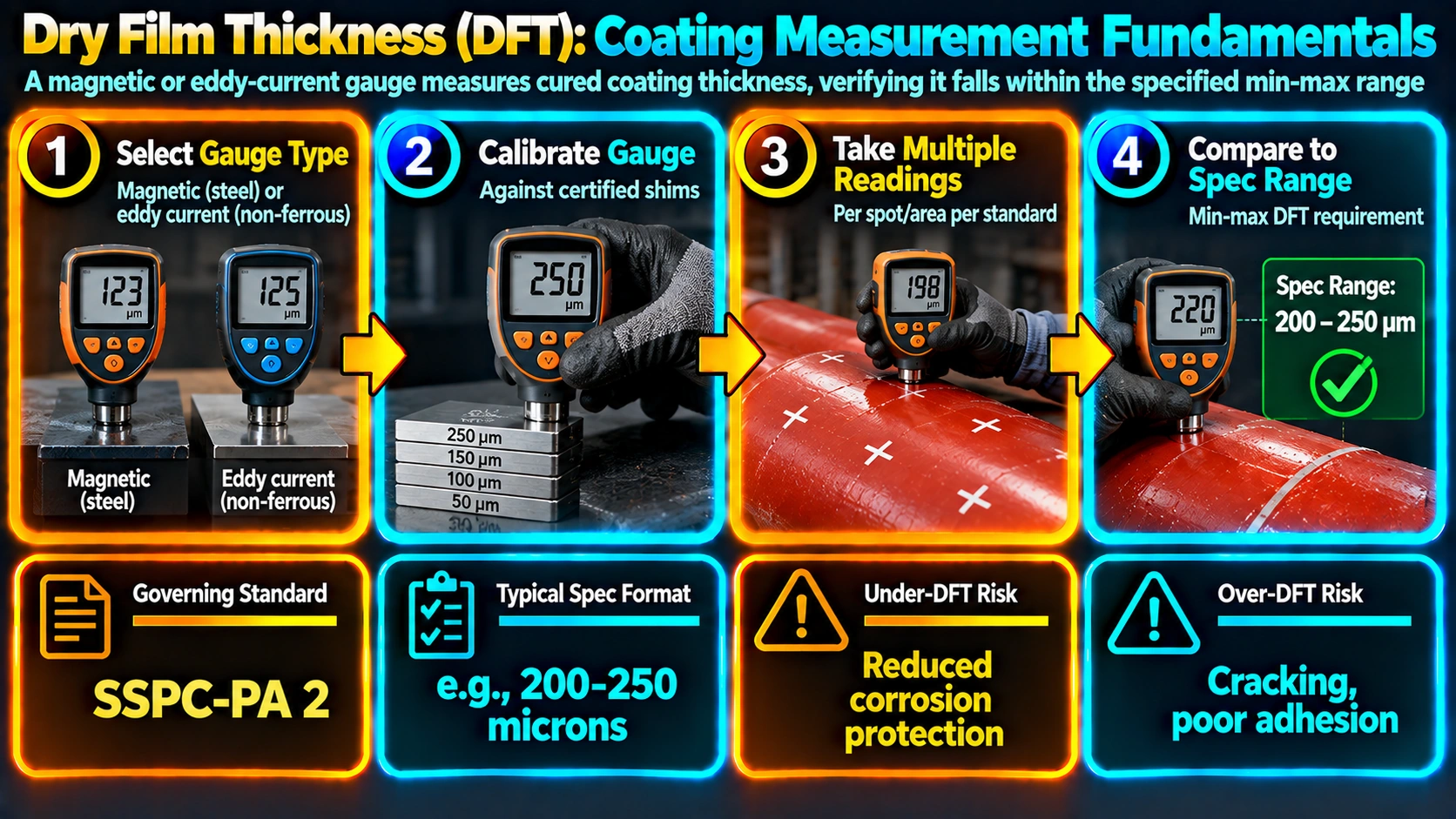
DFT stands for Dry Film Thickness. It is the thickness of a fully cured and dried coating film measured on a substrate after application and solvent evaporation.
In the coatings industry, DFT is measured in microns (µm) or mils (1 mil = 25.4 µm). It is also referred to as:
- DFT full form in paint: Dry Film Thickness — the cured paint layer thickness
- Paint DFT: same concept, used in automotive and industrial painting
- Coating thickness: broader term used in ISO and ASTM standards
- Film thickness: used in thin-film and plating industries
Why DFT Testing Is Crucial in Coating Inspection
DFT is arguably the single most important measurement in any protective coating inspection. Here is why coating inspectors treat it as a mandatory hold point:
Consequences of Low DFT (Under-application)
- Inadequate corrosion resistance — the coating barrier is too thin to block moisture and oxygen
- Significantly reduced service life of the coated asset
- Early coating breakdown and rust bleed-through
- Rejection during final inspection or handover
Consequences of High DFT (Over-application)
- Cracking, wrinkling, and mudcracking of the paint film on curing
- Solvent entrapment leading to blistering and delamination
- Increased material cost — unnecessary paint waste
- Longer curing times, delaying project schedules
Proper DFT testing is a key checkpoint in Inspection Test Plans (ITPs) and forms part of the QA/QC documentation submitted at project completion. It also connects directly to coating defect prevention — most coating defects in service trace back to DFT deviations during application.
WFT vs DFT — Wet Film Thickness and the Conversion Formula
During paint application, inspectors measure Wet Film Thickness (WFT) to predict and control the final DFT before the coating cures. Understanding the relationship is essential for avoiding under- or over-application.
Worked example: If WFT = 200 µm and Volume Solids = 60%, then: DFT = 200 × 60 ÷ 100 = 120 µm
WFT checks during application allow real-time adjustments. DFT measurement after full cure is the final pass/fail determination.
Instruments Used for DFT Testing
Two main types of instruments are used in coating inspection, defined under ISO 2808 and ASTM D7091:
Type 1: Magnetic Pull-Off Gauge
These gauges use a calibrated spring to measure the force required to detach a permanent magnet from a coated steel surface. The force inversely corresponds to coating thickness. The most common example is the Elcometer 211.
- Suitable for ferrous substrates only
- Rugged, battery-free, low cost
- Less precise than electronic gauges
- Used where data logging is not required
Type 2: Electronic/Digital DFT Gauges
Electronic gauges use two principles depending on the substrate:
- Magnetic Induction — for non-magnetic coatings on ferrous (steel/iron) substrates
- Eddy Current — for non-conductive coatings on non-ferrous substrates (aluminium, copper, stainless steel)
Industry-standard digital gauges include:
- Elcometer 456 — widely used in EPC and offshore projects, ±1% accuracy, up to 150,000 readings with Bluetooth data export to ElcoMaster software
- DeFelsko PosiTector 6000 — standard in North American projects, conforms to SSPC-PA 2 and ASTM D7091
Professional-grade digital DFT gauge for ferrous & non-ferrous substrates. Magnetic induction + eddy current, LCD display, auto-calibration. Used by coating inspectors for ISO 19840 & SSPC-PA 2 inspections.
Check Price on Amazon India → * As an Amazon Associate, WeldFabWorld earns from qualifying purchases.
Applicable International Standards for DFT Testing
DFT testing is governed by several international standards. Knowing which standard applies to your project is critical before beginning any inspection.
| Standard | Scope | Key Use |
|---|---|---|
| ISO 19840 | Measurement & acceptance criteria for DFT on rough surfaces | Most used in oil & gas, offshore, EPC |
| ISO 2808 | Methods for determining paint film thickness (destructive & non-destructive) | General laboratory & field testing |
| SSPC-PA 2 | Measurement of DFT on ferrous substrates using magnetic gauges | Standard in US projects and ARAMCO specifications |
| ASTM D7091 | Non-destructive measurement on ferrous & non-ferrous substrates | ASTM-governed projects |
| ISO 2178 | Magnetic induction method for DFT on ferrous substrates | Ferrous-specific applications |
| ISO 2360 | Eddy current method for DFT on non-ferrous substrates | Aluminium, copper, brass applications |
For most oil and gas, petrochemical, and offshore projects in the Middle East and Asia, ISO 19840 and SSPC-PA 2 are the primary governing documents. Always verify against the project-specific coating specification before commencing inspection.
Step-by-Step DFT Test Procedure
Step 1: Pre-Inspection Preparation
- Confirm the coating is fully cured as per the manufacturer’s data sheet (check pot life, recoat interval, and full cure time at ambient temperature)
- Clean the substrate surface of dust, salts, oil, or grease contamination
- Select the correct probe: Ferrous probe (F) for steel substrates, Non-Ferrous probe (N) for aluminium/copper, or FNF combo probe for both
- Check environmental conditions — temperature and humidity should be within the acceptable range for measurement
Step 2: Instrument Calibration and Verification
- Perform zero calibration on an uncoated sample of the same substrate material
- Verify calibration using certified foil standards of known thickness
- Calibration must be traceable to national or international standards (NIST, NPL, PTB)
- Verify before, during, and after each inspection shift
- Record calibration verification in the inspection dossier
Step 3: Taking DFT Measurements
Per SSPC-PA 2:
- Divide the coated area into sections of approximately 10 m² each
- Take 5 spot readings per section, randomly distributed
- Each spot reading = average of 3 gauge readings within a 38 mm (1.5-inch) diameter circle
- Place the probe perpendicular to the surface at all times
- Avoid measuring on edges, corners, weld seams, pits, or heavily pitted areas unless specifically instructed
- Minimum 50 mm distance from all edges
Step 4: Recording Results
- Record all individual spot readings and their averages
- Reference each reading to a grid map or area identifier on the inspection report
- Flag any area-average or individual reading that falls outside specification
- For digital gauges, export data directly to reporting software (ElcoMaster, PosiSoft)
Step 5: Pass / Fail Evaluation
Compare recorded values against the acceptance criteria defined by the applicable standard (see next section). Where readings fail, corrective actions are initiated before final acceptance.
DFT Acceptance Criteria — ISO 19840 and SSPC-PA 2
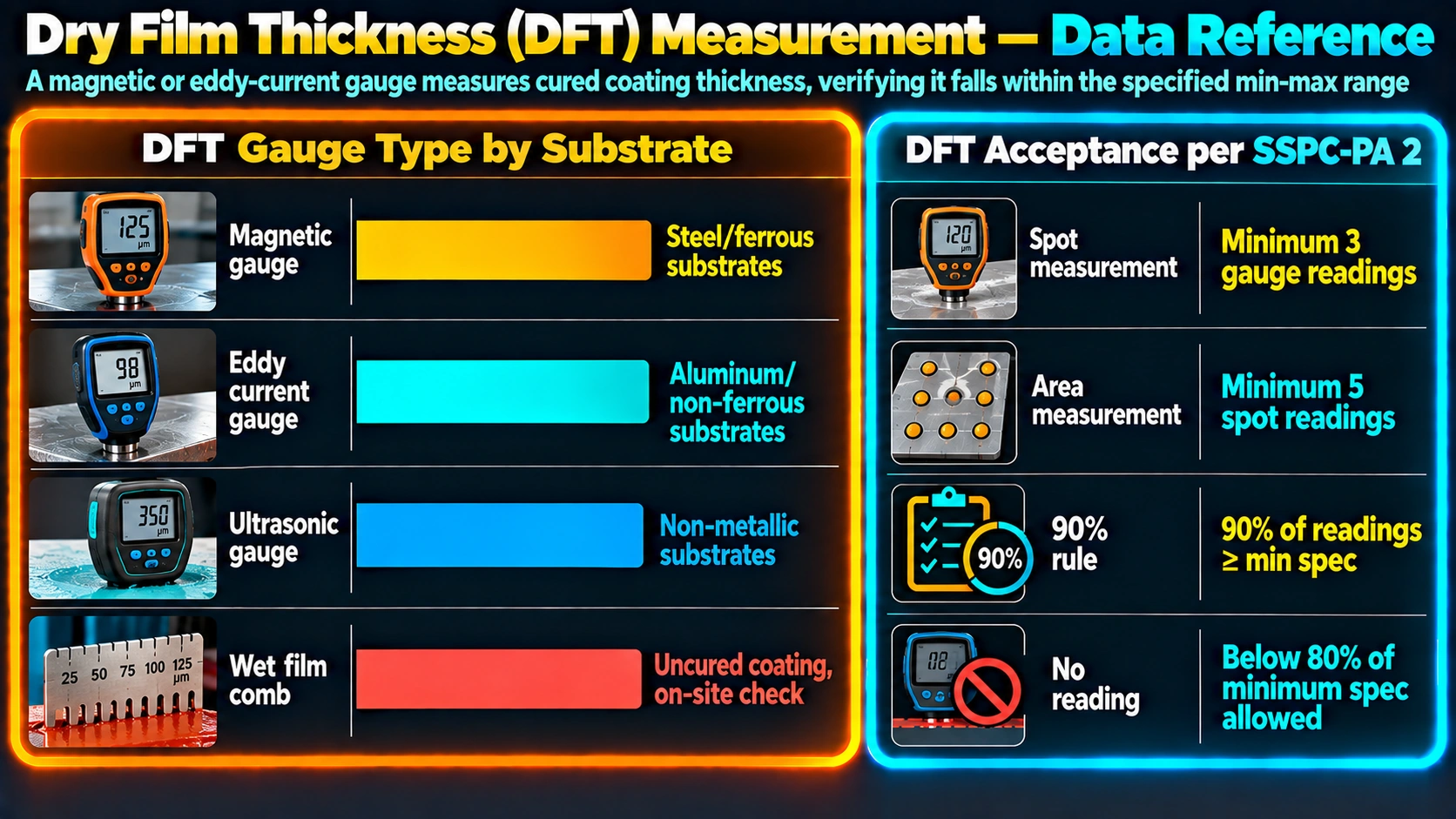
ISO 19840 Acceptance Criteria
| Measurement Type | Requirement |
|---|---|
| Mean of all readings | Shall not be less than the specified nominal DFT |
| Individual readings below nominal | Maximum 20% below nominal DFT is permitted |
| Frequency of low readings | Not more than 20% of all readings may fall below nominal |
SSPC-PA 2 Acceptance Criteria
| Reading Level | Requirement |
|---|---|
| Area average (5 spot readings) | 80–120% of specified DFT |
| Individual spot reading minimum | Not less than 80% of specified DFT |
| Individual spot reading maximum | Not more than 150% (unless otherwise specified) |
For projects governed by client specifications (ARAMCO, ADNOC, EIL, Shell, BP), acceptance tolerances are often stricter — typically ±25 µm from the nominal DFT. Always verify against the project-specific coating specification (PCS) before commencing inspection.
Typical DFT Ranges for Common Coating Systems
| Coat | Typical DFT Range | Purpose |
|---|---|---|
| Primer | 50–75 µm | Adhesion & corrosion inhibition (zinc-rich or epoxy) |
| Intermediate coat | 100–150 µm | Build coat for barrier protection (epoxy, MIO) |
| Finish coat | 50–75 µm | UV resistance, aesthetics, chemical resistance (polyurethane) |
| Total DFT (3-coat system) | 200–300 µm | Depends on environment classification (C3–C5 per ISO 12944) |
| Offshore / immersion zone | 400–600 µm+ | High-corrosivity environments (Im3 / C5-M per ISO 12944) |
| Hot dip galvanising | 45–85 µm | Measured as metallic zinc layer (ISO 1461) |
Always refer to the Paint Data Sheet (PDS) and Painting Specification for the exact nominal DFT and acceptable range applicable to your project — these override generic guidelines.
Practical Tips and Common Mistakes in DFT Testing
Common Mistakes to Avoid
- Measuring before full cure: Even if the coating looks dry, solvent may still be present. Check the PDS for full cure time at the actual ambient temperature.
- Ignoring surface profile: On blasted steel, the surface roughness (Ra/Rz/Ry) affects the measurement base. ISO 19840 provides a correction for rough surfaces.
- Wrong probe selection: Using a ferrous probe on aluminium substrate gives invalid readings. Always match probe type to substrate.
- Measuring at edges: Paint builds up or sags at sharp edges. Readings here are not representative of the overall coating integrity.
- Skipping verification: Instruments can drift. Failing to verify mid-shift can result in an entire day’s readings being invalid.
- Not accounting for holidays: DFT testing does not detect pinholes or holidays in the coating. Holiday detection testing (spark testing or wet sponge test) is a separate inspection step.
Environmental Conditions for DFT Measurement
- Surface temperature must be at least 3°C above the dew point
- Relative humidity should be below 85% (unless specification states otherwise)
- Avoid measuring on surfaces exposed to direct sunlight that may cause thermal expansion
- For very high or very low temperature environments, temperature-compensated gauges are required
Corrective Actions
- DFT too low: Apply additional coat(s) after proper surface preparation. Re-inspect after curing.
- DFT too high: Mechanical methods (grinding, sanding) may be required. Some specifications allow additional investigation before mandating rework.
DFT testing is always considered alongside non-destructive testing (NDT) principles — it is a non-invasive, non-destructive measurement that preserves the integrity of the coated surface.
DFT Test Reporting and Documentation
A complete DFT inspection report should include the following elements:
| Report Section | Details to Include |
|---|---|
| Project identification | Project name, P.O. number, component tag, area reference |
| Surface preparation | Blast standard (Sa 2.5 / SSPC-SP 10), roughness profile (Rz µm) |
| Coating system details | Manufacturer, product name, batch number, number of coats, curing time, ambient conditions during application |
| DFT readings | All individual and area-average readings, grid reference, pass/fail status |
| Instrument details | Make, model, serial number, calibration certificate number and validity |
| Inspector sign-off | Inspector name, qualification (BGAS, NACE, ICorr), date, contractor and client representative signatures |
DFT inspection reports are stored in QC dossiers and typically form part of welding and fabrication inspection packages submitted at mechanical completion or project handover. They are also a mandatory deliverable under ISO 9001 quality management systems.
Recommended DFT Gauges for Coating Inspection
Choosing the right DFT instrument depends on your project requirements, substrate type, and whether you need data logging for large-area inspection. Here are the most trusted options used by coating inspectors globally:
Auto-detecting ferrous and non-ferrous substrate gauge with LCD display, single-point calibration, 0–2000 µm range. Ideal for site work.
View on Amazon →Bluetooth-enabled digital DFT gauge with memory for batch readings and report export. Suited for EPC, pipeline, and offshore inspection.
View on Amazon →Battery-free, rugged pull-off gauge for ferrous substrates. Perfect for site conditions where digital gauges are impractical.
View on Amazon →* As an Amazon Associate, WeldFabWorld earns from qualifying purchases at no additional cost to you.
Related Articles on WeldFabWorld
- Coating Defects: Types, Causes & Challenges — what goes wrong when DFT is incorrect and how to identify it
- Non-Destructive Testing (NDT) — overview of NDT methods including DFT in the broader QC context
- Welding Inspection Checklist — how DFT fits into the complete pre-handover inspection sequence
- Mechanical Testing — understanding hardness testing, tensile, and impact testing alongside coating inspection
- How to Read a Material Test Certificate (MTC) — reading the ISO 10204 documentation that accompanies coating materials
- Corrosion and Its Types — why protective coatings and DFT control matter for long-term asset integrity
Frequently Asked Questions (FAQs)
What is DFT full form in paint?
DFT stands for Dry Film Thickness. In the context of paint and protective coatings, it is the thickness of the fully cured paint film measured in microns (µm) or mils after all solvents have evaporated.
What is the DFT full form in coating inspection?
DFT full form is Dry Film Thickness. In coating inspection, it refers to the quality-critical measurement of cured coating thickness that determines whether a paint system will provide adequate corrosion protection for the intended service life.
What is a DFT test for paint?
A DFT test is the non-destructive measurement of a cured paint film’s thickness using a magnetic induction or eddy current gauge. The test result is compared to the project’s paint specification to determine pass or fail. It is performed per standards such as ISO 19840 or SSPC-PA 2.
What is the difference between WFT and DFT?
WFT (Wet Film Thickness) is measured during paint application while the coating is still wet. DFT is measured after the coating has fully cured. The relationship is: DFT = WFT × (Volume Solids %) ÷ 100. WFT allows real-time control; DFT is the final quality check.
Which instruments are used for DFT measurement?
Type 1 (magnetic pull-off gauges such as Elcometer 211) and Type 2 (electronic digital gauges such as Elcometer 456 and DeFelsko PosiTector 6000) are the two main instrument types. Type 2 electronic gauges are preferred for precision work and projects requiring data logging.
What are the DFT acceptance criteria as per ISO 19840?
Per ISO 19840, the mean of all readings must not fall below the nominal DFT. Individual readings may fall up to 20% below nominal, provided no more than 20% of all readings are below nominal.
Is DFT a type of non-destructive testing (NDT)?
Yes. DFT testing using electronic or pull-off gauges is a non-destructive testing (NDT) method. It measures coating thickness without damaging or removing the coating. The only destructive DFT method is the V-notch cut (per ISO 2808 Method 6A), which is rarely used in field inspection.
What is hardness testing in coating inspection?
While DFT measures thickness, hardness testing of coatings (such as pencil hardness ASTM D3363 or König pendulum hardness) assesses the cured film’s mechanical strength and resistance to indentation. Both tests are complementary quality checks in coating inspection programmes.