Powder Coating Process Guide
Powder coating applies a dry, finely ground polymer coating electrostatically to a grounded metal part and then melts and cross-links it in a curing oven, producing a durable, uniform finish without any liquid solvent involved in the application step. Its combination of chip and abrasion resistance, essentially zero volatile organic compound emissions during spraying, and consistent film build has made it the standard finishing process for architectural aluminium, appliances, furniture, automotive components, and a large share of general fabricated steel parts small enough to fit through a cure oven.
This guide walks through the full powder coating process from pretreatment through electrostatic application and curing, explains the Faraday cage effect and how it’s managed, covers common surface defects like orange peel, and compares powder coating to the liquid coating systems covered elsewhere on WeldFabWorld.
This article covers thermoset electrostatic powder coating for fabricated steel and aluminium parts. It does not cover fluidized bed dipping (an older, less common powder application method) or UV-cure powder systems, which follow different process parameters.
The Powder Coating Process, Step by Step
Step 1: Pretreatment
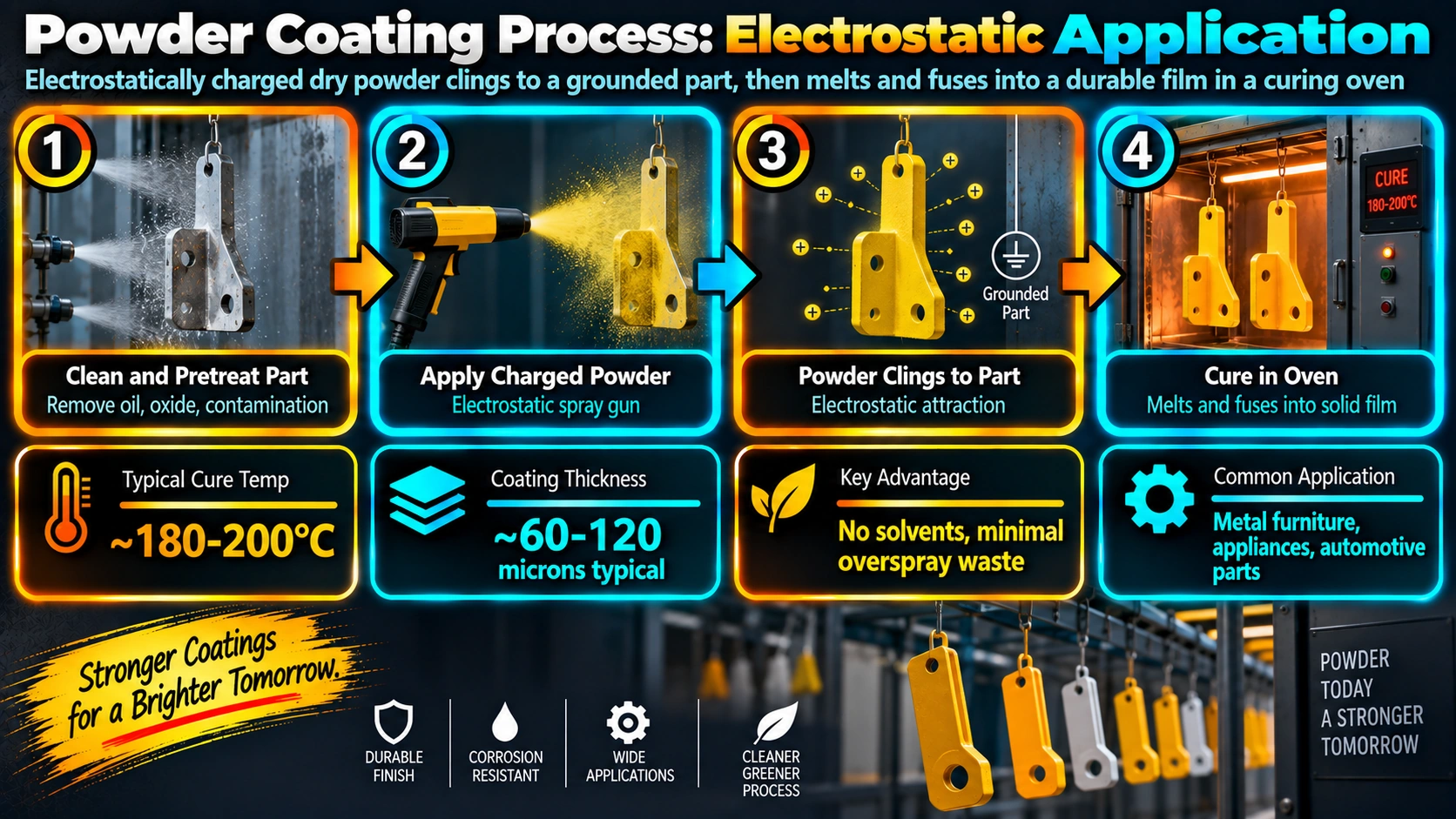
Pretreatment removes oils, mill scale, and contamination and, for most steel parts, deposits a chemical conversion coating that improves both corrosion resistance and powder adhesion. Common pretreatment sequences include multi-stage spray washers using iron phosphate or zinc phosphate conversion chemistry for sheet steel, or abrasive blast cleaning for heavier fabricated steel parts. Parts must be thoroughly dried before entering the powder booth, since any residual moisture can cause outgassing defects during cure.
Step 2: Electrostatic Spray Application
Dry powder, typically a blend of resin, curing agent, pigment, and additives ground to a fine particle size, is fed through a spray gun where it picks up an electrostatic charge, most commonly via corona charging (a high-voltage electrode ionizes the surrounding air) or tribo charging (particles gain charge through friction against the gun’s internal surfaces). The charged powder is attracted to the grounded metal part, adhering to vertical and even slightly recessed surfaces through electrostatic force alone, well before any curing has occurred.
The Faraday Cage Effect
Inside deep recesses, box sections, or tight inside corners, the electrostatic field lines are disrupted in a phenomenon called the Faraday cage effect, causing charged powder particles to be repelled away from these areas rather than deposited, which can leave thin or bare coating on internal surfaces of complex geometry. This is managed through gun settings (reduced kV, pulsed charge), adjusted spray angle and distance, specialized low-charge or tribo guns for problem areas, and in some cases powder formulations specifically designed to penetrate difficult geometry more effectively.
Step 3: Curing
The powder-coated part enters a curing oven, typically operating between 160 and 200 degrees Celsius depending on the powder chemistry, where the powder first melts and flows out into a continuous liquid film before cross-linking (curing) into its final hardened, cured state. Cure schedule is defined by both temperature and time (metal temperature, not just oven air temperature, is what governs the reaction), and the coating manufacturer’s data sheet specifies the minimum peak metal temperature and hold time required for full cure.
An undercured powder film can look visually acceptable immediately after cooling but will show reduced chemical, impact, and weathering resistance in service, so cure verification (via oven profiling with a data logger tracking actual part temperature through the cure cycle, not just oven set point) should be part of routine process control rather than a one-time qualification check.
Common Powder Coating Defects
| Defect | Common Cause |
|---|---|
| Orange peel | Insufficient flow before gel; low oven temperature/time, excessive film build, or incorrect particle size |
| Outgassing (pinholes/craters) | Trapped moisture, oil, or gas releasing from the substrate or a porous casting during cure |
| Thin coverage in recesses | Faraday cage effect, inadequate gun adjustment for part geometry |
| Poor adhesion | Inadequate pretreatment, contamination, or under-cure |
| Color/gloss variation | Inconsistent film thickness, oven temperature variation, powder batch differences |
Cast aluminium and iron parts can trap air or moisture in surface porosity from the casting process, which releases as gas bubbles through the melted powder film during cure, producing craters or pinholes. Preheating cast parts before powder application, sometimes called an outgassing bake, allows trapped gas to escape before the powder film is applied and can significantly reduce this defect.
Powder Coating vs Liquid Coating
| Property | Powder Coating | Liquid Coating |
|---|---|---|
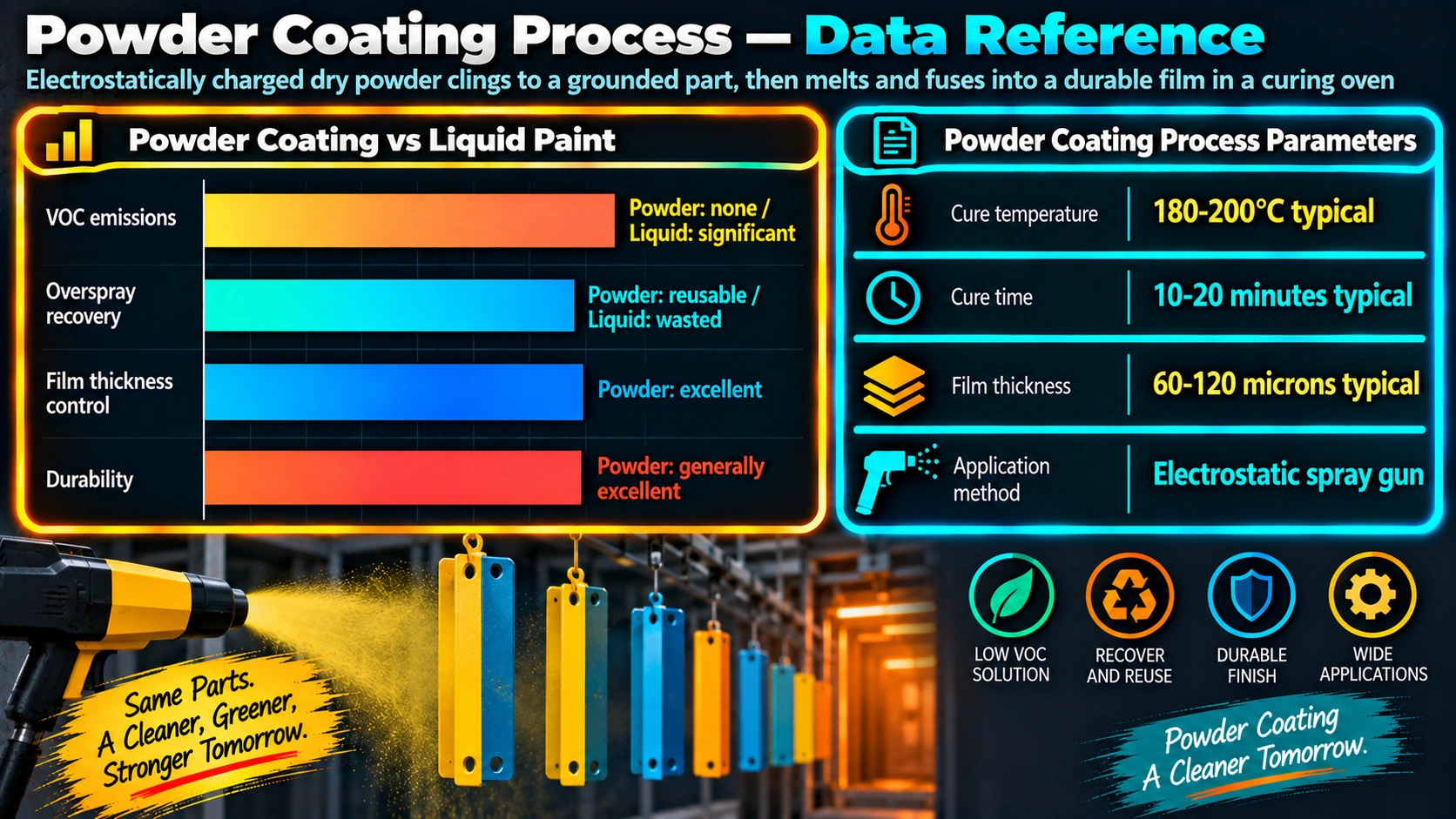
| VOC emissions during application | Essentially zero | Present, varies by product (waterborne lower than solvent-based) |
| Film build per coat | 60-120 microns typical, thicker in one pass | Varies widely, often multiple thin coats |
| Chip/abrasion resistance | Generally superior at equivalent thickness | Good, varies by product |
| Part size limitation | Limited by oven/booth size | No practical size limit, field-applicable |
| Overspray recovery/reuse | High, overspray typically reclaimed and reused | Not recoverable |
| Typical use | Shop-fabricated parts, appliances, architectural aluminium | Structural steel, tanks, pipelines, field-applied work |
Because powder coating is limited by cure oven size, it is generally not used for large structural steel, storage tanks, or offshore structures covered in our atmospheric, immersion, and splash zone coating systems guide; those applications rely on the liquid-applied primer, intermediate, and topcoat systems discussed throughout this category instead.
Film Thickness Measurement
Cured powder coating film thickness is measured with the same magnetic or eddy current dry film thickness gauges used for liquid coatings, following the same underlying principles covered in our WFT/DFT measurement guide, though there is no equivalent “wet film” check for a dry powder application, so process control relies instead on gun output settings, part speed, and powder feed rate calibration verified against periodic DFT sampling.
Record pretreatment process and chemistry, powder batch/lot number, oven profile data (time-temperature curve for a representative part), cured DFT readings, and any defect observations for each production run, since powder coating quality issues often trace back to a specific process parameter drift that is only identifiable through this kind of process data trail.
Small fasteners and hardware are commonly powder coated using barrel or rack systems designed for high-volume throughput, and the same electrostatic and Faraday cage principles apply, though part tumbling in barrel systems introduces additional considerations for even coverage that solid rack-mounted parts do not face.
Recommended Reference Material
Powder Coating Process Handbook
Covers pretreatment, electrostatic application, cure schedules, and troubleshooting for industrial powder coating.
View on AmazonPortable Digital DFT Gauge
Magnetic/eddy current gauge for verifying cured powder coating film thickness.
View on AmazonOven Temperature Data Logger
Thermal profiling data logger for verifying peak metal temperature and cure hold time in powder coating ovens.
View on AmazonElectrostatic Powder Coating Spray Gun
Corona or tribo-charge electrostatic powder spray gun for industrial and small-shop application.
View on AmazonDisclosure: WeldFabWorld participates in the Amazon Associates programme (StoreID: neha0fe8-21). If you purchase through these links, we may earn a small commission at no extra cost to you. This helps support free technical content on this site.
Frequently Asked Questions
How does powder coating actually stick to the part before curing?
Powder coating particles are given an electrostatic charge as they pass through the spray gun, and the grounded metal part attracts these charged particles through electrostatic attraction, holding the dry powder on the surface before it is cured. This electrostatic bond is what allows a dry powder to cling to a vertical or overhead surface without dripping or sagging the way a liquid coating would.
What is the Faraday cage effect in powder coating and how is it managed?
The Faraday cage effect occurs when the electrostatic field is disrupted inside recessed areas, corners, or box sections, causing charged powder particles to be repelled from deep internal surfaces rather than deposited evenly, resulting in thin or bare coating in those areas. It is managed by adjusting spray gun settings (reducing kV or using specialized low-charge guns for recessed areas), changing spray angle and distance, and in some cases using specially formulated powders designed to penetrate Faraday cage geometry more effectively.
What pretreatment is required before powder coating steel?
Steel pretreatment before powder coating typically includes degreasing to remove oils and shop contamination, followed by either a chemical conversion coating (iron phosphate or zinc phosphate) applied by spray or immersion for corrosion resistance and adhesion, or abrasive blast cleaning for heavier fabricated steel, followed by thorough drying before the part enters the powder booth. Inadequate pretreatment is one of the leading causes of premature powder coating adhesion failure.
What causes orange peel texture in powder coating?
Orange peel, a bumpy, dimpled surface texture resembling citrus peel, occurs when the melted powder does not flow out completely smooth before gelling during cure, commonly caused by insufficient oven temperature or time, excessive film thickness, incorrect powder particle size distribution, or inadequate part preheat. Adjusting cure schedule, film thickness, and powder formulation, or preheating parts before powder application, are the main corrective measures.
How is powder coating film thickness measured and controlled?
Powder coating film thickness is measured after cure using the same magnetic or eddy current dry film thickness gauges used for liquid coatings, since there is no equivalent wet film measurement for a dry powder application. Thickness is controlled primarily through spray gun output settings, gun-to-part distance, part speed through the booth, and powder feed rate, with typical industrial powder coating film builds ranging from 60 to 120 microns.
Is powder coating more durable than liquid paint?
Powder coating generally offers superior chip, scratch, and abrasion resistance compared to most liquid coatings at equivalent film thickness, due to its fully cross-linked cured film structure, and it produces zero volatile organic compound emissions during application since there is no liquid solvent. However, powder coating is generally limited to parts that can fit in a curing oven and withstand the cure temperature, making it less practical than liquid coatings for very large structures or heat-sensitive assemblies.