Holiday Testing (Spark Testing) for Coatings
Holiday testing, also known as spark testing or pinhole detection, is the inspection method used to find the microscopic discontinuities in a cured coating film that a visual inspection alone will almost always miss. A single pinhole-sized holiday in an otherwise flawless coating job can become the initiation point for localized corrosion, and on tank linings, buried pipelines, and offshore structures, holiday testing is a mandatory hold point precisely because the consequence of a missed holiday is disproportionate to its tiny physical size.
This guide explains the two main holiday testing methods, low-voltage wet sponge and high-voltage spark testing, how to calculate the correct test voltage for a given coating thickness, the step-by-step testing procedure, safety precautions, and how detected holidays should be marked and repaired. It builds on our earlier guides covering WFT/DFT measurement and coating system selection.
This article covers holiday testing of cured protective coatings and linings on steel substrates. It does not cover in-line pipeline coating inspection using automated holiday detection sleds, which follow a related but more specialised procedure beyond the scope of this guide.
Why Holiday Testing Matters
A coating film can pass every visual inspection, meet its dry film thickness requirement, and still contain scattered microscopic voids caused by air entrapment, contamination under the film, application defects, or damage from handling after cure. These voids, called holidays, create a direct path for moisture and oxygen to reach the substrate, and because the surrounding coating is otherwise intact, corrosion at a holiday can progress undetected for a long time before it becomes visible from the outside, particularly on buried or immersed structures where routine visual inspection is not possible.
Two Testing Methods
| Method | Standard | Voltage Range | Typical Coating Thickness |
|---|---|---|---|
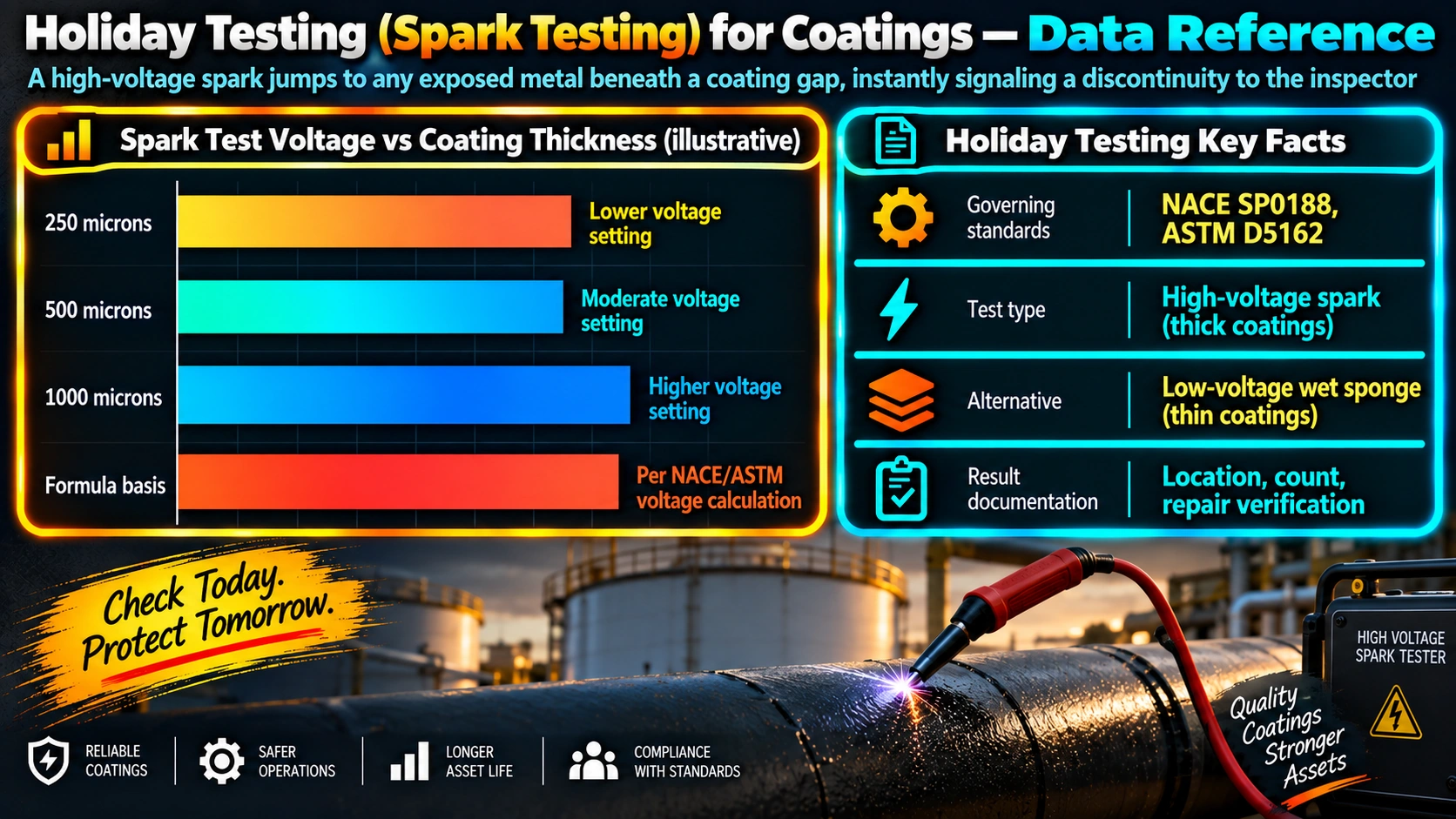
| Low-voltage wet sponge | ASTM D5162, NACE SP0188 | 9-90 volts DC | Up to approximately 500 microns (20 mils) |
| High-voltage spark (dry electrode) | NACE SP0188, ASTM D4787 | Several kV up to tens of kV DC | Thicker coatings, linings, pipeline coatings |
Low-Voltage Wet Sponge Testing
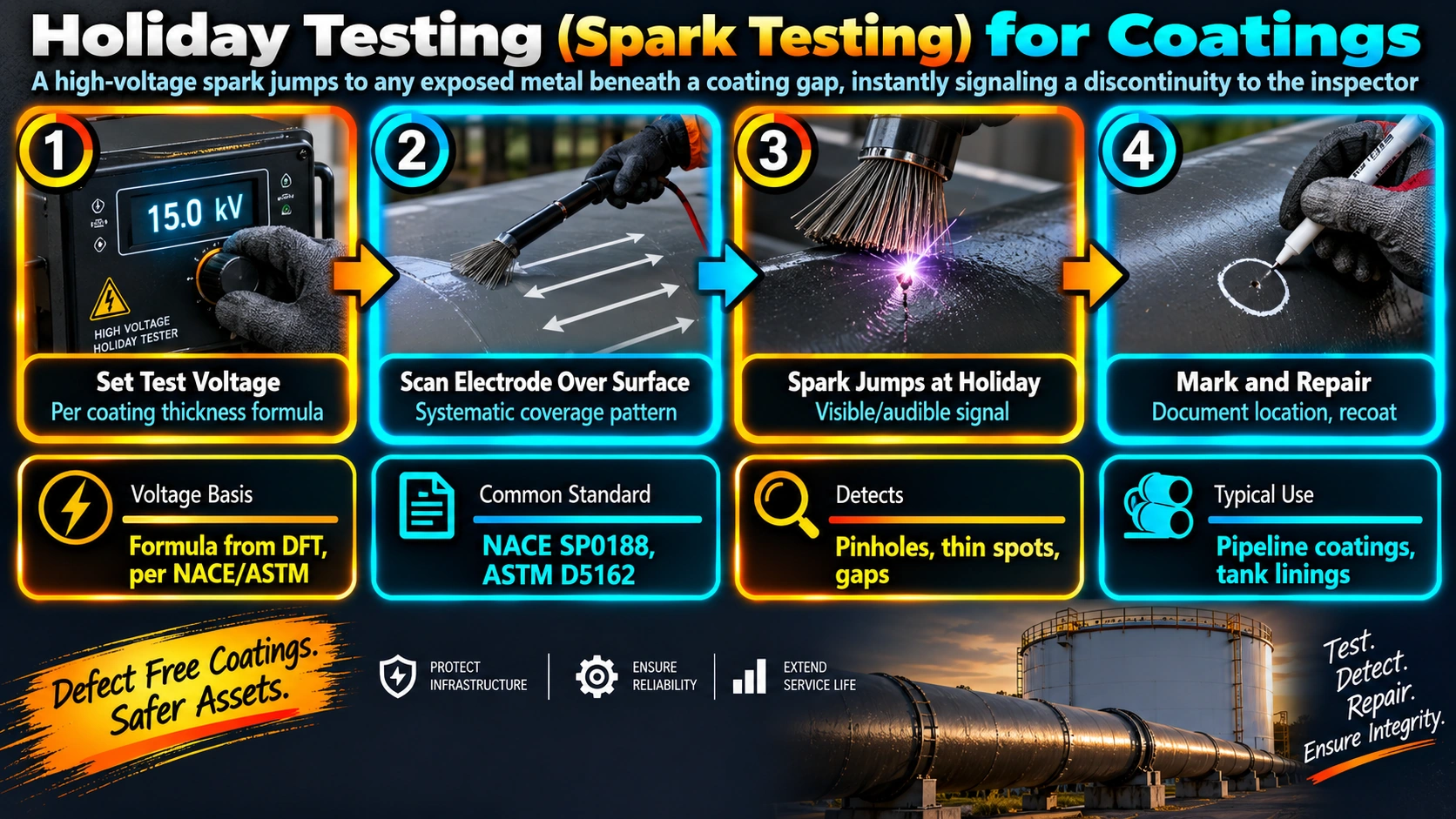
A damp cellulose sponge electrode, wired to a low-voltage DC power source and connected to the grounded substrate, is passed slowly and systematically across the coated surface. Where a holiday exists, the moisture in the sponge completes an electrical circuit through the pinhole to the bare steel beneath, triggering an audible alarm and often an indicator light on the instrument. This method is limited to relatively thin coating films, generally up to about 500 microns, because thicker films provide enough insulation resistance that the low test voltage cannot reliably detect a discontinuity.
High-Voltage Spark Testing
For thicker coatings and linings, a dry electrode, commonly a wire brush, coil spring, or phosphor bronze brush shape matched to the surface geometry, is connected to a high-voltage DC power source, often called a “jeep” or holiday detector in field jargon. As the electrode passes over a holiday, the electric field concentrates at the discontinuity and a visible and audible spark jumps across the gap to the substrate, since the dry electrode does not require an electrolyte to complete the circuit the way wet sponge testing does.
Calculating Test Voltage
Setting test voltage based on the specified minimum DFT rather than the actual measured DFT at a given location can either miss holidays in under-thickness areas or cause dielectric breakdown damage to intact film in over-thickness areas. Always base voltage calculation on representative measured DFT readings from that section, not the target value alone.
Testing Procedure
| Step | Action |
|---|---|
| 1 | Confirm coating is fully cured per manufacturer’s minimum cure time before testing |
| 2 | Verify DFT readings across the area to determine correct test voltage |
| 3 | Calibrate/verify the holiday detector against a known reference standard |
| 4 | Connect ground clamp securely to bare, conductive substrate |
| 5 | Pass the electrode over the surface at a controlled, consistent speed (typically 0.3 m/s or per equipment manual) |
| 6 | Mark any detected holiday immediately at the point of detection |
| 7 | Repair marked holidays per manufacturer’s touch-up procedure and re-test after cure |
| 8 | Document test voltage, coverage, results, and repairs performed |
Overlap each pass of the electrode with the previous pass to avoid leaving untested strips between sweeps, and pay particular attention to weld seams, corners, nozzle penetrations, and other complex geometry where coating film build is most likely to be inconsistent.
Safety Precautions
Only trained, competent personnel should operate high-voltage holiday detectors, using insulated gloves and footwear rated for the voltage in use, and confirming the equipment and structure are correctly grounded before starting. High-voltage testing must never be conducted in a flammable atmosphere or in the presence of explosive gas concentrations unless the equipment is specifically rated intrinsically safe for that environment, and low-voltage wet sponge or alternative methods should be used instead where hazardous area restrictions apply.
Marking and Repairing Holidays
Every detected holiday should be marked immediately at the exact point of detection, using chalk, wax crayon, or a paint marker compatible with the coating system, since the exact location becomes difficult to relocate once the electrode moves on. Repair follows the coating manufacturer’s touch-up procedure, typically involving local surface preparation of the defect area, feathering the edge of the surrounding sound coating to promote adhesion of the patch, and reapplying coating to the full specified system thickness. After the repair cures, the same area should be re-tested with the holiday detector to confirm the discontinuity has been fully closed before final acceptance.
Trapped air bubbles from spray application, contamination on the substrate before coating (dust, oil, moisture), inadequate surface profile causing poor wet-out at peak areas, mechanical damage from handling or rigging after cure, and pinholing from outgassing over porous primers such as inorganic zinc silicate are among the most common root causes of detected holidays.
Typical Applications
- Storage tank interiors: Mandatory holiday testing before hydrotest or service, given the immersion service consequence of a missed defect.
- Buried and subsea pipeline coatings: Holiday testing before backfill or lay, since post-installation repair is impractical or extremely costly.
- Offshore structures: Critical zones such as splash zone and cathodic protection interface areas often require 100% holiday test coverage.
- Concrete and lining systems: Some concrete protective linings and secondary containment coatings also require holiday testing per project specification.
Holiday testing follows completion of all mechanical testing, NDT, and coating cure, and should never be treated as a substitute for adequate surface preparation and correct film thickness control during application, since holiday testing finds discontinuities after the fact rather than preventing them.
Recommended Reference Material
High-Voltage Holiday Detector (Jeep Tester)
Adjustable high-voltage spark tester for holiday detection on thick coatings and pipeline linings.
View on AmazonLow-Voltage Wet Sponge Holiday Tester
Wet sponge holiday detector for thin-film coating inspection per ASTM D5162.
View on AmazonInsulated Electrical Safety Gloves
Voltage-rated insulated gloves for safe operation of high-voltage holiday testing equipment.
View on AmazonCoating Inspection and NDT Reference Handbook
Covers holiday testing, DFT measurement, and coating QC hold points for site inspectors.
View on AmazonDisclosure: WeldFabWorld participates in the Amazon Associates programme (StoreID: neha0fe8-21). If you purchase through these links, we may earn a small commission at no extra cost to you. This helps support free technical content on this site.
Frequently Asked Questions
What is holiday testing in coating inspection?
Holiday testing, also called spark testing or pinhole testing, is a non-destructive inspection method used to detect discontinuities such as pinholes, thin spots, and voids in a coating film that could expose the underlying substrate to a corrosive environment. It is typically performed after the coating has fully cured and is a mandatory quality hold point on tank linings, pipeline coatings, and other critical protective coating systems.
What is the difference between low-voltage wet sponge and high-voltage spark testing?
Low-voltage wet sponge testing, covered in ASTM D5162 and NACE SP0188, uses a damp sponge electrode at low voltage (typically 9 to 90 volts DC) and is suitable for thinner coating films up to about 500 microns, completing an electrical circuit through any holiday to bare metal. High-voltage spark testing uses a dry electrode, typically a wire brush, coil spring, or phosphor bronze brush, at voltages from several thousand up to tens of thousands of volts DC, and is used for thicker coatings and linings where wet sponge contact and sensitivity would be impractical.
How is the correct test voltage calculated for high-voltage holiday testing?
A widely used formula from NACE SP0188 and similar standards calculates test voltage in volts as approximately 1250 times the square root of the coating thickness in millimetres, or equivalently around 5 times the square root of the thickness in mils for a constant commonly used in North American practice. Coating manufacturers often specify their own recommended test voltage for a given product and thickness, which should take precedence over generic formulas where provided.
Can high voltage spark testing damage a good coating?
Yes, testing at excessive voltage for the coating thickness can cause dielectric breakdown through intact, defect-free coating, creating false holidays or actually damaging sound film, which is why correct voltage calculation and calibration against the actual coating thickness is critical. Testing at too low a voltage, conversely, risks missing genuine holidays, so voltage selection must be verified rather than assumed.
What safety precautions are needed for high-voltage holiday testing?
High-voltage holiday testing requires trained, competent operators, insulated gloves and footwear appropriate to the voltage in use, verification that the structure and test equipment are properly grounded, and exclusion of unauthorized personnel from the test area, since high-voltage units can deliver a significant electrical shock. Testing must never be performed in the presence of flammable atmospheres or explosive gas concentrations unless intrinsically safe equipment rated for that environment is used.
How are holidays marked and repaired once found?
Detected holidays are marked immediately with chalk, crayon, or paint marker at the exact location while the probe is still in contact, then repaired per the coating manufacturer’s touch-up procedure, typically involving local surface preparation, feathering the surrounding coating edge, and reapplying coating material to full specified thickness. Repaired areas should be re-tested with the holiday detector after the touch-up has cured to confirm the discontinuity has been fully closed.