Adhesion Testing: Pull-Off Test (ASTM D4541) Guide
The ASTM D4541 pull-off adhesion test is the standard method for quantifying how strongly a coating system is bonded to its substrate, giving a hard number in megapascals or psi rather than relying on qualitative scrape or tape tests alone. Because adhesion failure is one of the most common root causes of premature coating breakdown, especially blistering and disbondment, pull-off testing is a routine acceptance requirement on structural steel, tanks, pipelines, and offshore coating projects, and it is one of the few coating tests that gives a directly comparable numerical result across different coating systems and projects.
This guide walks through exactly how the pull-off test works, the different tester types available, correct dolly bonding procedure, how to classify and interpret failure modes, typical acceptance criteria, and the most common errors that produce misleading results in the field.
This article covers ASTM D4541 and the closely aligned ISO 4624 pull-off adhesion test for organic coatings on metal substrates. It does not cover cross-cut/cross-hatch tape adhesion testing (ASTM D3359), which is a separate, less quantitative qualitative method covered elsewhere.
How the Pull-Off Test Works
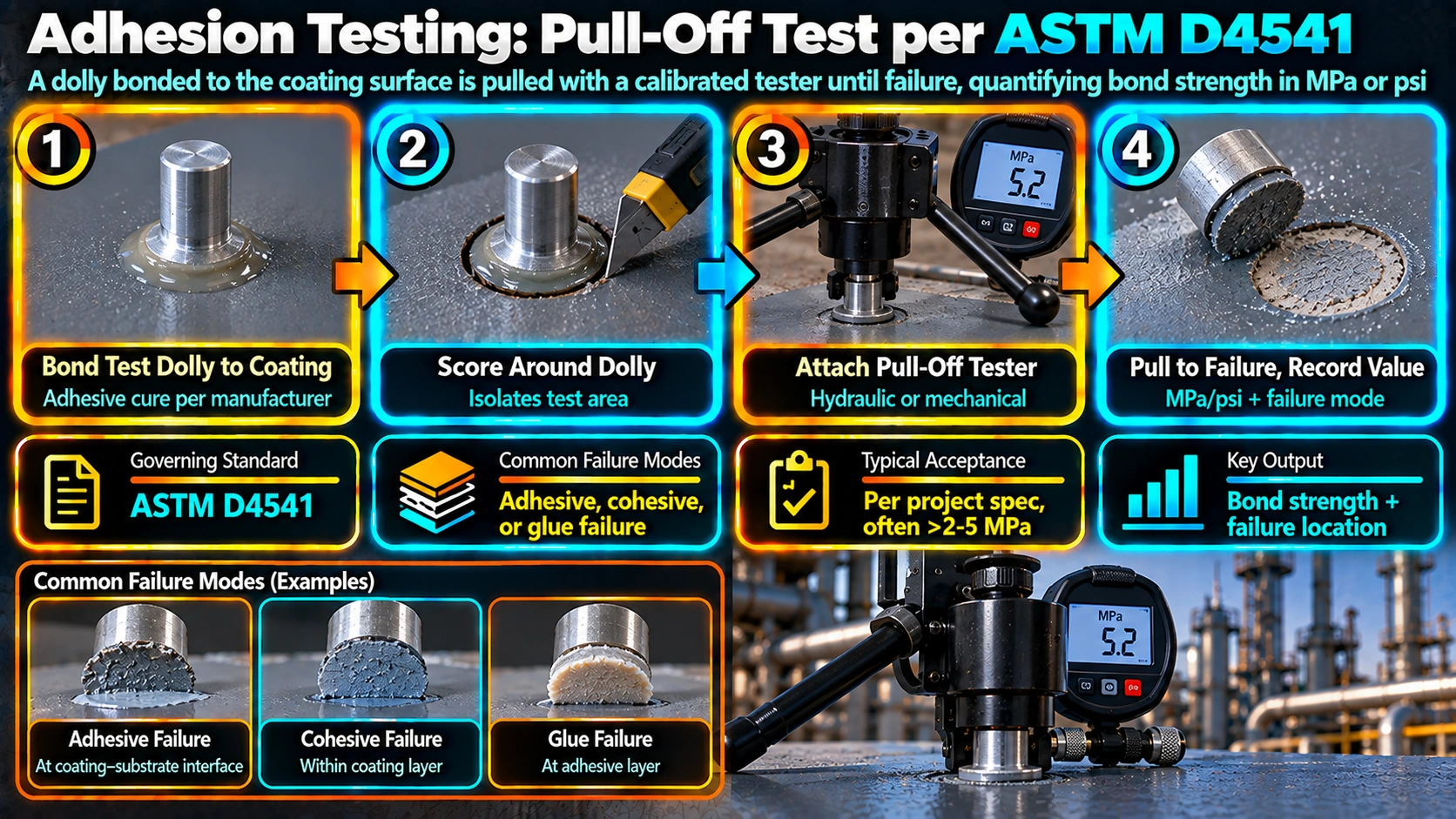
A circular metal test dolly, sized per the test method and typically 20mm or 50mm in diameter, is bonded to the surface of the cured coating using a compatible adhesive. Once the adhesive has fully cured, the coating around the dolly is scored down to the substrate to isolate the test area, and a calibrated pull-off tester applies a steadily increasing tensile force perpendicular to the surface until the dolly separates from the coating system. The force at separation, divided by the dolly’s bonded area, gives the tensile adhesion strength, and the resulting failure surface is examined to determine exactly where within the coating system the separation occurred.
Types of Pull-Off Adhesion Testers
| Tester Type | Operating Principle | Notes |
|---|---|---|
| Hydraulic | Hand pump builds hydraulic pressure, peak reading on analog gauge | Rugged, widely used in field conditions, less precise than digital |
| Mechanical (screw-type) | Manually turned screw applies increasing force, dial/digital readout | Portable, good for routine field checks |
| Motorized/self-aligning | Motor-driven, calibrated load cell applies controlled steady pull rate | Highest precision and repeatability, often used for critical/reference testing |
Dolly Bonding Procedure
Pulling a dolly before the bonding adhesive has fully cured is one of the most common causes of falsely low or scattered pull-off results, since the adhesive bond itself may fail before the true coating adhesion strength is reached. Always follow the adhesive manufacturer’s stated cure time, and account for lower ambient temperature extending cure time significantly.
Classifying the Failure Mode
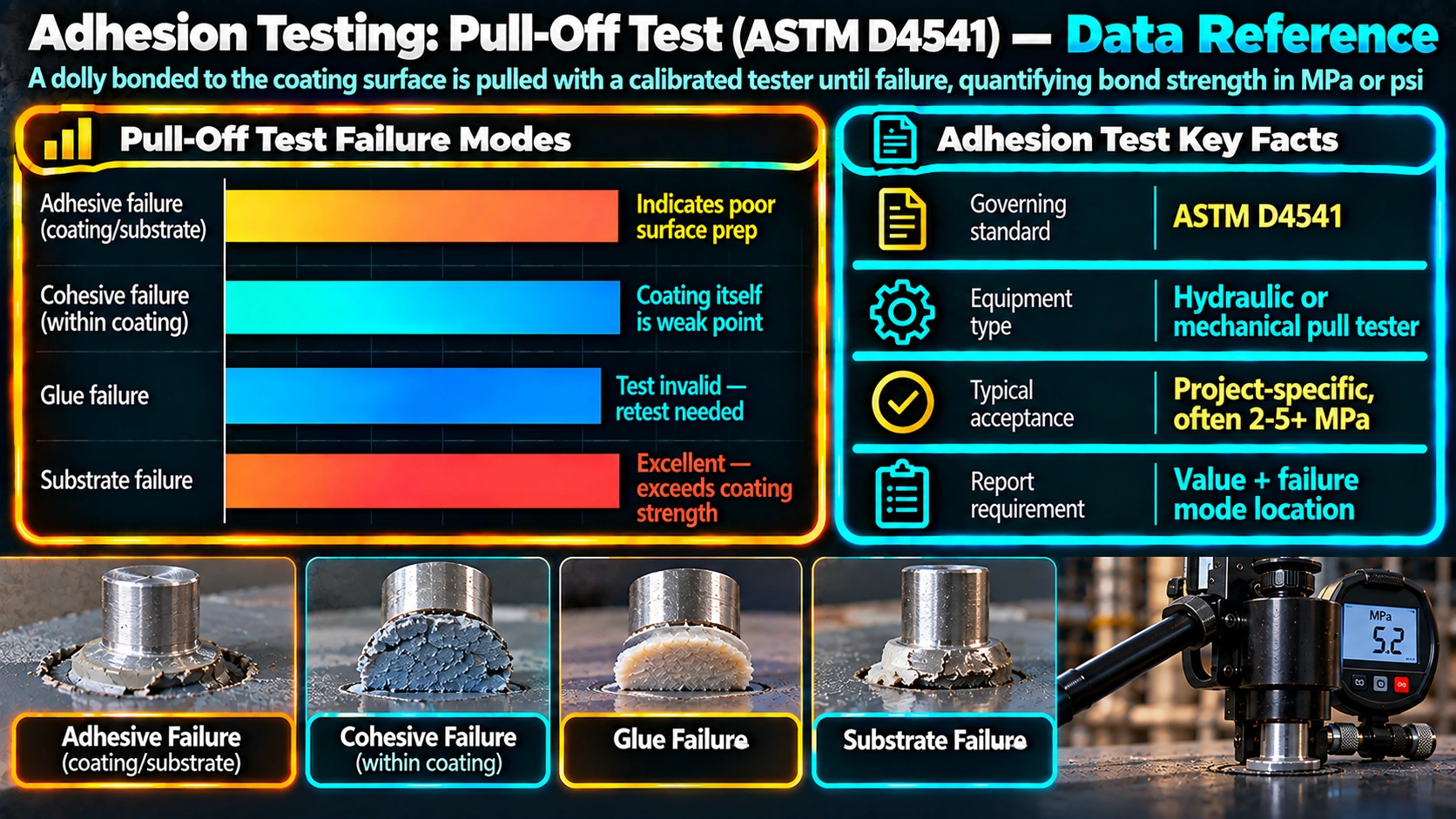
After the dolly separates, the exposed failure surface must be examined and the failure location recorded, since the reported strength value is only meaningful in the context of where the failure actually occurred.
| Failure Type | Location | What It Means |
|---|---|---|
| Adhesive (substrate) | Coating/substrate interface | Bond to substrate is the weak point – reflects true adhesion strength |
| Adhesive (intercoat) | Between two coating layers | Bond between coats is the weak point – check recoat window/compatibility |
| Cohesive (within coating) | Within a single coat’s film | Result reflects internal film strength, not substrate bond quality |
| Adhesive (glue failure) | Within the test adhesive layer | Test result invalid – re-test with fresh adhesive and full cure |
A cohesive failure within the coating film, rather than at the substrate interface, generally indicates that the substrate bond is stronger than the coating film itself, which is often interpreted as a favourable outcome, provided the recorded strength still meets or exceeds the specified minimum.
Typical Acceptance Criteria
| Coating System | Typical Minimum Adhesion |
|---|---|
| General industrial epoxy on steel | 3.0-5.0 MPa (435-725 psi) |
| High-performance / offshore systems | 5.0-10.0 MPa (725-1450 psi) |
| Tank lining / immersion systems | Often 5.0 MPa minimum, confirm with data sheet |
| Thermal spray metallizing | Reported per relevant metallizing spec, often higher due to mechanical bond mechanism |
Acceptance values vary significantly by product chemistry and film thickness, so treat the figures above as general orientation only, and use the actual coating manufacturer’s minimum adhesion requirement, or the project specification value, as the governing acceptance criterion.
Common Errors in Pull-Off Testing
| Error | Effect |
|---|---|
| Insufficient adhesive cure before pulling | Falsely low or invalid (glue-layer) failure result |
| Dolly not bonded perpendicular to surface | Uneven load distribution, misleading peak force reading |
| Coating not scored around the dolly (where required) | Surrounding intact coating resists pull, inflating the apparent result |
| Test performed on inadequately cured coating | Low result reflecting immature film strength, not final in-service adhesion |
| Tester not calibrated | Systematic error across all readings, invalidating comparison to spec |
Testing Frequency and Documentation
Because pull-off testing is destructive, it is performed at a limited number of representative locations rather than the full coated surface, with frequency typically defined by the project’s inspection and test plan, often one test location per defined area (for example per 100 to 500 m2) or per structural member for critical items. Every test result should be documented with the location, measured force/strength, failure mode classification, and photograph of the failure surface, and every test location must be repaired per the coating manufacturer’s touch-up procedure afterward, followed by holiday re-testing if the coating system requires holiday-free integrity.
Low pull-off adhesion results frequently trace back to inadequate surface preparation grade or insufficient surface profile depth rather than a coating material defect, so a failed adhesion test should prompt review of the original blast preparation records for that area before assuming a coating formulation problem.
Recommended Reference Material
Hydraulic Pull-Off Adhesion Tester
Portable hydraulic adhesion tester for field ASTM D4541 pull-off testing of coating systems.
View on AmazonDigital Motorized Adhesion Tester
Precision self-aligning adhesion tester with calibrated load cell for reference-grade testing.
View on AmazonAdhesion Test Dolly and Adhesive Kit
Standard 20mm test dollies with compatible cyanoacrylate/epoxy bonding adhesive.
View on AmazonCoating Inspection Field Handbook
Reference covering adhesion testing, DFT verification, and coating QC field procedures.
View on AmazonDisclosure: WeldFabWorld participates in the Amazon Associates programme (StoreID: neha0fe8-21). If you purchase through these links, we may earn a small commission at no extra cost to you. This helps support free technical content on this site.
Frequently Asked Questions
What does the ASTM D4541 pull-off adhesion test measure?
ASTM D4541 measures the force required to pull a metal dolly, bonded to the coating surface with an adhesive, away from the substrate, reported as tensile adhesion strength in megapascals or pounds per square inch. It quantifies how well a coating system is bonded to the substrate or to underlying coating layers, and identifies the specific failure plane where separation occurred.
What is the difference between adhesive failure and cohesive failure in a pull-off test?
Adhesive failure occurs at an interface between two layers, such as between the coating and the substrate or between two coats, and indicates a bonding problem at that interface. Cohesive failure occurs within a single material layer itself, such as a crack through the middle of the coating film or within the dolly adhesive, and indicates the tested value reflects the internal strength of that layer rather than the interfacial bond strength.
What are the three main types of pull-off adhesion testers?
The three main types are hydraulic testers, which use hydraulic pressure applied through a hand pump and read peak pressure on a gauge; mechanical (screw-type) testers, which apply force through a manually turned screw mechanism with a dial or digital readout; and self-aligning fixed alignment adhesion testers, motorized or manual, that apply a controlled, steadily increasing pull-off force through a calibrated load cell. Each type has different accuracy, portability, and typical use cases.
What surface preparation is needed before bonding a pull-off dolly?
The coating surface where the dolly will be bonded must be clean, dry, and free of contamination, typically lightly abraded with fine sandpaper to improve adhesive bonding without damaging the underlying coating, then wiped with a compatible solvent. The dolly itself must also be clean and, for many test adhesives, similarly abraded on the bonding face, and the adhesive must be allowed to cure fully per its data sheet before testing, since an inadequately cured adhesive bond will produce a falsely low or invalid result.
What minimum pull-off adhesion strength is typically required for industrial coatings?
Required minimum pull-off adhesion strength varies significantly by coating system and project specification, but general industrial coating systems often specify a minimum of 3 to 5 MPa (435 to 725 psi), while high-performance systems for immersion or offshore service may require 5 to 10 MPa or higher. The specific minimum should always be taken from the coating manufacturer’s data sheet or the project coating specification rather than assumed from a generic industry figure.
Is pull-off adhesion testing destructive to the coating?
Yes, ASTM D4541 pull-off testing is a destructive test method that removes the dolly and typically some coating material at the test location, so it should be performed at a limited number of representative locations rather than across the entire coated surface, and every test location must be repaired afterward per the coating manufacturer’s touch-up procedure and re-tested for holiday integrity if applicable.