NACE CIP vs FROSIO: Coating Inspector Certification Comparison
For anyone building a career in protective coating inspection, choosing between NACE CIP (now administered under AMPP) and FROSIO certification is one of the first major decisions to make, and the right choice depends heavily on which region and industry sector you plan to work in. Both programs certify an inspector’s competency in the same core subject matter, surface preparation, coating application, and inspection procedure, but they differ in structure, exam format, administering body, and, most importantly for a working inspector, regional recognition and client preference.
This guide compares the two certification pathways level by level, explains typical prerequisites and exam structure, and gives practical guidance on which certification, or combination, makes the most sense depending on where you intend to work. It complements the technical inspection procedures covered throughout our Painting & Coatings category, from surface preparation standards through holiday testing and adhesion testing, all of which a certified inspector is expected to competently perform and document.
This article gives a general orientation to NACE/AMPP CIP and FROSIO certification structure as understood at the time of writing. Certification requirements, exam formats, and administering body details change periodically, so candidates should always confirm current requirements directly with AMPP and FROSIO before enrolling in a course.
Two Certification Bodies, One Core Discipline
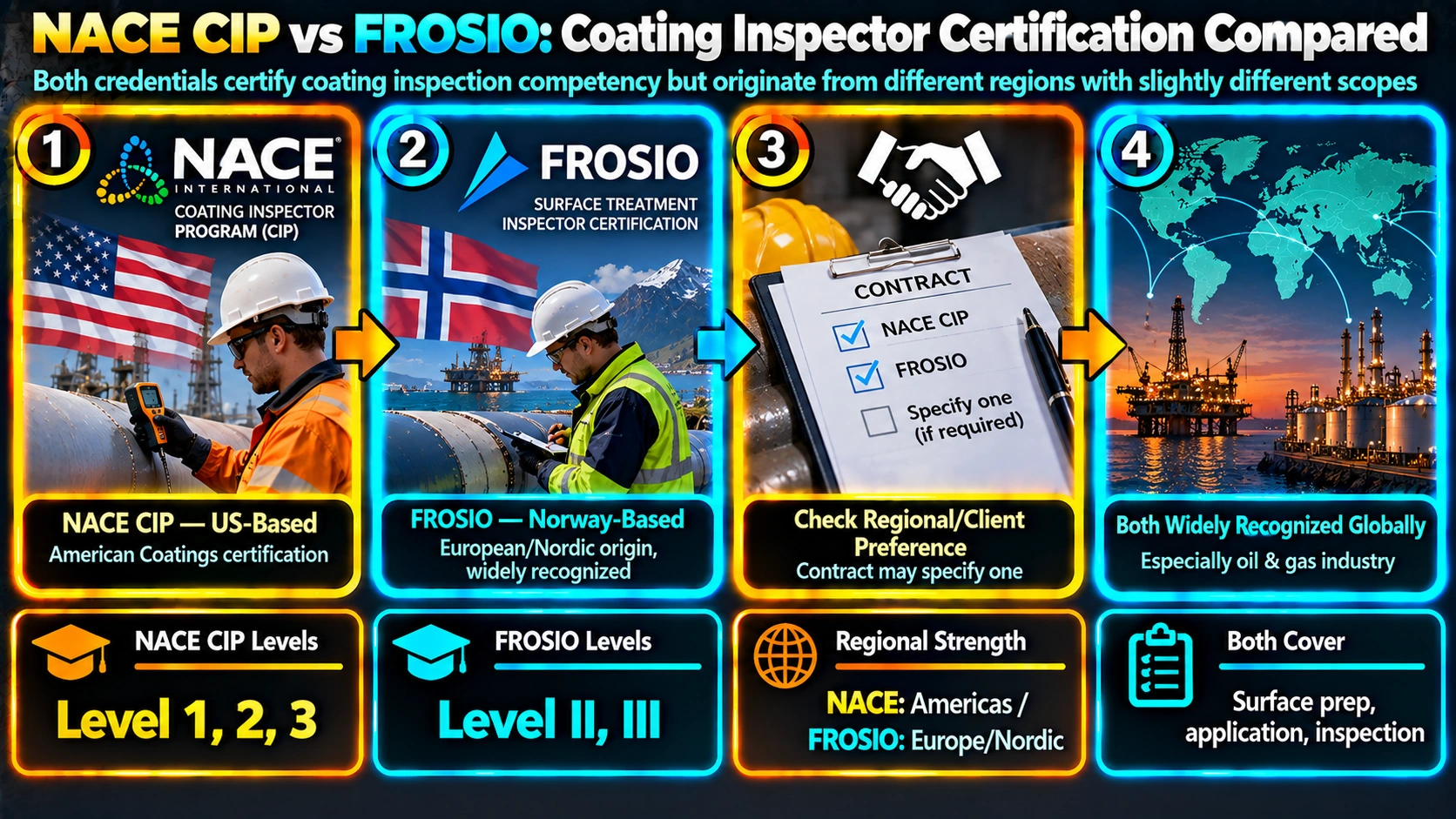
NACE International merged with SSPC in 2021 to form AMPP, the Association for Materials Protection and Performance, and the Coating Inspector Program (CIP) originally developed by NACE continues under the AMPP umbrella. FROSIO, an acronym derived from its Norwegian founding body (the Norwegian Professional Council for Education and Certification of Inspectors of Surface Treatment), was established independently in Norway and has become the dominant certification standard across Scandinavian and broader European offshore and marine coating work, particularly in the North Sea oil and gas sector.
NACE / AMPP CIP Structure
| Level | Typical Focus | Requirements |
|---|---|---|
| Level 1 | Fundamentals of coating inspection, basic testing methods | Classroom training + written/practical exam |
| Level 2 | Advanced inspection, specification interpretation | Level 1 held, additional training, exam |
| Level 3 | Peer-reviewed senior-level competency | Level 2 held, documented experience, peer review board |
CIP training covers surface preparation standards, coating types and application methods, environmental monitoring, film thickness and adhesion testing, holiday detection, and specification/documentation practice, closely mirroring the technical subject areas covered throughout this category, from blast cleanliness grading to film thickness verification.
FROSIO Structure
| Level | Typical Focus | Requirements |
|---|---|---|
| Level I | Basic surface treatment and coating inspection competency | Training course + examination |
| Level II | Broader inspection scope, more independent judgment | Level I held, documented experience, examination |
| Level III | Senior/advanced inspector role | Level II held, extensive documented experience, examination |
FROSIO certification includes distinct categories for surface treatment inspectors and paint/coating inspectors, and candidates should confirm which specific certificate category matches the type of inspection work they intend to perform, since the exact scope and terminology can differ from a simple “Level I/II/III” summary.
Head-to-Head Comparison
| Factor | NACE / AMPP CIP | FROSIO |
|---|---|---|
| Administering body | AMPP (formerly NACE International) | FROSIO (Norwegian professional council) |
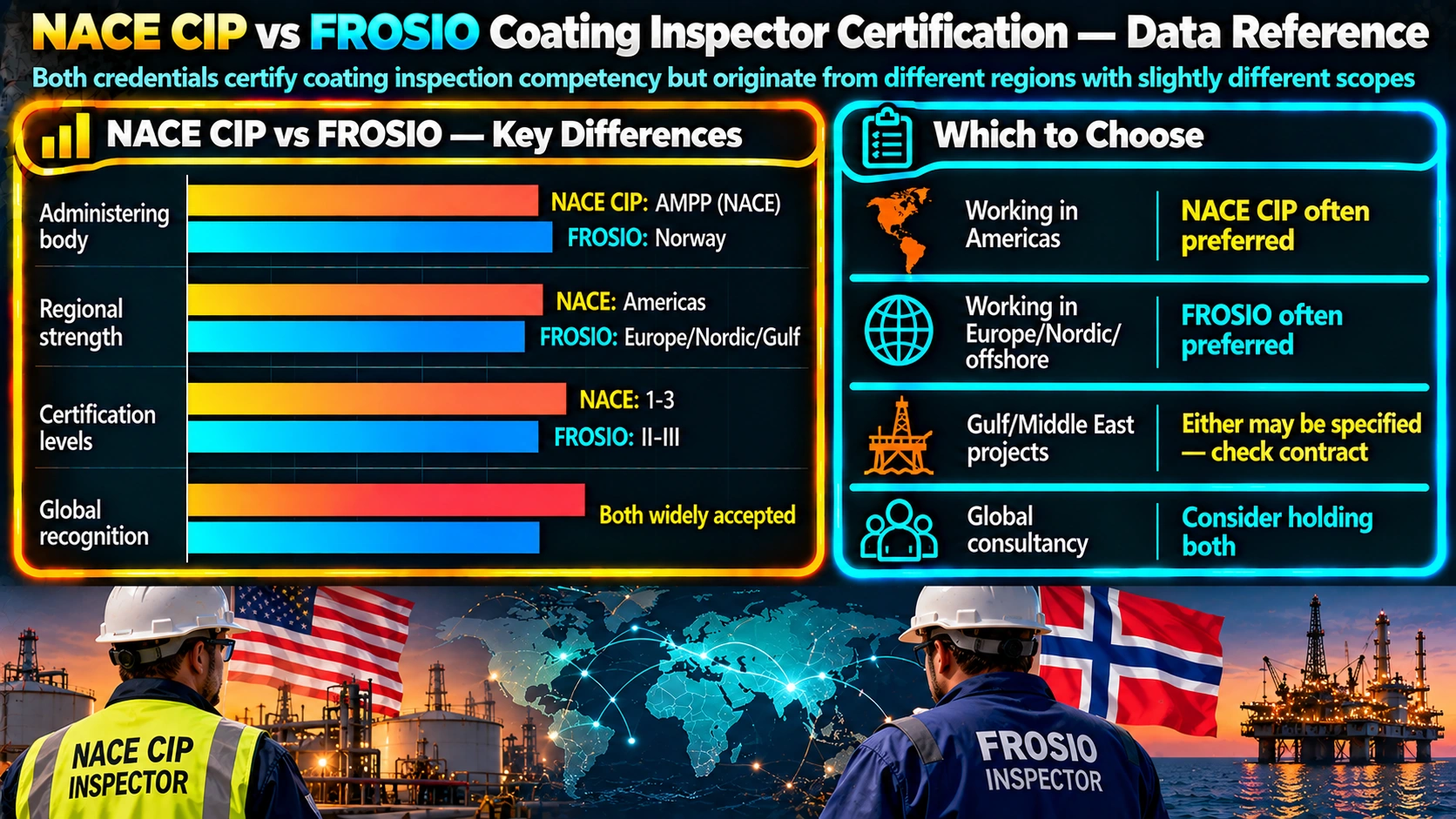
| Origin/strongest regional recognition | North America; broad global recognition | Norway/Scandinavia; strong North Sea/European offshore recognition |
| Number of levels | 3 (Level 1, 2, 3) | 3 (Level I, II, III) |
| Highest level requirement | Peer review board evaluation | Extensive documented experience + exam |
| Typical acceptance in Middle East / Asia | Widely accepted and often preferred/required | Accepted, less universally required than in Europe |
| Typical acceptance in Europe (esp. offshore) | Accepted, but FROSIO often specifically required | Frequently the specified requirement |
Individual project specifications and client requirements are the deciding factor on which certification (or both) is actually required for a given job, so always check the specific coating inspection and test plan or contract documents rather than assuming based on general regional trends alone.
Which Certification Should You Pursue?
| Career Situation | Recommendation |
|---|---|
| Working primarily in India, Middle East, or broad international contracting | NACE/AMPP CIP as primary certification |
| Targeting Scandinavian or North Sea offshore projects specifically | FROSIO as primary certification |
| Building a long-term international coating inspection career | Consider both over time, starting with the certification most relevant to current employer/region |
| New to coating inspection, unsure of career direction | Start with NACE/AMPP CIP Level 1 for broader initial recognition |
Why Certification Matters on Real Projects
A certified coating inspector is typically the person responsible for verifying and documenting every hold point covered in this category: confirming blast cleanliness grade and surface profile, verifying environmental conditions before application, checking wet and dry film thickness, performing holiday testing, and conducting pull-off adhesion testing where specified. Certification signals to employers and clients that the inspector has been formally trained and examined on this full scope of responsibility, not just picked it up informally on the job.
Both programs are widely respected precisely because they combine classroom knowledge with practical, experience-based exam components and, for higher levels, documented field experience requirements, reflecting the industry consensus that coating inspection competency cannot be built from theory alone.
Renewal and Continuing Requirements
Both NACE/AMPP CIP and FROSIO certifications are typically valid for a defined period and require renewal, which may involve continuing education, a renewal fee, and in some cases a refresher exam or documented ongoing professional practice, rather than being a one-time achievement. Inspectors should track renewal deadlines carefully, since an expired certification can affect project eligibility even for an inspector who remains professionally competent.
Maintain digital and physical copies of certification cards, exam completion certificates, and renewal confirmations, since project mobilisation and client vendor pre-qualification processes frequently require submitting proof of current, valid certification before an inspector can be approved to work on site.
Many coating inspectors also pursue complementary certifications relevant to broader QA/QC roles, such as welding inspection or NDT credentials, particularly on projects where coating inspection sits alongside mechanical testing and weld quality verification in the same overall inspection scope.
Recommended Reference Material
NACE CIP Level 1 Exam Study Guide
Study reference covering coating inspection fundamentals for NACE/AMPP CIP Level 1 certification.
View on AmazonProtective Coatings Inspection Handbook
Comprehensive reference covering surface preparation, application, and inspection procedures.
View on AmazonComplete Coating Inspection Field Instrument Kit
Combined DFT gauge, profile gauge, and adhesion tester kit for practical exam and field practice.
View on AmazonCorrosion and Coatings Reference Handbook
Broader technical reference on corrosion mechanisms and coating systems for inspector exam preparation.
View on AmazonDisclosure: WeldFabWorld participates in the Amazon Associates programme (StoreID: neha0fe8-21). If you purchase through these links, we may earn a small commission at no extra cost to you. This helps support free technical content on this site.
Frequently Asked Questions
What is the difference between NACE CIP and FROSIO certification?
NACE CIP, now administered under AMPP following the NACE-SSPC merger, is a coating inspector certification developed in North America with global recognition, structured across sequential levels each requiring classroom training and exams. FROSIO, developed by the Norwegian professional council for coating inspection, is widely recognised in Europe, particularly Scandinavia and the offshore North Sea industry, with a similar tiered structure but different exam format, standards emphasis, and administering body.
How many levels does NACE/AMPP CIP certification have?
NACE/AMPP CIP certification is structured across three progressive levels: Level 1 (Coating Inspector), Level 2 (Senior Coating Inspector), and Level 3 (Peer Review, the highest level), each requiring completion of the prior level and additional training, verified field experience, and a passing exam score, with Level 3 requiring a peer review board evaluation in addition to written and practical exams.
How many levels does FROSIO certification have?
FROSIO certification is structured across three levels, commonly Level I, Level II, and Level III, similarly progressing from basic inspection competency toward more advanced roles, with the exact certificate names and scope varying slightly by category (surface treatment inspector vs paint inspector). Each level requires documented practical experience alongside successful completion of the FROSIO examination for that level.
Which certification is more recognised offshore in Europe versus the Middle East and Asia?
FROSIO certification carries particularly strong recognition in Scandinavian and broader European offshore projects, especially North Sea oil and gas work, due to its Norwegian origin and regional industry adoption. NACE/AMPP CIP certification has broader global recognition overall and is commonly required or preferred on projects across North America, the Middle East, and much of Asia, including India, making it generally the more versatile choice for inspectors working across multiple regions.
Can a coating inspector hold both NACE CIP and FROSIO certification?
Yes, and many experienced coating inspectors working on international projects choose to hold both certifications, since some clients and regions specify one over the other, and holding both broadens the range of projects an inspector is qualified to bid for or be assigned to. There is no formal reciprocity or automatic cross-recognition between the two programs, so each must be pursued and maintained independently.
What prerequisites are typically needed before starting coating inspector certification?
Entry-level coating inspector certification courses generally have no formal prerequisite beyond a basic technical or trade background, though practical field experience in coatings, blasting, or related quality control work is strongly beneficial for passing the practical and field-based exam components. Higher levels (NACE CIP Level 2/3 and FROSIO Level II/III) require documented verified field experience and successful completion of the preceding level as formal prerequisites.