Dew Point and Humidity Calculation for Painting Operations
By WeldFabWorldAugust 17, 2026Updated: September 28, 2026
21 min read
Dew Point Calculation for Painting — Humidity Guide | WeldFabWorld
Dew Point and Humidity Calculation for Painting Operations
Painting & Coatings | By WeldFabWorld | Updated August 2026 | 14 min read
Dew point calculation for painting is the single environmental check that decides whether a coating shift can start, continue, or must stop. Before any blast cleaning or paint application begins, the applicator has to know two numbers: the dew point of the surrounding air, and the actual temperature of the steel surface. If the surface is too close to that dew point, moisture will condense directly onto freshly cleaned steel, and every coating specification from SSPC, ISO, and NACE treats that as an automatic hold point.
This page gives you a free calculator that converts dry-bulb temperature and relative humidity into dew point using the Magnus-Tetens formula, then compares it against your measured steel surface temperature to tell you, instantly, whether you are inside or outside the required safety margin. Below the calculator, we walk through the formula itself, a fully worked example, the differential requirements from the major coating standards, and the field instruments used to take these readings on a real job site.
Whether you are a coating inspector filling out a daily environmental log, a QA/QC engineer writing a site procedure, or an applicator trying to understand why a shift got held, this guide gives you the numbers and the reasoning behind them.
Dew Point & Surface Safety Margin Calculator
—
Dew Point
—
Surface Margin Above Dew Point
—
Painting Status
Scope note
This calculator uses the Magnus-Tetens approximation, which is accurate to within about 0.4 degC across the normal range of ambient painting conditions (0-50 degC, 20-100% RH). It is intended for field guidance and specification checking. Where a project explicitly mandates a sling psychrometer and ASTM E337 tables, use that method as the official record and treat this calculator as a quick cross-check.
Why Dew Point Control Matters in Coating Work
Steel does not need visible rain or fog to get wet. The moment its surface temperature drops to or below the dew point of the surrounding air, invisible water vapour condenses directly onto the metal. On a freshly abrasive-blasted surface, this moisture reacts almost immediately with the newly exposed, highly reactive steel to produce flash rust, a fine reddish-brown bloom that can appear within 30 to 60 minutes in humid, saline, or industrially polluted air.
Coating applied over a condensation film, or over steel that flash-rusted and was not re-cleaned, fails in predictable ways: loss of adhesion, osmotic blistering as trapped moisture tries to migrate back out through the film, pinholing where moisture droplets prevented proper wetting, and accelerated under-film corrosion that can undermine an otherwise correctly specified coating system years ahead of schedule. This is why coating and painting inspection tests always begin with an environmental check, not a film thickness reading.
Standards that govern this check
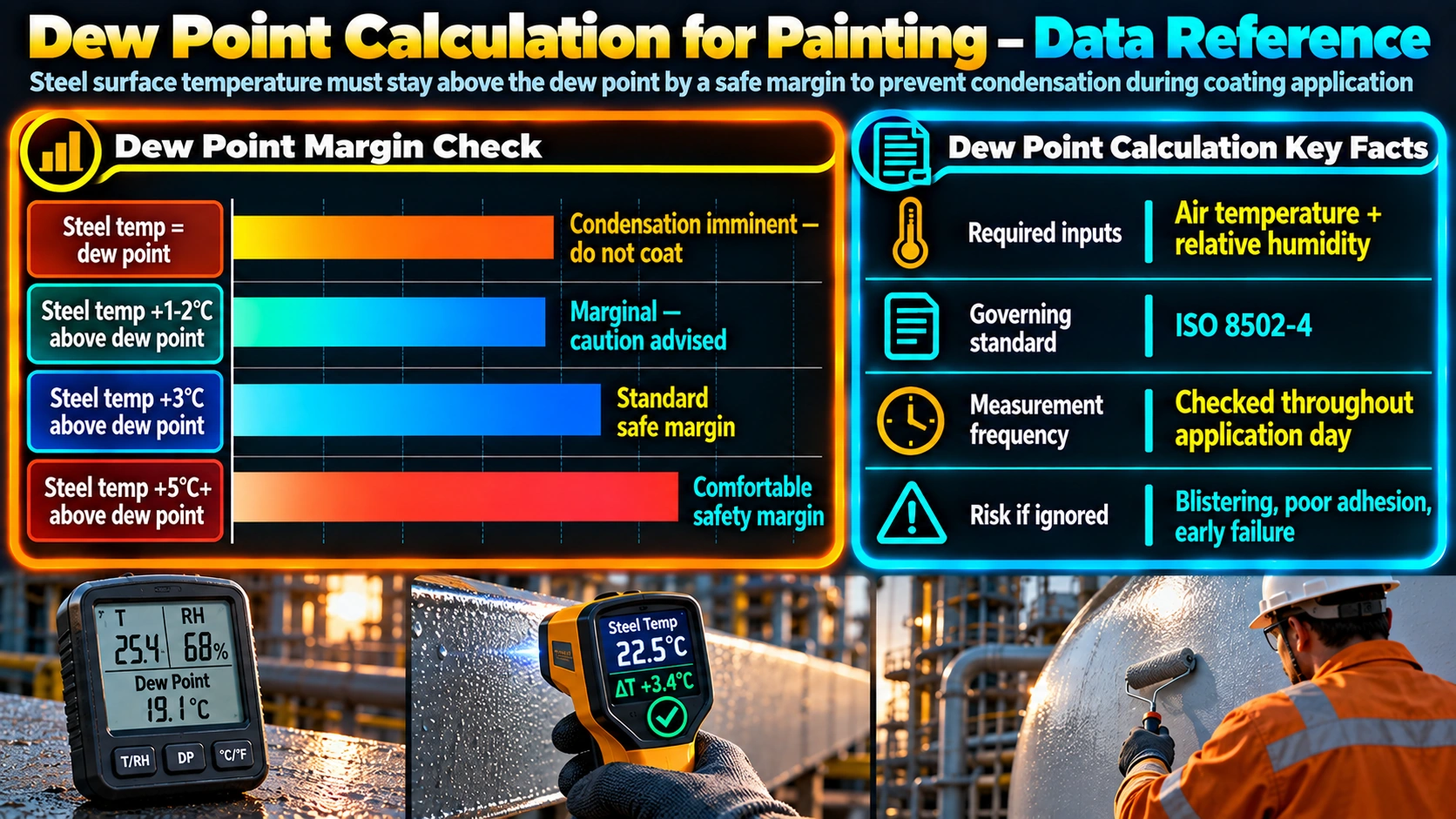
ISO 8502-4 (Guidance on the estimation of the probability of condensation prior to paint application), SSPC-PA Guide 20 (Chapter on ambient condition monitoring), NACE SP0178, and most major owner specifications (Shell DEP, ADNOC, Saudi Aramco) all require surface temperature to be measured directly and compared against calculated dew point before work starts and at regular intervals through the shift.
The Magnus-Tetens Dew Point Formula
Field crews historically used a sling psychrometer and printed tables to find dew point from wet-bulb and dry-bulb readings. Modern digital environmental meters, and this calculator, instead use the Magnus-Tetens approximation, which computes dew point directly from dry-bulb air temperature and relative humidity without needing a wet-bulb thermometer at all.
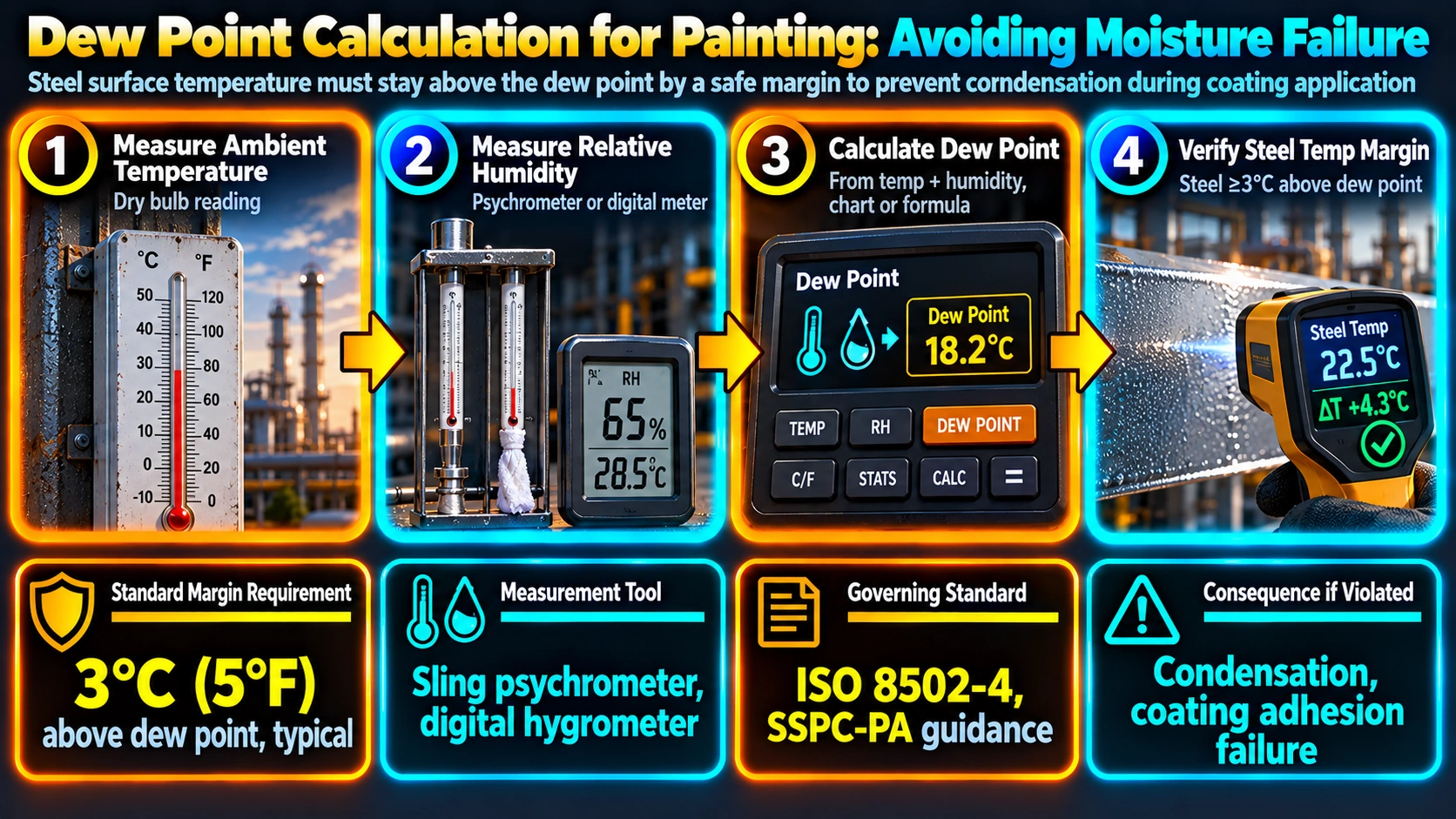
STEP 1 — Compute the intermediate term alphaalpha = ln(RH / 100) + (a * T) / (b + T)T = dry-bulb air temperature in degC, RH = relative humidity in %a = 17.27, b = 237.7 degC (Magnus-Tetens constants for water, 0-60 degC range)STEP 2 — Solve for dew point temperatureTd = (b * alpha) / (a – alpha)Td is returned in degC; convert to degF with Td_F = Td x 1.8 + 32 if requiredSTEP 3 — Compare surface temperature to dew pointMargin = Ts – TdTs = measured steel surface temperature (contact or infrared thermometer)If Margin is less than the specified minimum (typically 3 degC / 5 degF), HOLD work
Worked Example
A blasting crew takes readings at 09:00 on a coastal tank farm job: dry-bulb air temperature is 28.0 degC, relative humidity is 78%, and an infrared thermometer on a shaded section of the tank shell reads 27.4 degC. The project specification calls for the standard 3 degC minimum margin.
Note how close this example sits to the limit. A 1 degC rise in humidity, or a shift into the shade dropping surface temperature by a degree, would push the margin under 3 degC and force a hold. This is exactly why coating specifications require re-checks every two to four hours rather than a single reading at the start of the shift.
Minimum Differential Requirements by Standard
Standard / Guide
Minimum Surface-to-Dew-Point Margin
Typical Application
Status
SSPC-PA Guide 20
3 degC (5 degF)
General industrial and infrastructure coating
Widely used
ISO 8502-4
3 degC (5 degF), condition-dependent table
International projects, offshore, marine
Widely used
NACE SP0178
Project-specified, commonly 3 degC
Internal linings, immersion service
Verify spec
Aramco / ADNOC / Shell DEP
Often raised to 5 degC
Offshore platforms, high-humidity coastal sites
Stricter
Coating manufacturer TDS
Product-specific, may exceed generic guide
Any project — always the governing document
Always check
Governing document rule
When the generic standard, the owner specification, and the paint manufacturer’s technical data sheet disagree, the most conservative (largest) required margin always governs the work. Never default to the lowest number simply because it is the easiest to achieve.
Field Measurement Methods
Sling (Whirling) Psychrometer
The traditional method per ASTM E337. Two mercury or alcohol thermometers are mounted on a handle; one bulb is covered with a wetted wick. The instrument is whirled through the air for 60-90 seconds, and the wet-bulb depression (difference between dry-bulb and wet-bulb readings) is looked up against a psychrometric chart or slide rule to find both relative humidity and dew point directly.
Digital Dew Point Meters
Modern combined instruments use a capacitive humidity sensor and a thermistor or infrared surface probe, computing dew point electronically using the same Magnus-Tetens style approximation used in the calculator above. These give an instant digital readout of air temperature, relative humidity, surface temperature, dew point, and margin, and many models log timestamped readings automatically for the inspection record.
Contact vs. Infrared Surface Thermometers
Surface temperature must be measured on the actual steel being coated, never assumed equal to ambient air temperature. Contact thermometers (magnetic-back dial or digital) give the most reliable reading but require good contact and a few seconds’ dwell time. Infrared (non-contact) thermometers are faster for large or hot surfaces but are sensitive to emissivity settings and can be thrown off by reflective, wet, or shiny surfaces — always confirm the emissivity setting matches the coating or bare-metal condition being measured.
Practical tip
Take surface readings on the coldest accessible section of the structure, not the warmest. North-facing shaded steel, the underside of horizontal members, and areas exposed to overnight radiative cooling are typically the first to reach dew point, and they are where flash rusting or condensation failure will start.
Common Field Mistakes
Using a single morning reading for an entire shift instead of re-checking every 2-4 hours as conditions change.
Measuring ambient air temperature with a handheld meter and assuming it equals steel surface temperature, especially at sunrise or after rain.
Ignoring the effect of direct sun versus shade — the same structure can have a 5-10 degC surface temperature spread across different faces at the same time.
Applying the generic 3 degC rule when the project specification or manufacturer TDS calls for a stricter margin.
Not logging readings, so there is no objective record if a coating failure investigation later asks whether the environmental hold points were respected.
Related check
Dew point margin is one part of the full environmental envelope. You should also confirm relative humidity sits below the coating manufacturer’s stated maximum (commonly 85%), and that surface preparation and profile were verified beforehand — see our guide to coating and painting inspection tests for the full sequence.
Recommended Reference Reading
Protective Coatings: Fundamentals of Chemistry and Composition
Reference text covering coating chemistry, film formation, and environmental application limits for industrial protective systems.
Disclosure: WeldFabWorld participates in the Amazon Associates programme (StoreID: neha0fe8-21). If you purchase through these links, we may earn a small commission at no extra cost to you. This helps support free technical content on this site.
Figure 1 — As steel surface temperature falls toward evening, the safety margin above dew point narrows even if relative humidity has not changed, which is why late-shift re-checks are critical.
Setting Up an Environmental Monitoring Routine
A robust environmental monitoring routine for a coating shift generally follows a fixed sequence: take dry-bulb temperature and relative humidity with a calibrated instrument in an open, representative location away from direct exhaust or reflective heat sources; measure steel surface temperature directly on the coldest accessible part of the structure being worked; calculate dew point and margin using the formula above or an equivalent instrument; and log the reading with time, location, and the initials of the person taking it.
This should repeat at the start of the shift, at least every two to four hours through the day, and immediately after any visible weather change. On humid coastal or monsoon-season sites, many contractors tighten this to hourly checks during the most marginal periods, typically early morning and just after sunset when radiative cooling drops surface temperature fastest.
Documentation tip
Keep dew point logs alongside your wet film and dry film thickness records in the same daily inspection report. Coating failure investigations almost always start by asking whether the environmental hold points were checked and recorded, not just whether the film thickness was correct.
Figure 2 — Standard sequence for checking and documenting environmental conditions before and during a coating shift.
Frequently Asked Questions
Why must steel surface temperature stay above the dew point before painting?
When steel surface temperature drops to or below the dew point, moisture condenses directly on the surface as an invisible or visible film. This promotes flash rusting on freshly blasted steel, interferes with coating adhesion and wetting, can become trapped under the film, and often triggers pinholes, blistering, or premature disbondment. Every major coating specification requires a positive margin above dew point specifically to prevent this condensation. See our coating inspection tests guide for the full pre-paint check sequence.
What is the standard minimum temperature differential above dew point?
SSPC-PA Guide 20 and ISO 8502-4 both commonly reference a minimum of 3 degC (5 degF) between steel surface temperature and dew point before blasting or coating begins. Some owner specifications, particularly for offshore or coastal work, raise this to 5 degC or more. Always check the project-specific coating specification, since it governs over the generic guide value.
How is dew point calculated from dry-bulb temperature and relative humidity?
The most common field method uses the Magnus-Tetens approximation, which takes dry-bulb air temperature and relative humidity as inputs and returns dew point temperature directly, without needing a wet-bulb reading. Sling psychrometers instead measure wet-bulb and dry-bulb temperatures and use a look-up table or slide chart, per ASTM E337, to find dew point and relative humidity together.
Can I paint if relative humidity is high but the surface is still well above dew point?
Generally yes, provided the steel surface temperature clears the required margin above dew point and stays within the coating manufacturer’s maximum relative humidity limit, usually 85 percent, since some products such as moisture-cure urethanes are more tolerant of humidity than others. High relative humidity alone is not disqualifying; the surface-to-dew-point margin and the product data sheet limits both need to be satisfied together.
What instruments are used to measure dew point on site?
Common instruments include the sling (whirling) psychrometer with wet and dry bulb thermometers, digital dew point meters that combine an air temperature and humidity probe with a contact or infrared surface thermometer, and dedicated environmental monitoring stations that log dry-bulb temperature, relative humidity, surface temperature, and calculated dew point continuously through a shift.
How often should dew point be checked during a painting shift?
Most specifications, including SSPC-PA Guide 20 and typical NACE SP0178 based project procedures, require readings at the start of the shift, then at intervals of two to four hours, and immediately whenever conditions visibly change, such as clouds clearing, wind shifting, or a sudden temperature drop near sunset. Readings should be logged on the inspection record together with the calculated margin above dew point.
Does wind speed or direct sunlight affect the dew point calculation?
Wind speed and sunlight do not change the calculated dew point itself, which depends only on dry-bulb temperature and relative humidity, but they strongly affect the steel surface temperature that is compared against it. Direct sun can raise surface temperature well above ambient, while a clear night sky with radiative cooling can drop surface temperature below ambient air temperature even when the air itself feels mild, which is why the surface reading must always be measured directly rather than assumed equal to ambient.