The hot dip galvanizing process turns bare fabricated steel into a zinc-coated product that can resist atmospheric corrosion for decades, but only if the steel is designed, prepared, dipped and inspected correctly. Most galvanizing problems trace back to design details or steel chemistry, not to the bath itself.
Quick Answer
The hot dip galvanizing process cleans steel by degreasing, pickling and fluxing, then dips it in molten zinc at about 450 °C, where zinc reacts with iron to form a bonded coating of iron-zinc alloy layers under a pure zinc surface. Inspection under ASTM A123 checks finish, thickness with a magnetic gauge, and adhesion, and uncoated areas are repaired to ASTM A780.
This guide covers the process steps, the coating structure, the effect of steel chemistry, the standards, inspection and acceptance, common defects and repair, with a worked estimate of zinc life. It focuses on the coating itself. For welding steel that is already galvanized, including fume control, see our galvanized steel welding hazards and best practices guide, and for choosing between coating systems by environment, see the anti-corrosive coating selection guide.
Thickness limits, sampling plans and acceptance criteria change between editions of the standards. Treat the figures below as engineering orientation, and use the edition cited in your contract.
Key Takeaways
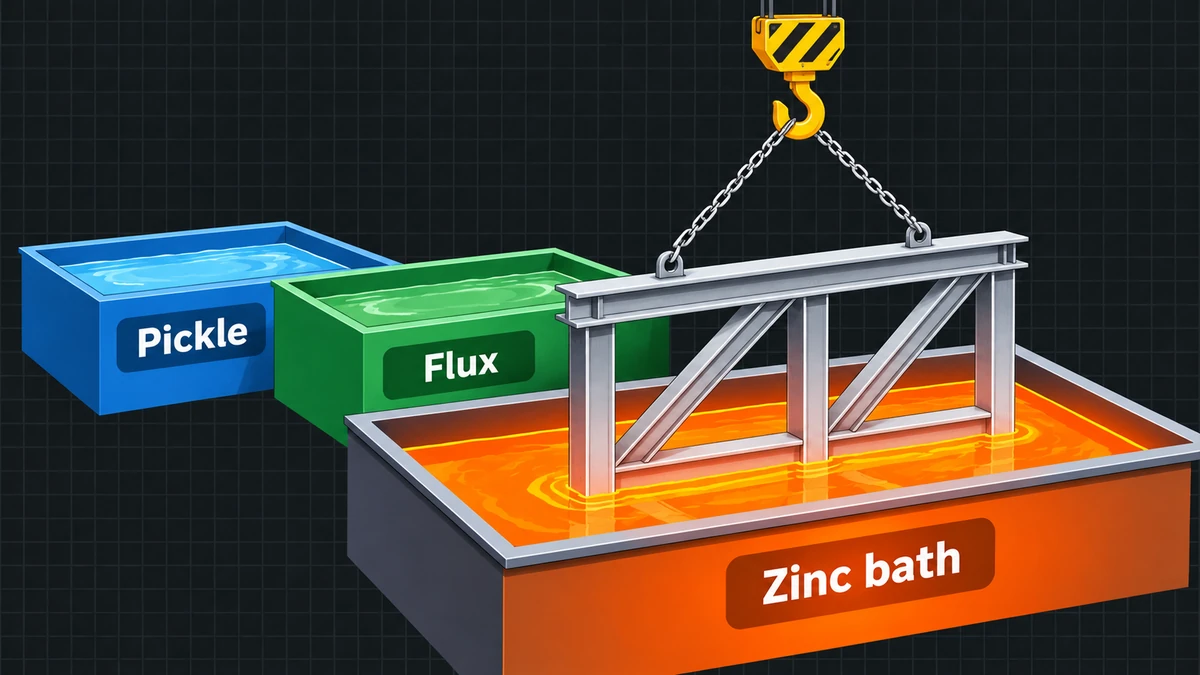
- The process is degrease, pickle, rinse, flux, dry, dip in zinc at about 450 °C, withdraw and cool.
- The coating is a series of iron-zinc alloy layers topped by a pure zinc layer, metallurgically bonded to the steel.
- Steel silicon and phosphorus content controls coating thickness and appearance, through the Sandelin effect.
- ASTM A123 requires an average of 100 microns for structural steel of 6.4 mm and above, checked with a magnetic gauge on a sampled basis.
- Vent holes, drain holes and clean surfaces before dipping prevent most defects and safety problems.
What Is the Hot Dip Galvanizing Process?
The hot dip galvanizing process is a coating method in which cleaned steel is immersed in molten zinc to form a metallurgically bonded zinc and iron-zinc alloy coating.
Zinc protects steel in two ways. It forms a barrier, and it protects sacrificially, because zinc corrodes in preference to steel at small scratches and cut edges. This galvanic action is the same principle used in zinc-rich primers, which are compared in the epoxy primer versus zinc-rich primer guide. Batch galvanizing of fabricated steel is the subject of this guide, while continuous galvanizing of sheet coil is a separate industrial process. For related topics, browse the Painting & Coatings articles.
What Are the Steps in the Hot Dip Galvanizing Process?
Batch galvanizing is a sequence of cleaning, fluxing and dipping steps, and every step exists to give molten zinc a chemically clean steel surface to react with.
- Degreasing: an alkaline or acid cleaner removes oil, grease and dirt. Pickling acid does not remove these, nor does it remove paint, weld slag or heavy marking.
- Pickling: a dilute acid bath, commonly hydrochloric acid, removes mill scale and rust. Rinsing follows to remove acid and iron salts.
- Fluxing: immersion in a zinc ammonium chloride solution cleans the surface of remaining oxides and protects it from re-oxidizing before the zinc bath.
- Drying: the flux is dried so that water does not enter the zinc bath, which would cause splashing and defects.
- Galvanizing: parts are immersed in molten zinc at about 450 °C until they reach bath temperature, during which zinc reacts with iron to form the alloy layers.
- Withdrawal and finishing: parts are lifted out slowly, excess zinc drains or is removed, and the parts are air cooled or quenched in water.
- Inspection: finish and thickness are checked before the parts are released, as described later in this guide.
Weld slag, paint, oil-based markers and anti-spatter compounds are not removed by pickling, so the fabricator must clean them off before delivery to the galvanizer. Fumes from the bath and from any later welding are a separate health matter, covered in the welding guide linked in the introduction.
What Is the Structure of a Galvanized Coating?
A galvanized coating is a stack of iron-zinc alloy layers topped by a layer of nearly pure zinc, and the alloy layers are harder than the base steel.
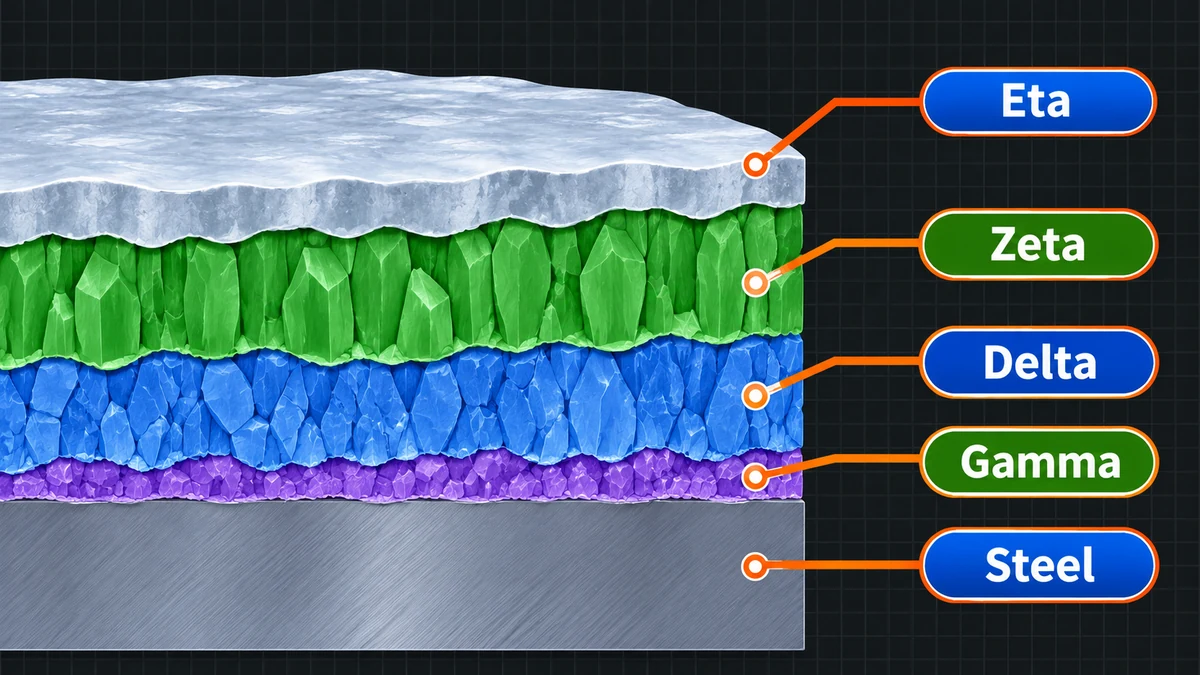
| Layer (from steel outward) | Approximate iron content | Approximate hardness (DPN) | Role |
|---|---|---|---|
| Gamma (Γ) | 21 to 28% | About 250 | Thin, hard layer bonded to the steel |
| Delta (δ) | 7 to 12% | About 244 | Main hard alloy layer |
| Zeta (ζ) | About 6% | About 179 | Thicker, more brittle alloy layer |
| Eta (η) | Essentially none (pure zinc) | About 70 | Soft outer layer that absorbs impact |
The alloy layers give the coating good abrasion resistance, and the metallurgical bond means the coating cannot be scraped off like a paint film. Coating thickness grows with immersion time and with the reactivity of the steel, and it is checked against the standards described below.
How Does Steel Chemistry Affect Galvanizing?
Silicon and phosphorus in the steel change how fast the iron-zinc layers grow, which determines coating thickness, appearance and brittleness.
The effect is called the Sandelin effect. Steels with low silicon, below about 0.04 percent, and with silicon plus 2.5 times phosphorus below about 0.09 percent, generally give normal coatings. Steels with silicon in a reactive range of roughly 0.04 to 0.14 percent, and steels above about 0.22 percent, can give very fast growth, producing thick, dull grey coatings that may be brittle and easily damaged.
| Silicon content | Typical growth | Typical appearance |
|---|---|---|
| Below about 0.04% | Normal | Bright, smooth |
| About 0.04 to 0.14% (Sandelin range) | Very rapid | Dull grey, thick, can be rough |
| About 0.14 to 0.22% | Moderate | Mixed, often acceptable |
| Above about 0.22% | Increases with silicon | Thick, dark grey |
Review the heat analysis on the mill test certificate before fabrication, as described in the incoming material checking rules, and tell the galvanizer about reactive steel. A thick grey coating is not a defect by itself, but it can chip at edges, so check it against the specification.
Which Standards Govern Hot Dip Galvanizing?
ASTM A123 covers general fabricated products, ASTM A153 covers hardware and fasteners, and ISO 1461 is the main international equivalent.
| Standard | Title | Scope |
|---|---|---|
| ASTM A123/A123M | Zinc (Hot-Dip Galvanized) Coatings on Iron and Steel Products | Fabricated structural steel, plates, bars, pipe and tube |
| ASTM A153/A153M | Zinc Coating (Hot-Dip) on Iron and Steel Hardware | Fasteners and small hardware |
| ASTM A767/A767M | Zinc-Coated (Galvanized) Steel Bars for Concrete Reinforcement | Rebar |
| ASTM A653/A653M | Steel Sheet, Zinc-Coated by the Hot-Dip Process | Continuous sheet products |
| ASTM A385/A385M | Providing High-Quality Zinc Coatings (Hot-Dip) | Design guidance for galvanizing |
| ASTM A143/A143M | Safeguarding Against Embrittlement of Hot-Dip Galvanized Structural Steel Products | Embrittlement control |
| ASTM A780/A780M | Repair of Damaged and Uncoated Areas of Hot-Dip Galvanized Coatings | Repair methods |
| ASTM E376 | Measuring Coating Thickness by Magnetic-Field or Eddy-Current Methods | Thickness measurement |
| ISO 1461 | Hot dip galvanized coatings on fabricated iron and steel articles | Specification and test methods |
| ISO 14713-2 | Zinc coatings – Guidelines for protection against corrosion of iron and steel in structures – Part 2: Hot dip galvanizing | Design and durability guidance |
| IS 4759 | Hot-dip zinc coatings on structural steel and other allied products | Indian standard |
The ASTM International standards and the American Galvanizers Association publish detailed guidance, and in India IS 2629 gives recommended practice for galvanizing. Always name the exact standard in the purchase order.
How Is Hot Dip Galvanizing Inspected?
Hot dip galvanizing is inspected for finish, thickness and adhesion, and the result is compared with the standard and the purchase order.
| Check | Method | Typical acceptance |
|---|---|---|
| Visual finish | Visual examination of all surfaces | Continuous coating, free of bare spots, blisters, flux deposits and sharp projections |
| Thickness | Magnetic or eddy-current gauge per ASTM E376 | Average meets the standard’s minimum for the steel category and thickness |
| Adhesion | Handling and a simple knife test | Coating stays attached under normal handling |
| Coating weight (if required) | Stripping test per ASTM A90 | Meets the specified mass per area |
| Repair areas | Visual and thickness check | Repaired to ASTM A780 within allowed area limits |
Under ASTM A123 the number of articles sampled depends on lot size: all articles for lots of 1 to 3 pieces, 3 articles for 4 to 500, 5 for 501 to 1,300, 8 for 1,301 to 3,200, 13 for 3,201 to 10,000 and 20 for larger lots. On each sampled article, thickness is taken as the average of several spot measurements, and gauges must be calibrated on a known thickness standard. Surface preparation checks for later painting follow the methods in the coating and painting tests guide.
What Coating Thickness Is Required?
Minimum thickness rises with steel thickness, and ASTM A123 and ISO 1461 set different values using different measurement rules.
| Standard | Steel thickness band | Minimum average thickness, microns |
|---|---|---|
| ASTM A123 (shapes, plates, bars) | Under 1.6 mm | 45 |
| ASTM A123 | 1.6 to under 3.2 mm | 65 |
| ASTM A123 | 3.2 to under 4.8 mm | 75 |
| ASTM A123 | 4.8 to under 6.4 mm | 85 |
| ASTM A123 | 6.4 mm and above | 100 |
| ISO 1461 (steel) | Under 1.5 mm | 45 |
| ISO 1461 | 1.5 to 3 mm | 55 |
| ISO 1461 | Over 3 to 6 mm | 70 |
| ISO 1461 | Over 6 mm | 85 |
The bands do not line up exactly because the two standards use different steel thickness ranges and different measurement rules. ISO 1461 also sets a lower local minimum for individual measurements. Heavier steel gets thicker coatings, and reactive steel can exceed the minimums by a large margin. Typical hot dip coatings on general fabrications fall in the range of about 45 to 100 microns.
What Are the Common Galvanizing Defects?
Galvanizing defects come from surface preparation, design, steel chemistry or handling, and each has a recognizable cause and remedy.
| Defect | Typical cause | Typical remedy |
|---|---|---|
| Bare or black spots | Weld slag, paint, oil or scale not removed | Clean before dipping; repair to ASTM A780 |
| Dross inclusions | Hard iron-zinc particles from the bath | Control bath practice; remove or repair local lumps |
| Runs and drips | Zinc drainage on edges and holes | Better draining design; finish by grinding or filing |
| Blisters | Trapped air, moisture or scale under the coating | Vent sealed spaces; clean steel properly |
| Rough, dark grey coating | Reactive steel (silicon, phosphorus) | Check chemistry; accept if thickness and adhesion are met |
| White rust | Wet storage with poor airflow | Store ventilated; remove heavy deposits |
| Distortion | Thermal stress and uneven heating | Symmetric designs; avoid thin and thick mixes |
| Embrittlement cracking | Cold working, high-strength steel or hydrogen from pickling | Follow ASTM A143; design to avoid |
High-strength steel above roughly 1,000 MPa can be sensitive to hydrogen picked up during acid pickling, as explained in the hydrogen embrittlement versus hydrogen cracking article. Highly stressed steels with high carbon equivalent can also suffer liquid metal assisted cracking, so use the carbon equivalent calculator when reviewing susceptible members. General coating failure modes are discussed in the coating defects guide.
How Should Steel Be Designed for Galvanizing?
Good design lets molten zinc and cleaning fluids flow in and out freely and lets air and steam escape, which prevents defects and explosions.
- Vent and drain holes: hollow sections and closed boxes need holes so that air and steam escape and zinc drains. Sealed sections can burst, which is a serious safety hazard.
- Overlapping surfaces: tight laps trap pickling acid and moisture and cause bleed-out stains. Seal-weld them fully or leave an open gap, and see the guidance in crevice corrosion causes and prevention for related concerns.
- Size and handling: parts must fit the kettle, and long members may need double dipping. Lifting points and balanced shapes avoid distortion.
- Mixed thickness: thin and thick members heat at different rates and can distort or crack, so keep thickness changes gradual.
- Welding for galvanizing: use continuous welds, remove slag and spatter, and avoid silicone-based anti-spatter products. ASTM A385 and ASTM A384 give detailed design guidance.
- Dissimilar metals: contact between zinc and other metals can set up galvanic cells, as explained in the galvanic corrosion in dissimilar metal welds article.
How Are Damaged Areas Repaired and Is Painting Allowed?
Damaged or bare areas are repaired to ASTM A780, and galvanized steel can be painted as part of a duplex coating system.
ASTM A780 allows repair by zinc-based solder, by zinc-rich paint with a high zinc content, or by thermal spraying of zinc. ASTM A123 limits the size and total share of areas that may be repaired before a part must be re-galvanized. Repairs are inspected for finish and thickness like the original coating.
Duplex systems, a zinc layer plus paint, can last considerably longer than either alone in harsh environments. The principle is discussed in the marine and offshore coating systems guide, and surface preparation for paint over galvanizing follows ASTM D6386. Newly galvanized surfaces are smooth and may need light sweep blasting or a specified treatment for paint adhesion.
How Long Will the Zinc Coating Last? Worked Example
A simple life estimate divides the zinc thickness by the zinc corrosion rate for the atmosphere, which shows how strongly environment controls galvanizing life.
The example uses a 100 micron coating, the ASTM A123 minimum for steel of 6.4 mm and above, and zinc corrosion rate ranges from the ISO 9223 categories. The rates are rounded, and the result is only the time to consume the zinc, not the time to first maintenance.
LIFE = t / r C3: 100 / 2.1 = 47.6 years to 100 / 0.7 = 142.9 years C4: 100 / 4.2 = 23.8 years to 100 / 2.1 = 47.6 years C5: 100 / 8.4 = 11.9 years to 100 / 4.2 = 23.8 years CX: 100 / 25 = 4.0 years to 100 / 8.4 = 11.9 years
COATING MASS (for ordering zinc or checking weight) Mass per area = t x density = 100 x 10^-6 m x 7,140 kg/m3 Mass = 0.714 kg/m2 (about 714 g/m2)
STEEL REACTIVITY CHECK (silicon 0.02%, phosphorus 0.015%) Si + 2.5 x P = 0.02 + 2.5 x 0.015 = 0.0575% Below 0.09% and Si below 0.04%, so normal coating growth is expected
Corrosivity categories and coating durability ranges are explained in the corrosion types and prevention guide. Use ISO 14713 for real design, because it accounts for factors such as local conditions, thickness variation and the definition of first maintenance.
Example Only
This is a teaching estimate. Actual life depends on the exact environment, coating thickness, maintenance practice and the end-of-life criterion used.
How Do You Specify and Inspect Hot Dip Galvanizing?
A good specification covers design, steel, standard, inspection and records. The numbered procedure follows that order.
- Design the fabrication for galvanizing. Add vent and drain holes to hollow sections, avoid sealed overlaps, and confirm the part fits the galvanizing kettle.
- Check steel chemistry and prepare the surface. Review silicon and phosphorus on the mill certificate and remove weld slag, paint, oil and marking before sending parts to the galvanizer.
- Specify the standard and coating thickness. Name the governing standard, such as ASTM A123, ASTM A153 or ISO 1461, and any thickness, finish and testing requirements.
- Agree the inspection plan. Define sampling, thickness gauge calibration, visual acceptance criteria and a hold point before the parts leave the galvanizer.
- Plan repair, post-treatment and storage. Specify ASTM A780 repair methods, any passivation or paint preparation, and ventilated storage to avoid wet storage stain.
- Record and close out. Keep the galvanizer certificate, thickness readings, repair records and inspection report with the quality documents.
Quick Reference: Which Galvanizing Standard for Which Product?
The table summarizes common practice and does not replace the project specification.
| Product | Typical standard | Reason |
|---|---|---|
| Structural steel, plate, bars and fabrications | ASTM A123 or ISO 1461 | General fabricated products |
| Bolts, nuts and small hardware | ASTM A153 | Hardware coating requirements |
| Reinforcing bar | ASTM A767 | Rebar-specific requirements |
| Sheet in coil | ASTM A653 | Continuous line product |
| Repair of damage | ASTM A780 | Accepted repair methods |
| Painting over galvanizing | ASTM D6386 | Surface preparation for paint |
What Are the Common Mistakes With Galvanizing?
Most mistakes come from design and communication, not from the galvanizing plant.
- Sealed hollow sections without vent and drain holes.
- Weld slag, paint or markings left on steel, which pickling cannot remove.
- Ignoring steel chemistry and expecting a bright finish on reactive steel.
- Over-specifying appearance when the real requirement is thickness and adhesion.
- Not stating the standard or the repair requirements in the order.
- Stacking wet parts tightly, which leads to white rust.
- Treating a rough grey coating as a reject without measuring thickness.
Edition and Contract Notice
Thickness limits, sampling plans and repair rules change between editions. The edition cited in your contract governs, not the values in this guide.
Key Terms
- Hot dip galvanizing
- Coating of steel by immersion in molten zinc to form a bonded zinc and iron-zinc coating.
- Pickling
- Acid cleaning that removes mill scale and rust before fluxing.
- Flux
- A zinc ammonium chloride solution that cleans and protects steel just before the zinc bath.
- Sandelin effect
- The strong effect of silicon content on the growth rate of the iron-zinc alloy layers.
- Dross
- Hard iron-zinc particles that settle in the bath and can become inclusions in the coating.
- Wet storage stain
- White powdery zinc corrosion products from stacking freshly galvanized parts wet.
- Duplex system
- A galvanized coating with an additional paint system on top.
Standards and References
- ASTM A123/A123M, Standard Specification for Zinc (Hot-Dip Galvanized) Coatings on Iron and Steel Products, ASTM International.
- ASTM A153/A153M, Standard Specification for Zinc Coating (Hot-Dip) on Iron and Steel Hardware, ASTM International.
- ASTM A767/A767M, Standard Specification for Zinc-Coated (Galvanized) Steel Bars for Concrete Reinforcement, ASTM International.
- ASTM A653/A653M, Standard Specification for Steel Sheet, Zinc-Coated (Galvanized) or Zinc-Iron Alloy-Coated (Galvannealed) by the Hot-Dip Process, ASTM International.
- ASTM A385/A385M, Standard Practice for Providing High-Quality Zinc Coatings (Hot-Dip), ASTM International.
- ASTM A384/A384M, Standard Practice for Safeguarding Against Warpage and Distortion During Hot-Dip Galvanizing of Steel Assemblies, ASTM International.
- ASTM A143/A143M, Standard Practice for Safeguarding Against Embrittlement of Hot-Dip Galvanized Structural Steel Products and Procedure for Detecting Embrittlement, ASTM International.
- ASTM A780/A780M, Standard Practice for Repair of Damaged and Uncoated Areas of Hot-Dip Galvanized Coatings, ASTM International.
- ASTM A90/A90M, Standard Test Method for Weight [Mass] of Coating on Iron and Steel Articles with Zinc or Zinc-Alloy Coatings, ASTM International.
- ASTM E376, Standard Practice for Measuring Coating Thickness by Magnetic-Field or Eddy-Current (Electromagnetic) Examination Methods, ASTM International.
- ASTM D6386, Standard Practice for Preparation of Zinc (Hot-Dip Galvanized) Coated Iron and Steel Product and Hardware Surfaces for Painting, ASTM International.
- ISO 1461, Hot dip galvanized coatings on fabricated iron and steel articles – Specifications and test methods, ISO.
- ISO 14713-1 and ISO 14713-2, Zinc coatings – Guidelines and recommendations for the protection against corrosion of iron and steel in structures, ISO.
- ISO 9223, Corrosion of metals and alloys – Corrosivity of atmospheres – Classification, determination and estimation, ISO.
- IS 4759, Hot-dip zinc coatings on structural steel and other allied products, and IS 2629, Recommended practice for hot-dip galvanizing of iron and steel, Bureau of Indian Standards.
Frequently Asked Questions
What is the temperature of the zinc bath in hot dip galvanizing?
The zinc bath is normally held at about 450 degrees C (roughly 840 degrees F), within a typical range of about 435 to 455 degrees C. At that temperature the steel reacts with the molten zinc to form the iron-zinc alloy layers. Immersion time depends on the mass and thickness of the steel, since the part must reach bath temperature.
How thick is a hot dip galvanized coating?
For general fabrications the coating is typically about 45 to 100 microns or more, and it rises with steel thickness. ASTM A123 sets minimum average thickness by material category and steel thickness, with 100 microns for structural steel of 6.4 mm and above. Reactive steels with higher silicon can give much thicker coatings.
Why is my galvanized coating dark grey and rough?
A dark, rough or patchy grey coating is usually caused by the steel chemistry, mainly silicon and phosphorus, which makes the iron-zinc alloy layers grow through to the surface. It is often thicker than normal, and it may be acceptable if the thickness and adhesion requirements are met. The surface finish requirement in the specification decides acceptance, not the color alone.
How do you inspect hot dip galvanizing?
Inspection normally covers visual finish, coating thickness and adhesion. The finish should be continuous and free of bare spots, blisters, flux deposits and sharp projections. Thickness is measured with a magnetic or eddy-current gauge as described in ASTM E376, using the sampling plan in ASTM A123, and adhesion is checked by a simple handling or knife test. Tests used for other coatings are described in the coating test methods.
What is white rust on galvanized steel?
White rust, also called wet storage stain, is a white powdery deposit of zinc corrosion products that forms when freshly galvanized parts are stacked wet with poor air circulation. A light stain is generally acceptable and weathers away, but heavy deposits should be removed and the remaining thickness checked. Storing parts separated and ventilated prevents it.
Can you weld or paint over hot dip galvanizing?
Yes, both are possible with the right preparation. Welding needs zinc removed near the joint and good fume control, as described in the welding galvanized steel safely article. Painting over galvanizing, called a duplex system, needs the surface cleaned and often lightly blasted or treated to follow ASTM D6386 and the paint manufacturer’s instructions.
How long does hot dip galvanizing last?
Life depends on the corrosivity of the environment and the coating thickness. A simple estimate divides the zinc thickness by the zinc corrosion rate for the ISO 9223 category, which for a 100 micron coating gives roughly 48 to 143 years in a C3 atmosphere but only about 4 to 12 years in the most corrosive CX category. Real time to first maintenance is shorter, so use ISO 14713 for design.
Conclusion
The hot dip galvanizing process gives fabricated steel a bonded zinc coating that protects by barrier and sacrificial action, and its quality depends on design details, steel chemistry, preparation and inspection. Provide vent and drain holes, clean off slag and paint, review silicon and phosphorus on the mill certificate, and name the governing standard and repair method in the order. Inspect finish, thickness and adhesion at the galvanizer before the parts are released, and store them ventilated to avoid white rust. As a next step, compare galvanizing with other options in the environment-based coating selection guide and plan any welding after galvanizing with the guide on welding after galvanizing and fume control.
About This Guide
This guide was prepared by the WeldFabWorld technical team from the standards listed in Standards and References. Verify every requirement against the code edition and specification that apply to your project.