Creep in Metals: Mechanisms, Stages, and Design Implications for High-Temperature Service
Creep in metals is the time-dependent plastic deformation that occurs under sustained mechanical stress at elevated temperatures, and it is among the most consequential material behaviours that welding engineers, pressure vessel designers, and power plant operators must understand and design against. Unlike yield or fracture — which occur rapidly at a critical stress threshold — creep accumulates slowly and silently over thousands of operating hours, eventually leading to dimensional changes, loss of pre-stress, or sudden rupture without prior warning. Every high-temperature pressure component, from boiler headers and turbine rotors to refinery reactors and steam piping, is subject to creep throughout its service life.
The significance of creep goes beyond simple deformation. In welded joints, creep behaviour is complicated by the heterogeneous microstructure created by the welding thermal cycle. The base metal, the weld metal, and the various sub-zones of the heat-affected zone (HAZ) all have different microstructures and therefore different creep rates. Under sustained loading, stress redistribution occurs across these mismatched zones, concentrating creep damage in the weakest region. In Creep-Strength-Enhanced Ferritic (CSEF) steels such as P91 and P92 — now widely used in ultra-supercritical power plants — this leads to a well-documented and potentially catastrophic failure mode known as Type IV cracking, which occurs in the fine-grained intercritical HAZ of circumferential welds.
This article provides a complete engineering reference on creep in metals: the temperature threshold at which creep becomes relevant, the three stages of the creep curve and the physical mechanisms driving them, the mathematical models used for design and life assessment, the ASME code framework for creep-limited pressure design, and the critical implications for welded structures in high-temperature service. Whether you are preparing a welding procedure for P91 headers, reviewing fitness-for-service of aged boiler components, or studying for professional certification, this guide provides the technical depth you need.
Temperature Threshold: When Does Creep Begin?
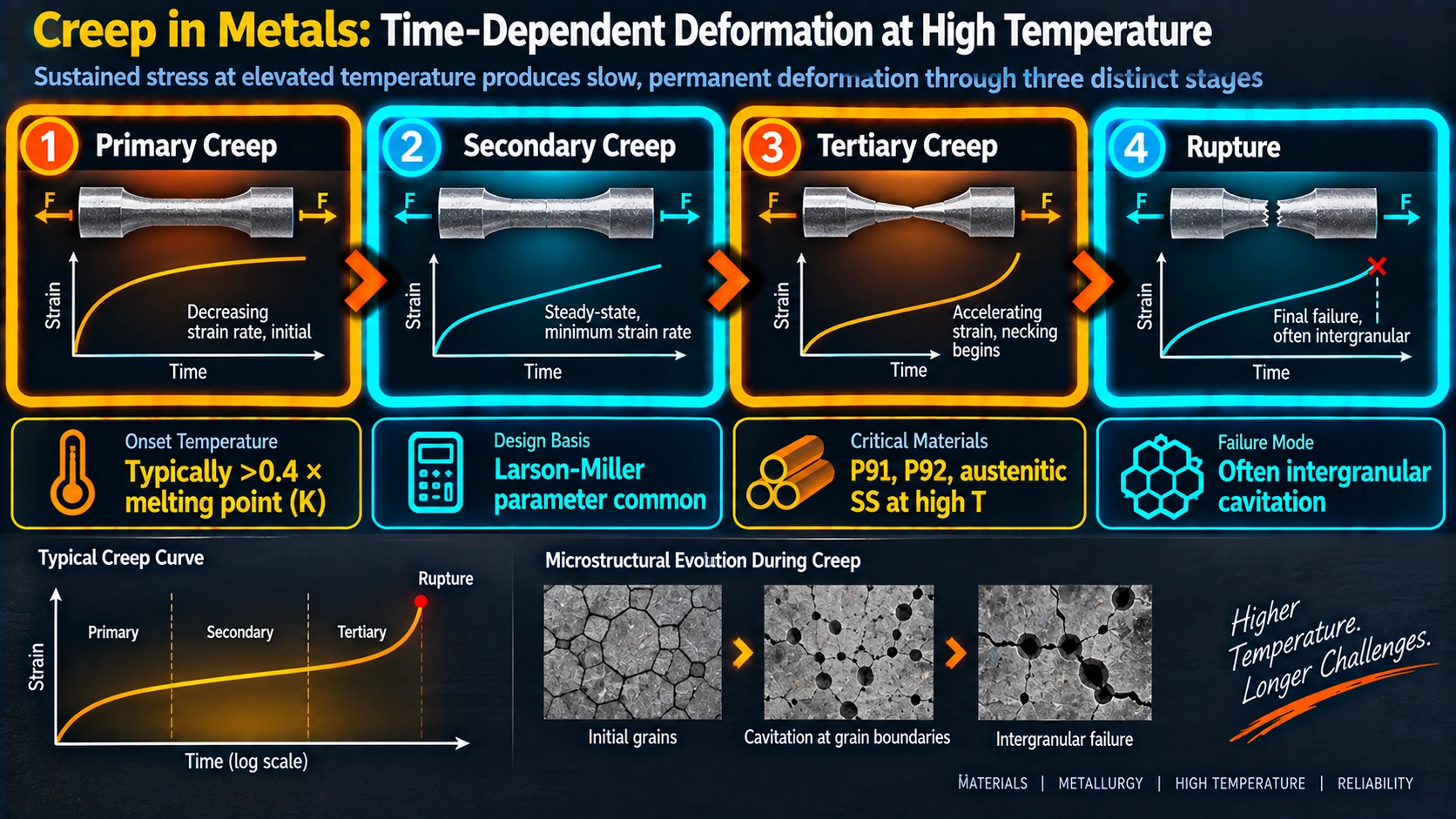
Creep is not unique to extreme environments — it occurs at all temperatures in all crystalline materials, but at low temperatures the creep rate is negligibly small for engineering purposes. The classical criterion for the onset of engineering-significant creep is when the homologous temperature T/Tm exceeds approximately 0.4 (where both T and Tm are expressed in Kelvin). Below this threshold, dislocation mobility and atomic diffusion are too slow to produce measurable time-dependent deformation under normal engineering stresses and timescales.
| Material | Melting Point (Tm) | Creep Onset (~0.4 Tm) | Design Code Creep Range Start |
|---|---|---|---|
| Carbon Steel (P-1) | ~1500°C (1773 K) | ~437°C (710 K) | 371°C (700°F) — ASME Sec. II-D |
| Low-Alloy Cr-Mo Steel (P-4/P-5A) | ~1480°C | ~420°C | 371°C (700°F) |
| Austenitic SS (P-8, 304/316) | ~1400°C (1673 K) | ~397°C (670 K) | 538°C (1000°F) — ASME Sec. II-D |
| P91 / P92 CSEF Steel (P-15E/F) | ~1490°C | ~423°C | 371°C — creep governs above ~520°C |
| Nickel Superalloy (IN718) | ~1260°C (1533 K) | ~340°C | Typically above 650°C for design |
| Lead (Pb) | 327°C (600 K) | ~-33°C (240 K) | Creeps measurably at room temperature |
| Copper (Cu) | 1085°C (1358 K) | ~270°C | Above 200°C for sustained loads |
The Creep Curve: Three Stages of Creep Deformation
The standard characterisation of creep behaviour is the engineering creep curve, obtained by applying a constant tensile load to a specimen held at constant temperature and recording the resulting strain as a function of time until fracture. The characteristic shape of this curve reveals three distinct stages, each governed by different physical processes operating at the microstructural scale.
Stage I — Primary Creep
Primary creep begins at the moment a load is applied at elevated temperature. The creep rate is initially high but decelerates continuously as deformation progresses. The controlling mechanism is work hardening: as the material deforms, dislocation density increases, dislocations tangle and pile up at grain boundaries and obstacles, and the material’s resistance to further deformation rises. At the same time, thermally-activated recovery processes (dislocation climb, cross-slip) begin to partially anneal the work hardened structure, but during primary creep the hardening rate exceeds the recovery rate. Primary creep is characterised by a rapidly falling creep rate and constitutes a relatively small fraction of the total creep life in most engineering applications.
Stage II — Secondary (Steady-State) Creep
Secondary creep represents the most important stage from a design perspective. The creep rate reaches a minimum constant value — called the minimum creep rate or steady-state creep rate (ἐ̇min) — because work hardening and thermally-activated recovery have reached a dynamic equilibrium. For every dislocation that becomes pinned, another is freed by thermal activation. The material deforms at a steady, constant rate that can persist for the majority of the component’s design life. The minimum creep rate is a direct function of stress and temperature and is the quantity measured in creep testing for design data. It is expressed mathematically by the Norton power law (described in detail in the mathematical models section).
Stage III — Tertiary Creep and Rupture
Tertiary creep is marked by a rapidly accelerating creep rate that leads quickly to fracture. Several concurrent damage mechanisms are responsible: the nucleation and growth of grain boundary voids and microcavities (grain boundary cavitation), the coalescence of these cavities into intergranular cracks, and macroscopic necking which increases the local true stress on the reduced cross-section. At the microstructural level, precipitate coarsening during tertiary creep reduces the pinning effect on dislocations and grain boundaries, further accelerating the deformation rate. In well-designed components, tertiary creep should not be reached during the intended design life, as significant dimensional changes and cracking may occur well before final rupture.
Atomic-Scale Mechanisms of Creep Deformation
Creep deformation occurs by several distinct physical mechanisms, each dominant in a different region of the stress-temperature space for a given material. Understanding which mechanism governs your design conditions allows you to make rational material selection decisions and predict how a material will behave when conditions change. In practice, more than one mechanism can operate simultaneously, and transitions between mechanisms occur smoothly across boundaries in stress-temperature space (visualised in deformation mechanism maps).
The relative importance of these mechanisms depends critically on the material’s grain size, because diffusion-based mechanisms (Nabarro-Herring and Coble creep) and grain boundary sliding all become faster as grain size decreases (grain boundary area per unit volume increases). This is why engineering alloys intended for high-temperature service are often specified in a coarse-grained condition, and why the fine-grained HAZ sub-zones in CSEF steel welds are so much weaker in creep than the parent base metal.
Mathematical Models: Norton Power Law and Larson-Miller Parameter
Norton Power Law (Steady-State Creep Rate)
The most widely used model for the steady-state (secondary) creep rate is the Norton-Bailey power law. It expresses the minimum creep rate as a function of applied stress and temperature:
ἐ̇ = A · σn · exp(−Q / RT)
where:
ἐ̇ = steady-state (minimum) creep strain rate [s−¹ or h−¹]
A = material constant (determined experimentally)
σ = applied stress [MPa or psi]
n = stress exponent (typically 1 for diffusion creep; 3–8 for dislocation creep)
Q = activation energy for the dominant creep mechanism [J/mol]
R = universal gas constant = 8.314 J/(mol·K)
T = absolute temperature [K]
Interpretation of stress exponent n:
n = 1 → diffusion-controlled (Nabarro-Herring / Coble creep)
n = 3–5 → dislocation creep (climb-controlled) — most steels
n > 8 → power-law breakdown (high-stress regime)
The exponential temperature dependence means a 10–20°C increase in operating temperature can double the creep rate of a steel component.
Larson-Miller Parameter (Creep Rupture Life Prediction)
The Larson-Miller Parameter (LMP) is a practical engineering tool that allows short-duration, high-temperature creep rupture test data to be extrapolated to predict rupture lives at lower temperatures and longer service times — the conditions that actually govern pressure equipment design. It is based on the observation that time to rupture and temperature are related through an Arrhenius-type dependence, so that the same rupture result can be achieved either by increasing temperature or by increasing time proportionally.
For test procedure and tolerances, see creep rupture testing.P = T · (C + log tr) × 10−3
where:
P = Larson-Miller Parameter [K · (log h + C) × 10−³]
T = absolute temperature [K]
tr = time to rupture [hours]
C = material constant (≈ 20 for carbon and low-alloy steels; 15–25 depending on material)
Worked Example — Predicting Rupture Life:
Problem: A P22 header is tested to rupture at 650°C (923 K) in 1,000 hours at 100 MPa.
Step 1: Calculate LMP from test data (C = 20)
P = 923 × (20 + log 1000) × 10−³
P = 923 × (20 + 3) × 10−³ = 923 × 23 × 10−³ = 21.23
Step 2: At same stress (100 MPa), find rupture time at 565°C (838 K):
21.23 = 838 × (20 + log tr) × 10−³
20 + log tr = 21.23 / 0.838 = 25.33
log tr = 5.33 → tr = 105.33 = ~213,800 hours
Reducing temperature from 650°C to 565°C at the same stress increases predicted rupture life by over 200×.
Monkman-Grant Relationship
The Monkman-Grant relationship provides a simple empirical link between the minimum creep rate from the secondary stage and the total time to rupture. For many engineering alloys, the product of minimum creep rate and rupture time is approximately constant for a given material:
ἐ̇min × trm = CMG
where CMG is the Monkman-Grant constant and m ≈ 1 for many steels
This means: if you measure ἐ̇min in a short test, you can estimate tr without running a full rupture test.
Application: Useful for in-service creep rate measurements to estimate remaining life.
Material Factors Governing Creep Resistance
Creep resistance is not an intrinsic property of a pure metal alone — it is strongly influenced by alloying strategy, microstructural condition, grain size, and heat treatment. The following factors are the primary levers available to alloy designers and fabricators for controlling creep behaviour:
Melting Point and Homologous Temperature
Materials with higher melting points have higher activation energies for diffusion and dislocation climb, which directly retards all thermally-activated creep mechanisms. Refractory metals (W, Mo, Ta, Nb) and nickel-based superalloys exploit this principle for the most demanding high-temperature applications such as gas turbine blades operating above 1000°C.
Grain Size
For diffusion-dominated creep mechanisms (Nabarro-Herring and Coble creep) and grain boundary sliding, the creep rate varies inversely with the square or cube of the grain size. Larger grains mean less grain boundary area per unit volume and a lower creep rate. This is why large-grain or directionally-solidified castings are used in applications like turbine blades where grain boundary sliding would otherwise govern. Conversely, the fine-grained HAZ sub-zones in CSEF steel welds are inherently more susceptible to creep by exactly this mechanism.
Precipitation and Dispersion Strengthening
Stable precipitates act as barriers to dislocation movement. In Cr-Mo steels (P-5A to P-15F), the creep strength comes primarily from M23C6 carbides and MX carbonitrides (where M is Cr or V and X is C or N) dispersed on grain boundaries and within grains. These precipitates pin dislocations and inhibit grain boundary sliding. The critical requirement is that these precipitates remain stable (do not coarsen or dissolve) throughout the intended service life — this is exactly what happens in the ICHAZ during welding (precipitate dissolution) and during long-term thermal exposure at the service temperature (Ostwald ripening / coarsening).
Solid-Solution Strengthening
Alloying elements in solid solution (Mo, W in steels; Cr in nickel superalloys) slow atomic diffusion and raise the activation energy for dislocation climb. This is why P91 (9Cr-1Mo-V-Nb) has dramatically better high-temperature creep strength than P22 (2.25Cr-1Mo) despite both being ferritic Cr-Mo steels — the combination of higher chromium content, vanadium, niobium, and nitrogen produces a much more potent and stable creep-resistant microstructure.
ASME Design Allowables in the Creep Temperature Range
ASME BPVC Section II Part D provides temperature-dependent allowable stress values for all listed pressure vessel and piping materials. As temperature increases into the creep range, the governing criterion shifts from static strength-based values (fraction of yield or ultimate tensile strength) to creep- and rupture-based values. The design stress value at any temperature is the minimum of all applicable criteria.
| Design Criterion | Basis | Temperature Range | Typical Governing Material |
|---|---|---|---|
| 2/3 × Yield Strength (Sy) | Short-term tensile / yield | Below creep range | Carbon steel at ambient to ~370°C |
| 1/3 × UTS (Su) | Static fracture prevention | Below creep range | All materials at lower temperatures |
| 1% / 100,000 hr creep | Creep rate criterion (0.01%/1000h) | Creep range | Carbon and low-alloy steels >370°C |
| 80% of min. rupture strength at 100,000 hr | Creep rupture prevention | Creep range | All materials in creep range |
| 67% of avg. rupture strength at 100,000 hr | Creep rupture (mean life) | Creep range | All materials in creep range |
In addition to design life considerations, the ASME approach recognises that operating temperature and stress history are rarely constant over a component’s life. Power plants cycle between full load and shutdown; refinery reactors experience temperature swings during catalyst regeneration. Cumulative creep damage is assessed using the linear damage rule (Robinson’s rule), analogous to Miner’s rule in fatigue:
D = ∑ (ti / tr,i) ≤ 1.0
where:
D = cumulative creep damage fraction
ti = time spent at stress σi and temperature Ti
tr,i = time to rupture at stress σi and temperature Ti (from Larson-Miller or material data)
When D ≥ 1.0, the component has exhausted its creep life fraction
In practice, API 579-1 recommends D ≤ 0.1 for conservative life assessment in the absence of detailed inspection data.
Creep in Welded Joints: Stress Redistribution and Type IV Cracking
Welded joints in high-temperature service present a fundamentally different and more complex creep scenario than the homogeneous base metal. The welding thermal cycle creates a structure with at least four distinct zones — weld metal, coarse-grain HAZ (CGHAZ), fine-grain HAZ (FGHAZ), intercritical HAZ (ICHAZ), and subcritical HAZ (SCHAZ) — each with different creep properties. When this heterogeneous structure carries a sustained load at elevated temperature, stress redistribution occurs continuously as the softer zones creep faster and shed load to the stronger zones. This redistribution drives damage accumulation preferentially in the zone with the lowest creep ductility or the most rapid creep rate.
Classification of Creep Damage in Weldments
A widely used classification scheme for creep damage location in circumferential weldments was developed by Schuller, Hagn, and Wotischeck (1974) and remains the industry standard for damage assessment:
| Type | Damage Location | Description | Governing Materials |
|---|---|---|---|
| Type I | Weld Metal | Longitudinal or transverse cracks within the weld metal, remaining within weld metal | Any material; weld metal undermatching |
| Type II | Weld Metal / HAZ interface | Cracks originating in weld metal but growing into adjacent HAZ | Moderate-strength welds |
| Type III | Coarse Grain HAZ (CGHAZ) | Creep cavitation and cracking in the high-temperature HAZ adjacent to the fusion line | Lower Cr-Mo steels (P-3, P-4, P-5A) |
| Type IV | Fine Grain / Intercritical HAZ | Premature creep failure in the soft, fine-grained zone at the outer edge of the HAZ. Life-limiting failure mode in CSEF steels | P91, P92, P122, E911 (CSEF steels) |
Implications for Welding Procedure and Design
Understanding weld creep behaviour has direct implications for how P91 welding procedures are qualified and applied in service:
The width of the ICHAZ is strongly influenced by welding heat input — high heat input creates a wider HAZ and a wider Type IV zone, while lower heat input narrows the HAZ but may increase hydrogen cracking risk during the pre-heat/interpass cycle. Optimal control of heat input within the qualified WPS range is therefore critical. Post Weld Heat Treatment (PWHT) at the correct temperature (730–800°C for P91) helps restore some of the precipitate structure in the ICHAZ but cannot fully replicate the base metal microstructure in this zone. PWHT temperature is critical: undertemperature PWHT leaves excess martensite hardness; overtemperature PWHT over-tempers the martensitic matrix and can dissolve beneficial precipitates.
Design strategies to mitigate Type IV failures include: avoiding placing welds in high-stress locations; specifying weld end preparations that minimise the HAZ contribution to the critical cross-section; using controlled heat input welding procedures; and implementing in-service inspection programmes that include replica metallography and hardness survey of weld heat-affected zones.
In-Service Monitoring and NDT for Creep Damage
Detecting and quantifying creep damage before it reaches the tertiary stage is essential for safe continued operation of high-temperature pressure equipment. Several complementary inspection techniques are used, each with different sensitivity to different stages of creep damage progression:
| Inspection Method | Creep Damage Stage Detectable | Sensitivity | Notes |
|---|---|---|---|
| Replica Metallography | Stage I/II (early cavitation) | High | Can detect isolated creep voids. Requires polished surface; semi-invasive. Most reliable early-stage technique. |
| Hardness Survey (Vickers/Brinell) | Stage I/II (softening) | Medium | Detects PWHT softening and over-tempering. Quick and cost-effective. Does not directly detect voids. |
| Ultrasonic Testing (UT / TOFD) | Stage II/III (linked cracks) | Medium | Detects subsurface cracking and wall thinning. Cannot detect isolated voids reliably. TOFD preferred for weld creep cracking. |
| Phased Array UT (PAUT) | Stage II/III | High | Improved resolution and coverage over conventional UT. Can characterise crack size and orientation. Required for most power plant weld inspections. |
| Dimensional Monitoring | Accumulated strain (any stage) | Low | Measures total creep elongation or diameter change. Requires baseline readings from installation. Slow to detect local damage. |
| Magnetic Particle / Dye Penetrant | Stage III (surface cracks only) | Low | Only detects surface-breaking cracks. Type IV cracks typically initiate mid-wall. NOT suitable as primary creep monitoring tool. |
High-Temperature Materials Comparison
Selecting the right material for a high-temperature pressure application requires comparing creep strength at the design temperature, long-term microstructural stability, weldability, and relevant code coverage. The table below summarises the key engineering alloys used in creep service and their practical design limits:
| Material | ASME P-No. | Max Design Temp. | Creep Mechanism | Key Risk | Typical Application |
|---|---|---|---|---|---|
| Carbon Steel (P-1) | P-1 | ~425°C | Dislocation climb | Creep onset above 370°C; spheroidisation | Low-pressure boilers, general vessels |
| 2.25Cr-1Mo (P22) | P-5A | ~565°C | Dislocation creep + grain boundary sliding | Type III HAZ cracking; hydrogen attack risk | Hydroprocessing reactors, boiler headers |
| 9Cr-1Mo-V (P91) | P-15E | ~620°C | Dislocation creep + precipitation pinning | Type IV HAZ cracking; soft zone from improper PWHT | USC boiler headers, steam piping |
| 9Cr-2W-Mo (P92) | P-15F | ~650°C | Dislocation creep + W solid-solution | Type IV cracking; Laves phase embrittlement | Advanced USC power plant |
| TP304/316 Austenitic SS | P-8 | ~700°C | Dislocation climb + grain boundary sliding | Sensitisation; sigma phase embrittlement | Chemical plant, heat exchangers, cryogenic |
| Alloy 800H (20Cr-32Ni) | P-45 | ~900°C | Dislocation creep in FCC matrix | Carburisation; metal dusting | Steam reformers, ethylene crackers |
| IN625 (UNS N06625) | P-43 | ~980°C | Solid-solution + gamma prime strengthening | Stress relaxation cracking in aged condition | Severe corrosion + high-temp environments |
For more on material selection and P-Number groupings for high-temperature service, see our complete ASME P-Number reference guide. For the specific welding and PWHT requirements for P91 in power plant applications, see our detailed article on P91 welding requirements.
Recommended Reference Books on Creep and High-Temperature Metallurgy
Creep Deformation Mechanism Domains
Different creep mechanisms dominate in different regions of the stress-temperature space. Engineers designing for creep service need to know which mechanism will govern their application so they can select appropriate materials and predict behaviour correctly. The following schematic deformation mechanism map illustrates the approximate boundaries for the most important mechanisms in a typical engineering steel: