Sigma Phase in Duplex & Austenitic Stainless Steel: Formation, Effects, Detection, and Remediation
Sigma phase (σ) is one of the most damaging secondary phases that can form in duplex and austenitic stainless steels. This hard, brittle, chromium-rich intermetallic compound precipitates when stainless steel is exposed to temperatures between approximately 550 °C and 1000 °C — a range encountered during welding, post-weld heat treatment, hot forming, and elevated-temperature service. Its effects are severe: even small volume fractions of 3 to 5% sigma phase have been documented to reduce impact toughness by up to 80% and simultaneously degrade corrosion resistance by depleting chromium and molybdenum from the matrix. For engineers and fabricators working with duplex stainless steels in oil and gas, chemical processing, and marine environments, understanding sigma phase is not academic — it is fundamental to safe and reliable fabrication.
This article covers the physical metallurgy of sigma phase formation, the mechanisms by which duplex and austenitic stainless steels differ in their susceptibility, the kinetics of precipitation, the effects on mechanical properties and corrosion resistance, and the three standardised detection methods of ASTM A923. It also addresses related secondary phases including chi (χ) phase, and provides clear guidance on prevention and remediation through solution annealing and welding procedure control. For a broader introduction to duplex stainless steel grades and properties, see our guide on duplex stainless steels.
What Is Sigma Phase? Crystal Structure and Composition
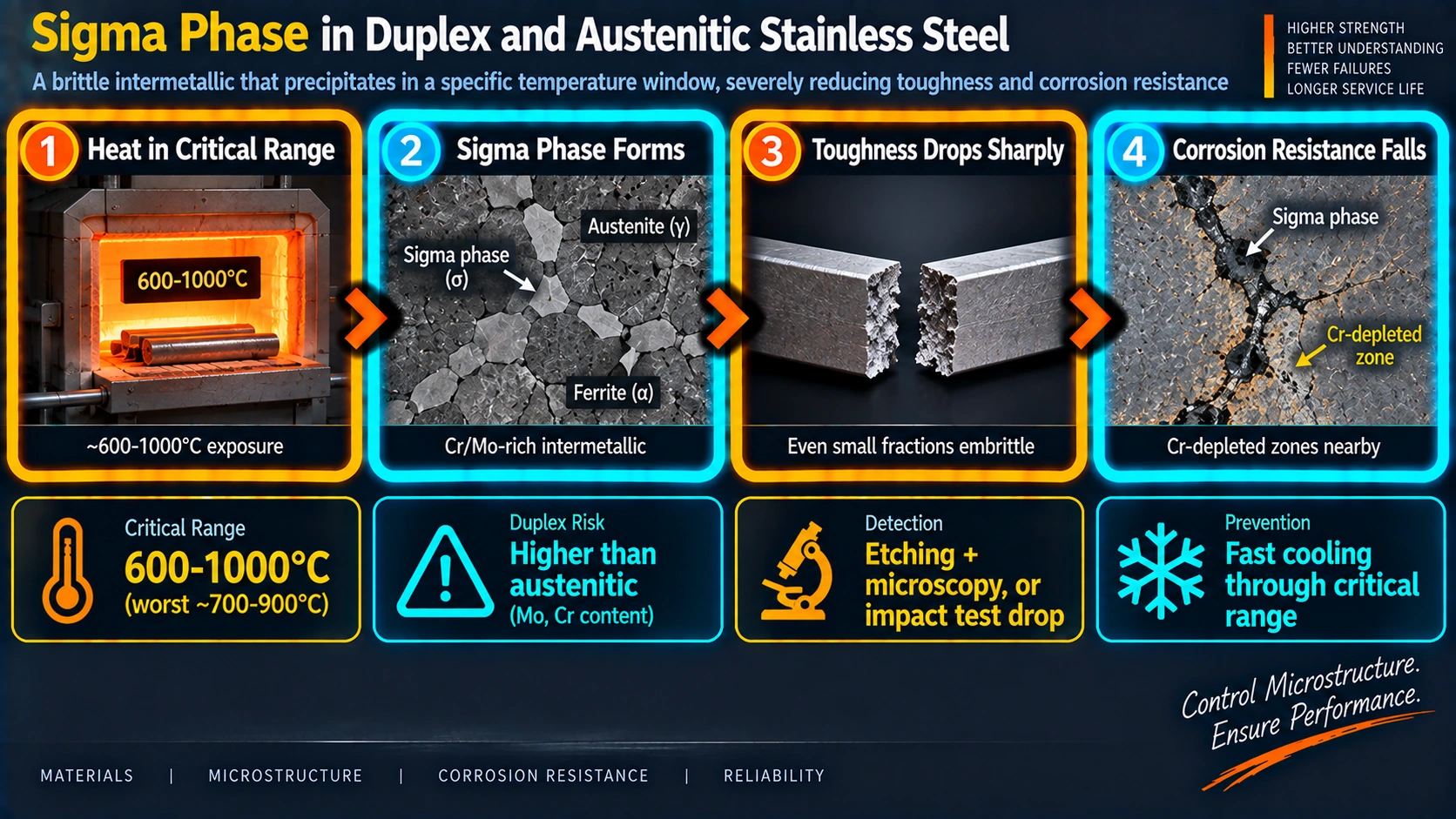
Sigma phase is a non-magnetic intermetallic compound that forms in iron-chromium-based alloy systems. Its crystal structure is tetragonal (space group P42/mnm) with 32 atoms per unit cell — a topology-close-packed arrangement that makes the phase extremely hard and inherently brittle. The tetragonal lattice parameters are a ≈ 0.880 nm and c ≈ 0.456 nm, values well established from X-ray diffraction studies dating back to the 1950s.
In engineering stainless steels, sigma phase is not a simple binary compound but a ternary or quaternary solid solution enriched in chromium, molybdenum, iron, and smaller amounts of silicon and manganese. Typical compositions in duplex stainless steel sigma phase are approximately 30 to 40 wt% Cr and 3 to 12 wt% Mo, substantially higher than the surrounding matrix. It is this chromium and molybdenum enrichment that creates the Cr-depleted zone in the adjacent ferrite and austenite, which is the primary mechanism for corrosion resistance degradation.
Physical Properties of Sigma Phase
| Property | Value / Description | Engineering Significance |
|---|---|---|
| Crystal structure | Tetragonal, P42/mnm, 32 atoms/unit cell | Lattice mismatch with austenite creates internal stresses |
| Hardness | ~68 HRC (approx. 900–1000 HV) | Harder than martensite; acts as hard brittle inclusion |
| Density | ~7.6–8.0 g/cm³ | Similar to matrix; not detectable by density methods |
| Magnetic response | Non-magnetic (paramagnetic) | Sigma formation can reduce apparent ferrite content measured by ferrite meters |
| Chromium content | 30–40 wt% | Depletes Cr from adjacent matrix — direct cause of sensitisation |
| Molybdenum content | 3–12 wt% (higher in Mo-bearing grades) | Mo enrichment in sigma accelerates its formation in SDSS |
| Dissolution temperature | >1020°C (standard DSS); >1080°C (SDSS) | Solution annealing above this temperature dissolves sigma |
Sigma Phase Formation Mechanisms
The Eutectoid Reaction in Duplex Stainless Steel
In duplex stainless steels, the dominant sigma phase formation mechanism is the eutectoid decomposition of ferrite (α) into sigma plus secondary austenite (γ2):
α (ferrite) → σ (sigma phase) + γ2 (secondary austenite)
The reaction is driven by the thermodynamic stability of sigma at temperatures
between 600°C and 1000°C. Chromium and molybdenum partition preferentially
into sigma; nickel and nitrogen partition into secondary austenite (γ2).
Precipitation rate in ferrite vs. austenite:
Rate(α → σ) ≈ 100 × Rate(γ → σ)
Ferrite has lower atomic packing density — faster atomic diffusion path for Cr, Mo
Equilibrium σ fraction at 800°C (DSS 2205, calculated):
~25 vol% σ phase at thermodynamic equilibrium
In practice, kinetics limit actual precipitated fraction; full equilibrium rarely reached
The ferrite phase in duplex stainless steel is enriched in chromium and molybdenum relative to the austenite, which makes it the preferred nucleation site for sigma. Sigma nucleates first at the ferrite/austenite (δ/γ) interface boundaries, then at triple points (the junctions of three grain boundaries), and progressively consumes ferrite inward. As ferrite is consumed, secondary austenite (γ2) is co-precipitated alongside sigma in the characteristic eutectoid microstructure. This secondary austenite is inferior to the primary austenite in corrosion resistance because it is depleted of nitrogen and has a lower PREN value.
Sigma Formation in Austenitic Stainless Steels
In austenitic stainless steels that are fully austenitic with no residual delta ferrite, sigma phase must nucleate at austenite grain boundaries or at grain boundary carbide particles. Without the rapid diffusion paths provided by ferrite, this process is much slower — typically requiring hundreds to thousands of hours at temperature. The critical temperature range is slightly narrower (approximately 600 °C to 900 °C) and the kinetics are strongly dependent on alloy content. Grades with higher chromium (e.g., 310S, 317L), higher molybdenum (e.g., 904L, 254 SMO), or silicon additions are more susceptible. Grades with carbon that has already precipitated as chromium carbide (M23C6) during sensitisation may be more susceptible because carbide precipitation depletes local chromium, potentially destabilising austenite at grain boundaries.
The most important practical case in austenitic steels is weld metal and HAZ microstructures that retain delta ferrite. Delta ferrite in austenitic stainless weld metal — intentionally retained at 3 to 10 FN to prevent hot cracking — acts as a fast sigma phase nucleation site. If weld metal is subsequently re-exposed to the critical temperature range during multi-pass welding or PWHT, sigma can form rapidly in the ferrite stringers.
Factors Accelerating Sigma Phase Formation
| Factor | Effect | Affected Grades |
|---|---|---|
| High chromium content (>22%) | Shifts sigma precipitation nose to shorter times; more thermodynamically stable sigma | SDSS 2507 (25Cr), 310S (25Cr), hyper-duplex |
| High molybdenum content (>3%) | Strongly accelerates kinetics; Mo partitions strongly into sigma | SDSS 2507 (7Mo), DSS 2205 (3Mo), 316L (2Mo) |
| Silicon additions | Accelerates sigma formation; displaces TTP nose to higher temperatures | All grades with Si > 0.5% |
| Presence of delta ferrite | Provides fast diffusion nucleation sites; rate 100x faster in α than γ | Duplex SS, austenitic weld metal, cast alloys |
| Cold work prior to heating | Increases dislocation density; provides heterogeneous nucleation sites | Any grade subjected to cold working before thermal exposure |
| Slow cooling through 600–1000°C | Prolonged exposure in sigma-stable zone; occurs in thick sections or slow cooling after annealing | All susceptible grades in heavy sections |
| Low nitrogen content | Nitrogen stabilises austenite and retards sigma; low N grades sensitise faster | Pre-1990s DSS grades with <0.10% N |
Related Secondary Phases: Chi Phase, Laves Phase, and Cr2N Nitrides
Sigma phase rarely precipitates in isolation. Several other secondary phases form in the same temperature range and are associated with similar or overlapping kinetics. Understanding the full spectrum of secondary phase precipitation is essential for correct interpretation of ASTM A923 test results and metallographic examination.
Chi Phase (χ)
Chi phase is a body-centred cubic (BCC) intermetallic compound with the approximate composition Fe36Cr12Mo10. It precipitates in the same temperature range as sigma (and typically slightly earlier in the time-temperature domain) and is enriched in molybdenum to a greater degree than sigma. Chi and sigma phases are frequently found together in aged duplex stainless steels, and their individual contributions to property degradation are difficult to separate experimentally. Chi phase precipitates at the same ferrite/austenite boundaries as sigma and similarly depletes the adjacent matrix of chromium and molybdenum. Like sigma, chi phase contributes to both embrittlement and corrosion resistance reduction.
Chromium Nitride (Cr2N)
Chromium nitride (Cr2N, hexagonal close-packed) precipitates preferentially in ferrite when nitrogen supersaturation occurs — typically during rapid cooling from the solution-anneal temperature, or in the HAZ of weld joints where ferrite is reformed from high-temperature austenite. While Cr2N does not embrittle as severely as sigma phase, it creates localised chromium-depleted zones that reduce corrosion resistance. In duplex stainless steel welds, Cr2N is commonly observed in the HAZ and is detected as fine needle-like precipitates in ferrite under optical microscopy after electrolytic etching.
Secondary Austenite (γ2)
Secondary austenite forms simultaneously with sigma phase via the eutectoid reaction. Because it is depleted of nitrogen and its PREN (Pitting Resistance Equivalent Number) is significantly lower than primary austenite, it is a preferential site for pitting corrosion initiation. The coral-shaped sigma morphology observed at lower aging temperatures is particularly associated with extensive secondary austenite formation and localised corrosion damage.
Effects of Sigma Phase on Mechanical Properties and Corrosion Resistance
Impact on Mechanical Properties
The impact of sigma phase on mechanical properties is both rapid in onset and severe in magnitude. The phase itself has a Vickers hardness of approximately 900 to 1000 HV — harder than martensite — and acts as a hard, brittle, non-deformable inclusion in the ductile ferrite-austenite matrix. Crack initiation occurs preferentially at sigma particles and at the sigma/matrix interface where residual stresses from the volume change during precipitation concentrate.
Research on super duplex stainless steel UNS S32750 (2507) has documented that just 5 vol% sigma phase causes an approximately 80% reduction in Charpy impact energy and lowers the critical pitting temperature by 25 °C. Separate work on standard DSS 2205 (UNS S31803) aged at 830 °C showed significant impact toughness reduction after treatments sufficient to precipitate even 3% sigma. The fracture mode progressively shifts from tough transgranular fracture in the sigma-free condition to brittle intergranular fracture as sigma content increases, as sigma preferentially occupies grain boundaries and the ferrite/austenite interface.
| Sigma Content (vol%) | Approximate Impact Toughness (relative) | Hardness Change | Fracture Mode |
|---|---|---|---|
| 0% (solution annealed) | 100% baseline | Baseline (typically 22–28 HRC for DSS) | Transgranular, ductile |
| 1–3% | 60–80% of baseline | Slight increase | Mixed ductile/intergranular |
| 3–5% | 20–40% of baseline | Measurable increase in macro-hardness | Predominantly intergranular |
| >10% | <10% of baseline — near-zero toughness | Significant macro-hardness increase | Fully intergranular brittle fracture |
Impact on Corrosion Resistance
The corrosion damage from sigma phase operates through the chromium-depletion mechanism. Each sigma precipitate, enriched to 30–40% Cr, withdraws chromium from the adjacent matrix. The ferrite and austenite immediately adjacent to sigma particles may be depleted to below 12% Cr locally — the threshold below which the passive film characteristic of stainless steels cannot be maintained. This creates preferential pitting attack sites that are activated at far lower potentials than the sigma-free base material.
Potentiodynamic polarisation testing of sigma-containing duplex stainless steel (UNS S31803) in simulated seawater has confirmed a systematic decrease in pitting potential with increasing sigma content. Both the chloride-containing sigma-bearing material and the surrounding Cr-depleted matrix contribute to the corrosion damage. The coral-shaped sigma morphology that forms at lower aging temperatures (below approximately 750 °C) tends to produce more severe localised corrosion than blocky morphologies that form at higher temperatures within the precipitation range, because coral-shaped sigma creates more extensive matrix/precipitate interfaces where the Cr-depleted zone is exposed to the environment.
Sigma Phase Detection Methods
ASTM A923 — Standard Test Methods for Duplex Stainless Steel
ASTM A923 is the primary standard for detecting detrimental intermetallic phases in duplex stainless steels. It was originally developed for mill products but has become the de facto standard for weld procedure qualification of DSS and SDSS fabrication. The standard provides three complementary test methods, and ASTM A923 explicitly states that presence of detrimental phases is readily detectable in all three methods provided that the sample is taken from the region most likely to have experienced the critical temperature range during thermal processing — typically the slowest-cooling region in the case of heat treatment, or the HAZ in the case of welded joints.
Test Method A: Sodium Hydroxide Electrolytic Etch
Method A is the rapid metallographic screening test. A polished metallographic specimen is electrolytically etched in 20% sodium hydroxide (NaOH) solution at 1.5–3 V DC for 10 to 60 seconds. Under this etch, sigma phase appears as an orange to brown coloured phase distinctly different from the blue-grey ferrite and the unaffected austenite. The etch structure is then classified as either “Unaffected Structure” (no detrimental intermetallic phase — specimen passes) or “Step Structure” / “Dual Structure” (intermetallic phase present — specimen fails and must proceed to Method C).
Specimens showing Unaffected Structure in Method A are acceptable and need not be tested by Method C. This makes Method A a useful rapid gateway test. However, for some critical applications and some user specifications (particularly in the oil and gas sector), Method A alone is not accepted as sufficient evidence of freedom from sigma, and Method B or C testing is required regardless.
Test Method B: Charpy Impact Test
Method B evaluates toughness as an indirect indicator of intermetallic phase presence. Standard Charpy V-notch specimens are tested at room temperature (approximately 20 °C). For standard duplex grades, ASTM A923 requires a minimum average impact energy of 40 J at room temperature to pass. Material containing detrimental sigma phase will fail this criterion because sigma embrittles the steel. Method B is useful for heavy product forms and for qualifying weld procedures, but it is a destructive, relatively expensive test that consumes significant material compared to Method A.
Test Method C: Ferric Chloride Corrosion Test
Method C is a 24-hour immersion corrosion test in 10% ferric chloride solution (FeCl3) at 40 °C. The corrosion rate (mass loss per unit area per unit time) is measured and compared to an acceptance criterion. Materials free of detrimental intermetallic phases will show very low corrosion rates, while sigma-bearing materials suffer accelerated attack at the chromium-depleted zones adjacent to sigma precipitates. ASTM A923 Method C is the most direct test of corrosion resistance degradation associated with sigma phase.
However, Method C has important limitations. Research has demonstrated that for 25% Cr super duplex grades (such as 2507), the test at 40 °C is extremely difficult to pass in weld metal even in the absence of detrimental phases, because SDSS weld metal inherently has some segregation. Many fabrication specifications for SDSS now either lower the test temperature to 25 °C for weld joints or rely primarily on Method A and Method B for SDSS weld qualification, reserving Method C for base metal acceptance.
| ASTM A923 Test Method | Technique | Pass/Fail Criterion | Primary Use |
|---|---|---|---|
| Method A | Electrolytic NaOH etch, optical microscopy | Unaffected etch structure = Pass; Step/Dual = Fail | Rapid screening; gateway test for Method C |
| Method B | Charpy V-notch impact, room temperature | Min. 40 J average (standard DSS at RT) | Toughness verification; weld procedure qualification |
| Method C | 24 h in 10% FeCl3 at 40°C (standard DSS) or 25°C (SDSS welds) | Corrosion rate below ASTM A923 acceptance limit | Direct corrosion resistance verification; base metal qualification |
ASTM A262 — Detection in Austenitic Stainless Steels
For austenitic stainless steels, ASTM A262 provides the relevant detection practices. Practice A (oxalic acid etch test) provides rapid optical classification of etch structures. Austenitic specimens are electrolytically etched in oxalic acid (10% solution, 1 A/cm² for 90 seconds). The resulting etch structure is classified as Ditch (carbide films at grain boundaries, associated with sensitisation), Step (grain boundaries etched but no continuous films — generally acceptable), or Dual (mixed). Practice A cannot directly detect sigma phase but can indicate its presence by step or dual structures associated with sigma at grain boundaries.
More directly applicable to sigma detection in austenitics, Practice B (ferric sulfate-sulfuric acid test) and Practice C (nitric acid test) measure corrosion rates that are elevated in the presence of sigma phase. ASTM A262 Practice B is specifically noted in the standard as sensitive to sigma phase in titanium or columbium (niobium) stabilised grades and cast molybdenum-bearing alloys, where sigma phase may cause elevated corrosion rates even without visible microstructural evidence of grain boundary carbides.
ISO 17781 — Testing for Duplex Stainless Steel in Subsea Applications
For subsea and offshore applications, duplex stainless steel qualification increasingly references ISO 17781 (Test methods for quality control of microstructure of austenitic/ferritic (duplex) stainless steels), which aligns broadly with ASTM A923 but adds specific requirements for weld qualification testing including ferrite content measurement and a microstructural examination covering grain size, phase balance, and absence of intermetallic phases in weld HAZ samples.
Sigma Phase Formation in Welding Operations
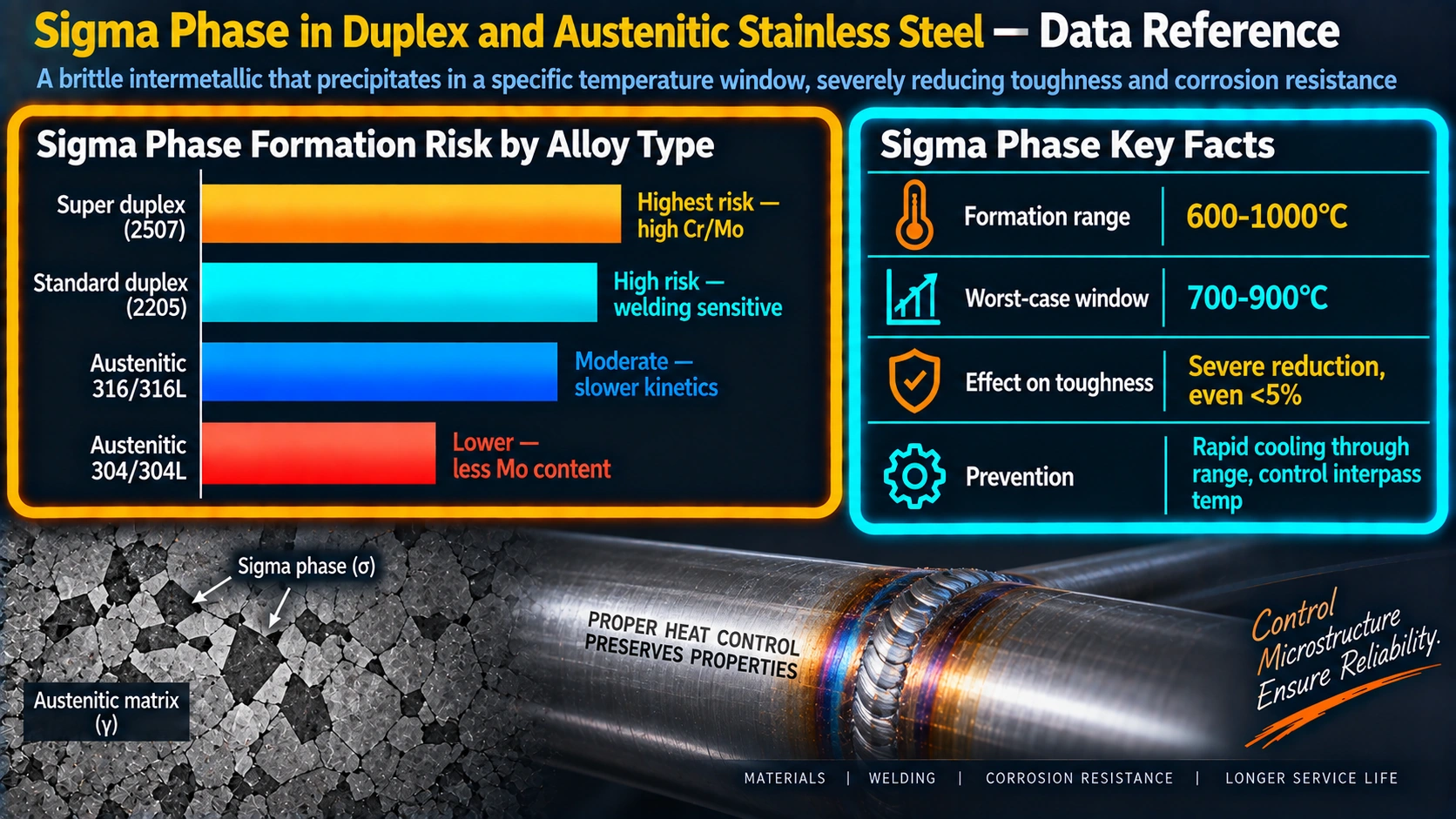
Welding is one of the most significant sources of sigma phase in duplex stainless steel components. Sigma formation during welding can occur through two primary mechanisms: time in the critical temperature range during the welding thermal cycle, and slow cooling after welding in components with high thermal mass.
Interpass Temperature and Heat Input Control
In multi-pass welding of duplex stainless steels, each successive weld pass re-heats the previously deposited metal and the HAZ. If the interpass temperature is allowed to rise above approximately 150 °C (100 °C for super duplex), the cumulative time spent in the sigma precipitation range increases with each pass. High heat input per pass also extends the residence time in the critical range. For this reason, maximum interpass temperatures of 150 °C for standard DSS and 100 °C for SDSS are standard procedure requirements, along with maximum heat input limits (typically 0.5 to 2.5 kJ/mm depending on grade and thickness).
Post-Weld Cooling Rate
The cooling rate from the maximum interpass temperature through the 600–1000 °C range must be rapid enough to prevent sigma precipitation. For thin sections and properly controlled procedures, air cooling provides adequate quench rate. For heavy sections where the heat sink effect slows cooling, water quenching or forced-air cooling may be required after each pass or upon completion of welding. Pipeline girth welds in thick-wall sour service pipelines often specify cooling to below 100 °C between passes to satisfy both interpass temperature limits and sigma prevention requirements.
Post-Weld Heat Treatment Risks
Post-weld heat treatment (PWHT) is not normally applied to duplex stainless steels, and for good reason: any PWHT temperature within the sigma precipitation range (550–1000 °C) will cause sigma formation. If a full solution anneal and quench is not possible after PWHT, the PWHT will degrade rather than improve the material. Where stress relief is required for duplex stainless steel pressure vessels — which is unusual — the engineering basis must demonstrate that the stress relief temperature and time do not cause detrimental sigma precipitation, typically by supporting ASTM A923 testing on representative samples subjected to the proposed PWHT cycle.
Prevention and Remediation
Prevention During Fabrication
The most effective approach to sigma phase is prevention. Key controls include limiting time in the critical temperature range at every stage of fabrication: solution annealing of incoming plate at the correct temperature with adequate hold time followed by rapid quenching; strict control of heat input and interpass temperature during welding; avoidance of PWHT in the sigma precipitation range; and rapid cooling of thick-section components after any hot-working operations.
For all welding positions in duplex stainless steel, a written Welding Procedure Specification (WPS) qualified per ASME Section IX or ISO 15614-1 with additional ASTM A923 testing is the minimum requirement for structural and pressure-retaining applications. The WPS must specify maximum heat input, maximum interpass temperature, and minimum cooling rate or maximum interpass time.
Remediation by Solution Annealing
Once sigma phase has formed, the only reliable remediation is solution annealing: heating the component to a temperature above the sigma dissolution range, holding long enough to dissolve all sigma, and then quenching rapidly to prevent re-precipitation. For standard duplex grades, solution annealing temperatures are typically 1020–1100 °C. For super duplex 2507, temperatures of 1080–1150 °C are required to fully dissolve the more thermodynamically stable sigma in high-Mo alloys.
// Based on ASTM A240, ASTM A182, and manufacturer technical data sheets
Standard DSS (e.g., 2205, UNS S31803/S32205):
Anneal temperature: 1020–1100°C
Hold time: minimum 30 min + 1 min per mm of section thickness
Cooling: water quench or rapid air cool (max 5 min to <300°C)
Super Duplex DSS (e.g., 2507, UNS S32750):
Anneal temperature: 1080–1150°C
Hold time: minimum 30 min + 1 min per mm of section thickness
Cooling: water quench mandatory for sections >6 mm
After solution annealing, verify by:
1. ASTM A923 Method A (NaOH etch — Unaffected Structure required)
2. ASTM A923 Method B (Charpy >40 J) and/or Method C (ferric chloride test)
3. Ferrite content check by Fischer Feritscope (target 40–60% ferrite)
Note: Full dissolution may not be achievable in very thick sections by furnace annealing alone
Grade-by-Grade Sigma Susceptibility
| Grade | UNS No. | %Cr / %Mo | Sigma Susceptibility | Typical Anneal Range |
|---|---|---|---|---|
| Lean DSS 2101 | S32101 | 21.5 / 0.3 | Low | 1000–1100°C |
| Standard DSS 2205 | S31803/S32205 | 22 / 3 | Moderate | 1020–1100°C |
| Super DSS 2507 | S32750 | 25 / 4 | High | 1080–1150°C |
| Hyper DSS (33Cr, 7Mo) | Various | 33 / 7+ | Very high | 1100–1180°C |
| Austenitic 304/304L | S30400/S30403 | 18 / 0 | Very low | 1010–1120°C |
| Austenitic 316/316L | S31600/S31603 | 17 / 2.1 | Low–moderate | 1010–1120°C |
| Austenitic 310S | S31008 | 25 / 0 | Moderate | 1040–1200°C |
| Super austenitic 904L | N08904 | 21 / 4.3 | Moderate–high | 1100–1150°C |
| Super austenitic 254 SMO | S31254 | 20 / 6.1 | High | 1150–1200°C |
Recommended Books on Stainless Steel Metallurgy and Corrosion
These authoritative references provide the in-depth metallurgical background necessary for understanding sigma phase, corrosion mechanisms, and the full range of duplex and austenitic stainless steel behaviour.
Disclosure: WeldFabWorld participates in the Amazon Associates programme (StoreID: neha0fe8-21). If you purchase through these links, we may earn a small commission at no extra cost to you. This helps support free technical content on this site.