Bainite in Steel: Upper Bainite vs Lower Bainite — Formation, Microstructure, and Properties
Bainite is one of the most versatile and technically important microstructures that can form in engineering steel. Sitting between pearlite and martensite on the continuous cooling or isothermal transformation diagram, bainite provides combinations of strength, hardness, and toughness that neither of its neighbours can match alone. Understanding how bainite nucleates and grows, what distinguishes upper bainite from lower bainite at the microstructural level, and how cooling rate controls the type of bainite that forms are fundamental skills for any welding engineer, metallurgist, or materials inspector working with structural steels, tool steels, or the heat-affected zones of welds.
This article covers the complete picture: the crystallographic and diffusional origins of bainite transformation, the structural differences between upper and lower bainite, quantitative comparisons of their mechanical properties, the role of alloying elements in shifting the bainite start temperature, carbide-free bainite as an advanced microstructural variant, and the practical significance of bainite in weld HAZ metallurgy and industrial heat treatment processes such as austempering.
Key Takeaways
- Bainite forms between approximately 125–550 °C, between the pearlite and martensite transformation ranges.
- Upper bainite (350–550 °C) has cementite between ferrite laths; lower bainite (<350 °C) has finer carbides inside ferrite plates at ~55°.
- Lower bainite has higher hardness and generally better toughness than upper bainite at equivalent strength levels.
- Austempering exploits isothermal bainite transformation to produce components without a separate tempering step.
- In HSLA weld HAZs, heat input controls whether coarse upper bainite or fine lower bainite forms, directly affecting sub-zero toughness.
- Carbide-free bainite in high-silicon steels can exceed 2 GPa tensile strength with useful ductility.
What Is Bainite? Historical Background
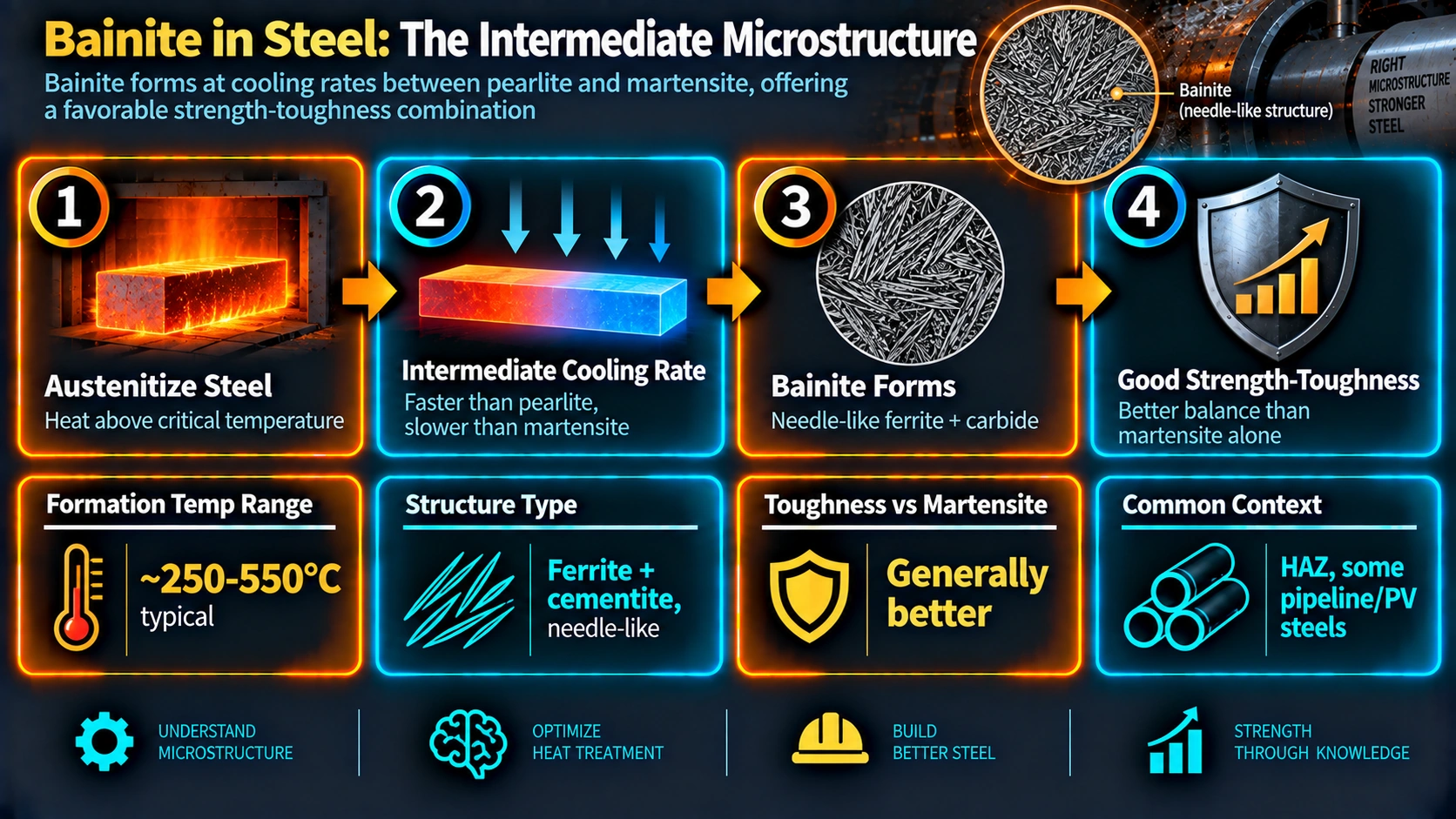
Bainite was first described in the 1930 study by Edgar Davenport and Edgar Bain at US Steel, who noted that austenite decomposed at intermediate temperatures to produce a microstructure unlike either pearlite or martensite. They originally described it as resembling tempered martensite in appearance. The phase was subsequently named bainite in honour of Edgar Bain’s foundational contributions to steel metallurgy. Robert Mehl later introduced the distinction between upper bainite and lower bainite based on the differing transformation temperatures and carbide locations within the two structures.
Bainite forms when austenite is cooled (or held isothermally) at temperatures below those required for pearlite formation but above the martensite start temperature (Ms). In this intermediate range, iron self-diffusion is limited but carbon can still diffuse short distances. The precise nature of the transformation mechanism remains a topic of academic discussion: one school holds that the initial ferrite formation is displacive (shear-like, similar to martensite), with carbon subsequently partitioning by diffusion; the other treats it as a primarily diffusional process. The displacive model is the more widely accepted in current literature, supported by the surface relief effects observed on polished specimens after bainitic transformation.
The Bainite Transformation Range on the TTT and CCT Diagrams
On the isothermal transformation (TTT) diagram, the bainite transformation field appears as a C-curve below and separate from (or merged with, depending on carbon content) the pearlite C-curve. In plain carbon steels above about 0.4 wt% C, the pearlite and bainite C-curves are clearly resolved; in lower-carbon steels, the curves may overlap. The bainite C-curve typically has its nose (minimum incubation time) between 450 and 500 °C for most engineering steels.
On the continuous cooling transformation (CCT) diagram, bainite appears between the pearlite and martensite fields. Whether a given cooling rate produces bainite depends on the steel’s hardenability; this is why alloying elements such as manganese, chromium, molybdenum, and nickel are added to structural steels to shift the CCT bainite field to slower cooling rates, allowing bainite to form even in thick sections or with moderate welding heat input.
Upper Bainite: Formation and Microstructure
Upper bainite forms between approximately 350 and 550 °C, directly below the temperature range for pearlite formation. At these temperatures, carbon diffusion is relatively rapid compared to lower in the bainite range.
Mechanism of Upper Bainite Formation
Upper bainite nucleates at austenite grain boundaries. Groups of parallel bainitic ferrite laths (also called sub-units or sheaves) grow into the austenite grain by the displacive mechanism. As each lath forms, carbon is rejected into the surrounding residual austenite between the laths. Because diffusion at these temperatures is fast enough to allow the carbon to migrate out of the newly formed ferrite before it can precipitate within it, the laths themselves remain relatively free of carbide. The enriched interlath austenite subsequently decomposes to cementite (Fe3C) films or particles, creating the characteristic feathery appearance of upper bainite visible at the optical microscope.
Upper Bainite Morphology
Under optical microscopy with nital etch, upper bainite has a feathery or sheaf-like acicular appearance. The ferrite laths are roughly parallel within each sheaf, and the interlath cementite stringers run more or less parallel to the long axes of the laths. In higher-carbon steels (>0.4 wt% C), the interlath carbide can form as nearly continuous films, significantly embrittling the structure because these carbide films act as crack propagation paths. In lower-carbon steels, the carbide is more discontinuous. The overall prior austenite grain boundary is visible as the envelope containing the bainite sheaf.
Lower Bainite: Formation and Microstructure
Lower bainite forms below approximately 350 °C, closer to the martensite start temperature. At these lower temperatures, carbon diffusion is sufficiently slow that the rejected carbon cannot escape from the bainitic ferrite before precipitating as fine carbide particles within the ferrite plate itself.
Mechanism of Lower Bainite Formation
As in upper bainite, ferrite plates nucleate at austenite grain boundaries and grow by the displacive mechanism. However, because carbon mobility is restricted, the carbon that is supersaturated in the newly formed ferrite precipitates as fine carbide (predominantly epsilon carbide, Fe2.4C, or cementite at higher carbon levels) within the ferrite plate before it can reach the plate boundary. These precipitates form at a characteristic angle of approximately 55–60 degrees to the long axis of the ferrite plate, a feature that is diagnostic of lower bainite under TEM examination. A proportion of carbon also partitions to the residual austenite between plates, which may subsequently transform to martensite or be retained as austenite films.
Lower Bainite Morphology
Under optical microscopy, lower bainite appears darker and finer than upper bainite, resembling lightly tempered martensite. The two are genuinely difficult to distinguish at the light microscope level in many steels, and TEM is required for unambiguous identification based on the 55° intra-plate carbide orientation. The ferrite plates in lower bainite are finer than upper bainite laths, contributing to higher hardness and, counterintuitively, often superior toughness through the Hall-Petch relationship and a more uniform, finer carbide distribution.
Comparison of Upper and Lower Bainite: Mechanical Properties
The structural differences between upper and lower bainite translate directly into measurable differences in mechanical properties. The table below summarises typical property ranges for both types in medium-carbon low-alloy steels.
| Property | Upper Bainite | Lower Bainite | Notes |
|---|---|---|---|
| Transformation temperature range | 350–550 °C | 125–350 °C | Depends on alloy composition |
| Hardness (typical) | 30–45 HRC | 45–58 HRC | Increases with carbon content |
| Tensile strength (MPa) | 900–1400 | 1400–2000 | For medium-C low-alloy steel |
| Yield strength (MPa) | 700–1100 | 1100–1700 | — |
| Elongation (%) | 10–18 | 6–14 | Upper bainite more ductile at equivalent hardness |
| Charpy impact toughness | Moderate | Good to High | Lower bainite superior at sub-zero temperatures |
| Carbide location | Interlath (between laths) | Intra-plate (inside plates, at 55°) | Key structural differentiator |
| Plate/lath width | Coarser (0.2–2 µm) | Finer (0.1–0.5 µm) | Finer size contributes to higher strength |
| Tempering required? | No | No | Unlike martensite; austempering gives direct-use parts |
| Identification (optical) | Feathery, acicular sheaves | Dark, fine; resembles tempered martensite | TEM needed for unambiguous lower bainite ID |
Alloying Effects on the Bainite Start Temperature (Bs)
The bainite start temperature is depressed by the same substitutional solutes that depress the martensite start temperature (Ms), because both transformations involve the same displacive ferrite formation mechanism. The empirical formula developed by Steven and Haynes (1956) is widely used in engineering practice:
Example: 0.40C, 0.80Mn, 0Ni, 1.0Cr, 0.20Mo steel Bs = 830 − (270×0.40) − (90×0.80) − (37×0) − (70×1.0) − (83×0.20) = 830 − 108 − 72 − 0 − 70 − 16.6 = 563 °C
Silicon and aluminium are notable because, although they have little effect on Bs itself, they strongly suppress carbide precipitation during the bainite transformation. This is the basis of carbide-free bainite, discussed in the next section. Molybdenum not only depresses Bs but also widens the bainite transformation bay on the CCT diagram, giving the transformation more time to complete before martensite starts, which is why Mo is a key alloying element in bainitic structural steels and pressure vessel plate such as SA-533 Grade B.
| Alloying Element | Effect on Bs | Effect on Bainite Range Width | Primary Mechanism |
|---|---|---|---|
| Carbon (C) | Strong depression | Narrows | Stabilises austenite |
| Manganese (Mn) | Moderate depression | Extends C-curve nose to longer times | Hardenability |
| Nickel (Ni) | Moderate depression | Broadens bainite bay | Austenite stabiliser |
| Chromium (Cr) | Moderate depression | Extends C-curve | Hardenability; carbide former |
| Molybdenum (Mo) | Strong depression | Significantly broadens bainite bay | Retards pearlite; hardenability |
| Silicon (Si) | Small depression | Enables carbide-free bainite | Suppresses cementite precipitation |
| Boron (B) | Negligible | Suppresses grain boundary ferrite | Segregates to austenite grain boundaries |
Carbide-Free Bainite: The Advanced Variant
When steel contains approximately 1.5–2.0 wt% Si or a similar Al addition, cementite precipitation is thermodynamically suppressed because silicon has essentially zero solubility in cementite and its presence in the surrounding austenite raises the chemical potential of carbon in cementite to the point where it is unstable. Under these conditions, the carbon rejected from bainitic ferrite enriches the interlath or inter-plate austenite rather than forming carbide. The result is a two-phase microstructure of bainitic ferrite and carbon-enriched retained austenite.
This carbide-free bainite, sometimes called TRIP-assisted bainitic ferrite or, in its extreme form, nanostructured bainite (developed by Bhadeshia and co-workers from the late 1990s onwards), can achieve remarkable property combinations. At very low transformation temperatures (150–250 °C, requiring days or weeks of isothermal holding), ferrite plate widths below 50 nm are achievable, giving tensile strengths exceeding 2 GPa with adequate ductility. The absence of cementite eliminates the brittle fracture initiation sites associated with conventional bainite, and the retained austenite can transform to martensite under stress, providing a TRIP (transformation-induced plasticity) effect that enhances work hardening and toughness.
Austempering: Practical Production of Bainite
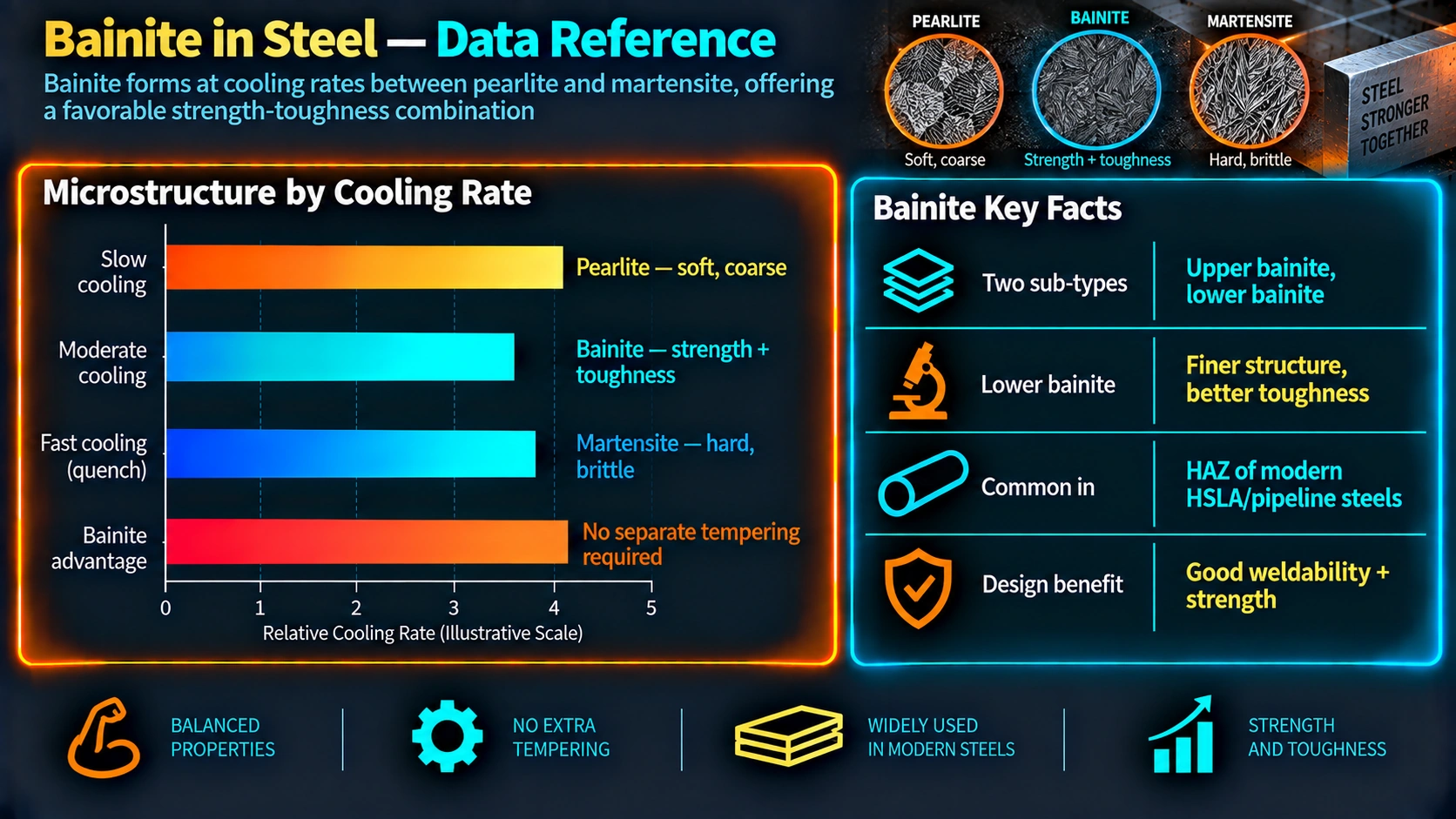
Austempering is the industrial heat treatment process designed to produce a fully bainitic microstructure in components. It is widely applied to spring steels, stampings, small forgings, and cast irons. The process sequence is as follows:
- Austenitise at the appropriate temperature (typically 830–950 °C for carbon steels) to dissolve carbides and homogenise carbon.
- Quench rapidly into a molten salt bath held at a temperature within the bainite transformation range, typically 250–450 °C, at a rate fast enough to avoid pearlite transformation (requires adequate hardenability).
- Hold isothermally for sufficient time to complete bainite transformation throughout the section. Transformation times range from a few minutes for thin sections to several hours for thick sections.
- Air cool to room temperature. No separate tempering step is required.
Compared to quench-and-temper (Q&T) treatment producing tempered martensite at equivalent hardness, austempered bainite typically offers superior ductility and impact toughness, reduced distortion (because the isothermal transformation is more uniform through the section than a martensite quench), and better fatigue strength. The principal limitation is section size: steels without sufficient hardenability will transform to pearlite in the core before the surface-adjacent bainite transformation is complete.
Bainite in Weld Heat-Affected Zone (HAZ) Metallurgy
The formation of bainite in the HAZ of welds is one of the most practically significant aspects of bainite for the welding engineering community. Whether bainite in the HAZ is beneficial or harmful depends on its morphology, carbon content, and the service conditions of the joint.
HAZ Thermal Cycle and Microstructure Selection
The HAZ of a single-pass weld experiences a rapid thermal cycle: fast heating to peak temperature (which can exceed 1400 °C in the coarse-grained HAZ immediately adjacent to the fusion line), followed by continuous cooling at a rate determined by heat input, base material thickness, and preheat temperature. The effective t8/5 cooling time (time to cool from 800 to 500 °C) determines which microstructure forms in the HAZ. Slow cooling (high t8/5) promotes upper bainite, Widmanstatten ferrite, or pearlite; fast cooling (low t8/5) promotes lower bainite or lath martensite.
HAZ Microstructure in HSLA Structural Steels
Modern HSLA structural steels (S355, S460, S690 and similar grades) are designed with CCT diagrams that place the desired microstructure — granular bainite or lower bainite — within the cooling rate window achievable by standard welding procedures. Granular bainite, a variant of upper bainite where the interlath carbon is partially retained as martensite-austenite (M-A) islands rather than decomposing fully to cementite, provides improved toughness compared to classical upper bainite with carbide films, and is the dominant HAZ microstructure in many modern HSLA plate welds.
For P91 creep-resistant steel welds, bainite formation in the HAZ is generally undesirable and the PWHT regime is specifically designed to temper any martensite or bainite back to tempered martensite with M23C6 carbide precipitation. Refer to the GTAW welding guide for guidance on GTAW procedures for alloy steel joints where HAZ microstructure control is critical.
Martensite-Austenite (M-A) Constituents in Bainitic HAZ
One of the most technically significant HAZ microstructural features in high-strength steel welds is the martensite-austenite (M-A) constituent, sometimes called the M-A island or M-A microphase. It forms when carbon-enriched interlath austenite in the bainitic HAZ does not fully transform to ferrite or cementite on cooling, instead transforming partially or fully to martensite. M-A islands are hard (700–900 HV), brittle, and their presence in the coarse-grained HAZ significantly reduces low-temperature toughness, particularly at high heat inputs. Control strategies include limiting heat input, selecting steels with lower carbon hardenability, and using multiple weld passes to thermally temper the coarse-grained HAZ of prior passes. This topic is also relevant to duplex stainless steel HAZ microstructure, though the transformation products differ.
Identifying Bainite in Metallographic Sections
Reliable identification of bainite requires understanding both the optical microscopy appearance and the limitations of light microscopy for finer bainite morphologies.
Optical Microscopy (Nital Etch)
With 2–3% nital etch, upper bainite appears as mid-grey feathery or needle-like colonies within the prior austenite grain. The parallel lath arrangement gives a distinctive textured look. Lower bainite etches darker and more uniformly, resembling tempered martensite. The prior austenite grain boundaries are visible, and the bainite sheaves typically radiate from these boundaries.
Electron Microscopy
Scanning electron microscopy (SEM) with secondary electron imaging resolves the coarser carbide features and the lath boundaries of upper bainite at magnifications above about 5,000x. For lower bainite, SEM can reveal the general morphology but the intra-plate carbides are below 100 nm and require TEM. In TEM, the 55° orientation of epsilon carbide or fine cementite needles relative to the ferrite plate axis is the definitive criterion for lower bainite identification, distinguishing it from tempered martensite, which has randomly oriented carbide precipitates.
Lepera’s Etchant
Lepera’s reagent (sodium metabisulphite + picric acid) selectively colours M-A constituents white, fresh martensite white-to-light, and bainite brown, against a background of dark etching ferrite. This etchant is widely used in weld metal and HAZ characterisation of HSLA steels, where distinguishing bainite from martensite and M-A is important for toughness assessment.
Industrial Applications of Bainitic Steels
The combination of high strength, reasonable toughness, and the ability to achieve properties without post-forming heat treatment makes bainitic steels attractive across a range of industries:
- Structural plate: S690 and S890 high-strength structural steels are often supplied in the thermomechanically rolled plus accelerated-cooled (TMCP) condition, with predominantly granular bainite or lower bainite microstructure achieved by controlled cooling on the rolling mill run-out table.
- Springs: Austempered spring steel strip and wire (SAE 9260, 5160) in the lower bainite condition gives fatigue life advantages over Q&T springs at equivalent hardness.
- Gears and bearings: Austempered ductile iron (ADI) and austempered steels for gears benefit from the bainite matrix for wear resistance and contact fatigue performance.
- Rails: Bainitic rail steel (B320 and B360 grades per EN 13674) is used in heavy-haul and high-speed rail for improved rolling contact fatigue resistance compared to pearlitic rail.
- Armour: Nanostructured carbide-free bainite provides superior ballistic protection per unit weight compared to conventional armour steels.
- Pressure vessel plate: SA-533 Grade B (ASTM) is a Mn-Mo-Ni low-alloy plate steel commonly supplied in the quenched-and-tempered condition with a largely bainitic microstructure, used for nuclear reactor pressure vessels and heavy pressure vessel fabrication.
Recommended References
Frequently Asked Questions
What is bainite in steel?
Bainite is a non-lamellar steel microstructure that forms by the decomposition of austenite at temperatures between the pearlite and martensite transformation ranges, roughly 125–550 °C depending on alloy composition. It consists of bainitic ferrite plates or laths together with carbides (cementite) or, in silicon-bearing steels, carbon-enriched retained austenite. First characterised by Davenport and Bain in 1930, bainite provides a useful balance of strength, hardness, and toughness not achievable with pearlite or martensite alone. It is encountered in heat-treated components, HSLA structural steels, and the heat-affected zones of welds in higher-strength steels.
What is the key difference between upper bainite and lower bainite?
Upper bainite forms between approximately 350–550 °C and consists of parallel ferrite laths with cementite carbides precipitated in the interlath regions (between the laths). Lower bainite forms below roughly 350 °C, closer to the martensite start temperature; its carbides precipitate inside the ferrite plates at approximately 55–60 degrees to the plate long axis. Lower bainite has finer plate dimensions and higher hardness than upper bainite, and typically offers superior toughness because the intra-plate carbide distribution is finer and more uniform, eliminating the brittle carbide films that can embrittle upper bainite at higher carbon levels. The distinction was first introduced by Robert Mehl and remains the standard classification used in metallurgical practice.
How is bainite produced in practice?
Bainite is produced by either isothermal transformation (austempering) or continuous cooling through the bainite formation temperature range. In austempering, the steel is austenitised, quenched into a salt bath held between 250–450 °C, and held isothermally until transformation is complete before air cooling. Continuous cooling can also produce bainite in sufficiently alloyed steels where the CCT diagram places the bainite nose in an accessible cooling-rate window, such as in HSLA structural steels and air-hardening tool steels. Alloying with molybdenum, manganese, nickel, and chromium extends the bainite transformation to slower cooling rates, allowing bainite to form through thicker sections.
What are the mechanical properties of bainite compared to pearlite and martensite?
Bainite occupies the intermediate strength and toughness range between pearlite (softer, tougher) and martensite (hardest, most brittle when untempered). Typical upper bainite hardness ranges from 30–45 HRC, and lower bainite from 45–58 HRC. Compared to martensite at equivalent hardness, lower bainite generally shows better impact toughness because transformation residual stresses are lower and the fine carbide distribution is more uniform. Compared to pearlite, bainite offers significantly higher strength. These characteristics make bainite attractive for springs, gears, bearings, structural plate, and pressure vessel applications. See the full steel microstructure phases guide for a broader comparison.
What is carbide-free bainite?
Carbide-free bainite forms in steels with high silicon (1–2 wt%) or aluminium additions that strongly retard cementite precipitation. During isothermal transformation, bainitic ferrite plates form but carbon partitions into the surrounding austenite rather than forming carbide. The resulting microstructure consists of ultra-fine bainitic ferrite plates (as thin as 20–40 nm in nanostructured variants) separated by films of carbon-enriched retained austenite. This gives exceptional combinations of strength (over 2 GPa in nanostructured forms) and toughness, and is applied in armour plate, bearings, and rail steels. The absence of brittle cementite eliminates one of the key fracture initiation mechanisms in conventional bainite.
How does bainite form in the heat-affected zone of a weld?
In the heat-affected zone (HAZ) of a weld, the cooling rate from austenite determines which microstructure forms. High heat input welds cool slowly, allowing upper bainite or Widmanstatten ferrite to form in the coarse-grained HAZ; this coarser microstructure reduces toughness, particularly at sub-zero temperatures. Low heat input welds cool faster, promoting lower bainite or lath martensite. In HSLA steels, the desired HAZ microstructure is granular bainite or lower bainite. Controlling heat input and interpass temperature is the primary means of managing HAZ bainite morphology. For pressure vessel applications, refer to the UG-84 Charpy impact test requirements which govern acceptability of HAZ toughness.
Does bainite require tempering after formation?
Unlike martensite, bainite does not normally require post-transformation tempering to achieve adequate toughness for service, because the transformation itself occurs at temperatures high enough for some self-tempering to take place. However, a low-temperature stress-relief anneal is sometimes applied to bainitic steels to reduce internal stresses without significantly softening the microstructure. In austempering, the product is used directly without a separate tempering step, which is one of the key process advantages over conventional quench-and-temper treatment. This makes austempering cost-effective for mass-produced components like springs and small gears.
How do you identify bainite in a metallographic section?
At the optical microscope level after 2–3% nital etch, upper bainite appears as a feathery or sheaf-like acicular structure, distinguishable from pearlite by its non-lamellar appearance. Lower bainite appears darker and finer, resembling tempered martensite. Scanning electron microscopy resolves the inter-lath or intra-lath carbide distribution more clearly. Transmission electron microscopy is required to unambiguously distinguish lower bainite from tempered martensite based on the 55° carbide orientation within the ferrite plates. Lepera’s etchant can help delineate bainite (brown), fresh martensite (white), and martensite-austenite (M-A) constituents in weld metals and HAZ sections of HSLA steels.
What steels are commonly supplied in a bainitic condition?
Several engineering steel families are commonly used in the bainitic condition: high-strength low-alloy (HSLA) structural steels (S690, S890 grades), air-hardening tool steels, spring steels processed by austempering, bainitic rail steels (B320, B360 per EN 13674), and through-hardening bearing steels such as 100CrMnSi6-4. Microalloyed forging steels for automotive components (crankshafts, connecting rods) are also designed to produce bainite during controlled cooling after hot forging, eliminating the need for subsequent quench-and-temper heat treatment. SA-533 Grade B nuclear pressure vessel plate is a well-known example of a bainitic steel used in safety-critical pressure vessel fabrication.
What is the bainite start temperature (Bs) and how is it calculated?
The bainite start temperature (Bs) is the highest temperature at which bainite will begin to form on cooling from austenite. It depends strongly on alloy composition and is depressed by carbon, manganese, nickel, chromium, and molybdenum. The Steven and Haynes (1956) empirical formula is widely used: Bs (°C) = 830 − 270C − 90Mn − 37Ni − 70Cr − 83Mo, where element contents are in wt%. Knowing Bs is essential for designing austempering heat treatment cycles and for predicting HAZ microstructures from weld thermal cycles. It should be used alongside the martensite start temperature Ms and the carbon equivalent for comprehensive HAZ microstructure prediction.