Martensite is the hardest and most
Martensite in Steel: Formation, Hardness and Tempering
Martensite is the hardest and most brittle microstructural phase that forms in steel, and understanding how it arises, what governs its hardness, and how tempering restores its toughness is fundamental to welding engineering. From preventing hydrogen-induced cold cracking (HICC) in carbon steel pipework to achieving the correct tempered microstructure in P91 power-generation piping, the metallurgy of martensite underpins some of the most critical decisions a welding engineer makes.
This guide covers the complete technical picture: the crystallographic mechanism of martensitic transformation, the role of carbon and alloying elements, the Ms and Mf temperatures, Continuous Cooling Transformation (CCT) diagrams, the four stages of tempering, hardness limits in fabrication codes, and the direct practical implications for preheat, interpass temperature, and post-weld heat treatment (PWHT) of structural steels, low-alloy steels, and creep-resistant Cr-Mo grades.
Whether you are preparing for a P-Number and Group Number qualification, optimising PWHT for P91 steel welding, or troubleshooting sour service HAZ hardness issues, this article provides the foundational metallurgy you need.
What Is Martensite?
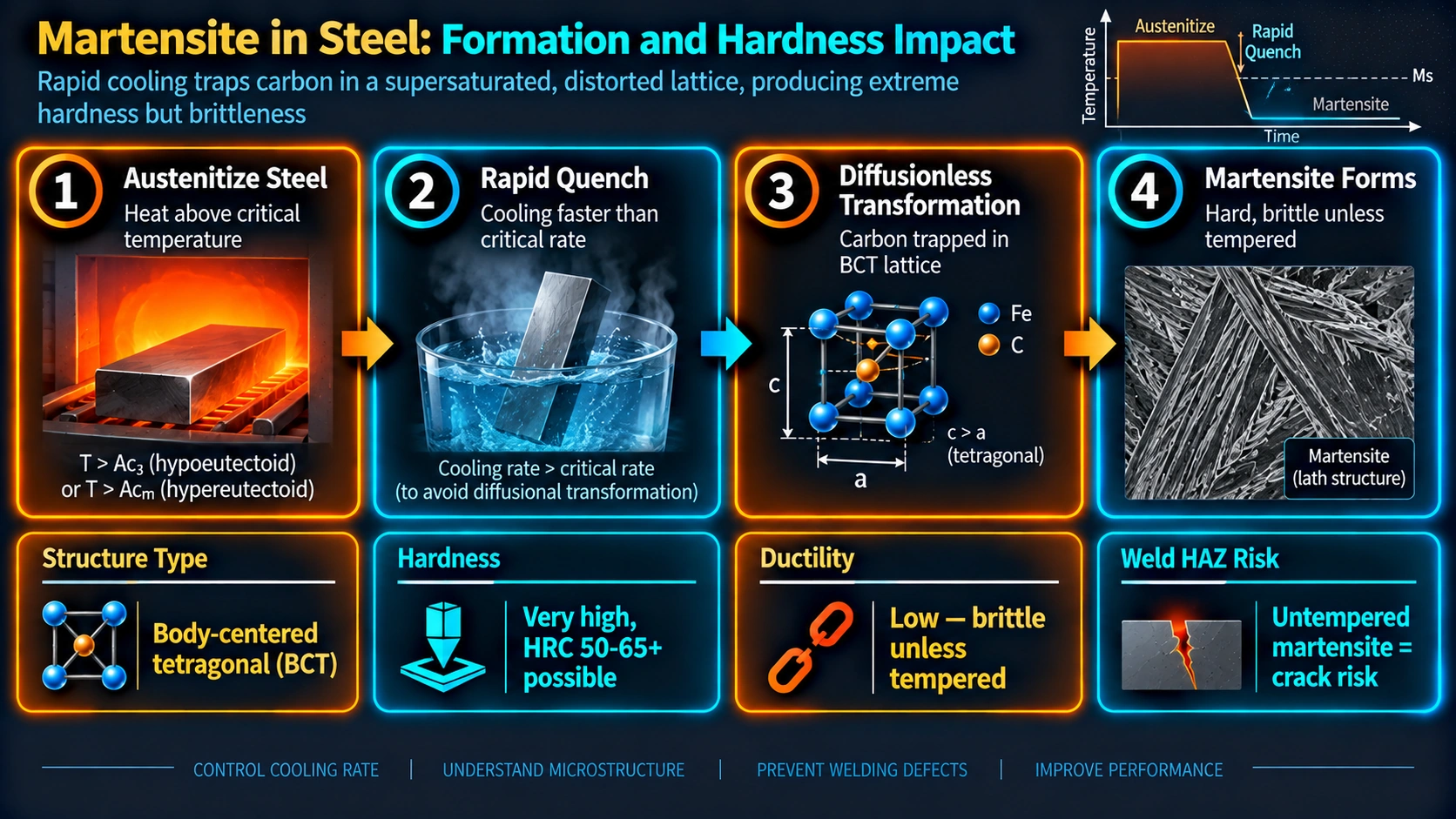
Martensite is a metastable, supersaturated solid solution of carbon in iron that forms by a diffusionless shear transformation when austenite is cooled too rapidly for the equilibrium decomposition products — ferrite, pearlite, or bainite — to form. The name honours the German metallurgist Adolf Martens, who first characterised the phase in the late nineteenth century.
At room temperature, the stable crystal structure of iron is body-centred cubic (BCC). Austenite, stable above the A3 temperature, is face-centred cubic (FCC) and can dissolve much more carbon than BCC iron — up to approximately 2.1 wt% C in the FCC lattice compared to only 0.02 wt% C in the BCC lattice. When austenite is quenched rapidly, there is insufficient time for carbon to diffuse out and partition into carbides. Instead, the FCC lattice collapses to a body-centred structure with carbon atoms forcibly retained in the interstitial sites. Because there are more interstitial sites along one crystallographic axis than the others, the lattice distorts unevenly into a body-centred tetragonal (BCT) structure. This distortion is the origin of martensitic hardness.
Lath vs. Plate Martensite
Martensite exists in two principal morphologies depending on carbon content:
- Lath martensite (below ~0.6 wt% C): Parallel arrays of elongated laths within prior austenite grains, with a high dislocation density and significant autotempering. This is the morphology found in low-carbon and low-alloy structural steels, as well as Cr-Mo creep-resistant steels such as P22 and P91.
- Plate (or acicular) martensite (above ~0.6 wt% C): Lens-shaped plates that impinge on one another, generating micro-cracks at plate intersections. This is the highly brittle morphology found in tool steels and high-carbon alloys. It is almost never desired in weldable structural steels.
Formation Mechanism: The Diffusionless Shear
Unlike the reconstructive transformations that produce ferrite, pearlite, and bainite — all of which require long-range diffusion of carbon or substitutional atoms — the martensitic transformation is a displacive transformation. Atoms move cooperatively by small fractions of an interatomic distance in a coordinated shear motion, without any change in chemical composition. This is why martensite can form at extremely high rates, essentially limited only by the speed of sound in the material.
The transformation proceeds as follows:
- Steel is austenitised above A3 (or Accm for hypereutectoid steels), dissolving all carbides into a uniform FCC solid solution.
- During cooling, austenite becomes increasingly undercooled as it passes below A3. If the cooling rate exceeds the critical cooling rate (CCR) for the steel, the diffusion-controlled transformation to ferrite, pearlite, or bainite is suppressed.
- Once the temperature drops below the martensite start temperature (Ms), a shear instability develops and lath or plate martensite nucleates heterogeneously at grain boundaries, twin boundaries, and dislocation tangles.
- Each martensite unit grows at near-sonic speed and stops when it impinges on a grain boundary or a pre-existing martensite plate. The volume fraction of martensite increases as temperature falls below Ms, reaching 100% at the martensite finish temperature (Mf).
The Role of Hardenability
Hardenability is the property that describes how deep into a section martensite can be formed — it is a kinetic concept, not to be confused with maximum hardness. High hardenability means the CCR is low, so even slow cooling through thick sections produces martensite. Hardenability is increased by most alloying elements (Mn, Cr, Mo, Ni, B) that shift the bainite and pearlite noses on the CCT diagram to longer times. Carbon is the most potent single element for both hardness (intrinsic) and hardenability.
Ms and Mf Temperatures
The martensite start (Ms) and martensite finish (Mf) temperatures are among the most practically important parameters in welding metallurgy. They define the temperature window during which the HAZ and weld metal transform from austenite to martensite on cooling.
Empirical Formulae for Ms
Several empirical formulae have been developed for predicting Ms from composition. The most widely used in welding engineering practice are:
The Mf temperature is not as readily predicted but is typically 100 to 200°C below Ms depending on steel grade. For most low-alloy structural steels, Mf lies between 150 and 300°C, well above room temperature. This means the transformation is essentially complete before the weld cools to ambient — important because it implies that significant martensite forms while the joint is still relatively warm.
| Steel Grade | Approx. C (wt%) | Ms (°C) | Mf (°C) | Risk Level |
|---|---|---|---|---|
| ASTM A36 / S275 | 0.18 max | 420–450 | 270–310 | Low |
| ASTM A516 Gr.70 | 0.20 max | 410–435 | 260–300 | Low |
| ASTM A572 Gr.50 / S355 | 0.23 max | 390–420 | 250–290 | Moderate |
| ASTM A335 P11 (1.25Cr-0.5Mo) | 0.15 max | 420–450 | 280–320 | Moderate |
| ASTM A335 P22 (2.25Cr-1Mo) | 0.15 max | 410–440 | 270–310 | Moderate |
| ASTM A335 P91 (9Cr-1Mo-V) | 0.08–0.12 | 380–420 | 200–260 | High (mandatory PWHT) |
| 410 Martensitic SS | 0.15 max | 300–350 | 100–180 | High |
| 4140 / 42CrMo4 | 0.38–0.43 | 315–340 | 120–160 | Very High |
Martensite Hardness and the Role of Carbon
Of all the factors that influence martensitic hardness, carbon content is overwhelmingly dominant. The relationship is well established empirically across a wide range of alloy compositions:
| Carbon Content (wt%) | Max Martensite HV | Approx. HRC | HICC Risk | NACE Compliant? |
|---|---|---|---|---|
| 0.05 | ~250 | ~24 | Low | Yes (borderline) |
| 0.10 | ~300 | ~29 | Moderate | Marginal |
| 0.15 | ~360 | ~37 | High | No |
| 0.20 | ~420 | ~42 | High | No |
| 0.30 | ~530 | ~51 | Very High | No |
| 0.40 | ~620 | ~57 | Extreme | No |
| 0.60+ | ~800+ | ~65+ | Extreme | No |
Alloying elements affect hardness primarily through their influence on hardenability (ensuring a fully martensitic structure is achieved throughout the section) rather than by raising the intrinsic hardness ceiling. For example, adding chromium and molybdenum to a 0.20% C steel does not significantly change its maximum martensite hardness — approximately 420 HV — but it ensures that hardness is achieved through much thicker wall sections than a plain carbon steel of equal carbon content.
Carbon Equivalent and Hardenability Prediction
Because the risk of forming hard martensite in the HAZ is a function of the total steel composition, the carbon equivalent (CE) formula is used to compare steels on a common scale for cracking susceptibility. The IIW formula is the most widely referenced:
Use the Carbon Equivalent Calculator on WeldFabWorld to calculate both IIW and Pcm values from a steel’s mill test report chemistry.
CCT Diagrams and Cooling Rate
A Continuous Cooling Transformation (CCT) diagram is the primary tool for predicting the microstructure that will form in the HAZ or weld metal after a welding thermal cycle. Unlike Time-Temperature-Transformation (TTT) diagrams — which show isothermal transformation behaviour — CCT diagrams plot the transformation boundaries against temperature and time during continuous cooling from the austenitising temperature.
Key features of a CCT diagram include:
- Ferrite, pearlite, and bainite noses: Cooling curves that pass through these regions produce the respective microstructures. The faster the cooling, the further left and higher the curve needs to go to produce ferrite or pearlite.
- The martensite line (Ms): A horizontal line marking the temperature below which martensite begins to form. Cooling curves that reach this line without intersecting the ferrite, pearlite, or bainite regions produce fully or predominantly martensitic microstructures.
- Critical cooling rate (CCR): The slowest cooling rate that still produces 100% martensite. Any slower, and mixed microstructures (martensite + bainite, or martensite + pearlite) result.
- Weld HAZ t8/5: In welding, the cooling time from 800 to 500°C (t8/5) is the standard parameter used to locate the HAZ cooling curve on the CCT diagram. A short t8/5 (fast cooling) produces martensite; a long t8/5 produces bainite, ferrite, and pearlite.
Tempering of Martensite
As-quenched martensite is in a highly strained, thermodynamically unstable state. The dislocation density in lath martensite is comparable to heavily cold-worked steel — on the order of 1014–1016 dislocations/m2. Tempering is a controlled reheating below the A1 temperature that drives the system toward a more stable state by releasing stored strain energy and redistributing carbon. The process is divided into four overlapping stages:
Stage I: Carbon Clustering and Epsilon Carbide Precipitation (100–200°C)
At low tempering temperatures, carbon atoms become mobile enough to diffuse short distances and cluster. Metastable epsilon carbide (Fe2.4C) precipitates as fine rods within the martensite laths, reducing the carbon content of the BCT matrix toward BCC. Hardness decreases slightly. This stage is relevant to understanding preheat holds in certain high-strength steels.
Stage II: Retained Austenite Decomposition (200–300°C)
Most low- and medium-alloy steels contain some retained austenite at room temperature, particularly if Ms is below about 200°C. On tempering through this range, retained austenite decomposes to bainite or a mixture of ferrite and cementite. This can cause a secondary hardening or, more commonly, a brief plateau in the hardness-vs-temperature curve.
Stage III: Cementite Formation and Lath Recovery (300–450°C)
Epsilon carbide dissolves and is replaced by the equilibrium cementite (Fe3C) as thin plates or rods. The martensite lath structure begins to recover — dislocation density decreases significantly and internal stresses are substantially relieved. Toughness rises sharply; hardness falls progressively. This stage is the practical lower bound of effective PWHT for most structural and pressure vessel steels.
Stage IV: Recrystallisation, Carbide Coarsening, and Spheroidisation (above 450°C)
At higher temperatures, cementite coarsens and spheroidises, dislocation networks reorganise, and subgrain boundaries develop. The martensite lath morphology is progressively replaced by an equiaxed or polygonal ferrite structure with coarse, well-spaced carbides. This condition is called tempered martensite or, at the highest temperatures, spheroidised martensite. It offers the best balance of strength and toughness for most engineering applications. PWHT temperatures of 600–750°C for low-alloy steels and 730–780°C for P91 target this stage.
Martensite and Hydrogen-Induced Cold Cracking (HICC)
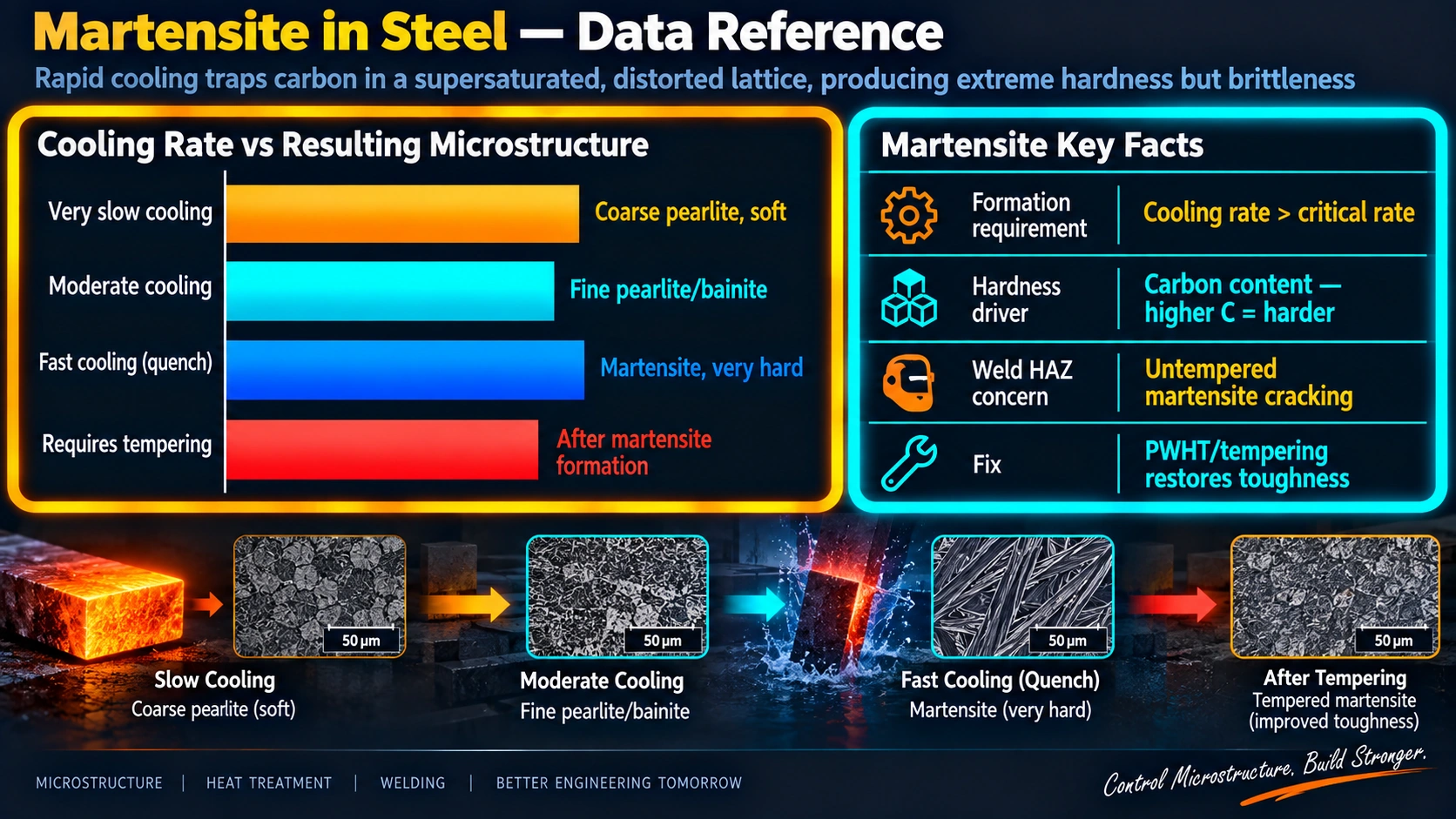
Hydrogen-induced cold cracking (HICC) — also called hydrogen cracking, underbead cracking, delayed cracking, or HAZ cracking — is one of the most serious weld defects encountered in the fabrication of medium- and high-strength steels. Martensite in the HAZ is the primary microstructural enabler. Three conditions must coexist for HICC to occur:
- Susceptible microstructure: Hard martensite, typically above ~350 HV, in the HAZ or weld metal.
- Hydrogen: Diffusible hydrogen absorbed from moisture in consumables, contaminated base metal surfaces, or humid atmospheric conditions during welding.
- Tensile stress: Residual welding stresses (transverse and longitudinal) plus any applied loading.
HICC is called “cold” or “delayed” cracking because it typically initiates after the weld has cooled to below about 150°C — often hours or even days after welding completion. This makes it particularly dangerous in production environments where NDT inspection is performed shortly after welding and before full hydrogen diffusion or before the joint has been stress-relieved.
The Role of Hydrogen in Martensite
Hydrogen has a very high diffusivity in BCC iron at ambient temperatures. As the HAZ cools and martensite forms, atomic hydrogen trapped in the joint redistributes toward regions of triaxial tensile stress (stress concentrations at weld toes, weld roots, and HAZ grain boundaries). The local concentration of hydrogen reduces the cohesive energy of the iron lattice and the critical stress intensity for crack propagation. In as-quenched martensite, the combination of high dislocation density, residual lattice strain, and trapped hydrogen creates conditions where cracks can initiate at very low applied loads.
- AWS D1.1: Annex I provides preheat recommendations based on carbon equivalent and plate thickness for structural steels.
- BS EN 1011-2: Method A and Method B preheat calculations for ferritic steels, based on carbon equivalent Pcm or CET and hydrogen content.
- ASME Section IX: P-Numbers define preheat and PWHT groupings; supplementary essential variables include preheat temperature.
- NACE MR0175 / ISO 15156: Specifies 250 HV maximum HAZ hardness for sour service environments.
Control Measures
| Control Measure | How It Works | Code Basis |
|---|---|---|
| Preheat | Reduces cooling rate through the Ms-Mf range; slows hydrogen diffusion rate so hydrogen has more time to escape before martensite forms; reduces residual stresses. | AWS D1.1 / BS EN 1011-2 / ASME IX |
| Interpass temperature control | Minimum: prevents excessive cooling between passes (same as preheat rationale). Maximum: prevents excessive grain coarsening in the HAZ, which would increase martensite packet size and HICC susceptibility. | WPS requirements; BS EN 1011-2 |
| Low-hydrogen consumables | Limits diffusible hydrogen input at source. E7018-H4 (SMAW) limits HD to ≤4 ml/100g; ER70S-6 (GMAW) is inherently low hydrogen. | AWS A5.1 / A5.18 hydrogen classifications |
| Hydrogen bake-out | Post-weld hold at 200–300°C for 1–4 hours allows hydrogen to diffuse out before the joint cools fully, where diffusivity would drop sharply. | Project specifications; BS EN 1011-2 |
| PWHT | Tempers martensite, reducing hardness and dislocation density below the HICC susceptibility threshold; also drives out any remaining diffusible hydrogen. | ASME VIII Div.1 UCS-56 / B31.3 Table 331.1.1 |
Martensite in P91 and Other Cr-Mo Steels
The Cr-Mo steel family — encompassing ASTM A335 grades P11, P22, P91, and P92 — presents a particularly important case study in the engineering application of martensite. Unlike structural steels where the goal is to avoid martensite in the HAZ, these grades are specifically designed to utilise tempered lath martensite as the strengthening microstructure in service.
Why Tempered Martensite for High-Temperature Service?
At elevated service temperatures (500–650°C in power generation and petrochemical applications), ferritic microstructures coarsen rapidly and lose strength through creep. Tempered lath martensite provides a far more stable substructure because:
- The high dislocation density within the laths, even after PWHT, acts as a barrier to dislocation movement (creep).
- Fine, coherent M23C6 and MX carbides precipitated during PWHT pin subgrain boundaries and resist coarsening at service temperature.
- Vanadium and niobium additions in P91 form stable MX carbonitrides that remain effective at high temperatures.
- The lath packet and block size (sub-grain structure inherited from the prior austenite grain) is finer than could be achieved by a quench-and-temper treatment of a plain ferrite structure.
Read the detailed P91 welding requirements guide for a comprehensive treatment of P91 WPS qualification, PWHT, and hardness surveying requirements.
The As-Welded P91 Problem
Fresh, as-welded P91 contains essentially 100% untempered martensite in the HAZ and weld metal (unless an immediately-post-weld tempering cycle is applied, which is rarely practical). This as-welded microstructure is:
- Hardness: typically 390–430 HV (above the 350 HV structural limit and far above the NACE 250 HV limit).
- Toughness: very low — Charpy impact energy may be below 10 J at room temperature for fully untempered P91.
- Creep strength: non-existent as a stand-alone microstructure — the carbides that provide high-temperature creep resistance in service have not yet precipitated.
This is why PWHT of P91 is an absolute mandatory requirement, not a discretionary one. Per ASME B31.3 Table 331.1.1 and ASME Section VIII Div. 1 Table UCS-56, P91 (Material Group 5B Grade 2) requires PWHT at 730–780°C regardless of wall thickness. Failure to PWHT — or inadequate PWHT (wrong temperature, insufficient soak time) — leaves P91 joints in a microstructural state that will fail prematurely in service, often by stress corrosion or creep damage at temperatures far below design intent.
PWHT: Tempering Martensite Back Into Service
Post-weld heat treatment for carbon and low-alloy steels is fundamentally a controlled tempering operation. The engineering objectives are:
- Reduce HAZ and weld metal hardness to below the code limit (350 HV general; 250 HV for sour service).
- Temper as-welded martensite to restore toughness.
- Relieve welding residual stresses to reduce susceptibility to brittle fracture, stress corrosion cracking, and fatigue.
- Drive out diffusible hydrogen (hydrogen bake-out effect).
- For Cr-Mo steels: precipitate the correct carbide dispersion (M23C6, MX) to establish creep resistance.
| Material / P-Number | Min. PWHT Temp (°C) | Max. PWHT Temp (°C) | Min. Holding Time | Notes |
|---|---|---|---|---|
| P1 (C & C-Mn steel) | 593 | 650 | 1 hr/25 mm (min 15 min) | Not required for t ≤ 19 mm per B31.3 (certain conditions) |
| P3 (½Cr-½Mo etc.) | 593 | 650 | 1 hr/25 mm | Always required for pressure piping |
| P4 (1.25Cr-0.5Mo, P11) | 593 | 650 | 1 hr/25 mm (min 1 hr) | Mandatory regardless of thickness |
| P5A (2.25Cr-1Mo, P22) | 677 | 760 | 1 hr/25 mm (min 1 hr) | Temperature critical for carbide stability |
| P5B Gr.2 (9Cr-1Mo-V, P91) | 730 | 780 | 1 hr/25 mm (min 2 hr) | Mandatory; within narrow window; verify with hardness survey |
| P5B Gr.2 (9Cr-2Mo-W, P92) | 730 | 780 | 1 hr/25 mm (min 2 hr) | Same as P91; confirm to applicable code edition |
Verifying Adequate Tempering: Hardness Surveying
The standard method for verifying that PWHT has achieved adequate tempering of the HAZ is a post-PWHT hardness survey. ASTM E92 (Vickers, with a 5 or 10 kgf load) or ASTM E18 (Rockwell) are used depending on access and instrument availability. Hardness traverses are taken across the weld metal, fusion line, and HAZ on a metallurgical cross-section or, for production welds, on the weld cap surface using a portable Vickers tester.
For production weld verification, refer to the mechanical testing guide for sampling frequency, traverse requirements, and acceptance criteria applicable to ASME and EN-compliant fabrication.
Martensite in Stainless Steels and Duplex Grades
The discussion above focuses on carbon and low-alloy (ferritic) steels. Martensite also appears in other steel families with important differences:
Martensitic Stainless Steels (Type 410, 420, 431)
These 12–17% Cr grades are specifically designed to hardenability by air cooling. Type 410 is the most common; it is used for valves, pump shafts, and compressor blades. Weldability is limited by the tendency to form untempered martensite in the HAZ with hardnesses exceeding 450 HV. Preheating to 200–300°C and immediate PWHT at 650–700°C are essential when welding these grades. See the discussion of corrosion and types guide for service environment limitations of martensitic stainless steels.
Deformation-Induced Martensite in Austenitic Stainless Steels
Metastable austenitic stainless steels (particularly Types 301 and 304L) can partially transform to martensite under cold deformation or at cryogenic temperatures. This strain-induced martensite is ferromagnetic and can affect delta ferrite measurement accuracy on some magnetic instruments. It also influences the work-hardening behaviour of these grades during forming operations. In weld HAZs, the temperatures are high enough to ensure any strain-induced martensite reverts to austenite before further transformation can occur.
Duplex Stainless Steels
Standard duplex grades (2205) and super duplex grades do not form martensite under normal welding thermal cycles. However, incorrect austenitising temperature or excessive cooling rate from a high peak temperature can shift the phase balance unfavourably. Refer to the duplex stainless steels guide for detailed discussion of HAZ microstructure control in these grades.
Recommended Technical References
Disclosure: WeldFabWorld participates in the Amazon Associates programme (StoreID: neha0fe8-21). If you purchase through these links, we may earn a small commission at no extra cost to you. This helps support free technical content on this site.
Frequently Asked Questions
What is martensite and why does it form in steel?
Martensite is a supersaturated, body-centred tetragonal (BCT) phase that forms when austenite is cooled faster than its critical cooling rate, preventing carbon from diffusing out to form the equilibrium ferrite-pearlite or bainite microstructures. The transformation is diffusionless: carbon atoms are trapped inside the iron lattice, causing it to distort from BCC to BCT and generating enormous lattice strain. This strain, combined with fine sub-structure (lath or plate morphology), makes martensite extremely hard and brittle. Unlike reconstructive transformations, the martensitic transformation proceeds by a cooperative shear mechanism and requires no diffusion — which is why it can form almost instantaneously during fast cooling.
What is the martensite start (Ms) temperature and why does it matter to welders?
The martensite start (Ms) temperature is the temperature at which austenite begins to transform to martensite on cooling. It is primarily controlled by carbon content — higher carbon lowers Ms significantly. For welders, Ms matters because the HAZ or weld metal must pass through the Ms-to-Mf (martensite finish) range before the joint cools to ambient. If hydrogen is present and the joint is stressed, hydrogen-induced cold cracking (HICC) can initiate in as-welded hard martensite below Ms. Preheat and interpass temperature controls keep the joint warm above Ms and allow hydrogen to diffuse out before cracking occurs. The Andrews formula is commonly used to estimate Ms from steel chemistry.
How hard can martensite get, and what controls its hardness?
The hardness of fully martensitic steel is governed almost entirely by carbon content. At 0.10 wt% C, martensite reaches approximately 300 HV; at 0.40 wt% C it approaches 620 HV; and above 0.60 wt% C it can exceed 800 HV. Alloying elements such as chromium, molybdenum, and nickel have a modest secondary effect by increasing hardenability — ensuring a fully martensitic microstructure through thicker sections — but they do not significantly raise the intrinsic hardness ceiling the way carbon does. This is why the IIW carbon equivalent formula weights carbon ten times more heavily than most other elements when assessing cracking risk.
What happens during tempering of martensite?
Tempering is a sub-critical heat treatment applied after hardening or welding to relieve internal stresses, reduce hardness, and restore toughness. It proceeds through four overlapping stages as temperature increases: carbon clustering and epsilon carbide precipitation (100–200°C); retained austenite decomposition (200–300°C); cementite formation and lath recovery (300–450°C); and recrystallisation and coarsening of carbides (above 450°C). Each stage progressively reduces dislocation density and lattice strain, converting brittle as-welded martensite into tough tempered martensite. PWHT for carbon and low-alloy steels typically targets 600–750°C to achieve full Stage IV tempering with hardness reliably below 350 HV.
What is the link between martensite and hydrogen-induced cold cracking (HICC)?
Hard, as-welded martensite in the HAZ or weld metal is the primary microstructural prerequisite for HICC. Three conditions must coincide: a susceptible microstructure (martensite above approximately 350 HV), a hydrogen source (moisture in consumables, contaminated base metal), and tensile residual stress. Martensite is susceptible because its high dislocation density provides crack initiation sites, and hydrogen atoms diffuse to regions of triaxial tensile stress where they reduce the energy needed to propagate a crack. Control strategies include preheat, low-hydrogen consumables, interpass temperature control, post-weld hydrogen bake-out at 200–300°C, and PWHT. NDT inspection should be delayed until at least 48 hours after welding when HICC risk is elevated, to allow any delayed cracking to manifest.
Why is martensite desirable in P91 steel, yet still requires PWHT?
P91 (9Cr-1Mo-V-Nb) is designed to have a fully tempered martensitic microstructure in service — the fine M23C6 and MX carbides within the tempered lath martensite provide the high-temperature creep strength that makes the grade suitable for 600°C+ service. However, as-welded P91 contains fresh, untempered martensite that is hard (typically above 400 HV) and extremely brittle, with virtually no creep resistance. PWHT at 730–780°C for the required soak time tempers this martensite and precipitates the correct carbides to establish both toughness and creep strength. Skipping or incorrectly performing PWHT leaves P91 welds vulnerable to stress corrosion cracking, HICC, and premature creep failure in service.
What is a CCT diagram and how is it used to predict martensite formation?
A Continuous Cooling Transformation (CCT) diagram plots the transformation start and finish lines for different microstructural products (ferrite, pearlite, bainite, martensite) against temperature and time during continuous cooling from the austenite field. If the HAZ cooling curve passes to the left of the bainite nose without intersecting the ferrite or pearlite regions, the transformation will be fully or predominantly martensitic. Welding engineers use CCT diagrams alongside thermal modelling of the HAZ peak temperature and cooling rate (t8/5) to predict whether hard zones will form and to set preheat requirements accordingly. CCT diagrams are composition-specific and must be used for the actual heat chemistry being welded, not a generic grade diagram.
What is the maximum acceptable hardness in a weld HAZ according to welding codes?
Most fabrication codes specify a maximum HAZ hardness of 350 HV (approximately 35 HRC) for carbon and low-alloy steels in general service. NACE MR0175 / ISO 15156 for sour service specifies a more stringent limit of 250 HV (22 HRC) for base metal, weld metal, and HAZ to prevent sulphide stress cracking. These limits are verified by hardness testing per ASTM E92 (Vickers) or ASTM E18 (Rockwell). For P91 and Cr-Mo alloys, ASME Section IX and the construction code specify PWHT requirements rather than absolute hardness limits alone, though post-PWHT hardness surveys are still used to confirm adequate tempering. The sour service guide on WeldFabWorld covers NACE hardness requirements in detail.