Hybrid Laser-Arc Welding (HLAW) — Complete Technical Overview
Hybrid laser-arc welding (HLAW) is an advanced fusion joining process that simultaneously combines a high-power laser beam and a conventional electric arc — most commonly Gas Metal Arc Welding (GMAW) — in a single, shared weld pool. Rather than operating the two sources sequentially or as separate passes, HLAW exploits a genuine synergistic interaction: the laser creates a deep, narrow keyhole that drives penetration and travel speed far beyond what arc welding alone can achieve, while the arc adds filler metal, stabilises the weld pool, and dramatically improves tolerance to joint gaps. The combined process outperforms each individual heat source in virtually every quantifiable metric.
First demonstrated by Steen and Eboo at Imperial College London in the late 1970s, HLAW remained a laboratory curiosity for two decades until the emergence of compact, high-brightness solid-state and fibre lasers in the 1990s made industrial deployment economically viable. Today, HLAW is the production welding standard in sectors where the cost of distortion rework, slow travel speeds, or multi-pass sequences would otherwise dominate manufacturing budgets — most notably in shipbuilding, offshore pipeline construction, railcar manufacture, and automotive body-in-white production. Understanding HLAW requires a firm grasp of both laser physics and arc welding metallurgy, as well as the complex interactions that emerge when both energy sources share a weld pool.
This guide covers the complete engineering picture: process configuration, laser types, arc process selection, all key process parameters and their interactions, the metallurgical effects on the HAZ and microstructure, common weld defects and their prevention, joint design considerations, qualification under ASME Section IX and AWS codes, and the industrial applications where HLAW delivers the greatest return.
1. Process Principles and Synergistic Effects
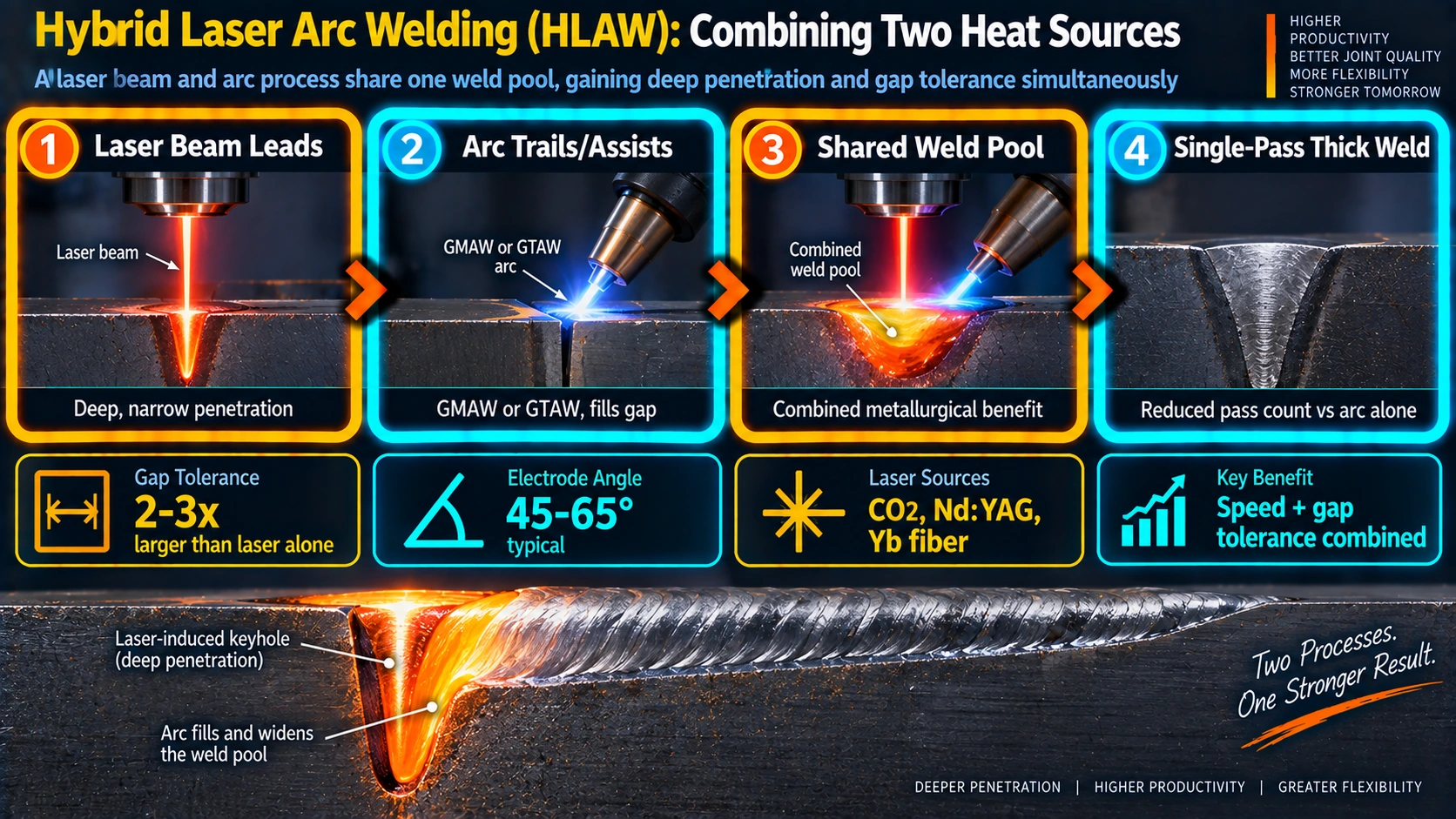
To understand why HLAW outperforms its component processes, it is necessary to consider what each heat source contributes independently — and what emergent properties arise when they share a weld pool.
1.1 Standalone Laser Welding Limitations
Autogenous laser welding (laser beam welding, LBW) achieves very high energy density — typically 105 to 107 W/cm2 at the focal spot — enabling keyhole formation and deep-penetration welds at high travel speeds with minimal heat input. The weld is characteristically narrow with a small HAZ and low distortion. However, autogenous laser welding has critical constraints: joint fit-up tolerance is extremely tight (gap typically less than 10% of plate thickness, often less than 0.3 mm for thick sections); no filler metal is added to compensate for material variation or to adjust weld metal chemistry; and weld pool stability is sensitive to surface contamination and plasma shielding effects at high powers.
1.2 Standalone GMAW Limitations
Conventional GMAW is robust, inexpensive, gap-tolerant, and versatile but is limited in penetration depth per pass (typically 3–6 mm), requires multiple passes for thick sections, and imposes significant heat input. For a 20 mm steel plate, a conventional GMAW multi-pass procedure may require 8–12 passes, producing a large HAZ, significant residual stress, and measurable distortion — particularly problematic for large panel structures in shipbuilding.
1.3 The Synergistic Effect
When the laser and arc occupy the same weld pool simultaneously, several synergies occur that exceed simple superposition of the two energy contributions:
- Arc stabilisation by the laser plasma: The laser-generated plasma above the keyhole pre-ionises the shielding gas, reducing the arc ignition voltage and stabilising the arc at higher travel speeds than arc welding alone can maintain.
- Increased gap bridging: The arc’s filler metal addition allows HLAW to bridge joint gaps 2–3 times larger than autogenous laser welding tolerates, while still achieving laser-level penetration depths.
- Extended keyhole stability: The arc heat input raises the temperature of the surrounding weld pool, reducing the viscosity of molten metal around the keyhole and allowing it to remain open more stably at higher travel speeds.
- Reduced porosity risk at high speed: The enlarged weld pool created by the combined sources provides a longer liquid residence time, allowing keyhole-collapse bubbles to escape before solidification — provided travel speed and inter-source distance are correctly optimised.
- Metallurgical flexibility: GMAW wire selection allows weld metal chemistry to be controlled independently of the base metal — critical for crack-sensitive materials, for matching toughness requirements, or for adding alloying elements to the weld zone.
2. Laser Sources Used in HLAW
The choice of laser source is the primary capital cost driver and determines beam quality, wavelength, delivery method, and maintenance burden. Three laser technologies are used in industrial HLAW systems.
| Laser Type | Wavelength | Power Range | Beam Quality (BPP) | Delivery | Status |
|---|---|---|---|---|---|
| CO2 Laser | 10.6 µm | 2–25 kW | Good (3–10 mm·mrad) | Mirror optics only | Legacy |
| Nd:YAG Lamp-Pumped | 1.06 µm | 1–6 kW | Moderate (10–25 mm·mrad) | Fibre-deliverable | Declining |
| Yb Fibre Laser | 1.07 µm | 1–30 kW | Excellent (<2 mm·mrad) | Fibre-deliverable | Current Standard |
| Yb:YAG Disk Laser | 1.03 µm | 2–16 kW | Excellent (<3 mm·mrad) | Fibre-deliverable | Active Industrial Use |
Yb fibre lasers now dominate new HLAW installations. Their near-infrared wavelength (approximately 1.07 micron) is much more efficiently absorbed by steel and aluminium than CO2 radiation, their wall-plug efficiency reaches 35–45%, they require virtually no realignment during operation, and their beam is delivered through a flexible fibre optic cable directly to a compact welding head that integrates with industrial robots. A 10 kW fibre laser on a 6-axis robot arm is the archetypal modern HLAW system.
CO2 lasers were historically the first used in HLAW shipbuilding installations (Meyer Werft and Blohm + Voss shipyards in Germany in the mid-1990s) but their 10.6 micron wavelength requires large, fixed mirror beam delivery systems incompatible with flexible robotic handling. They remain in service at established shipyards but are not specified for new installations.
3. Arc Process Selection
HLAW can in principle be combined with any arc welding process. In industrial practice, three arc variants are used, each with distinct characteristics.
3.1 Laser-GMAW Hybrid (Laser-MAG / Laser-MIG)
The dominant industrial configuration. GMAW adds filler metal at wire feed speeds of 4–18 m/min, using solid wire, metal-cored wire, or flux-cored wire. The arc current typically ranges from 150–450 A depending on wire diameter (0.9–1.6 mm) and deposition requirements. Shielding gas is usually an argon-rich mix (Ar + 8–18% CO2 for steel, or Ar + He for aluminium). The GMAW torch is positioned at an inter-source distance of 2–6 mm from the laser focal point, at an angle of 20–35 degrees to the laser beam axis. This is the configuration used for shipbuilding panels, pipeline girth welds, and structural fabrication.
3.2 Laser-GTAW Hybrid
GTAW (TIG) combined with laser welding is used for thin-section precision work and for materials where contamination from a consumable electrode is unacceptable (e.g., titanium, some aerospace alloys). The GTAW arc adds heat and stabilises the weld pool without adding filler metal unless a cold wire feed is included. The process achieves excellent surface quality and low spatter. It is, however, limited to thin sections (typically less than 6 mm) because the non-consumable arc contributes less heat than a GMAW arc at the same energy input level.
3.3 Laser-Plasma Hybrid
Plasma arc welding combined with a laser offers deeper penetration than GTAW hybrid and excellent plasma stability. It is used in specialised applications including tube-to-tubesheet joints in heat exchangers and high-precision aerospace welding. The plasma torch geometry is more complex to integrate with the laser head, making it less common in general fabrication.
| Configuration | Filler Metal | Typical Penetration | Gap Tolerance | Primary Application |
|---|---|---|---|---|
| Laser-GMAW | Yes (wire) | Up to 25 mm (single pass) | Up to 1.5 mm | Shipbuilding, pipelines, structural steel |
| Laser-GTAW | Optional (cold wire) | Up to 8 mm | 0.3–0.6 mm | Precision sheet, aerospace, Ti alloys |
| Laser-Plasma | No (autogenous) | Up to 12 mm | 0.2–0.5 mm | Aerospace, heat exchanger components |
4. Process Configuration: Laser-Leading vs. Arc-Leading
The relative positioning of the two heat sources in the travel direction is one of the most influential HLAW setup variables and is not freely interchangeable between materials or applications.
4.1 Laser-Leading (Laser-Ahead)
The laser beam precedes the arc in the welding direction. This is the standard configuration for steel fabrication. The laser pre-heats the joint line, forms the keyhole, and generates a stabilising plasma that improves arc ignition and reduces arc wander. The GMAW arc then fills the upper portion of the joint, producing a well-formed cap bead. Laser-leading maximises penetration depth and travel speed for a given total power input, and produces a narrower, lower heat input weld than arc-leading.
4.2 Arc-Leading (Arc-Ahead)
The arc precedes the laser. The arc pre-heats the base metal, reducing reflectivity (particularly beneficial for highly reflective materials such as aluminium), and softening the material ahead of the laser focal spot. Arc-leading is preferred for aluminium alloys because it reduces the initial laser power required to initiate keyhole formation and reduces the risk of porosity from hydrogen evolution. It also benefits stainless steel welding by providing a pre-heated, cleaner surface for the laser interaction.
5. Key Process Parameters and Their Interactions
HLAW is parameterically complex because it couples two welding processes, each with their own independent variables, plus a set of jointly defined coupling parameters. Optimisation requires understanding each parameter’s individual effect and the interactions between them.
5.1 Laser Parameters
| Parameter | Typical Range | Primary Effect | Interaction |
|---|---|---|---|
| Laser Power (PL) | 2–16 kW | Controls keyhole depth and penetration | Must balance with travel speed |
| Focus Position (Zf) | −5 mm to +3 mm | Controls spot diameter at workpiece | Negative defocus widens beam, reduces intensity |
| Focal Spot Diameter | 0.2–0.6 mm | Energy density; keyhole width | Determined by beam quality and focal length |
| Laser Beam Angle | 0° to 10° tilt | Keyhole shape and plasma plume direction | Affects arc stability at small inter-source distances |
5.2 Arc Parameters
| Parameter | Typical Range | Primary Effect | Interaction |
|---|---|---|---|
| Arc Current (IA) | 150–450 A | Deposition rate; weld pool temperature | Higher current demands higher travel speed to avoid excess heat |
| Arc Voltage (UA) | 20–38 V | Arc length; bead width | Must match wire feed speed (synergic curves) |
| Wire Feed Speed (WFS) | 4–18 m/min | Deposition rate; cap bead height | Defines current in constant-voltage systems |
| Torch Angle | 15°–35° from vertical | Arc impingement point on weld pool | Affects keyhole stability when torch is close to laser |
| Contact Tip-to-Work Distance (CTWD) | 12–20 mm | Electrical extension; deposition stability | Longer CTWD increases resistance heating of wire |
5.3 Coupled Parameters
The most critical HLAW-specific parameters are those that couple the two heat sources:
- Inter-source distance (d): The distance between the laser focal point on the workpiece surface and the GMAW wire tip (or arc impingement point). Optimal range: 2–6 mm. Too small — the arc disrupts the laser plasma, causing instability; too large — the two sources act independently and the synergistic effect is lost.
- Travel speed (v): Governs the combined heat input per unit length. Typically 0.8–4.0 m/min in steel, depending on plate thickness and power level. Both laser power and arc current must be adjusted as travel speed changes.
- Energy ratio (PL / Ptotal): The fraction of total power contributed by the laser versus the arc. A higher laser fraction produces deeper, narrower welds; a higher arc fraction improves filler deposition but increases HAZ width. For structural steel, laser contribution is typically 50–70% of total power.
- Shielding gas composition and flow rate: Typically Ar + 8–18% CO2 for steel at 15–25 L/min. The shielding gas must protect both the laser focal zone and the arc interaction zone simultaneously. Helium additions (Ar + He mixtures) suppress the laser-induced plasma at very high power levels, improving energy coupling.
HI = (PL + PA) / (v × 1000)
HI = Heat input [kJ/mm]
P_L = Laser power [W]
P_A = Arc power = I_A × U_A [W]
v = Travel speed [mm/s]
// Example: 6 kW fibre laser + 250A @ 28V arc, v = 25 mm/s
P_L = 6000 W
P_A = 250 × 28 = 7000 W
P_total = 13000 W
HI = 13000 / (25 × 1000) = 0.52 kJ/mm
Combined heat input: 0.52 kJ/mm
Note: Equivalent GMAW multi-pass for same plate thickness may produce
1.8–2.5 kJ/mm over all passes — HLAW reduces total heat input 3–5x.
6. Joint Design for HLAW
HLAW joint designs are not interchangeable with those used for conventional GMAW. The laser’s ability to achieve full penetration in a single pass from one side changes the geometry requirements fundamentally.
6.1 Square Butt Joints
For thin to medium sections (up to approximately 10–12 mm), HLAW can weld a square butt joint in a single pass with no chamfering required. This eliminates bevel preparation entirely, saving significant pre-weld machining or grinding time. The gap must be tightly controlled — typically less than 0.5 mm for thin plates, and up to 1.0–1.5 mm for thicker sections where the GMAW filler bridges the opening.
6.2 Narrow V-Groove for Thick Sections
For sections above 12–15 mm, a narrow V-groove or Y-groove is used. The included angle is substantially smaller than for conventional GMAW (typically 20–30 degrees total, vs. 60 degrees for SMAW/GMAW), reducing the volume of filler metal required and the total heat input. The keyhole handles the root penetration; the arc fills the upper groove. This dramatically reduces the number of passes compared with conventional GMAW multi-pass welding. For a 25 mm plate, a conventional SMAW/GMAW procedure might require 10–14 passes; a well-developed HLAW procedure achieves the same joint in 1–3 passes.
6.3 T-Joint and Fillet Welds
T-joint and fillet weld applications are common in shipbuilding panel fabrication (longitudinal stiffeners welded to plate). HLAW in 2F (horizontal fillet) position achieves single-pass penetration of 8–10 mm on each side at high travel speed. The reduced heat input minimises plate distortion — a significant advantage when fabricating large flat panels where angular distortion traditionally requires expensive post-weld straightening.
7. Metallurgical Effects and Microstructure
The metallurgical consequences of HLAW differ from both autogenous laser welding and conventional GMAW because the combined thermal cycle is faster, more concentrated, and involves filler metal addition.
7.1 HAZ Width and Grain Structure
The narrower heat-affected zone (HAZ) is one of the most cited metallurgical advantages of HLAW. Because the combined heat input per unit length is lower than multi-pass GMAW (for the same total plate thickness), the peak temperature isotherm extends less distance into the base metal. The grain-coarsened HAZ sub-zone — where temperatures exceed the grain coarsening threshold (approximately 1100°C for low-carbon steel) — is measurably narrower, typically 1–3 mm wide vs. 3–8 mm in conventional multi-pass GMAW. This translates directly to better notch toughness in the HAZ, as grain coarsening is the primary mechanism for HAZ toughness degradation.
7.2 Cooling Rate and Microstructure
HLAW produces higher cooling rates than GMAW for the same plate thickness because the weld volume is smaller and heat dissipates rapidly into the surrounding cold base metal. For carbon-manganese steels with carbon equivalents above 0.40, this rapid cooling can produce martensite or bainite in both the HAZ and the fusion zone if preheat is not applied. Preheat requirements for HLAW are generally lower than for SMAW or GMAW of the same material (because total heat input is higher per pass and t8/5 cooling time from 800 to 500°C is extended relative to autogenous laser welding), but are not zero. Preheat calculation should be performed to carbon equivalent (CE) methodology or EN 1011-2 nomogram approach.
7.3 Solidification Cracking
The rapid solidification in the keyhole zone combined with the steep solidification front can increase susceptibility to hot cracking (solidification cracking and liquation cracking) in crack-sensitive alloys. For austenitic stainless steel, controlling delta ferrite content in the weld metal is essential. For high-strength low-alloy (HSLA) steels, sulphur and phosphorus levels in the base metal should be low (less than 0.005% S preferred), and the GMAW filler wire should be selected to provide adequate Mn:S ratio in the weld pool. For duplex stainless steels, nitrogen-bearing filler wires (ER2209, ER2594) are used to maintain austenite/ferrite balance across the weld thermal cycle.
7.4 Weld Metal Properties
The weld metal microstructure in HLAW consists of acicular ferrite, polygonal ferrite, and small amounts of bainite in carbon-manganese and HSLA steels. The acicular ferrite content — which governs impact toughness — is influenced by the cooling rate and by weld metal chemistry, particularly oxygen content (from shielding gas and wire composition) and titanium content of the wire. Properly optimised HLAW welds in shipbuilding grades (AH36, EH36, DH36) routinely achieve Charpy impact values of 60–120 J at −40°C in the weld metal, meeting the requirements of classification society rules.
8. Weld Defects in HLAW and Prevention
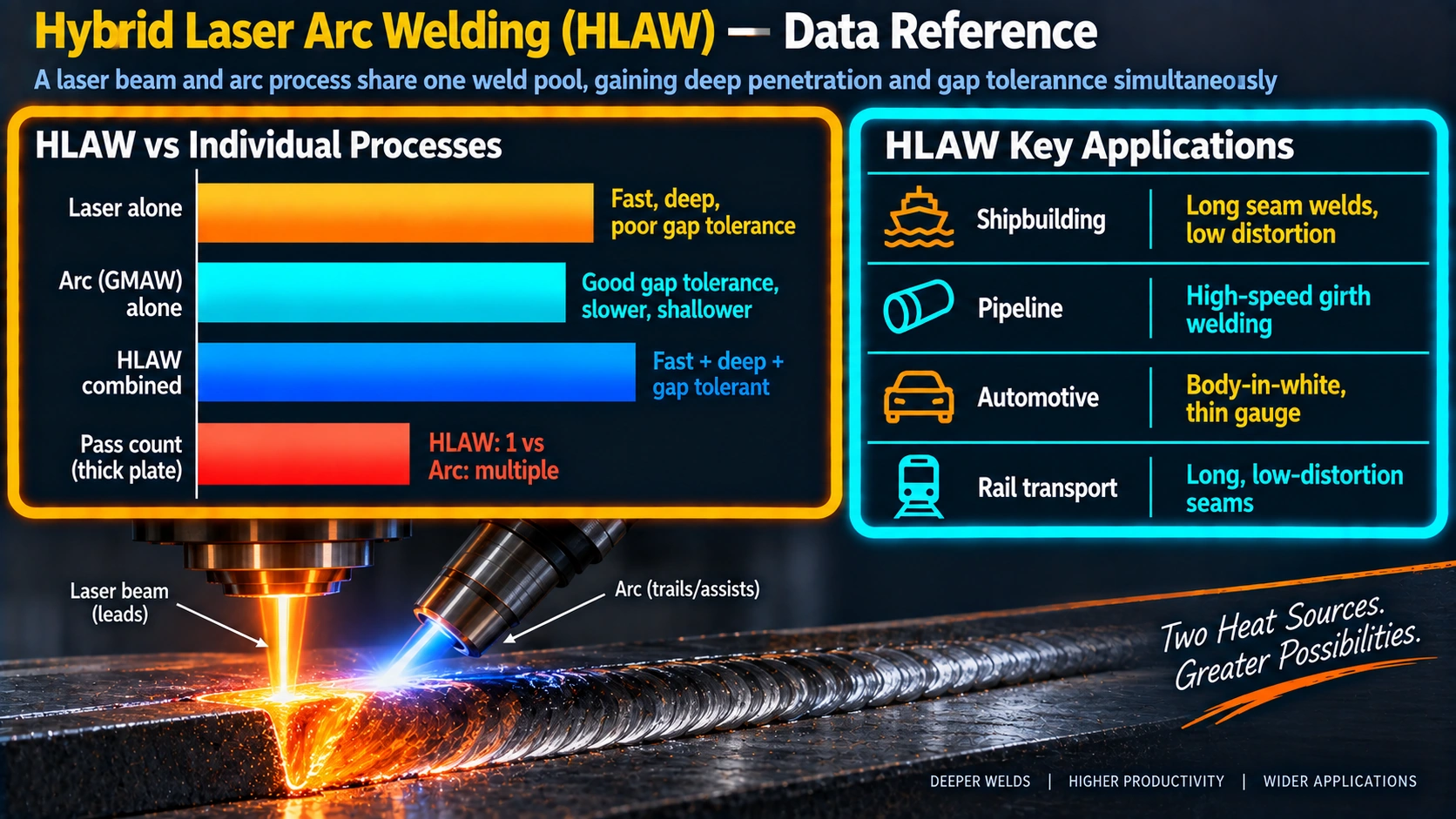
8.1 Porosity
Porosity is the most prevalent defect in HLAW and arises from two distinct mechanisms that must be addressed separately. Keyhole-collapse porosity forms when the keyhole closes faster than the surrounding melt can fill the void, trapping a gas bubble that solidifies before it can escape. Prevention: optimise travel speed and inter-source distance to maximise the time available for bubble migration; use helium additions in the shielding gas to reduce keyhole instability; avoid excessive laser power at low travel speed. Hydrogen porosity arises from moisture, contamination, or organic residues on the base metal or filler wire. Prevention: pre-weld cleaning of base metal with acetone or alkaline cleaner, dry storage of filler wire, and use of low-hydrogen shielding gas (dew point below −40°C). For pipeline applications, hydrogen-induced cracking (HIC) susceptibility should also be evaluated — see our guide to sour service welding requirements.
8.2 Humping
Humping is a periodic bead irregularity — alternating bulges and valleys — that occurs when travel speed exceeds the threshold at which the weld pool can be maintained as a continuous liquid film ahead of the solidification front. It manifests typically above 3–4 m/min in steel. Prevention: reduce travel speed; increase arc energy contribution relative to laser (which stabilises the pool); adjust inter-source distance to improve pool dynamics. Humping is an absolute rejection criterion in structural and pressure-containing applications.
8.3 Undercut
Undercut — a groove along the weld toe — is caused by excessive arc voltage, too-steep torch angle, or excessive travel speed relative to arc current. It reduces the effective load-carrying section area and acts as a stress concentration. Prevention: reduce arc voltage slightly; adjust torch angle to 20–25 degrees; ensure travel speed is within the validated parameter window. For fatigue-critical joints, weld toe geometry must meet the requirements of mechanical and geometric acceptance criteria.
8.4 Lack of Fusion / Incomplete Penetration
Lack of fusion at the keyhole-arc interface boundary (the zone between the deep laser keyhole and the wider arc fusion pool) can occur if inter-source distance is too large or if the energy ratio is incorrectly balanced. It produces a planar internal discontinuity that is difficult to detect by radiographic testing (RT) but is detectable by phased array ultrasonic testing (PAUT). Macro section examination of procedure qualification test pieces is mandatory to verify full fusion through the section.
9. Industrial Applications
9.1 Shipbuilding
Shipbuilding was the first industry to adopt HLAW at production scale, and it remains the most significant application by welded volume. The motivation is distortion reduction: it has been estimated that 20–30% of man-hours in shipbuilding are expended on correcting welding distortions in deck panels and bulkheads. HLAW-welded panels exhibit angular distortion 70–80% lower than equivalent GMAW-welded panels, dramatically reducing straightening work. European shipyards (Meyer Werft, Meyer Turku, Blohm + Voss, STX Europe) began installing HLAW panel lines in the mid-1990s and the technology is now considered standard for new-build cruise ships, container vessels, and offshore platforms. Typical applications: butt welds in deck panels, T-fillet welds joining longitudinal stiffeners, and coaming joints. Materials: AH36, DH36, EH36 structural shipbuilding steels.
9.2 Pipeline Welding (Onshore and Offshore)
HLAW is applied to girth welds in high-strength pipeline steels (API 5L X70, X80, X100, X120) both onshore and in pipeline manufacturing facilities. The process achieves single-pass or two-pass completion of pipe wall thicknesses up to 25 mm at girth welding speeds 3–5 times higher than orbital GTAW. Qualification must follow API 1104 or ASME Section IX requirements. The narrow HAZ is particularly valuable for high-strength pipeline grades where HAZ softening (reduction in yield strength due to tempering of the base metal microstructure) can otherwise reduce the effective operating pressure rating.
9.3 Automotive Manufacturing
HLAW is used in automotive body-in-white production for tailored blank welding — joining sheets of different gauges and grades that are then pressed into structural components. The process accommodates the mixed-material combinations (galvanised steel, AHSS, dual-phase steels) used for crash performance at high production speeds. Typical travel speeds in automotive HLAW lines are 4–8 m/min for 1–3 mm sheet thicknesses. The low heat input minimises zinc vapour evolution from galvanised coatings, reducing porosity in galvanised sheet welds.
9.4 Power Generation and Process Plant
In the power generation sector, HLAW is applied to longitudinal seam welds in boiler tube panels, header welds, and thick-section steam drum fabrication. The advantage in this sector is the combination of deep penetration (reducing the number of passes in heavy section drums) with low heat input (reducing the risk of sensitisation in austenitic stainless steels — a mechanism described in detail in our article on stainless steel weld decay). For high-chromium creep-resistant steels such as P91 (9Cr-1Mo-V), HLAW is under active development but requires careful control of heat input to avoid Type IV cracking susceptibility in the intercritical HAZ.
9.5 LNG Construction
A notable recent application is the HLAW butt welding of 9% nickel (9Ni) cryogenic steel plates for LNG tank construction. The process achieves full penetration of 14–16 mm thick plates in a single pass at welding positions including 1G (flat), 2G (horizontal), and 3G (vertical-down) — all relevant to large fixed-tank fabrication. The narrow HAZ and low heat input are advantageous for maintaining the cryogenic toughness of 9Ni steel, which is sensitive to heat-induced precipitation changes near the weld boundary.
| Industry | Typical Material | Joint Type | Key Advantage of HLAW |
|---|---|---|---|
| Shipbuilding | AH/DH/EH36 | Butt, T-fillet | Low Distortion |
| Pipeline | API X70–X120 | Girth (butt) | High Speed, Narrow HAZ |
| Automotive | AHSS, DP, galvanised | Lap, butt (tailored blank) | High Speed, Low Heat |
| Power / Boiler | SS 316L, P91, CS | Butt, seam | Reduced Sensitisation Risk |
| LNG Construction | 9Ni Steel | Butt | Preserved Cryogenic Toughness |
| Offshore Structures | S460, S690 | Butt, T-joint | Fewer Passes, Lower HI |
10. Procedure Qualification Under Welding Codes
HLAW is not explicitly codified in the same way as GMAW or SMAW in most welding standards, but it can be qualified under existing frameworks with specific considerations for its dual-source nature.
10.1 ASME Section IX
HLAW can be qualified under ASME Section IX as a special process. A separate WPS must be prepared that documents all essential variables for both the laser and the arc simultaneously. Essential variables specific to HLAW include: laser power class (kW range), laser type (fibre, disk, CO2), focus position range, inter-source distance range, leading process (laser or arc), arc process type, wire classification, shielding gas composition, and travel speed range. PQR testing must include tensile, bend, and notch toughness testing. Preheat and PWHT requirements apply to the base material P-Number in the same manner as for conventional arc processes — see our guide to P-Numbers and F-Numbers in ASME Section IX.
10.2 AWS D1.1 Structural Welding Code
AWS D1.1 does not contain pre-qualified HLAW joint details. All HLAW procedures must be qualified by test under Clause 4 (Qualification). The test requirements are identical to those for any non-pre-qualified process: groove weld qualification tests (tensile, transverse bend, macro section), fillet weld qualification (macro section), and impact testing if required by the contract documents. Given the relatively small HAZ and the potential for lack-of-fusion defects at the keyhole-arc interface, RT or PAUT of the procedure qualification test weld is strongly recommended even where the production code does not mandate it.
10.3 Essential Variables Unique to HLAW
Because HLAW combines two processes, its essential variables list is longer than for a standalone arc process. The following changes require requalification:
- Change of laser source type (e.g., fibre to CO2)
- Change of laser power by more than ±10% of qualified value
- Change of leading process (laser-leading to arc-leading or vice versa)
- Change of inter-source distance outside qualified range
- Change of shielding gas type or composition
- Change of arc process type (e.g., GMAW to GTAW)
- Change of base metal P-Number or Group Number
- Change of filler wire classification (F-Number change)
11. HLAW vs. Competing Processes — Comparative Summary
| Criterion | HLAW | GMAW (Multi-pass) | Autogenous LBW | SAW |
|---|---|---|---|---|
| Penetration (single pass, 10 kW) | Up to 20–25 mm | 4–6 mm | 15–20 mm | 8–12 mm (tandem) |
| Travel Speed (12 mm plate) | 1.5–3.0 m/min | 0.3–0.6 m/min | 2.0–4.0 m/min | 0.5–1.0 m/min |
| Heat Input (relative) | Low–Medium | High (multi-pass) | Very Low | High |
| HAZ Width | Narrow (1–4 mm) | Wide (4–10 mm) | Very Narrow (0.5–2 mm) | Wide (5–12 mm) |
| Joint Fit-Up Tolerance | Moderate (up to 1.5 mm) | Good (up to 3 mm) | Tight (<0.3 mm) | Good |
| Distortion | Low | High | Very Low | High |
| Filler Metal Addition | Yes | Yes | No | Yes |
| Capital Cost | High | Low | Very High | Medium |
| Automation Requirement | High (robotic) | Low–High | Very High | High (mechanised) |
Recommended Technical References
Disclosure: WeldFabWorld participates in the Amazon Associates programme (StoreID: neha0fe8-21). If you purchase through these links, we may earn a small commission at no extra cost to you. This helps support free technical content on this site.
Frequently Asked Questions
What is hybrid laser-arc welding (HLAW)?
Hybrid laser-arc welding (HLAW) is a process that simultaneously combines a focused laser beam and an electric arc — most commonly GMAW — in a single, shared weld pool. The two heat sources act synergistically: the laser creates a deep keyhole and drives fast travel speeds, while the arc adds filler metal, improves gap bridging, and stabilises the weld pool. The result is deeper penetration, higher speed, and better metallurgical control than either process achieves alone. For more on the constituent arc process, see our GMAW welding guide.
What is the difference between laser leading and arc leading in HLAW?
In laser-leading configuration, the laser beam precedes the arc in the travel direction. The laser pre-heats the base metal, stabilises the arc, and drives deep keyhole penetration; the arc then fills the upper weld pool. In arc-leading (arc-ahead) configuration, the arc pre-heats and softens the material before the laser acts, which benefits welding of highly reflective metals like aluminium and reduces porosity risk. Laser-leading is the most common arrangement for steel applications requiring maximum penetration. Switching between configurations is treated as an essential variable change requiring WPS/PQR requalification under ASME Section IX and equivalent codes.
What laser types are used in hybrid laser-arc welding?
The three main laser types used in HLAW are CO2 lasers (10.6 micron wavelength — legacy technology, mirror beam delivery), Nd:YAG lasers (1.06 micron, fibre-deliverable but declining), and Yb fibre and disk lasers (approximately 1.07 micron — now the current industrial standard). Fibre and disk lasers operating at 4–20 kW are preferred for new installations because of their high wall-plug efficiency (35–45%), excellent focusability (beam parameter product below 2 mm·mrad), low maintenance, and fibre delivery compatibility with 6-axis robotic welding heads.
What are the main process parameters in HLAW and how do they interact?
HLAW involves two sets of interacting parameters. Laser parameters include power (kW), focal spot diameter (mm), focus position relative to surface, and beam angle. Arc parameters include current (A), voltage (V), wire feed speed (m/min), torch angle, and shielding gas composition. The critical coupled parameters are: inter-source distance (2–6 mm gap between laser focal point and arc contact tip); the laser/arc energy ratio; and travel speed. All must be optimised together. The carbon equivalent of the base metal also influences required preheat and must be factored into the parameter window.
What weld defects are specific to HLAW and how are they prevented?
HLAW is susceptible to porosity, humping, and undercut. Porosity is the most common defect and arises from two mechanisms: keyhole collapse trapping gas bubbles, and hydrogen from moisture or contamination. Prevention includes optimising travel speed to allow gas escape before solidification, increasing heat input to slow solidification, thorough pre-weld cleaning, dry shielding gas, and controlling inter-source distance. Humping (periodic bead irregularities) occurs at excessive travel speed. Undercut results from mismatched arc voltage or poor torch angle. Proper parameter optimisation and seam tracking eliminate most defects in production. All HLAW welds should be inspected by appropriate NDT methods; PAUT is recommended for detecting internal lack-of-fusion at the keyhole-arc interface.
How does HLAW compare to conventional GMAW for thick-section steel?
For thick-section steel (10–25 mm), HLAW offers substantially higher travel speed (often 3–5 times faster than multi-pass GMAW), a reduced number of passes, a much narrower HAZ, and significantly lower distortion. The narrow weld bead minimises shrinkage forces. However, HLAW requires tight joint fit-up (gap typically less than 1.5 mm with arc filler), high capital investment, and skilled parameter optimisation. Conventional GMAW or SAW remain preferred where fit-up is poor, cost sensitivity is high, or where access limits robotic automation.
Is HLAW approved under ASME or AWS codes for pressure vessel and pipeline work?
HLAW may be qualified under ASME Section IX as a special welding process. A separate WPS and PQR are required that specifically define all hybrid process parameters — laser power, arc current, inter-source distance, travel speed, focus position, and shielding gas. AWS D1.1 does not have a dedicated HLAW clause, but hybrid welds can be procedure-qualified under Section 4. For pipeline girth welds, API 1104 qualification testing applies. Any change to essential HLAW variables (laser power class, arc process type, joint design, leading configuration) requires requalification. See our P-Number and F-Number guide for base metal and filler classification context.
What materials can be welded using HLAW?
HLAW has been successfully applied to carbon steel (structural grades, pipeline grades up to X120), stainless steel (austenitic, duplex, and super duplex), HSLA steels, 9% Ni cryogenic steel, aluminium alloys (5xxx and 6xxx series for shipbuilding and railcar manufacture), titanium alloys, magnesium alloys, and nickel-based superalloys. The laser energy ratio and filler wire selection must be adjusted for each material class. For reflective aluminium alloys, arc-leading configuration is typically preferred. For crack-sensitive materials, ferrite content in stainless steel or carbon equivalent in structural steels governs preheat and wire selection requirements.