Ultrasonic Testing (UT) — Understanding the Science Behind Sound-Based Inspection
Ultrasonic Testing (UT) is one of the most powerful and widely used Non-Destructive Testing (NDT) methods in modern industrial inspection. By transmitting high-frequency sound waves into a material and analysing the returning echoes, UT enables engineers and inspectors to detect internal discontinuities, measure component thickness, evaluate material integrity, and verify weld quality — all without causing any damage to the component under test. This makes UT indispensable across the oil & gas, petrochemical, power generation, pressure vessel fabrication, and aerospace sectors.
The effectiveness of any ultrasonic examination depends not just on equipment sensitivity but on a thorough understanding of the underlying physics: how sound waves propagate through solids, how they interact with material boundaries, what happens when they encounter a discontinuity, and how the resulting signals are calibrated and interpreted. This guide covers all of that — from the fundamental pulse-echo principle and acoustic impedance through to wave mode selection, beam angle geometry, attenuation, applicable standards, and the full set of working formulae used in daily practice.
Whether you are preparing for a Level II certification, performing production weld inspection under ASME code requirements, or simply building a solid technical foundation in NDT, this article provides the comprehensive reference you need.
What Is Ultrasonic Testing?
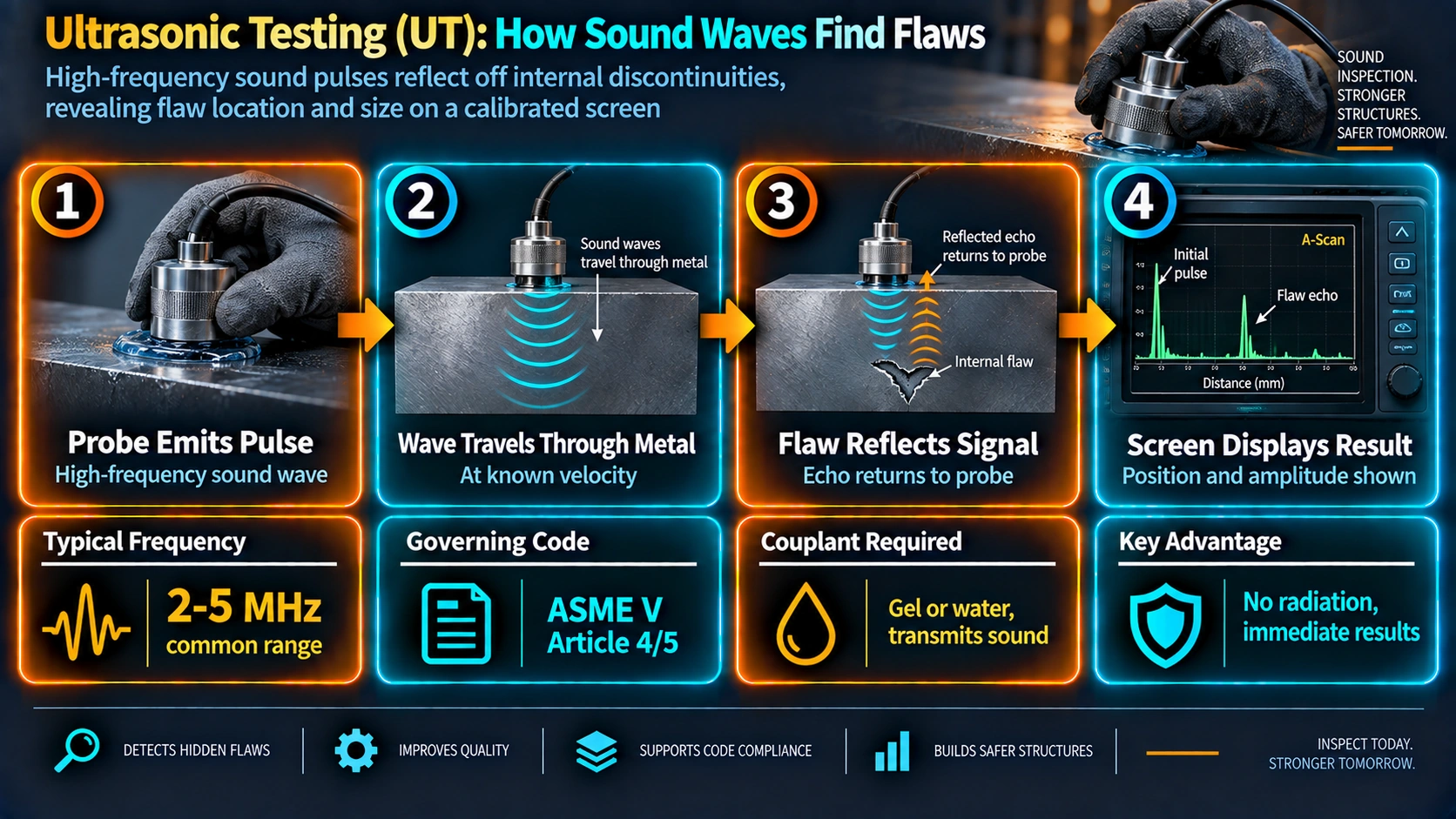
Ultrasonic Testing belongs to the volumetric family of NDT methods — meaning it can interrogate the full thickness of a material, not just the surface. Sound waves in the frequency range of 0.5 MHz to 25 MHz (well above the human audible range of 20 kHz) are generated by a piezoelectric transducer and coupled into the test piece through a liquid couplant. These waves travel through the material at a velocity that is characteristic of both the material type and the wave mode. When the wave encounters an interface where acoustic properties change — a crack face, an inclusion, a void, or the back wall — some energy is reflected back toward the transducer and recorded as an echo on an A-scan display.
The time between the initial pulse and the returning echo, combined with the known wave velocity in the material, allows the distance to the reflector to be calculated precisely. The amplitude of the echo provides information about the size, orientation, and nature of the reflector. This combination of distance and amplitude information forms the basis of all UT interpretation.
Key Formulae Used in Ultrasonic Testing
A solid command of the fundamental UT equations is essential for Level II and Level III personnel. These formulae are used daily in calculating sound velocity, determining flaw depth, selecting probe frequency, and understanding energy behaviour at interfaces.
Wave Modes in Ultrasonic Testing
Ultrasonic waves can propagate through materials in several distinct modes, each characterised by a different relationship between particle motion and wave propagation direction. The choice of wave mode is one of the most critical decisions in setting up a UT examination because it determines velocity, attenuation behaviour, and the types of discontinuities that can be detected.
Longitudinal (Compression) Waves
Particle motion is parallel to the direction of wave propagation. These are the fastest wave mode in any given material. Used for straight-beam contact testing, thickness measurement, and immersion testing. Velocity in steel: approximately 5,920 m/s.
Shear (Transverse) Waves
Particle motion is perpendicular to the direction of wave propagation. Slower than longitudinal waves in the same material (approximately 0.55 times the longitudinal velocity in most metals). Used predominantly in angle-beam weld inspection. Velocity in steel: approximately 3,230 m/s.
Surface (Rayleigh) Waves
Travel along the surface of a material to a depth of approximately one wavelength. Particle motion is elliptical. Effective for detecting surface-breaking and near-surface discontinuities on smooth surfaces. Sensitive to surface condition and couplant type.
Plate (Lamb) Waves
In thin plates and sheets, guided waves known as Lamb waves propagate through the entire cross-section. They are used in corrosion screening and structural health monitoring of thin-walled components. Lamb wave behaviour is complex — multiple wave modes (symmetric and antisymmetric) exist simultaneously — and their interpretation requires specialised equipment and expertise.
| Wave Mode | Velocity in Steel | Particle Motion | Primary Applications |
|---|---|---|---|
| Longitudinal | ~5,920 m/s | Parallel to propagation | Thickness measurement, straight-beam, immersion |
| Shear | ~3,230 m/s | Perpendicular to propagation | Weld inspection, angle-beam |
| Surface (Rayleigh) | ~2,960 m/s | Elliptical | Near-surface cracks, surface examination |
| Lamb (plate) | Dispersive (varies) | Complex (symmetric / antisymmetric) | Thin plates, pipes, guided wave screening |
Acoustic Impedance and Reflectivity
Acoustic impedance is the fundamental material property that governs how sound energy behaves at any interface. Defined as Z = ρ × V, it represents the material’s resistance to the oscillating motion of the particles within it as a sound wave passes through. When a sound beam encounters an interface between two materials with different acoustic impedances, the wave is partially reflected back and partially transmitted forward.
The reflection coefficient R = (Z₂ − Z₁) / (Z₂ + Z₁) determines the fraction of sound pressure amplitude that is reflected. Squaring R gives the energy reflection coefficient. At a steel-to-air interface (as occurs at the face of an open crack), Z₂ for air is approximately 0.0004 MRayl compared to ~45.4 MRayl for steel. The resulting R ≈ −0.9999, meaning virtually 100% of the incident energy is reflected — which is precisely why UT is so sensitive to planar, tight-fitting cracks.
| Material | Density (kg/m³) | Long. Velocity (m/s) | Acoustic Impedance Z (MRayl) |
|---|---|---|---|
| Steel (carbon) | 7,800 | 5,920 | 46.2 |
| Stainless steel (316) | 7,970 | 5,740 | 45.7 |
| Aluminium | 2,700 | 6,320 | 17.1 |
| Copper | 8,900 | 4,700 | 41.8 |
| Water (couplant) | 1,000 | 1,480 | 1.48 |
| Perspex (wedge) | 1,180 | 2,730 | 3.22 |
| Air | 1.21 | 343 | 0.000415 |
Attenuation of Ultrasonic Waves
Attenuation describes the progressive loss of ultrasonic energy as the beam travels through a material. It is expressed in decibels per unit length (dB/m or dB/mm) and has three distinct physical causes:
- Absorption: Acoustic energy is converted into heat through internal friction between vibrating particles. This is strongly temperature-dependent and increases with frequency.
- Scattering: The sound beam is redirected in multiple directions by grain boundaries, second-phase particles, porosity, and microstructural heterogeneity. Scattering becomes severe when the grain size approaches the wavelength of the ultrasound (grain size ≥ λ/10 is a useful rule of thumb).
- Beam Divergence: As the sound beam spreads beyond the near field, energy density decreases with distance from the transducer even in a perfectly homogeneous, lossless medium.
The total attenuation coefficient α (in dB/m) is often expressed as: α = αabs + αscat. For fine-grained ferritic steel, attenuation is low and high-frequency probes (5–10 MHz) can be used effectively. Coarse-grained austenitic stainless steel welds and cast materials present a severe challenge: high scattering produces elevated acoustic noise (often called “grass” on the A-scan), which can mask genuine flaw echoes. In these materials, lower frequencies (1–2 MHz) and specialised low-noise probes are required, though at the cost of reduced resolution.
Angle-Beam Inspection — Beam Geometry and Sound Path
Angle-beam probes are the workhorses of weld inspection. A Perspex (or PEEK) wedge is bonded to the front face of a standard transducer, and the wedge angle is designed — using Snell’s Law — to generate a refracted shear wave in steel at a specific angle (typically 45°, 60°, or 70°). The beam is then scanned along the weld area to ensure coverage of the full weld volume.
Key Geometry Parameters
UT Equipment and Probes
A conventional UT system consists of a flaw detector (pulse generator and receiver), connecting cable, and transducer probe. The flaw detector generates an electrical pulse, converts it to a sound pulse via the probe’s piezoelectric element, amplifies the returning echoes, and displays them on an A-scan time-base. Modern digital instruments store A-scans, apply DAC (Distance Amplitude Correction), TCG (Time Corrected Gain), and enable data logging.
Probe Types
| Probe Type | Wave Mode | Typical Frequency | Application |
|---|---|---|---|
| Normal (straight-beam) | Longitudinal | 2–10 MHz | Thickness measurement, lamination detection, plate testing |
| Angle beam (shear wave) | Shear (45°, 60°, 70°) | 2–5 MHz | Weld inspection, flaw characterisation |
| Twin-crystal (TR/SE) | Longitudinal | 2–10 MHz | Near-surface detection, corrosion mapping |
| Immersion probe | Longitudinal / angle | 5–25 MHz | High-resolution inspection, automated scanning |
| Phased array (PAUT) | Longitudinal / Shear | 2–10 MHz | S-scan weld inspection, TOFD complement |
Frequency Selection
Probe frequency is one of the most important variables in UT. Higher frequency improves near-surface resolution and minimum detectable flaw size (because wavelength λ = V/f decreases), but increases attenuation and makes the technique more sensitive to material noise from large grains. Lower frequency penetrates further with less attenuation but provides poorer resolution.
As a general guideline: fine-grained ferritic steel welds are inspected at 4–5 MHz; thick section forgings at 2–4 MHz; coarse-grained austenitic welds at 1–2 MHz; and composite materials at 1–5 MHz depending on construction. For P91 and creep-resistant alloy welds, 4 MHz angle-beam probes are typical.
Calibration in Ultrasonic Testing
Calibration is performed before, during, and after each inspection to ensure the UT system is operating within defined sensitivity and accuracy limits. Calibration establishes the distance scale (time-base) and the sensitivity reference level (gain setting). Improper calibration is the single most common cause of missed flaws or unacceptable false calls in UT.
Reference Blocks
Standard reference blocks are machined from representative material and contain artificial reflectors of known geometry. The most commonly used are:
- IIW (V1) Block: Used for time-base calibration and angle verification. Contains a 100 mm radius curved face, 1.5 mm diameter side-drilled hole, and 50 mm thick flat section.
- V2 (Miniature Angle-Beam) Block: Compact version for angle measurement and range calibration in restricted access situations.
- Basic Calibration Block (ASME): Contains flat-bottomed holes (FBH) and side-drilled holes (SDH) for establishing DAC curves per ASME Section V.
- Area-Amplitude / Distance-Amplitude Blocks: Used to plot DAC/TCG curves showing how echo amplitude varies with distance for a reflector of fixed size.
Common Defects Detected by Ultrasonic Testing
UT is sensitive to a wide range of discontinuity types depending on wave mode, probe angle, and frequency. Understanding the characteristic echo patterns of each defect type is fundamental to Level II and Level III interpretation skills. All of these can be found during weld qualification and production inspections.
| Defect Type | Echo Characteristics | Preferred Wave Mode | Typical Origin |
|---|---|---|---|
| Planar Cracks | High amplitude, sharp, directional (angle-dependent) | Shear wave angle-beam | HAZ, root, toe regions |
| Lack of Fusion (LoF) | High amplitude, planar, detected from specific angle | Shear wave angle-beam | Fusion faces, inter-run |
| Lack of Penetration (LoP) | Strong linear echo at root depth | Shear wave, root skip | Root of butt weld |
| Porosity (cluster) | Multiple scattered, low-amplitude echoes | Longitudinal normal beam | Weld bead, solidification zone |
| Slag Inclusions | Irregular echoes, may appear as cluster | Longitudinal or shear | Between passes (SMAW, SAW) |
| Laminations | High amplitude, parallel to surface, masks back wall | Normal beam longitudinal | Plate, pipe base material |
| Corrosion Damage | Reduced back-wall echo, irregular thickness readings | Normal beam (thickness mode) | Internal pipe / vessel walls |
| Shrinkage Cavities | Diffuse, irregular echoes in casting/forging | Longitudinal immersion | Cast components, thick welds |
UT Applications in Industry
The versatility of Ultrasonic Testing makes it the dominant volumetric NDT method across virtually all heavy industries. Below is a summary of the primary application categories and the UT techniques employed in each.
| Application | Primary UT Technique | Typical Requirement |
|---|---|---|
| Weld inspection (butt, fillet) | Angle-beam shear wave | ASME Sec. V Art.4, EN ISO 17640 |
| Forging inspection | Normal beam immersion / contact | ASTM A388, EN 10228-3 |
| Plate and bar testing | Normal beam, grid scan | ASTM A435, A578 |
| Corrosion mapping (in-service) | Normal beam, C-scan grid | API 570, API 510 |
| Thickness measurement | Normal beam / twin-crystal | ASTM E797 |
| Pressure vessel and piping | Angle beam + normal beam | ASME Sec. VIII, B31.3 |
| Composite structures | Through-transmission or pulse-echo | Aerospace OEM specs, ASTM E1495 |
| Aerospace components | Immersion or phased array | AMS, NADCAP requirements |
For pressure vessel and piping inspection, UT is often required by construction codes such as ASME Section VIII. Sour service and hydrogen-service components in particular demand thorough UT of all welds and base material to ensure freedom from hydrogen-induced cracking and laminations that could catastrophically fail under operating stress.
Applicable Standards and Codes
UT examinations must be performed in accordance with a written procedure conforming to the applicable code or standard. The most commonly invoked standards are listed below.
| Standard | Issuing Body | Scope |
|---|---|---|
| ASME BPVC Section V, Art. 4 | ASME | Contact UT of welds and base material in pressure equipment |
| ASME BPVC Section V, Art. 5 | ASME | Normal beam UT of products (plate, forgings, castings) |
| ASTM E114 | ASTM | Pulse-echo straight-beam contact testing practice |
| ASTM E317 | ASTM | Evaluating UT system performance characteristics |
| EN ISO 17640 | ISO / CEN | Non-destructive testing of welds — UT of fusion-welded joints |
| ISO 16810 | ISO | UT general principles |
| IS 13311 | BIS (India) | Methods for non-destructive testing of welds — ultrasonic examination |
| EN ISO 10863 | ISO / CEN | Time-of-Flight Diffraction (TOFD) technique for weld testing |
Advanced UT Methods — PAUT and TOFD
Conventional manual UT has been substantially supplemented — and in many modern fabrication shops replaced — by advanced digital methods that provide improved detection capability, full data recording, and reduced operator dependence.
Phased Array UT (PAUT)
A phased array probe contains multiple small piezoelectric elements that can be pulsed with controlled time delays. By adjusting these delays, the beam can be electronically steered and focused without moving the probe. A single scan produces an S-scan (sector scan) image showing the weld cross-section simultaneously at all inspection angles. PAUT is now widely specified for fabrication inspection of pressure vessels and pipelines because it offers faster scanning, better coverage documentation, and superior flaw characterisation compared to conventional single-probe techniques. For duplex stainless steel welds, PAUT with low-frequency probes is the method of choice.
Time-of-Flight Diffraction (TOFD)
TOFD uses two probes — one transmitter and one receiver — placed on either side of the weld. Rather than measuring reflected amplitude, TOFD detects the diffracted signals that arise at the tips of planar flaws. Because tip diffraction signals are largely independent of flaw orientation, TOFD is far less sensitive to flaw orientation than amplitude-based methods. It excels at accurate through-thickness flaw sizing and is often paired with PAUT for a complementary, code-compliant examination package per EN ISO 10863 and ASME Code Case 2235.
Comparison with Other NDT Methods
| Parameter | UT | Radiography (RT) | Magnetic Particle (MT) | Dye Penetrant (PT) |
|---|---|---|---|---|
| Flaw access | Volumetric (internal + surface) | Volumetric | Surface + near-surface only | Surface only |
| Planar flaw detection | Excellent | Poor (orientation-dependent) | Very good (surface) | Good (surface-breaking) |
| Thickness range | Very wide (1 mm to 1 m+) | Limited by source/film geometry | Thin to moderate | All thicknesses (surface) |
| Radiation safety concern | None | Yes (significant) | None | None |
| Immediate results | Yes | Delayed (film processing) | Yes | Yes |
| Permanent record | Digital A/B/C-scan | Radiograph / digital image | Photograph only | Photograph only |
| Operator skill demand | High | Moderate | Low-Moderate | Low |
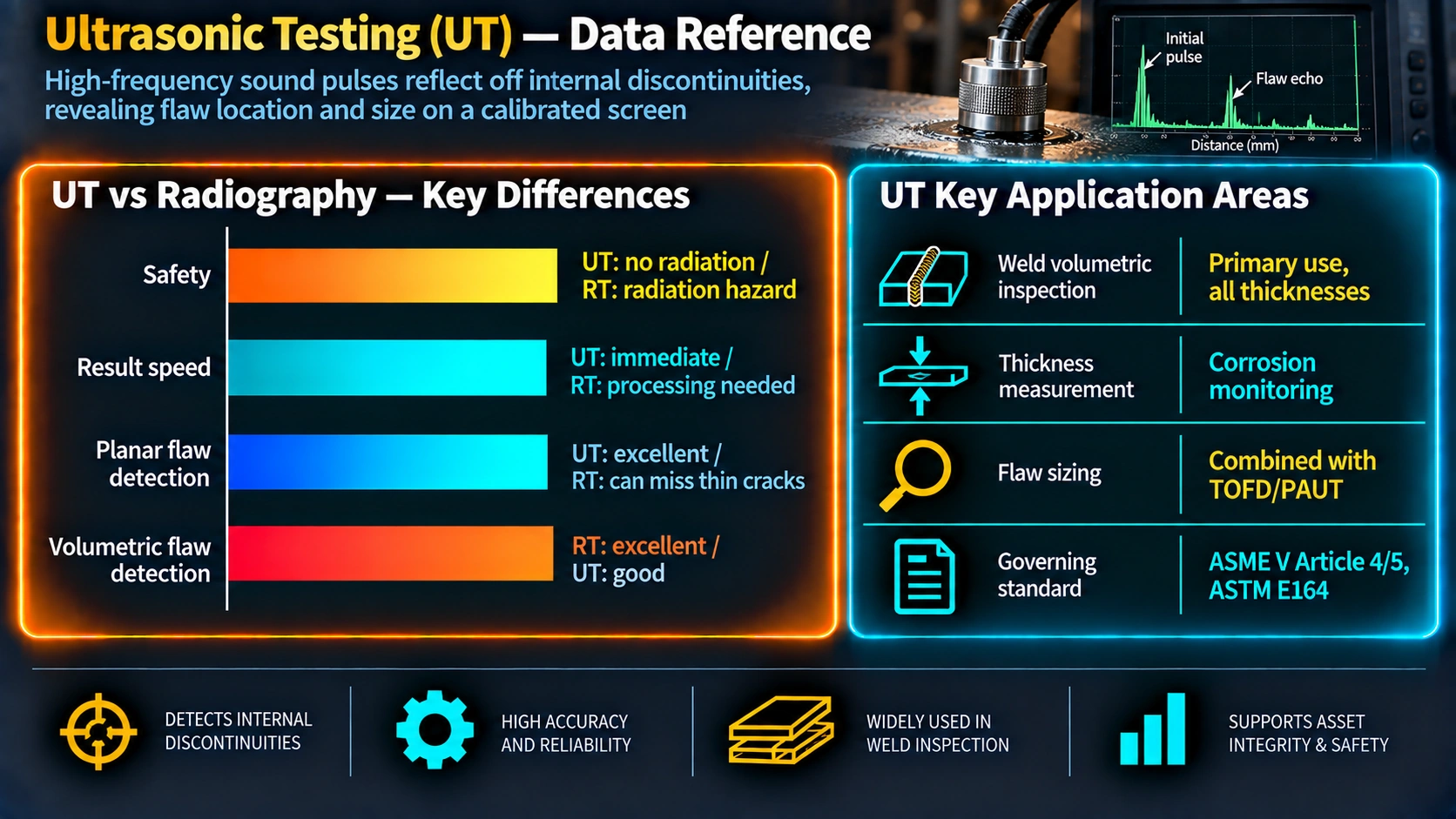
UT and RT are complementary. RT gives a permanent two-dimensional image of volumetric flaws (porosity, inclusions) but is insensitive to tight planar cracks oriented parallel to the radiation beam. UT is highly sensitive to planar flaws regardless of their position through the thickness but requires high operator skill. Many GTAW root-run welds in code fabrication are now inspected using TOFD + PAUT in lieu of radiography, eliminating radiation safety hazards and providing superior flaw characterisation data.