Fume Extraction in Welding — Health Hazards, OSHA Requirements, and Ventilation Design
Who this guide is for: Safety officers, welding supervisors, QC coordinators, and fabrication shop managers who must comply with OSHA 29 CFR 1910/1926, ACGIH ventilation guidelines, and AWS Z49.1. This article covers fume composition and toxicology, permissible exposure limits (PELs), local exhaust ventilation (LEV) design, respiratory protection requirements, and workplace monitoring protocols.
Welding fume extraction is one of the most critical occupational health obligations in any fabrication facility. Every welding arc — whether SMAW, GMAW, FCAW, GTAW, or SAW — generates a complex mixture of metallic oxides, fluorides, and gaseous by-products that can cause irreversible lung disease, neurological damage, and cancer with prolonged overexposure. Unlike noise or vibration hazards that have gradual onset, respiratory damage from welding fumes is cumulative and largely silent until clinical symptoms emerge — often after years of exposure.
Regulatory agencies including OSHA (US), HSE (UK), and Safe Work Australia have progressively tightened permissible exposure limits (PELs) as epidemiological evidence has accumulated. The International Agency for Research on Cancer (IARC) classified welding fume as a Group 1 carcinogen (definite human carcinogen) in 2017 — a reclassification from Group 2B — driven by strong evidence linking welding fume to lung cancer and limited evidence for kidney cancer. This reclassification changed the regulatory landscape significantly: where earlier ventilation guidance was prescriptive, current practice demands exposure monitoring, engineering controls as the first line of defence, and thorough documentation.
This guide consolidates the key technical and regulatory requirements that safety officers and fabrication managers need in a single reference. It covers fume generation physics, health hazard data by metal type, ventilation engineering design (local exhaust and dilution), respiratory protective equipment (RPE) selection, air monitoring protocols, and documentation requirements under OSHA and relevant consensus standards including AWS Z49.1 and ACGIH Industrial Ventilation.
How Welding Fume Forms
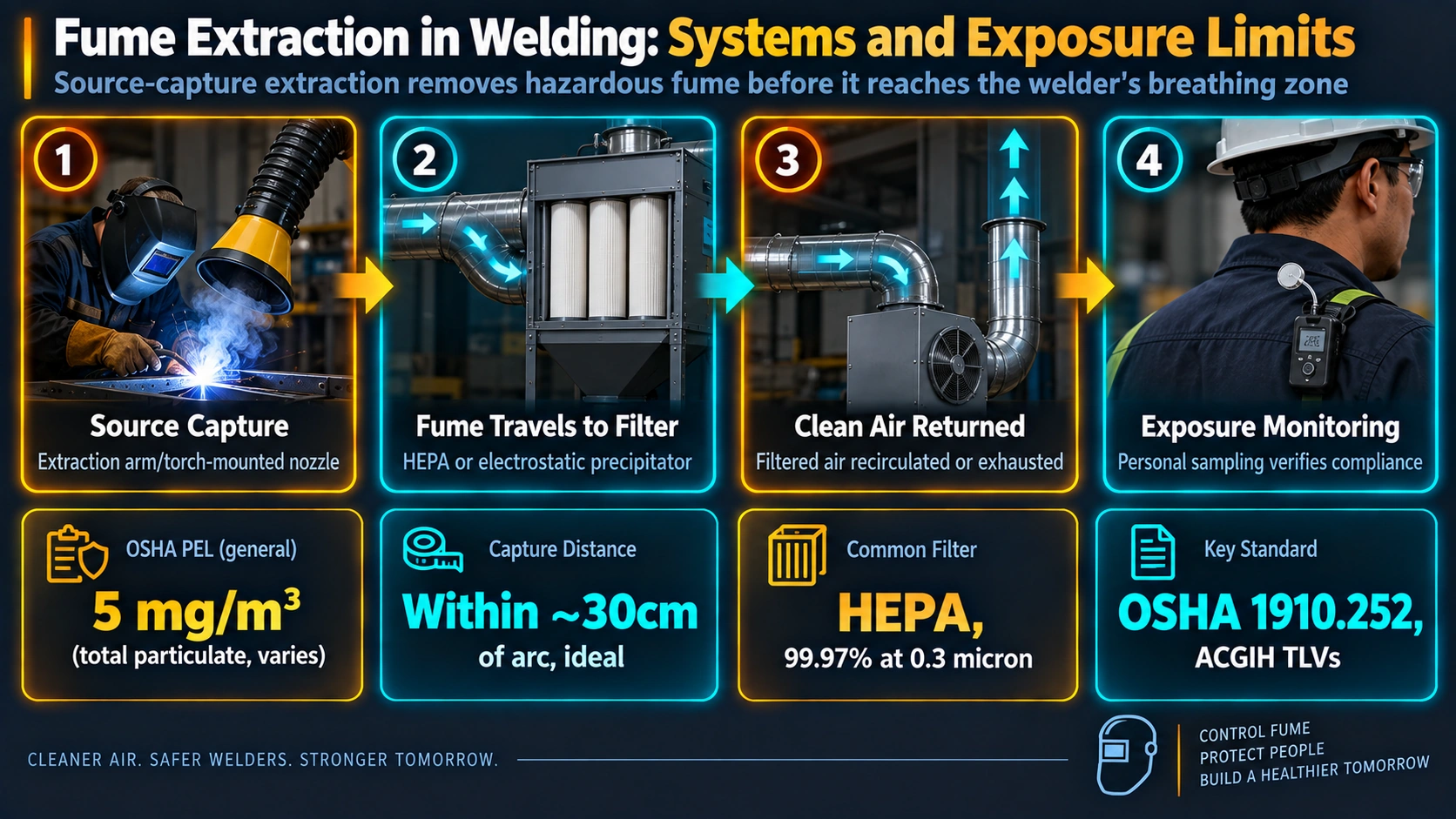
Welding fume is not simply smoke. It is generated primarily by vaporisation and condensation of metals from the electrode, filler wire, base material, and consumable coatings at or near the arc. Arc temperatures routinely exceed 6,000°C at the plasma core, well above the boiling points of most metals. Vaporised metal and flux compounds are immediately carried upward by the thermal convection plume, where they cool, oxidise, and condense into extremely fine solid particles — typically 0.01 to 1 µm aerodynamic diameter. This sub-micron particle size is critical from a health perspective: particles below 10 µm (the respirable fraction) penetrate deep into the alveolar regions of the lung, where they are not cleared by the mucociliary system.
The composition of welding fume varies enormously depending on:
- Base metal: carbon steel generates primarily iron oxide; stainless steel generates Cr VI, nickel oxide, manganese compounds; galvanised steel generates zinc oxide; aluminium generates aluminium oxide
- Electrode / wire type: SMAW coatings add fluorides, potassium silicate, and metal alloy oxides; FCAW flux-cores add fluorides and additional alloying elements; GTAW fume levels are the lowest of all fusion processes
- Shielding gas: CO⊂2; and Ar/CO⊂2; mixtures influence oxidation state of manganese; 100% CO⊂2; increases fume generation rate compared to argon-rich mixtures
- Welding parameters: higher current, voltage, and wire feed speed all increase fume generation rate (FGR) proportionally
- Surface contaminants: paint, coatings, galvanising, oils, and anti-spatter compounds can all contribute additional toxic species
Health Hazards by Fume Component
Not all welding fume is equally hazardous. Toxicity depends on the specific metal compounds generated, their solubility in biological fluids, their oxidation state, and the dose received over time. The table below summarises the principal toxic species, their sources, OSHA PEL / ACGIH TLV values, and primary health effects.
| Fume Component | Primary Source | OSHA PEL (TWA) | ACGIH TLV-TWA | IARC Classification | Key Health Effects |
|---|---|---|---|---|---|
| Iron Oxide (Fe⊂2;O⊂3;) | Carbon / low-alloy steel | 10 mg/m³ (fume) | 5 mg/m³ | Group 3 | Siderosis (benign pneumoconiosis); minimal fibrosis |
| Manganese compounds | All carbon / alloy steels, FCAW wires, SMAW electrodes | 5 mg/m³ (ceiling) | 0.02 mg/m³ (inhalable) | Group 2B | Manganism (neurological, Parkinson-like); lung damage |
| Hexavalent Chromium (Cr VI) | Stainless steel, chrome-plated parts, Cr-Mo alloys | 5 µg/m³ | 0.01 mg/m³ | Group 1 | Lung cancer; nasal/sinus cancer; skin sensitisation |
| Nickel compounds | Stainless steel (austenitic / duplex), Ni-alloys | 1 mg/m³ (soluble); 1 mg/m³ (insoluble) | 0.1 mg/m³ (insoluble) | Group 1 | Nasal/lung cancer; nickel dermatitis; asthma |
| Zinc Oxide | Galvanised steel, zinc-coated fittings | 5 mg/m³ (fume) | 2 mg/m³ | Group 3 | Metal fume fever (flu-like, self-limiting); no long-term effects at PEL |
| Copper fume | Copper alloys, bronze, MIG contact tips | 0.1 mg/m³ | 0.1 mg/m³ (fume) | Group 3 | Metal fume fever; upper respiratory irritation |
| Aluminium oxide | Aluminium and Al-alloy welding | 5 mg/m³ (respirable) | 1 mg/m³ (respirable) | Group 3 | Aluminosis; occupational asthma (limited evidence); fibrosis at high dose |
| Beryllium | Beryllium-copper alloys; special aerospace applications | 0.2 µg/m³ (TWA) | 0.00005 mg/m³ | Group 1 | Chronic beryllium disease (CBD); lung cancer; sensitisation |
| Ozone (O⊂3;) | GTAW / PAW with argon, UV from arc | 0.1 ppm (ceiling) | 0.05 ppm (TWA) | — | Pulmonary oedema at high conc.; chronic lung damage |
| Nitrogen Oxides (NO⊂x;) | All open-arc processes; elevated in CO⊂2; shielding | 5 ppm (NO⊂2; ceiling) | 0.2 ppm (NO⊂2; STEL) | — | Chemical pneumonitis; pulmonary oedema; bronchitis |
Fume Generation Rate (FGR) by Process
Understanding how much fume a given process produces allows safety engineers to select appropriately sized extraction systems. Fume generation rate is typically expressed in grams per kilogram of electrode consumed (g/kg) or milligrams per second (mg/s).
| Welding Process | Typical FGR (g/kg electrode) | Fume Toxicity Level | Primary Control Method |
|---|---|---|---|
| SMAW (E6010/E7018) | 6–15 | Moderate | LEV hood or extraction gun |
| SMAW on S/S (E308/E316) | 6–15 | High (Cr VI) | LEV + RPE mandatory |
| GMAW (MIG) — Short-circuit | 1–5 | Lower | LEV hood adequate; monitor Mn |
| GMAW (MIG) — Spray/Pulsed | 3–10 | Moderate | LEV hood, monitor if S/S |
| FCAW — Self-shielded | 10–30 | High | LEV + RPE; highest FGR |
| FCAW — Gas-shielded | 5–20 | Moderate–High | LEV; RPE if S/S wire |
| GTAW (TIG) | 0.1–1 | Lowest | General ventilation adequate for C/S; LEV for S/S |
| SAW (Submerged Arc) | Flux-generated; arc enclosed | Low (at arc) | Flux handling dust control; slag removal ventilation |
| Plasma Arc Cutting | High — depends on material | High | Downdraft table + LEV mandatory |
For a detailed comparison of welding processes, refer to the SMAW welding guide, the GMAW process guide, and the overview of submerged arc welding on WeldFabWorld.
Regulatory Framework — OSHA, ACGIH, and Consensus Standards
OSHA General Industry — 29 CFR 1910
The primary OSHA regulatory framework for welding fume in general industry is found across several standards:
- 29 CFR 1910.252: Welding, cutting, and brazing — general requirements including ventilation requirements by space type (confined, semi-confined, outside), operator training, and hot-work permits
- 29 CFR 1910.1000 (Table Z-1): General industry PELs — sets the 5 mg/m³ ceiling for welding fume (as nuisance particulate) and element-specific limits for manganese, zinc oxide, copper, etc.
- 29 CFR 1910.1026: Hexavalent chromium standard — action level 2.5 µg/m³, PEL 5 µg/m³, engineering controls, monitoring, medical surveillance
- 29 CFR 1910.1043: Cotton dust (not directly welding-relevant, but sets OSHA methodology precedent for airborne dust standards)
- 29 CFR 1910.134: Respiratory protection programme — fit-testing, RPE selection, medical evaluation, training
- 29 CFR 1910.94: Ventilation — covers exhaust ventilation system design and operation
OSHA Construction — 29 CFR 1926
For construction site welding, 29 CFR 1926.353 (ventilation in welding, cutting and heating) and 29 CFR 1926.55 (gases, vapors, fumes, dusts, and mists — incorporating ACGIH TLVs) apply. Construction sites present unique challenges: variable work locations, outdoor draughts, confined structural spaces, and the absence of fixed LEV infrastructure.
ACGIH Threshold Limit Values (TLVs)
The ACGIH publishes annual Threshold Limit Values and Biological Exposure Indices (BEI) that are generally more protective than OSHA PELs. While ACGIH TLVs are not legally enforceable, OSHA frequently references them in enforcement guidance, and courts have upheld citations based on the General Duty Clause (29 USC 654(a)(1)) where TLV overexposures occur even when PELs are not formally exceeded. ACGIH also publishes the Industrial Ventilation: A Manual of Recommended Practice for Design (current edition) — the definitive engineering reference for welding LEV design.
AWS Z49.1 — Safety in Welding, Cutting, and Allied Processes
AWS Z49.1 is the key consensus standard specifically for welding safety. It classifies ventilation requirements by:
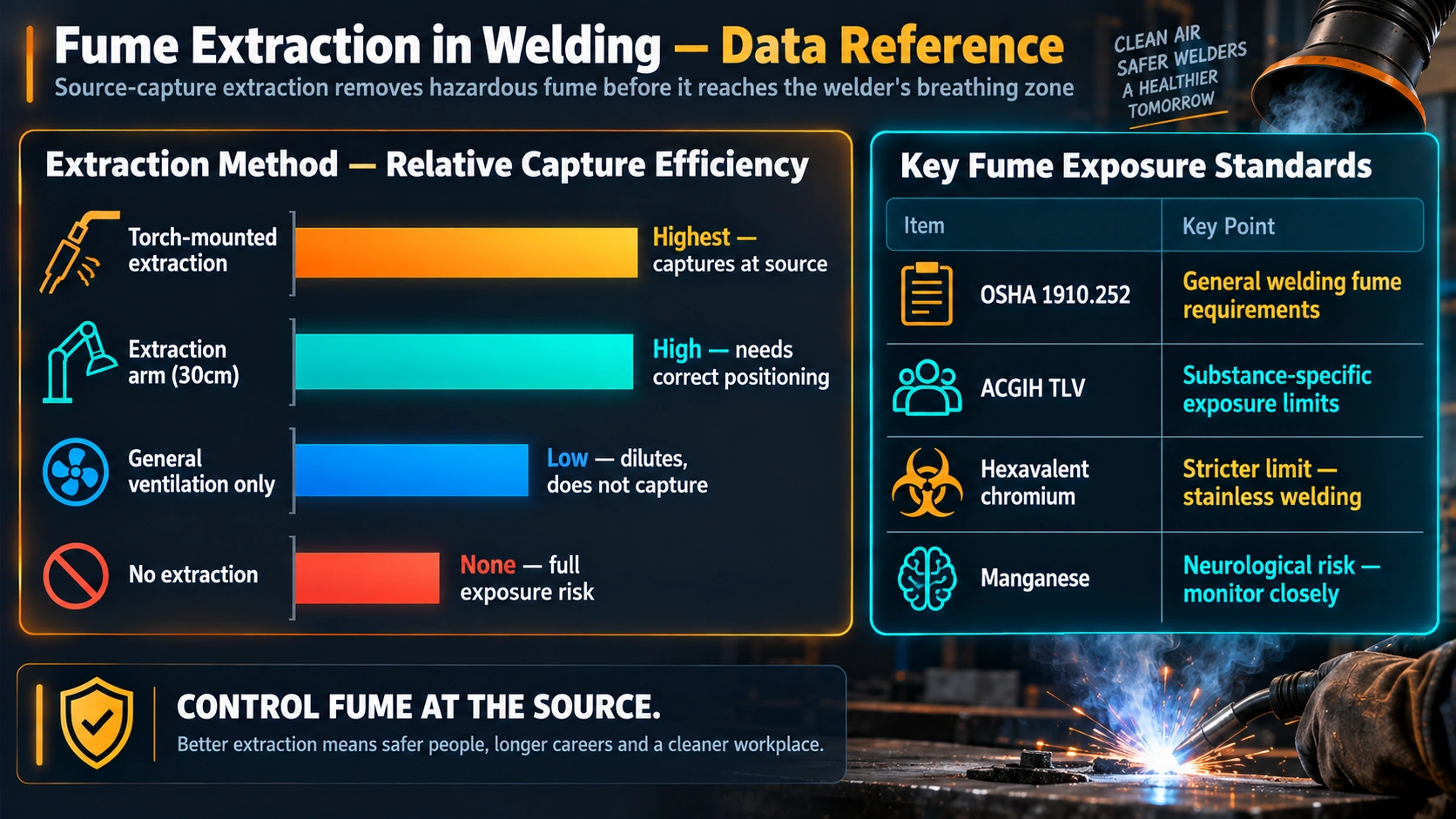
- Base metal type — the most critical factor; stainless steel and coated metals require mandatory LEV regardless of space size
- Space classification — confined spaces vs. semi-enclosed vs. open/outdoor
- Welding process rate — electrode consumption rate determines minimum ventilation volume
- Workspace volume — a minimum of 280 m³ (10,000 ft³) per welder is specified for general dilution ventilation to be permissible with low-toxicity carbon steel
Welding Ventilation Engineering — LEV Design and Selection
The hierarchy of controls (elimination > substitution > engineering controls > administrative controls > PPE) places engineering ventilation above respiratory protective equipment. A well-designed local exhaust ventilation (LEV) system is the most effective engineering control for welding fume and should always be the first line of defence before selecting RPE.
Types of Welding Ventilation Systems
1. Fixed Canopy Hoods
Canopy hoods are positioned above the welding position and capture rising fume by thermal convection. They are suitable for fixed workstations with consistent welding positions. The main weakness is susceptibility to cross-draughts that deflect the fume plume sideways, bypassing the hood. ACGIH recommends a minimum face velocity of 0.5 m/s at the hood face and a maximum hood-to-arc distance of 300–450 mm for effective capture.
2. Backdraft Hoods (Bench Exhaust)
Backdraft hoods are positioned behind and slightly above the welder’s work, drawing fume away from the breathing zone. They are preferred over canopy hoods where the welder works at varying positions along a bench, as they maintain consistent capture geometry. ACGIH Industrial Ventilation VS-65-10 provides the design template for welding bench exhaust hoods.
3. Fume Extraction Torches / Guns
Fume extraction torches integrate the extraction nozzle directly into the GMAW or FCAW torch body, capturing fume within 50–75 mm of the arc. They are the most effective capture method for mobile welding operations and achieve capture efficiencies of 90–95% when used correctly. Typical suction rates are 15–35 m³/hr per torch. The main limitation is that extraction flow must be calibrated carefully — too high a suction rate can disturb the shielding gas envelope and cause porosity.
4. Moveable Arm / Flexible Duct LEV
Articulated extraction arms with a hood at the end allow the welder to position the capture point close to the arc regardless of position. These are widely used in fabrication shops where work is varied. Arms typically 1.5–3 m in length, with suction flow of 250–600 m³/hr. Proper use requires the welder to position the arm so the hood inlet is within 150–200 mm of the arc at all times — a discipline that requires training and supervision.
5. General Dilution Ventilation
General ventilation introduces clean make-up air into the workshop and exhausts contaminated air from the opposite side. It is acceptable only for low-toxicity carbon steel welding at low electrode consumption rates in large open spaces (>280 m³ per welder per AWS Z49.1). General ventilation is not a substitute for LEV where Cr VI, Mn, Ni, or Be hazards exist.
LEV Hood Airflow Calculation
The required exhaust volume flow rate (Q) to achieve a target capture velocity at a given capture distance can be estimated using the ACGIH exterior hood formula:
Respiratory Protective Equipment (RPE) Selection
Where engineering controls cannot reduce exposures below the PEL — or while LEV is being installed or maintained — respiratory protection is mandatory under OSHA 29 CFR 1910.134. A written respiratory protection programme must be in place, covering: hazard assessment, RPE selection, medical evaluation, fit-testing, training, and maintenance/storage procedures.
RPE Selection by Material and Hazard
| Welding Application | Minimum RPE Required | NIOSH Approval Class | When Upgraded RPE Is Needed |
|---|---|---|---|
| Carbon / low-alloy steel (open shop, good LEV) | None, if LEV in place and monitoring confirms < PEL | — | Confined space, high amperage, inadequate LEV |
| Carbon steel (no LEV or confined space) | Half-face APR with N95 or P100 filter | TC-84A (N95) or TC-21C (P100) | Confined space: SAR or PAPR |
| Stainless steel (Cr VI / Ni hazard) | Half-face APR with OV/P100 combination cartridge | TC-23C (OV/P100) | Confined space: SAR (Type C supplied-air) |
| High-manganese alloys / FCAW on C/S | Half-face APR with P100 filter | TC-21C | Elevated Mn confirmed by monitoring: PAPR |
| Galvanised steel (zinc oxide hazard) | Half-face APR with N95 or P100 filter | TC-84A or TC-21C | Enclosed space: full-face APR or PAPR |
| Beryllium-copper alloys | Full-face APR with P100 filter as minimum | TC-21C (full-face) | Always: PAPR or SAR for reliable protection |
| All processes in confined space | Supplied-air respirator (SAR), Type C | TC-19C | IDLH conditions: SCBA required |
Air Monitoring — Sampling Strategy and Compliance
Air monitoring is the only reliable way to determine whether exposures are within regulatory limits. Visual assessment of fume plume behaviour is not a valid substitute. OSHA requires baseline monitoring under the Cr VI standard whenever a worker is exposed to Cr VI-generating operations, and permits monitoring to be discontinued only after two consecutive monitoring results demonstrate exposures below the action level of 2.5 µg/m³.
Sampling Methods
Personal breathing zone (PBZ) sampling is the preferred approach. The sample is taken as close as possible to the welder’s nose and mouth, usually clipped to the collar or inside the welding helmet. For a full OSHA compliance demonstration, samples must be collected for a full-shift (up to 8 hours TWA). For process characterisation or spot-checks, shorter representative samples can be used with time-weighted averaging.
- Total particulate / total fume: NIOSH Method 0500 (gravimetric) — filter cassette in closed-face 37 mm sampler
- Hexavalent chromium (Cr VI): NIOSH Method 7605 or OSHA ID-215 — PVC or cellulose ester filter, ion chromatography analysis
- Manganese: NIOSH Method 7300 — ICP-AES analysis; OSHA Method ID-121
- Nickel: NIOSH Method 7300 — same filter / ICP-AES
- Real-time monitoring: Direct-reading photometers (e.g., MIE DataRAM, TSI DustTrak) provide immediate feedback for process characterisation but are not valid for regulatory compliance determinations — only accredited laboratory analysis of filter samples meets the OSHA standard
Monitoring Frequency
Under OSHA 29 CFR 1910.1026 (Cr VI), initial monitoring must be performed. If results confirm exposures:
- At or above the PEL (5 µg/m³) — re-monitor within 3 months
- At or above the action level but below the PEL — re-monitor within 6 months
- Below the action level — monitoring may be discontinued (with documentation)
Confined Space Welding — Special Requirements
Welding in confined spaces — pressure vessels, storage tanks, pipe interiors, ship compartments, trenches, and similar restricted areas — presents multiplied hazards: oxygen deficiency from shield gas accumulation, explosive gas build-up from incomplete combustion products, and extremely high fume concentrations. All confined space welding must comply with both OSHA’s welding ventilation rules (29 CFR 1910.252) and the Permit-Required Confined Space standard (29 CFR 1910.146).
Key requirements specific to confined space welding include:
- Continuous forced-air mechanical ventilation providing a minimum of 2,000 ft³/min (56 m³/min) per welder, or specific calculation-based ventilation rate
- Pre-entry atmospheric testing for oxygen content (19.5–23.5% acceptable), flammable gas (<10% LEL), and toxic contaminants (Cr VI, CO, NO⊂x; below action levels)
- Continuous atmospheric monitoring during all welding operations with audible/visual alarm if oxygen or toxic limits are breached
- An attendant stationed outside the confined space throughout all welding operations
- Written entry permit signed by the entry supervisor covering all hazards, control measures, and emergency procedures
- Supplied-air respirator (SAR) available at all times, worn whenever air monitoring indicates exposures above PELs or in IDLH conditions
Welding GTAW (TIG) with argon shielding in confined spaces creates an additional oxygen-depletion hazard from argon accumulation at low levels; welders must never enter tanks or vessels where argon has been purging for back-purging applications without confirming adequate oxygen levels. This is particularly relevant for back purging of stainless and titanium piping — see WeldFabWorld’s guide to back purging for titanium and stainless pipe systems for full precaution details.
Material-Specific Fume Control Guidance
Stainless Steel Welding
Stainless steel welding is the highest-priority fume hazard in most fabrication shops. All grades of austenitic (304/316), ferritic (410/430), and duplex stainless steel contain 10–25% chromium, which generates hexavalent chromium (Cr VI) at the arc. LEV at source is mandatory. The duplex stainless steel welding guide and stainless steel weld decay article on WeldFabWorld provide additional process context. For stainless welding, OSHA requires:
- Initial exposure assessment (air monitoring or objective data)
- Engineering controls to maintain Cr VI below 5 µg/m³
- Medical surveillance when action level is exceeded for 30+ days/year
- Hygiene facilities (washing, clean eating areas away from Cr VI operations)
- Hazard communication (SDS, training, labels)
P91 and Chromium-Molybdenum Alloy Steels
P91 steel (9Cr-1Mo-V) and related Cr-Mo grades (P22, P11, P5) generate Cr VI and vanadium pentoxide in the fume, both of which are regulated carcinogens. PWHT procedures on P91 involve extended hold times that increase total fume generation in enclosed vessels. When welding P91 chrome-moly steel, ensure LEV is operational throughout preheat, welding, and PWHT operations, and that vanadium pentoxide exposure is assessed separately where P91 flux-cored wires are used.
Galvanised and Zinc-Coated Steels
Zinc oxide from galvanised steel causes metal fume fever — an acute, self-limiting influenza-like illness typically beginning 4–10 hours after exposure. Although symptoms resolve within 24–48 hours, repeated exposure does not confer immunity and may mask the onset of more serious lung disease from other co-contaminants. Grinding or flame-cutting back the galvanised coating 50–75 mm from the weld joint before welding is the most practical engineering substitution. Where this is not possible, maximum-efficiency LEV and respiratory protection are mandatory.
Aluminium Welding
Aluminium welding fume consists primarily of aluminium oxide (Al⊂2;O⊂3;), with additional contributions from alloying elements such as magnesium, silicon, and manganese. While aluminium oxide at PEL concentrations is classified as nuisance dust, certain aluminium alloys (particularly high-magnesium 5xxx series) produce magnesium oxide fume, which has a lower ACGIH TLV. General LEV is appropriate for most aluminium GTAW and GMAW operations in open shops; confined space aluminium welding requires full LEV and monitoring for ozone (O⊂3;), which is generated at elevated levels by GTAW with argon shielding.
Documentation Requirements for Compliance
Maintaining a complete and auditable documentation record is essential for OSHA compliance and protects the employer in the event of an inspection or worker compensation claim. The following documentation should be maintained as part of the welding safety management system:
| Document | Regulatory Basis | Minimum Retention | Responsible Party |
|---|---|---|---|
| Written Respiratory Protection Programme | OSHA 29 CFR 1910.134(c) | Current + update as conditions change | Safety Officer / Program Administrator |
| Air monitoring results (Cr VI) | 29 CFR 1910.1026(m) | 30 years from sampling date | Industrial Hygienist / Safety Officer |
| Air monitoring results (other hazardous elements) | 29 CFR 1910.1000 (General Duty) | 5 years minimum (best practice: 30 years) | Industrial Hygienist |
| Medical surveillance records (Cr VI) | 29 CFR 1910.1026(k) | Duration of employment + 30 years | Occupational Health Physician |
| Fit-test records | 29 CFR 1910.134(f)(5) | Until superseded by new fit-test | Safety Officer |
| LEV inspection and test records (TExT) | ACGIH / Good Practice (COSHH Reg. 9 in UK) | 5 years minimum | Maintenance / Safety Officer |
| SDS for all welding consumables | 29 CFR 1910.1200 (HazCom) | Current; archive previous versions 30 years | Safety Officer |
| Welder training records (fume hazard) | 29 CFR 1910.1026(j) and 1910.134(k) | Duration of employment + 3 years | Training Coordinator |
| Confined space entry permits | 29 CFR 1910.146(e) | 1 year from date of entry | Entry Supervisor |
Welding Fume Control — Safety Officer’s Practical Checklist
Use this checklist when commissioning a new welding operation, auditing an existing facility, or responding to a hazard identification event.
- Identify all base metals, consumables, and coatings — review SDS for each for Cr VI, Mn, Ni, Pb, Zn, Be content
- Classify workspace: open shop / semi-enclosed / confined space
- Determine applicable OSHA standard (1910 or 1926) and identify specific regulated substances (Cr VI, Mn, Ni)
- Perform baseline air monitoring or obtain objective data from comparable operations
- Confirm LEV is installed, operational, and has been tested within the past 14 months
- Confirm welders are enrolled in medical surveillance programme where required
- Confirm welders have been fit-tested for any RPE they will wear
- Confirm written respiratory protection programme is current
- For confined spaces: obtain entry permit, confirm attendant assigned, atmospheric testing equipment available and calibrated
- Verify LEV is running before welding commences — do not rely on the welder to switch it on
- Confirm extraction arm / hood is positioned within 200 mm of arc
- Check LEV pressure-drop gauge — a drop below set-point indicates filter blockage or duct leak
- Conduct periodic direct-reading photometer spot-checks during high-fume-rate operations
- Ensure welders are wearing RPE wherever monitoring indicates approach to action levels
- Confirm no welding in areas with known cross-draughts that would bypass canopy hoods
Recommended Reference Books
Disclosure: WeldFabWorld participates in the Amazon Associates programme (StoreID: neha0fe8-21). If you purchase through these links, we may earn a small commission at no extra cost to you. This helps support free technical content on this site.